
 Search

Terra-charge.co.jp
Japan's EV ambitions have long run into a wall that money alone cannot dissolve: for the tens of millions of people living in apartment buildings and condominiums, installing a home charger requires convincing a management association, navigating subsidy bureaucracy, and coordinating contractors — a process so time-consuming and technically opaque that most residents simply abandon the idea before it starts. On Monday, Terra Charge Corporation, which operates Japan's largest EV charging network, launched UchiTera! program — a name blending the Japanese word for "home" (uchi) with its brand — that attempts to solve not the hardware problem but the human one. Under the new initiative, any apartment resident who wants a charger at their building can submit a request and let TeraCharge handle everything else: management association outreach, building-owner negotiations, installation cost simulations, subsidy applications, construction oversight, and ongoing operational support.
Why Apartment Charging Remains Japan's Biggest EV Bottleneck
Japan's EV market has accelerated sharply in the past year: combined EV and plug-in hybrid vehicle sales reached 5.27% of new car sales as of June 2026, up from 2.91% the prior year — the highest share since Japan began tracking the figure. Yet the infrastructure to support those vehicles at home tells a different story, particularly for urban residents. A survey of EV and PHEV drivers in Japan's multi-dwelling units found that 85% had no access to charging facilities at their building. For those residents, every charge requires a trip to a public station — and for many prospective buyers, the calculation is simple: if you cannot charge at home, an EV may not be worth buying.
The physics and electrical engineering of residential EV charging are not particularly exotic. A basic 3-kilowatt (kW) AC charger — the standard for overnight home charging in apartment parking garages — delivers approximately 20 kilometers (12.4 miles) of range per hour, sufficient to top up a typical commuter EV overnight. The installation hardware itself (a Japanese-standard AC outlet or wall box, rated to 100 or 200 volts) is not prohibitively expensive. The problem is everything else.
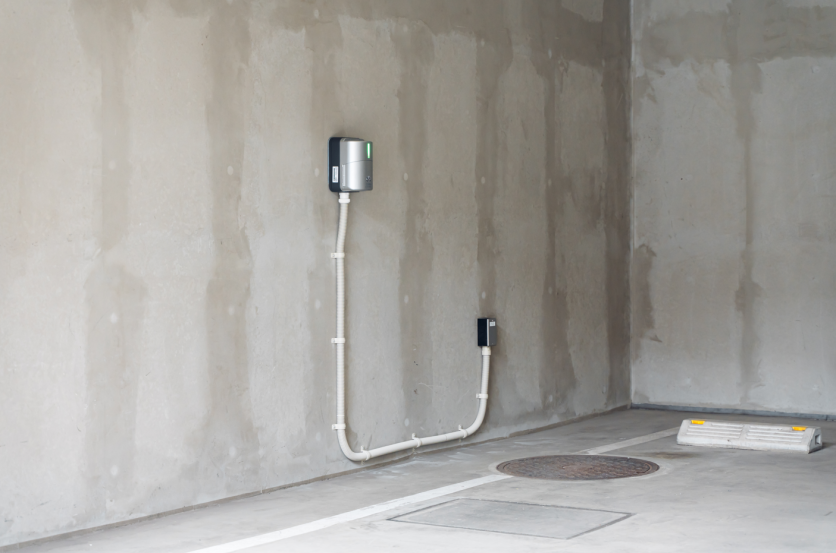
Installing that charger in an existing condominium building requires running new electrical cabling from the shared panel to individual parking spaces, adding sub-metering to each outlet so the building can bill each resident separately for the electricity they use, and deploying smart-charging coordination software to prevent every charger from activating simultaneously and tripping the building's circuit breakers. Each of those steps requires a licensed contractor, the approval of the building's electrical inspector, and — critically — majority approval from residents on the condominium's management association or homeowners' board. Japan's condominium governance rules require a majority vote from unit owners to approve any significant modification to common areas. Assembling that vote, answering residents' questions, and shepherding the proposal through an association meeting is work that a single EV-owning resident is almost never equipped to do alone.
What UchiTera! Actually Does
TeraCharge's UchiTera! program is designed to be a professional proxy for that entire process. A resident who wants charging at their building — whether they own or rent their unit — submits a request through TeraCharge. From there, the company takes over: it contacts the management association, homeowners' board, or building owner; conducts introductory briefings; runs installation cost simulations; files the subsidy paperwork; manages construction; and provides post-installation operational support.
The cost proposition is the program's most striking element. By applying Japan's government subsidy framework, TeraCharge has structured UchiTera! so that charging infrastructure valued at approximately ¥550,000 (roughly $3,481) per unit can be installed for as little as ¥1,000 (approximately $6) per unit, subject to eligibility conditions. That offer is built on TeraCharge's existing business model, which already provides hardware, construction, and maintenance at zero upfront cost to building owners — the company recovers its investment through usage fees charged to EV drivers via its app. UchiTera! adds a new layer: the resident who first contacts the company to initiate the process also receives a coupon granting six months of free charging at the newly installed unit, creating a direct financial incentive for apartment dwellers to act as local advocates for the program.
The distinction between this model and the supply-side approaches most operators have pursued is meaningful. Japan's central government has earmarked approximately ¥8 billion (roughly $50.6 million) in national condominium EV subsidies, with the Tokyo Metropolitan Government committing an additional ¥3.6 billion (roughly $22.8 million). Most of that money has flowed through agreements between charging operators and large property management companies — Ubiden, for example, partnered with Orix Group subsidiaries Daikyo Astage and Anabuki Community to target 150,000 residential charger installations by 2027 across the approximately 540,000 condominium units (roughly 10% of Japan's total stock) those companies manage. That approach works when a management company is already motivated to act. UchiTera! is built for the other case: the building whose management has not yet decided, where the only motivated party is a single resident who owns an EV.
How Is Japan So Far Behind on Residential Charging?
Japan currently has approximately 68,000 charging outlets nationwide — still using the CHAdeMO DC fast-charging standard for the majority of its rapid chargers, a proprietary connector developed by the Tokyo Electric Power Company and five Japanese automakers that has lost ground to CCS in Europe and NACS (North American Charging Standard) globally. Against the national target of 300,000 outlets by 2030 — of which up to 200,000 are slated for apartment and condominium buildings — the gap is substantial. TeraCharge's own target of 105,000 outlets by 2030 (comprising 80,000 basic residential connectors, 5,000 en-route fast chargers, and 20,000 destination chargers) would represent approximately one-third of the national goal.
The shortfall has structural causes that predate TeraCharge. A 2010 pilot by Nissan and Daikyo — one of Japan's major condominium developers — distributed information on EV charging installations to 280 homeowners' associations in Yokohama. Forty-five expressed interest. Two agreed to a formal assessment. One approved an installation. That conversion rate has not improved dramatically in the 15 years since, because the governance problem has not changed: a homeowners' association has no institutional incentive to champion EV charging installation unless management has made it a priority or an individual resident is willing to push it through.
Japan's Ministry of Economy, Trade and Industry (METI) has noted that installing chargers at new-build condominiums is far more tractable — the decision is made before residents move in, and installation costs are lower. The government of Tokyo has gone further: it has put in place Tokyo's EV charger mandate requiring that new residential buildings include EV charging infrastructure. Retrofit of existing buildings is the harder problem, and it is where the most units are.
Is This the Right Moment to Solve It?
TeraCharge's timing reflects a real urgency. Japan has committed to eliminating new gasoline-powered vehicle sales by 2035. With fewer than nine years remaining, the apartment charging problem is no longer a long-term planning issue — it is becoming an immediate barrier to adoption for the tens of millions of people who live in condominiums in Tokyo and other major cities. As EV sales accelerate — the 5.27% share recorded in June 2026 would have seemed ambitious just a few years ago — the number of apartment dwellers who own EVs and cannot charge them at home will grow, making the governance bottleneck more acute.
The property-value argument is gaining traction. Kenji Yamamoto of Daikyo Astage, one of Japan's largest condominium management companies, put it plainly in 2024: EV chargers are becoming as expected a residential amenity as an elevator, and buildings that lack them will see a competitive disadvantage in the market for tenants and buyers. That framing shifts the incentive for building management from passive resistance to active interest — which is precisely the receptive audience TeraCharge's UchiTera! program is designed to encounter when it makes its initial approach.
What Comes Next for Japan's EV Network
TeraCharge is also managing a transition in charging standards. The company announced in August 2026 that it will integrate the North American Charging Standard (NACS) into its network beginning in fiscal year 2028, targeting 2,500 NACS charging points by 2033. That announcement reflects a broader shift in Japan, where a growing number of automakers are adopting NACS for new models — signaling that the CHAdeMO-dominant era is winding down. For apartment-building chargers specifically, the transition matters less in the near term (3kW and 6kW AC residential chargers use standard outlet connectors rather than CHAdeMO or NACS), but it signals that TeraCharge is planning for a diversifying vehicle market.
The UchiTera! model is a bet that the remaining obstacle to Japan's residential charging build-out is not money or technology but process. The hardware subsidies exist. The business model for zero-upfront installation exists. What has been missing, for most of Japan's millions of apartment buildings, is someone to walk in the door, introduce the idea to the management board, run the numbers, handle the paperwork, and see the project through. That is the job TeraCharge has decided to assign to itself.
Currency conversions in this article use an approximate mid-market rate of 1 USD ≈ ¥158 (September 7, 2026) and are approximate.
Frequently Asked Questions
Why is it so difficult to install EV chargers in Japanese apartment buildings?
The engineering challenge is real but manageable — a standard 3kW AC charger requires new cabling, individual sub-metering for billing, and smart-load software to prevent circuit overloads — but the governance challenge is larger. Installing anything in a shared building space requires a majority vote from the condominium's management association or homeowners' board, and most EV-owning residents lack the time, technical knowledge, and persuasion capacity to shepherd a proposal through that process on their own. Japan's condominium governance structure places full decision authority over common-area modifications with the collective body of unit owners, and assembling that vote is the task TeraCharge's UchiTera! program has taken on as a professional service.
Does TeraCharge really charge only ¥1,000 (~$6) for installation?
The figure refers to the cost after applying Japan's government subsidy framework, which covers a large portion of the ¥550,000 (~$3,481) total installation cost per unit. TeraCharge's existing business model also absorbs all hardware, construction, and maintenance costs up front — it recovers those through usage fees charged to EV drivers via its app. The ¥1,000 figure is for eligible buildings and subject to conditions; not every condominium will qualify, and subsidy budgets are finite. Japan's METI subsidy programs have previously run out of funding well before their stated deadlines, so speed of application matters.
How will Japan close the gap between its ~68,000 current charging outlets and its 300,000-by-2030 goal?
The shortfall is largest in the residential segment: the national plan calls for up to 200,000 of the 300,000 total outlets to be installed at apartment and condominium buildings. Most public and commercial charging deployment has proceeded more smoothly because those decisions don't require homeowner association votes. The residential gap will require large-scale programs like UchiTera! operating across thousands of individual buildings simultaneously, alongside continued government subsidies and the cultural shift — already underway — toward viewing home EV charging as a standard building amenity rather than an optional upgrade.
Could a model like UchiTera! work in the United States for apartment EV charging?
The structural barriers are similar: US condominium residents also face HOA approval requirements, shared electrical infrastructure constraints, and individual sub-metering challenges. Several US states have passed "right-to-charge" laws limiting HOA veto power, which removes part of the governance friction. Where the US differs is in housing density — fewer Americans live in multi-unit buildings than Japanese urbanites — and in the absence of a national operator with TeraCharge's footprint and subsidy-processing relationships. The demand-side activation model (empowering individual residents to trigger a professional installation process) is transferable; the scale of subsidy support is not yet available in most US markets.

-
 C114 Communication Network
 -
 Communication Home
