
 Search

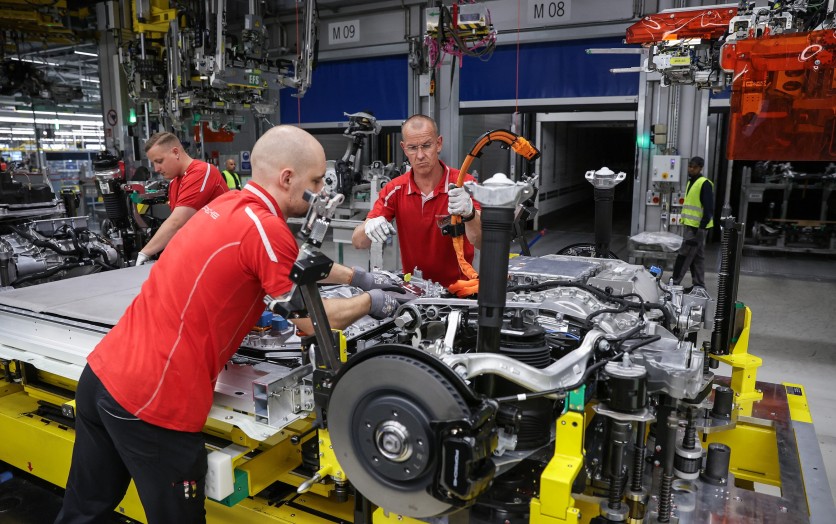
Employees of German car producer Porsche AG work on the battery pack and chassis of a new Porsche Macan 4 Electric model at the assembly line of the production site of German car producer Porsche AG in Leipzig, eastern Germany, May 6, 2024. RONNY HARTMANN/AFP via Getty Images
Porsche AG and its General Works Council reached an agreement on Monday to cut 5,000 additional jobs by 2035, bringing the Stuttgart automaker's total planned workforce reduction to approximately 9,000 positions — about one in five of its roughly 42,600 employees. The deal, announced after months of negotiations and approved the previous week by the company's supervisory board, includes no compulsory redundancies and commits €2.1 billion (approximately $2.39 billion) to the company's main factory in Stuttgart-Zuffenhausen and its R&D center in Weissach. That investment, and the site guarantees that accompany it, is the price the works council extracted for accepting cuts of this scale — a structure that reveals as much about German labor law as it does about Porsche's crisis.
The deal is the most significant restructuring in Porsche's history, driven by four consecutive years of collapsing China sales, a disastrously mismanaged electric vehicle transition, and the ongoing weight of U.S. import tariffs. CEO Michael Leiters, who joined from McLaren on January 1, 2026 and was immediately tasked with overhauling the business, describes the goal as making Porsche "leaner, faster, and even more desirable." Whether that framing holds depends on whether the revenues stop falling before the concessions run out.
Second Wave of Cuts in Eight Months
Monday's 5,000-position agreement is the second major restructuring package in less than a year. It builds on a first package that began with 1,900 job cuts first announced in February 2025 and was expanded to 3,900 positions and formally confirmed with unions on June 24, 2026, plus an additional 500 positions tied to the closures of three subsidiaries — Cellforce Group (battery cell manufacturing), Porsche eBike Performance (electric bike drive systems), and Cetitec (specialized data-communication software) — that Leiters announced in May.
Under the terms of the deal, affected management and employees will see 3.5% of their anticipated pay increases deferred until 2035. In 2027 and 2028, senior and top management will waive an equivalent contribution from basic remuneration increases. Christmas bonuses — which had been worth up to one month's salary — will fall to 60% of a month's salary. The allowance to work from home will be reduced from a maximum of 12 days per month to 8.
Read more: Porsche Shuts Down E-Bike Subsidiary to Refocus on Core Business
Employment and site protections at Zuffenhausen and Weissach will run through the end of 2035. Ibrahim Aslan, chairman of Porsche's General Works Council, said the agreement was the right outcome: the investment in the sites "will also play a major role in securing employment for another five years."
China: From Crown Jewel to Crisis
No single factor has driven Porsche's restructuring harder than its near-total loss of the Chinese market. From a peak of 95,700 units delivered in 2021, China sales fell to 93,300 in 2022, 79,300 in 2023, 56,900 in 2024, and 41,900 in 2025 — a 56% collapse over four years. In the first half of 2026, deliveries in China dropped a further 32% year-over-year to 14,501 vehicles — fewer than the 14,938 vehicles Porsche delivered in its home market of Germany during the same period. A year earlier, China had taken more than 5,300 additional cars than Germany. The reversal is that complete.
Alexander Pollich, president and chief executive of Porsche China, described the conditions as a "perfect storm" at a media roundtable in January 2026. The structural causes run deeper than any single market cycle. Domestic Chinese electric vehicle makers have introduced technology-heavy models at lower price points that are eroding the prestige advantage European brands spent decades cultivating. In the ultra-premium segment above 700,000 yuan (approximately $97,500), the Huawei-JAC Maextro S800 electric sedan recorded higher December 2025 sales in China than the combined deliveries of the Porsche Panamera, BMW 7 Series, and Mercedes-Maybach S-Class.
Porsche has responded by shrinking its Chinese dealer network from roughly 150 locations in 2024 to 114 by the end of 2025, with plans to reduce further to approximately 80 outlets in 2026.
What Getting EVs Wrong Actually Costs
The China slide arrived simultaneously with a financial reckoning over Porsche's electric vehicle strategy — a commitment that turned out to be among the most expensive reversals in automotive history.
Group operating profit fell to €413 million (approximately $471 million) in 2025 from €5.64 billion (approximately $6.43 billion) the prior year — a 93% collapse driven largely by approximately €3.9 billion (approximately $4.45 billion) in extraordinary charges. Those charges broke down as roughly €2.4 billion (approximately $2.74 billion) linked to product strategy realignment and organizational restructuring, €700 million (approximately $798 million) in battery-related costs, and another €700 million (approximately $798 million) in U.S. tariff impacts. In the automotive division specifically, operating profit fell 98% — from €5.3 billion to €90 million (approximately $103 million).
The most concrete expression of that reversal is an engineering story that rarely makes headlines: the PPE Sport platform — Premium Platform Electric Sport — was developed by Porsche in conjunction with Audi as an EV-only architecture, deliberately designed without provisions for a central tunnel (required for a driveshaft in a mid-engine combustion layout), without fuel tank provisions, and without exhaust routing. The floor-mounted battery, which stores energy in a flat pack beneath the passenger cell, was also designed as a structural load-bearing element — meaning that removing it requires rebuilding the car's torsional rigidity from the ground up. Porsche engineers at Weissach are now engaged in exactly that project: reverse-engineering combustion capability into a platform that was purpose-built to exclude it. New combustion 718 variants built on the reconfigured platform are not expected until 2028 or 2029 at the earliest — and that timeline was further complicated by the November 2024 bankruptcy of Northvolt, the Swedish battery cell maker Porsche had contracted to supply the electric 718.
The 911 will not go electric, but will instead incorporate hybrid technology more extensively — a meaningful retreat from the brand's public positioning of the Taycan as the future of the Porsche experience. In H1 2026, the Taycan fell 25% to 6,219 deliveries, while the Macan line dropped 22%. The brand's most resilient product was not its electric flagship but its oldest nameplate: the 911 grew 19% to 30,534 deliveries, driven by demand for the GTS, Turbo, and GT variants — the combustion-only, high-margin models that the EV pivot had been designed to move away from.
Read more: VW's Affordable EV Family Crosses 70,000 Orders Before Fourth Model Arrives
Leiters' Mandate and Strategy 2035
Leiters, who served as CEO of McLaren Automotive before joining Porsche, has moved quickly since taking the helm. In addition to the two rounds of job cuts, he has sold Porsche's stake in Bugatti Rimac and Rimac Group, closed Cellforce (which had been positioned as Porsche's answer to the battery supply problem), and dissolved a recently created Car-IT division. All of these moves are confirmed in the Porsche restructuring timeline.
Under the "Strategy 2035" framework Leiters presented at Porsche's annual results conference in March 2026, the plan rests on three pillars: Brand and Customer, Products and Technology, and Company and Operations. The full strategic detail — including a concrete product roadmap and margin recovery targets — is expected at a capital markets day scheduled for October 7, 2026. CEO Leiters has publicly asked shareholders for patience in the interim. The company's 2026 financial guidance calls for revenue of €35 billion to €36 billion (approximately $39.9 billion to $41.0 billion) and an operating return on sales of 5.5% to 7.5% — modest but meaningful recovery from the 1.1% margin recorded in 2025.
German Law Is Why There Are No Forced Layoffs — and Why That Creates Its Own Risk
The deal's structure — no compulsory redundancies, site guarantees, investment commitments — reflects something that goes unmentioned in most coverage of German auto sector restructuring: workers at German companies like Porsche have statutory legal rights under the Works Constitution Act (Betriebsverfassungsgesetz) and the Codetermination Act of 1976. Under these laws, the works council must be consulted and can effectively veto forced redundancies by demanding a social plan (Sozialplan). Companies above 2,000 employees are required to have 50% employee representation on their supervisory boards.
This is not generosity from Porsche management. The no-forced-redundancy commitment and the 10-year site guarantees are the legal and political price of German labor law — the works council's negotiated concession in exchange for accepting 9,000 job cuts at all. Analyst Daniel Schwarz of Metzler noted that the cuts "roughly correspond to the decline in sales volume." The math is brutally direct: Porsche built its workforce for a sales trajectory that China's market collapse and the EV reversal have permanently erased.
The same legal framework that prevented forced redundancies creates a structural problem going forward. Five-year site guarantees and a fixed cost base locked in through 2035 limit how quickly Porsche could respond if China's decline accelerates beyond current projections or if the EV market fails to recover on the timeline Leiters' strategy assumes. A company whose revenues are still falling has committed to protecting its cost structure through the end of the decade.
Porsche Is No Longer VW's Profit Engine
Porsche's crisis does not exist in isolation. The company went from Volkswagen Group's highest-margin subsidiary to one of its most urgent problems in less than three years. VW Group CEO Oliver Blume — Leiters' predecessor at Porsche, who now holds the top position at the parent company — is pushing for a doubling of job cuts across the VW Group to 100,000, measures he says are necessary to remain competitive as more Chinese brands move into European markets. Blume has also warned that four of the group's factories, including one belonging to premium brand Audi, are threatened with closure after 2030.
Mercedes-Benz and BMW are also cutting costs and restructuring as they navigate the EV transition against Chinese rivals while absorbing the impact of high tariffs. Germany's automotive association VDA estimates that 225,000 jobs could disappear from the sector by 2035, on top of roughly 100,000 positions already lost since 2019.
Porsche's shares have fallen roughly 50% since the company's September 2022 listing on the Frankfurt Stock Exchange — an IPO that was, at the time, the largest in German history. Shares were modestly lower in Frankfurt trading on Monday following the July 27 announcement, a muted reaction that suggests much of the bad news has already been priced in.
What Porsche Buyers Decide Next
For consumers, the restructuring has direct product implications. The ICE 718 Boxster and Cayman were discontinued in 2025 in preparation for the planned EV transition. The electric 718 successors are now delayed, at best, until 2027; combustion versions built on the reworked PPE Sport platform are not expected until 2028 or 2029 at the earliest. A buyer who wants a new Porsche sports car below the 911's price point — which starts at $137,850 in the U.S. — currently has no option from the brand's lineup.
The Taycan continues in production but delivered only 6,219 units globally in H1 2026, a 25% decline, against a backdrop of softening luxury EV demand in its key markets. The fully electric Cayenne began customer deliveries in late June 2026 alongside existing combustion and plug-in hybrid Cayenne variants — a mixed-powertrain lineup that reflects the strategic uncertainty more than it resolves it.
Leiters' own framing is revealing: his stated goal is to "make money with fewer cars." That is a significant departure from a brand that defined the last decade of its growth by chasing volume in China. Whether fewer, more profitable cars can offset the revenue still falling in that market is the central question Strategy 2035 has not yet answered. The October 7 capital markets day is where investors will expect Leiters to answer it.
Frequently Asked Questions
Why is Porsche cutting so many jobs, and why now?
Porsche's operating profit fell 93% in 2025 — from €5.64 billion (approximately $6.43 billion) to €413 million (approximately $471 million) — driven by €3.9 billion (approximately $4.45 billion) in charges tied to its abandoned electric vehicle roadmap and the impact of U.S. tariffs, combined with four consecutive years of collapsing sales in China. The July 27 deal with the General Works Council formalizes the cost base that Leiters believes Porsche can sustain given those reduced revenues. The deal took months because German labor law gives the works council significant leverage to negotiate terms — including the no-forced-redundancy commitment and the 5-year site guarantees — in exchange for accepting the scale of cuts at all.
Will Porsche still sell an electric 718 Boxster or Cayman?
That outcome is uncertain and may not happen on any predictable timeline. The gasoline 718 was discontinued in 2025. The electric successors — originally planned for 2025-2026 — were delayed first by the 2024 bankruptcy of battery supplier Northvolt, then further complicated by internal discussions about whether to proceed with the electric program at all. Porsche is simultaneously working to reverse-engineer combustion capability back into the PPE Sport platform — a platform designed without a central tunnel, fuel tank provisions, or exhaust routing — which adds at least 1-2 years to that timeline. Combustion 718s are not expected before 2028-2029 at the earliest. A buyer who wants a new Porsche sports car below the 911's entry price currently has no option.
What does the works council agreement actually guarantee workers?
Under the agreement, there will be no compulsory redundancies through 2035. Job reductions will come through natural attrition, expanded partial-retirement programs, and voluntary severance. All current Porsche sites remain operational at least through 2035. In exchange, employees accepted a deferral of 3.5% of anticipated pay increases until 2035, a reduction in Christmas bonuses from one month's salary to 60% of a month's salary, and a cut in remote-work entitlement from 12 days to 8 days per month. Senior management separately waives an equivalent contribution from basic remuneration increases in 2027 and 2028. The €2.1 billion (approximately $2.39 billion) investment in Zuffenhausen and Weissach was the works council's main demand in exchange for accepting cuts of this scale.
Why did China's market reverse so sharply for Porsche specifically?
China has been Porsche's fastest-growing market for two decades and its largest single market by the mid-2010s. The reversal reflects two structural shifts: first, younger affluent Chinese buyers are increasingly choosing domestic tech-focused EV brands — like the Huawei-JAC Maextro S800 — that offer comparable prestige with superior in-cabin technology integration; second, Porsche's own EV product strategy left a gap in China's crucial electric vehicle segment just as domestic Chinese brands accelerated their luxury push. Porsche is also pursuing a "value-oriented sales" strategy that deliberately constrains supply to protect pricing, which amplifies the volume decline. Porsche China CEO Alexander Pollich described the combined pressures as a "perfect storm."

-
 C114 Communication Network
 -
 Communication Home
