
 Search

Byd.com
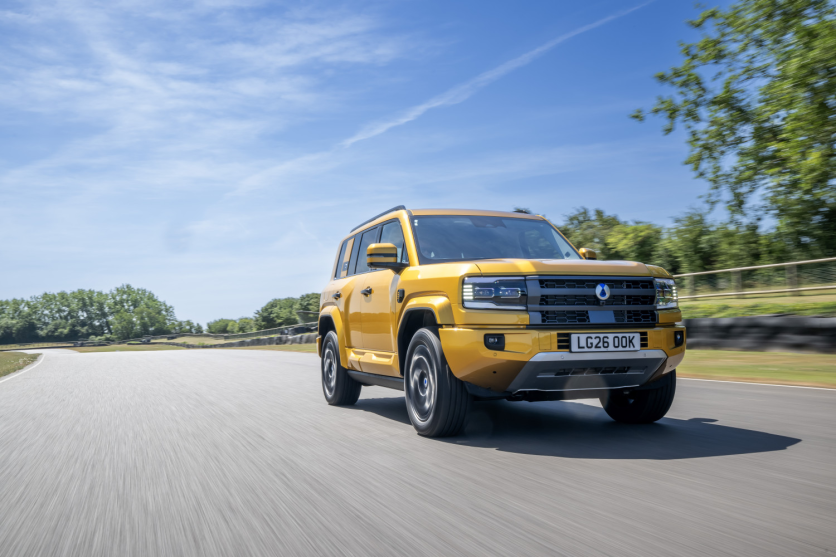
BYD's premium Denza sub-brand has confirmed UK pricing for the BAO 5, a ladder-frame plug-in hybrid SUV priced from £69,500 (approximately $92,500 USD — exchange rate as of July 28, 2026; conversions are approximate) for the Elegance grade and £78,880 (approximately $105,000 USD) for the Ultimate. Interest registration is now open; first deliveries are targeted for late 2026 or early 2027, with orders expected to open in autumn, according to PistonHeads and autoevolution's same-day UK coverage. The BAO 5 arrives with an EV-only range of up to 56 miles under UK WLTP testing — or up to 62 miles (100 km) under the European WLTP standard — and a 100 kW DC fast-charging capability the Land Rover Defender P300e cannot match.
What no automotive press release will tell buyers: every BAO 5 sold in the UK will operate under China's National Intelligence Law of 2017. Article 7 of that law requires any Chinese organization or citizen to support, assist, and cooperate with national intelligence efforts in accordance with law. BYD, headquartered in Shenzhen, is a Chinese company. That legal obligation applies regardless of where its vehicles operate, where user data is physically stored, or what GDPR protections UK law provides. No privacy policy Denza publishes in London can override a statute passed in Beijing, as the Carnegie Endowment for International Peace has documented in its analysis of China's data-access framework.
BAO 5 Comes to UK as BYD Accelerates European Premium Push
The BAO 5 is the first SUV from Denza, BYD's luxury sub-brand — positioned above the main BYD lineup and below the ultra-luxury Yangwang marque, in the same relationship to BYD as Lexus is to Toyota. Originally a 50/50 joint venture between BYD and Mercedes-Benz, formed in 2010, Denza is now wholly owned by BYD following Mercedes-Benz's exit from the partnership in late 2023, and has repositioned as the company's premium technology showcase.
Denza launched in Europe in April 2026 at the Paris Opera House, simultaneously opening order books in the UK, France, Germany, Italy, and Spain — its first significant European footprint outside China. The BAO 5 joins the Z9 GT grand tourer and the Denza Z electric supercar, which made its UK public debut at the Goodwood Festival of Speed earlier this month and is priced from £142,900 (approximately $190,300 USD).
Design direction comes from Wolfgang Egger, formerly design director at both Audi and Lamborghini — a deliberate credential that signals the brand's European aesthetic ambitions.
The BAO 5 in its Chinese guise is sold under BYD's Fangchengbao brand, where it has been on sale since November 2023. The UK launch gives British buyers access to a vehicle with an established production and reliability track record, at least by the standards of a relatively new platform.
How the DMO Drivetrain Actually Works
The BAO 5's DMO — Dual Mode Off-road — system is not a conventional plug-in hybrid. Where most PHEVs use a transmission that mechanically links both the engine and electric motor to the drivetrain simultaneously, the DMO operates primarily in series-hybrid (EREV) mode: the 1.5-litre turbocharged petrol engine drives a generator, which feeds the battery and motors rather than the wheels. The front motor produces 272 PS (268 hp) and the rear motor produces 388 PS (383 hp), for a combined system output of 544 PS (536 hp) and 760 Nm (561 lb-ft) of torque. At highway speeds or under heavy load, the engine can couple directly to the drivetrain in parallel mode for maximum efficiency — but in everyday driving and off-road crawling, the electric motors do the work.
This matters for off-road use in a specific way: electric motors deliver maximum torque instantaneously, from zero rpm, which conventional petrol engines cannot do. The result is that the BAO 5 can feed torque to individual axles with a speed and precision that no mechanically linked conventional drivetrain can match. The intelligent torque-vectoring center differential redistributes power between front and rear axles up to 30 times faster than a mechanical differential — a figure that reflects the fundamental speed advantage of electronic actuation over mechanical clutch packs.
Front and rear electronic differential locks are standard on both trim levels. Sixteen driving modes span motorway cruising, standard and sport road modes, sand, mud, rock, wading, and track-day configurations. The "tank turn" function — which rotates the vehicle on its own footprint by spinning the front and rear axles in opposite directions — has been available on military and agricultural machinery for decades; its appearance on a £69,500 (approximately $92,500 USD) luxury SUV is a marketing demonstration, but it is also genuinely useful in tight technical off-road scenarios where reversing is not possible.
The 0–62 mph sprint takes 4.8 seconds in the Elegance and 5.0 seconds in the Ultimate — the small difference reflecting the additional weight of the air suspension system and electrically deploying side steps fitted to the higher trim. The combined powertrain-plus-battery system contributes to a curb weight of approximately 2,897 kg (6,388 lbs) in the base configuration.
Read more: Denza Z Hits Goodwood: Five-Minute Charging, 1,604 PS, and China's Data Obligation
Why the Blade Battery Gives BAO 5 a Charging Edge Over Defender
The BAO 5 is powered by a 31.8 kWh Blade Battery — BYD's proprietary lithium iron phosphate (LFP) Cell-to-Pack design, integrated directly into the ladder-frame chassis.
Standard lithium iron phosphate cells have long been known for their thermal stability and long cycle life, but were traditionally packaged in modules — intermediate housings that added weight and wasted space before cells reached the pack level. BYD's Blade Battery eliminates that module layer entirely, arranging long, flat LFP cells directly into the structural pack in what it calls Cell-to-Pack (CTP) architecture. The result is roughly 50% greater space utilization than conventional LFP block batteries — meaning more usable energy from the same volume — while preserving LFP's core safety advantage: the chemistry does not release oxygen during thermal runaway, which is why the Blade Battery passes the industry's nail penetration test without fire or smoke.
The practical outcome for BAO 5 buyers: a 31.8 kWh battery pack that supports DC fast charging at 100 kW, taking the pack from 30% to 80% charge in 16 minutes. The Land Rover Defender P300e PHEV, by comparison, carries a 15.4 kWh usable battery offering up to 30 miles of EV range under official UK WLTP testing — real-world reviewers report approximately 20 miles in mixed driving. The Defender P300e supports DC rapid charging at 40 kW, meaning the BAO 5's 100 kW peak is meaningfully superior.
The BAO 5's larger pack also means an official combined range of up to 519 miles (835 km) petrol-plus-electric, and a claimed fuel economy of up to 68.9 mpg — falling to approximately 26 mpg with a depleted battery, according to Select Car Leasing's first drive.
Off-Road Specification: Ground Clearance, Wading, Air Suspension
The BAO 5 is built on a body-on-frame ladder chassis — the same basic construction used by the Land Rover Defender and the Toyota Land Cruiser, and for the same reason: a separate frame provides greater rigidity than monocoque construction under towing loads, provides better protection for the battery against underbody impacts, and allows more predictable flex articulation across uneven terrain.
Standard ground clearance is 220 mm (8.7 inches). The BAO 5 can wade through up to 790 mm (31 inches) of water in base trim. Towing capacity is 2,500 kg (5,512 lbs). Approach and departure angles are aided by the 4.88-metre body length — comparable to a Defender 110 — though the BAO 5 is not available in a six- or seven-seat configuration.
The Ultimate trim adds DiSus-P intelligent air suspension featuring adaptive air springs with continuous damping control. The system raises the body by up to 90 mm (3.5 inches) for challenging terrain and lowers it by 50 mm (2.0 inches) for aerodynamic efficiency or easier entry and exit — a total travel range of 140 mm (5.5 inches). A self-levelling parking function automatically levels the vehicle on uneven ground when parked.
Interior Equipment and the Distinctive Cold-and-Hot Storage Compartment
Both trim levels include a 15.6-inch central infotainment touchscreen running Google built-in, separate digital displays for driver and front passenger, Devialet audio with 18 speakers, leather upholstery, panoramic sunroof, and front seats that heat, ventilate, and massage. Three interior color schemes are offered: Eclipse Blue, Shoal Green, and Tarim Desert Beige.
One of the more genuinely distinctive standard inclusions is a built-in storage compartment that can cool contents to between -6°C and 6°C (21°F to 43°F) or warm them to between 35°C and 50°C (95°F to 122°F), remotely controllable via the Denza app. The autoevolution review confirmed these temperature ranges from the official Denza specification.
The Elegance rides on 18-inch alloy wheels with fixed side steps. The Ultimate adds 20-inch alloys, electrically deploying side steps, Nappa leather, ventilated rear seats, and a second wireless charging pad.
One exterior color — Snowy White — is included at no additional cost. Shadow Black, Pinnacle Grey, Wagner Glacier Blue, Dolomite Green, and Tarim Polar Gold each add £2,000 (approximately $2,660 USD). Mineral Purple adds £3,500 (approximately $4,660 USD), as confirmed by PistonHeads' pricing coverage.
How the BAO 5 Prices Against Defender and Land Cruiser
The Denza BAO 5 Elegance at £69,500 (approximately $92,500 USD) sits below the Land Rover Defender 110 plug-in hybrid, which starts from £72,000 (approximately $95,900 USD) in base PHEV configuration. Upper Defender 110 PHEV trims reach £80,000–£90,000 (approximately $106,500–$119,800 USD) — territory where the BAO 5 Ultimate at £78,880 (approximately $105,000 USD) competes directly.
A Toyota Land Cruiser with its 2.8-litre diesel starts from approximately £80,945 (approximately $107,800 USD), making the BAO 5 Ultimate price-competitive while offering a far lower CO2 output (30 g/km) and the PHEV efficiency advantage.
At 30 g/km of CO2, the BAO 5 falls into the 10% Benefit-in-Kind tax band — the same band as the BMW X5 xDrive50e and Range Rover Sport P460/P550e — producing an annual company-car tax bill of approximately £1,390 for the Elegance and £1,580 for the Ultimate at the 2026/27 rate.
What China's Data Law Means for Every BAO 5 Sold in the UK
The BAO 5 will arrive as a fully connected vehicle platform. Its infotainment system connects via built-in cellular, collects GPS location history, mirrors smartphone data, logs driving behavior, and runs the Denza remote-control app. None of that is unusual for a premium vehicle in 2026. What is unusual is the legal framework governing who can access that data.
China's National Intelligence Law of 2017, Article 7, states that all Chinese organizations and citizens must support, assist, and cooperate with state intelligence work. China's Cybersecurity Law — amended January 2026 with strengthened enforcement and significantly increased penalties — and China's Data Security Law of 2021 extend government data-access provisions and introduce data localization requirements. China's 2023 Counter Espionage Law broadened the scope of what constitutes national security-relevant data.
These laws apply to BYD as a Chinese company headquartered in Shenzhen. They apply regardless of where BAO 5 vehicle data is physically stored, regardless of what servers BYD routes European data through, and regardless of what GDPR commitments Denza publishes in its UK privacy policy. UK law provides no override mechanism for a foreign country's national security statute, as research from the Carnegie Endowment for International Peace on China's data-access legal framework has documented.
A concrete finding grounds this concern. In October 2025, security researchers at PlaxidityX demonstrated that personal data from a 2023 BYD Atto 3 — including GPS location history, contacts, healthcare information, and app preferences — could be extracted from the vehicle's infotainment unit without any active network intrusion, because the data was stored with a flawed encryption implementation that researchers could bypass even after a factory reset. The vulnerability was assigned CVE-2025-7020.
BYD has publicly denied unauthorized government access to vehicle data. The company holds R155 Cybersecurity Management System and R156 Software Update Management System certifications from international regulatory bodies. Those certifications govern how BYD manages its own security practices. They do not and cannot override a legal obligation imposed by the Chinese state.
No independent security audit of the BAO 5 specifically has been published, because the vehicle has not yet been delivered to customers.
What UK buyers can do to limit exposure: network-segment the vehicle by connecting it only to a dedicated router rather than a home or corporate network. Review permissions granted to the Denza mobile app. Minimize smartphone mirroring through the infotainment system, where practical. Understand that no mitigation fully resolves the structural legal condition: as long as BYD operates as a Chinese company, Chinese law governs what its engineers may be compelled to do with vehicle data on demand.
Read more: BYD Canada Confirms Late 2026 Retail Push: Chinese Intelligence Law Applies to Owners
Performance Gaps and What Denza Has Not Yet Proven
The BAO 5's published specification sheet is impressive. Its real-world track record in UK hands is, as of today, nonexistent — the vehicle has not been delivered to private buyers. Three limitations are worth naming explicitly before a purchase decision.
Benchmark reliability: BYD's official figures — 62 miles EV range, 68.9 mpg combined, 4.8-second 0–62 mph — are manufacturer claims. UK media testing by PistonHeads and Select Car Leasing puts the EV range figure at 56 miles under UK WLTP conditions — a meaningful difference from the 62-mile European figure. Real-world fuel economy on a depleted battery drops to approximately 26 mpg. Independent long-term testing of the BAO 5's off-road durability, cold-weather battery performance, and infotainment reliability has not yet been published.
Ecosystem immaturity: Denza's UK retail infrastructure is still being assembled. Flash Charging infrastructure — available for BYD's higher-performance Z9 GT — is not relevant to the BAO 5's 100 kW DC charging standard, but Denza service network depth, parts availability, and over-the-air update frequency are all factors that UK buyers cannot yet evaluate from real-world owner experience.
No six- or seven-seat option: The BAO 5 is a five-seat only vehicle. The Toyota Land Cruiser and Defender 110 both offer extended-seat configurations for buyers who need to carry more people. The BAO 5 offers 475 litres of boot space, expanding to over 1,000 litres with seats folded — practical, but without the third-row option that some buyers in the Defender's market segment specifically need.
BYD's Broader UK and European Expansion
The BAO 5's UK pricing announcement is one development within a coordinated Denza expansion. BYD has set a target of at least 150 European retail stores by the end of 2026. The brand's design director is Wolfgang Egger, former design chief at Audi and Lamborghini, a credential that signals European styling ambitions rather than simply a transplanted Chinese product.
For buyers weighing the BAO 5 against established premium off-roaders, the decision is not simply a specification comparison. A £69,500 (approximately $92,500 USD) SUV with 62-mile EV range, 100 kW DC charging, a 544 PS dual-motor drivetrain, and a body-on-frame chassis represents an objectively strong specification at the price. The question that automotive reviews largely do not address — and that buyers must — is whether that specification is worth accepting the full package it comes with: a manufacturer headquartered in an authoritarian jurisdiction, operating under compelled-access national security laws, with a documented data vulnerability on a related model, in a UK regulatory environment that has not yet established any formal framework to govern Chinese connected-vehicle data.
That is the complete decision framework. The specification is real. The legal condition is equally real. Neither disappears because the other is impressive.
Frequently Asked Questions
How does the Denza BAO 5 compare to the Land Rover Defender PHEV on electric range and charging?
The BAO 5 Elegance offers up to 56 miles of EV range under UK WLTP testing — or up to 62 miles (100 km) under the European standard — from a 31.8 kWh Blade Battery, with 100 kW DC fast charging that takes the pack from 30% to 80% in 16 minutes. The Land Rover Defender P300e PHEV offers up to 30 miles of official EV range from a 15.4 kWh usable battery, with real-world range typically around 20 miles; it supports DC rapid charging at 40 kW. The BAO 5's EV range and charging speed are significantly superior on paper, though its advantage is built on a vehicle that has not yet been independently tested by long-term UK owners.
What Chinese laws apply to a BYD Denza BAO 5 purchased in the UK?
China's National Intelligence Law of 2017 (Article 7) requires BYD, as a Chinese company, to cooperate with government intelligence requests on demand — regardless of where the vehicle operates or where its data is stored. China's Cybersecurity Law (amended January 2026), Data Security Law (2021), and Counter Espionage Law (2023) extend government data-access provisions further. GDPR and UK data protection law cannot override these Chinese national security statutes. BYD denies unauthorized government access to vehicle data and holds international cybersecurity certifications, but those certifications address internal practices — not legal obligations imposed by the Chinese state.
Is the Denza BAO 5 available to order in the UK right now?
Interest registration is open as of July 28, 2026. Order and delivery timelines are currently described differently by different UK sources: autoevolution reports that UK customers can now order, while PistonHeads' same-day coverage indicates customers can register interest ahead of sales in 2027. Denza has targeted deliveries for late 2026 or early 2027. Prospective buyers should contact Denza UK directly for their specific order timeline.
What does the Denza BAO 5's off-road technology actually include, and how does it work?
The BAO 5 uses BYD's DMO (Dual Mode Off-road) platform, which operates primarily as a series-hybrid (EREV) drivetrain: the 1.5-litre turbo petrol engine acts as a generator, feeding the battery and the dual electric motors that drive the axles. The system can also couple the engine directly to the drivetrain in parallel mode under high load. Electronic differential locks are standard front and rear; an intelligent torque-vectoring center differential lock redistributes power between axles up to 30 times faster than a mechanical differential. Ground clearance is 220 mm (8.7 inches) in standard trim, rising to 310 mm (12.2 inches) on the Ultimate with DiSus-P air suspension engaged. Wade depth is 790 mm (31 inches). Sixteen driving modes cover everything from motorway to deep mud.

-
 C114 Communication Network
 -
 Communication Home
