
 Search

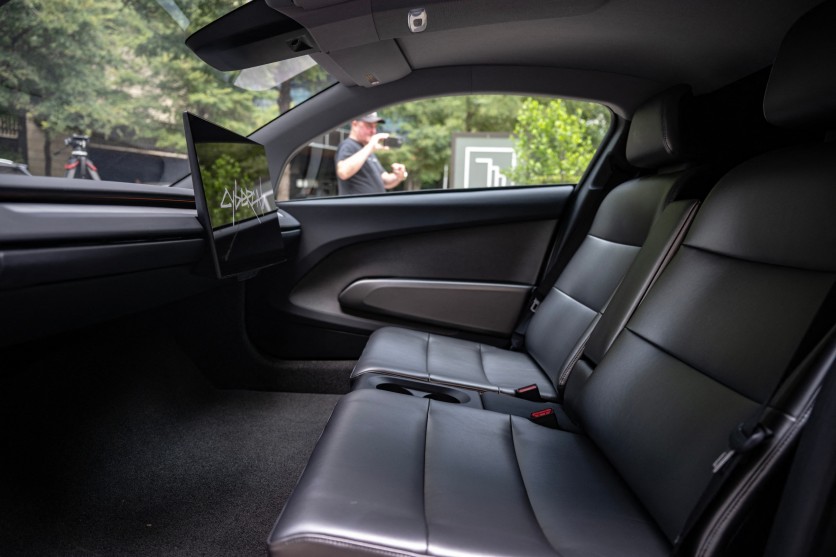
The interior of a Tesla's "Cybercab" is shown as it's displayed in downtown Austin, Texas, on September 3, 2026. Tesla launched the "Cybercab" which is a taxi with no steering wheel or pedals, designed purely for autonomy. RONALDO SCHEMIDT/AFP via Getty Images
The most legally exposed document in Tesla's regulatory history may be the sworn response it now owes the federal government by September 30. On September 10, the National Highway Traffic Safety Administration issued a formal Special Order to Tesla under the Safety Act at 49 U.S.C. § 30166 — a legally binding demand, signed by NHTSA Chief Counsel Peter Simshauser and carrying a $139,356,994 civil penalty ceiling, that requires a Tesla officer to attest under oath how a vehicle with no steering wheel, no pedals, and no mirrors was legally self-certified as compliant with federal safety standards written for human drivers. At the center of the 21 requests in the Special Order is one federal regulation whose plain text Tesla has not publicly explained away: FMVSS No. 135, which states that "the service brakes shall be activated by means of a foot control." The Cybercab has no foot control.
The Special Order marks a significant legal upgrade from the informal Audit Query NHTSA opened on September 3, the same day Tesla began commercial Cybercab deployment in Austin, Texas. An audit query is a request with no oath requirement and limited enforcement leverage. A Special Order is a different legal instrument: it compels a response, requires the signing Tesla officer to personally attest under oath to the completeness and accuracy of every answer, and subjects that officer to criminal penalties of up to 15 years in prison or a fine — or both — for falsifying or withholding information.
Tesla has not publicly responded to the Special Order. Cybercab service in Austin continued through the week the order became public.
Read more: Tesla Cybercab Launched; NHTSA Opened Probe It Once Sent Zoox Down for Four Years
From Audit Query to Legal Demand: What Changed on September 10
The escalation from AQ26002 to Special Order took exactly seven days. NHTSA opened Audit Query AQ26002 on September 3, 2026, hours after Tesla began commercial Cybercab deployment in Austin. That opening was an investigative step — an agency request for information, not a legal demand. On September 10, Simshauser signed a Special Order addressed directly to Brian Jazaeri, Tesla's Senior Director and Head of Litigation, and Eric Williams, Tesla's Associate General Counsel for Regulatory Affairs, at the company's Washington D.C. office.
The legal basis for the Special Order is 49 U.S.C. § 30166(g)(1)(A). Under that authority, NHTSA's Chief Counsel can compel any manufacturer to produce documents and sworn testimony in connection with an investigation. The penalty for non-compliance is not a warning; it is $27,874 per day, accumulating to a maximum of $139,356,994 for a related series of violations. Civil penalties require only that Tesla fail to respond fully or truthfully — not that the agency find a safety defect. Criminal penalties require a false or materially incomplete sworn response.
NHTSA issued the same Special Order mechanism against Tesla in 2023 during its Autopilot investigation, confirming this is an established federal enforcement tool the agency reaches for when an audit query is not producing results fast enough. That 2023 Autopilot Special Order was also signed under 49 U.S.C. § 30166(g)(1)(A) and carried the same criminal penalties for false responses.
The Foot-Brake Problem — One Sentence, One Legal Wall
Of all 21 requests in the Special Order, Request 19 is the sharpest. It quotes FMVSS No. 135 Section S5.3.1 verbatim: "The service brakes shall be activated by means of a foot control." Then it asks Tesla to explain, in detail, how it certified Cybercab compliance with that sentence.
FMVSS 135, which has governed light-vehicle brake systems since 1995, was written on the assumption that a driver sits in the vehicle and presses a pedal. The Cybercab has no pedal. Its braking is commanded entirely by the autonomous driving system — the ADS directs the brake actuator directly, with no mechanical link to a foot control. NHTSA noted explicitly in the Special Order that it has publicly stated that "a manufacturer of a vehicle without a service brake activated by means of a foot control could not certify to that standard," and then asked Tesla to explain how it did exactly that.
NHTSA had proposed amending this requirement on June 26, 2026 — an NPRM that would remove the foot-control mandate for vehicles designed exclusively for autonomous driving — but the comment period closed July 27 and no final rule has been issued. Until a final rule is published, the foot-control text remains in force, and NHTSA is enforcing it.
The foot-brake issue is one of six specific FMVSS standards named in the order. Requests 11 through 18 work through the rest of them: FMVSS 101 (controls and telltales, designed for a driver's field of view and interaction range); FMVSS 102 (transmission shift-position display); FMVSS 108 (turn signals, which the standard requires to self-cancel by steering-wheel rotation — a mechanism the Cybercab lacks); FMVSS 111 (mirrors and rearview imaging, three separate requests covering inside mirrors, outside mirrors, and rearview image); and FMVSS 126 (electronic stability control telltales). Every named standard in the 100-series is a crash-avoidance standard — part of the regulatory framework written in 1966 and 1967 to govern vehicles with human drivers in fixed positions, with hands and feet at known control points and eyes at known sight lines. The Cybercab has none of those reference points. All of this is spelled out in Request 19 and surrounding requests in the Special Order.
Did Tesla Certify With Controls It Then Removed?
A cluster of requests in the Special Order targets a question that goes beyond whether the final Cybercab meets FMVSS: did Tesla use temporarily attached driver controls to establish the original compliance certification, and then remove them before commercial deployment?
Requests 5, 6, and 7 work through this methodically. Request 5 asks whether the Cybercab can be driven by a human using temporarily attached controls. Request 6 asks whether temporarily installed human driver controls "were a part of Tesla's basis for certifying compliance with any FMVSS" — and if so, which standards. Request 7 asks how Tesla's removal of those controls is consistent with the Safety Act's "make inoperative" prohibition.
The Safety Act at 49 U.S.C. § 30122(b) prohibits a manufacturer from knowingly rendering inoperative a safety system or feature a vehicle was required to have. If Tesla certified the Cybercab with a steering wheel, pedals, and mirrors temporarily installed — and then removed them before delivering vehicles to commercial service — that sequence raises a distinct legal question beyond the certification gap: whether the removal itself violated the Safety Act.
Tesla's first-responder guide for the Cybercab, published ahead of the Austin launch, confirmed that "a number of Cybercabs" are equipped with hardware for manual operation, including a steering wheel and pedals. Independent documentation from Not A Tesla App confirmed all pre-launch test vehicles that all Cybercab release candidates and test vehicles observed on public roads during the pre-launch period were equipped with temporary steering wheels, pedals, and side mirrors — and that production vehicles manufactured from April 2026 onward had the controls removed.
Tesla VP of Vehicle Engineering Lars Moravy characterized the manual controls as "strictly a test feature" and not intended for consumer sale. But NHTSA's Request 6 specifically asks whether those test-feature controls were used as part of the compliance certification basis — and Request 7 asks how their removal is legally defensible. These are questions only Tesla can answer under oath.
The Zoox Contrast: One Company Went Through the Door
The Special Order's final request — Request 21 — may be the most structurally significant for the AV industry. It cites NHTSA's own 2022 Final Rule on Occupant Protection for Vehicles with Automated Driving Systems, which stated that regulatory changes to the 100-Series FMVSSs "would likely be necessary" before a vehicle operated solely by an ADS could be manufactured for sale — absent an exemption under 49 CFR Part 555. Tesla does not hold a Part 555 exemption. Request 21 asks Tesla to explain, in detail, how Cybercab is legally saleable without one.
The implicit contrast NHTSA draws is with Zoox, Amazon's AV subsidiary. Zoox builds a purpose-built robotaxi with no steering wheel and no pedals — the only other company to have attempted commercial deployment of a vehicle in this category before Tesla. Rather than self-certifying, Zoox navigated the formal Part 555 exemption process: it applied for temporary exemptions from eight specific FMVSS, including the foot-brake rule (FMVSS 135) and the mirror standards (FMVSS 111) that the Special Order is pressing Tesla on. NHTSA granted Zoox commercial clearance on July 30, 2026. The exemption caps Zoox at 2,500 vehicles per year and carries ongoing crash reporting requirements and federal oversight.
Tesla chose the opposite route. It self-certified the Cybercab under existing FMVSS, arguing that standards written for human-driver controls are simply "inapplicable" to a vehicle built without them, and started charging fares on September 3 — the day NHTSA opened its audit. That choice avoided the 2,500-vehicle annual cap the Part 555 process imposes. It also avoided four years of federal engagement that delayed Zoox's commercial launch. And it placed Tesla in the position of defending a legal theory — that manufacturers can self-determine which FMVSS apply to their vehicles — that NHTSA is now forcing it to justify under oath.
Request 10 of the Special Order addresses that theory directly: it asks Tesla to list every FMVSS it contends does not apply to the Cybercab, describe the full basis for each inapplicability determination, and state whether Tesla's certification rests on inapplicability arguments or on other grounds. The answer Tesla provides will be the first sworn, detailed articulation of the inapplicability argument ever given to a federal agency under penalty of criminal prosecution. All of this stems from the specific requests NHTSA signed on September 10.
What Can Austin Riders Do Right Now?
Nothing in the Special Order restricts Cybercab commercial operations. NHTSA has not issued a safety defect finding, has not sought an injunction, and has not ordered Tesla to halt service. As of publication, anyone in Austin can book a Cybercab through the Tesla Robotaxi app in the service's approved operating zone, and the vehicle will arrive. The NHTSA enforcement process is ongoing paperwork and legal proceedings, not an operational halt.
What has changed for riders is the information landscape. The Special Order is now public. It lays out, in the agency's own language, the specific standards Tesla must defend: the foot-brake rule, the mirror requirements, the turn-signal self-cancellation mechanism, the telltale display standards. A rider who is comfortable taking a robotaxi with those questions formally unresolved is making an informed choice. A rider who is not comfortable has that information now.
The Cybercab also shares a broader technical context worth understanding. NHTSA simultaneously has an active Engineering Analysis (EA26002) covering approximately 3.2 million consumer Tesla FSD vehicles — that probe targets camera-only perception failure in degraded visibility conditions, including nine documented incidents with one fatality. That investigation covers the consumer FSD software branch, not the Robotaxi's FSD v15 branch that the Cybercab runs. But both probes concern the same underlying camera-only architecture: eight cameras, no lidar, no radar. The questions being asked about consumer FSD visibility performance and the questions being asked about Cybercab certification are legally separate. They are not technically unrelated.
How This Ends: What NHTSA Can Do After September 30
Tesla's response to the Special Order is due September 30, signed under oath by a responsible officer and delivered to NHTSA's Office of the Chief Counsel. What happens after depends on what Tesla submits.
If NHTSA finds Tesla's compliance arguments credible — that the foot-brake rule and other named standards genuinely do not apply to a vehicle designed without driver controls, and that Tesla's certification methodology was legally sound — the agency could close the audit query with no further action, effectively validating the inapplicability argument as a regulatory pathway. Every future manufacturer of a purpose-built autonomous vehicle could use the same argument to bypass the Part 555 process.
If NHTSA finds the arguments unconvincing, the agency retains authority to demand vehicle modifications, require Tesla to apply for a Part 555 exemption retroactively, seek a recall of vehicles already deployed, or pursue civil penalties. Any of these outcomes would materially affect Tesla's Cybercab expansion timeline. The company has signaled plans to scale the Cybercab fleet gradually across additional vehicles and cities; a mandatory pivot to the Part 555 process would cap that expansion at 2,500 vehicles per year until either Congress raises the cap or NHTSA finalizes its proposed rule changes.
The third possible outcome — one that requires no action from NHTSA at all — is that the agency finalizes the proposed FMVSS amendments before the investigation concludes. If the foot-brake rule is formally struck from the standard for ADS-only vehicles, the legal basis for Request 19 disappears. NHTSA has not put a public timeline on that rulemaking.
What the Special Order does not allow is ambiguity. The 21 requests are not voluntary disclosures. They are legally compelled answers, signed under oath, subject to criminal prosecution for falsification. When Tesla's response arrives on September 30, the inapplicability argument — which the company has never had to articulate under legal compulsion — will be on the record for the first time.
Is This the Moment FMVSS Meets Its AV Limit?
The larger story that the Special Order cannot resolve is the one it was never designed to: whether a regulatory framework built in 1966 for human-operated vehicles is structurally capable of governing Level 4 autonomous systems at commercial scale, or whether it needs to be replaced rather than patched.
Every 100-series FMVSS standard named in the Special Order — the foot-brake rule, the mirror standards, the turn-signal cancellation mechanism — was written around a single architectural assumption: that a person sits in a specific position at the front of the vehicle, reaches a pedal, turns a wheel, and checks a mirror. The Cybercab was designed from first principles to have none of that. The regulatory question is whether "inapplicable" is a determination a manufacturer can make in a self-certification document, or one that requires a formal NHTSA ruling.
That question has now been put to Tesla under oath. The answer will shape how every future AV manufacturer — Waymo, Zoox's competitors, international entrants — approaches the self-certification question in the US market. NHTSA's Administrator said it clearly when the Cybercab investigation was announced: "NHTSA fully supports the safe development and deployment of automated vehicles. But as the federal regulator, we need to ensure that all of our laws are followed." The Special Order is the mechanism by which the agency intends to find out whether they were.
Frequently Asked Questions
What is NHTSA's Special Order, and how is it different from the original audit query?
An audit query is an informal information request with no legal compulsion and no oath requirement. A Special Order is a legally binding instrument issued under 49 U.S.C. § 30166(g)(1)(A), signed by NHTSA's Chief Counsel, that compels a response under oath from a responsible company officer. Non-compliance or a false or incomplete response exposes Tesla to civil penalties of up to $27,874 per day, capped at $139,356,994, and the signing officer to criminal penalties of up to 15 years in prison or a fine — or both. The Special Order issued September 10 contains 21 detailed requests and sets a September 30 deadline for Tesla's sworn response.
What is the foot-brake rule, and why is it the central challenge?
FMVSS No. 135 Section S5.3.1 states: "The service brakes shall be activated by means of a foot control." This regulation has governed light-vehicle brake systems since 1995 and was written on the assumption that a driver sits in a vehicle and presses a pedal. The Cybercab uses a software-commanded braking system — the ADS directs the brake actuator directly, with no foot control in the chain. NHTSA has previously stated publicly that a manufacturer of a vehicle without a foot-activated brake cannot certify to that standard, and Request 19 of the Special Order asks Tesla to explain, in detail, how it did anyway. NHTSA proposed removing the foot-control requirement for ADS-only vehicles on June 26, 2026, but that proposed rule has not been finalized and the existing requirement remains in force.
What does NHTSA's resolution of this case mean for the entire autonomous vehicle industry?
Tesla's inapplicability argument — that FMVSS standards written for human-driver controls simply do not apply to a vehicle built without those controls — has never been formally adjudicated by a federal agency. If NHTSA accepts it, every future manufacturer of a purpose-built Level 4 autonomous vehicle could use the same argument to bypass the Part 555 exemption process, effectively eliminating the 2,500-vehicle annual production cap for the industry. If NHTSA rejects it, the agency will have established that purpose-built AVs require a formal Part 555 exemption — keeping that cap in place as a binding ceiling on fleet growth until Congress amends the statute or NHTSA finalizes the rule changes it has proposed. The sworn answer Tesla submits on September 30 will be the first time the inapplicability argument has been put on the legal record under criminal prosecution risk. For every AV company watching this case, the outcome sets the regulatory baseline for whether self-certification or formal exemption is the viable US deployment pathway.
Can people still ride the Tesla Cybercab in Austin right now?
Yes. The Special Order is a legal process, not an operational halt. NHTSA has not found a safety defect, has not sought an injunction, and has not ordered Tesla to suspend service. Cybercab rides remain available through the Tesla Robotaxi app in Austin's approved service zone while the enforcement process plays out. What has changed is the information available to prospective riders: NHTSA has now publicly documented, in a sworn-demand format, the specific federal safety standards whose applicability to the Cybercab remains legally unresolved.

-
 C114 Communication Network
 -
 Communication Home
