
 Search

Koncar.hr
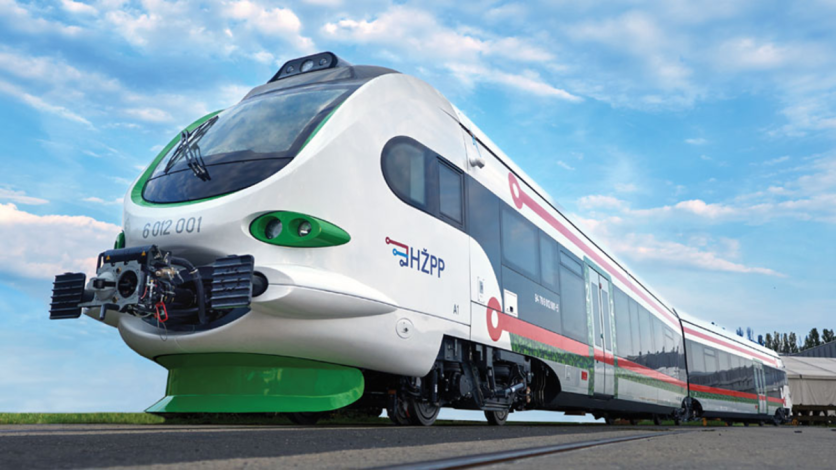
Croatia on Monday put its first domestically built electro-diesel bimodal train into passenger service on the 429-km (267-mile) Zagreb–Split corridor — the same day a European rail regulator named the country's network the least punctual passenger rail system among all EU members that reported data for 2024. The timing was coincidence, not irony: the new bimodal unit answers the rolling stock problem that decades of diesel-only tilting trains created, but it cannot, by design, answer the infrastructure problem that keeps the Zagreb–Split journey at roughly eight hours. That gap — the gap between modern hardware on aging track — is now Croatia's defining rail challenge.
The train, a six-car electro-diesel multiple unit (EDMU) produced by Croatian engineering company KOŃCAR Electric Vehicles, is the first of six units ordered under a €57.3 million EIB-financed contract (approximately $64.7 million USD). Five additional trains from the same production run are expected to enter service by the end of 2026, one per month, replacing tilting trains that had operated the route since 2004.
How Bimodal Traction Works — and Why Croatia Needed It
The Zagreb–Split railway stretches 429 km (267 miles) but is only electrified for its first 103 km (64 miles), from Zagreb to the mountain junction at Oštarije. The remaining 326 km (203 miles) to Split — more than three-quarters of the entire corridor — carry no overhead power lines. That electrification gap is the engineering reason Croatia needed a bimodal train rather than a conventional electric multiple unit.
An EDMU solves the gap by carrying both power sources on board. On the electrified Zagreb–Oštarije segment, a roof-mounted pantograph draws 25kV alternating current from the overhead catenary and routes it through onboard converters to electric traction motors. No diesel is burned; the train can also feed energy back into the grid during braking. At Oštarije, the traction mode switches: onboard diesel engines — pre-warmed while the train was still under the wire, a standard bimodal procedure to ensure reliability before the pantograph retracts — fire up and drive electric generators, which then power the same traction motors that carried the train on electric current through the mountains. The key technical point is that the traction motors never change; what changes is the power source upstream of them. A conventional diesel multiple unit uses mechanical or hydraulic transmission from engine to axle; an EDMU uses diesel-electric transmission in diesel mode, keeping the torque and regenerative-braking benefits of electric traction motors across the full journey.
The tradeoff is weight. Carrying diesel engines and their fuel reserves adds mass that a pure-electric EMU avoids. On Croatia's mountainous terrain — the Dalmatian hinterland's steep gradients were a key design constraint — that additional weight affects acceleration and fuel consumption on the non-electrified section. The KOŃCAR EDMU's designed maximum speed is 160 km/h (99 mph), though track geometry on the current infrastructure limits what can actually be achieved in practice.
The engineering logic is straightforward: electrifying all 326 km (203 miles) of non-electrified track would eliminate the diesel penalty but would require billions in infrastructure investment and years of construction. An EDMU fleet costing €57.3 million ($64.7 million USD) provides seamless through-operation today, without requiring passengers to change trains at Oštarije, while Croatia works on the longer-term infrastructure question.
KOŃCAR's Fifth Traction Type — and a Window Into Croatia's Industrial Capacity
The new EDMU is KOŃCAR Electric Vehicles' fifth distinct traction technology. The Zagreb-based manufacturer previously built electric multiple units, diesel multiple units, electro-battery units, and battery-powered units — each representing a different propulsion approach for Croatia's varied rail network. The EDMU represents the most technically demanding addition to that portfolio.
"Such projects are the best indicator of the strength of the national industry, because behind every train stand Croatian engineers, local development, and a broad ecosystem of suppliers," KOŃCAR President Gordan Kolak said at the launch. The production involved dozens of Croatian companies beyond KOŃCAR itself, with key subsystems — traction converters, transformers, control systems, traction motors — developed within the KOŃCAR Group's own subsidiaries.
KOŃCAR is publicly listed on the Zagreb Stock Exchange and has been building electric rail vehicles for over half a century. Its export record includes 14 low-floor trams delivered to Liepāja, Latvia, and the company is currently producing 40 new trams for Zagreb. The EDMU program, at a unit value of approximately €9.5 million ($10.7 million USD) per train, is the highest-complexity product the rail subsidiary has commercially delivered.
A second train from the Zagreb–Split series will be exhibited at InnoTrans 2026 in Berlin, the world's leading transport technology trade fair, which opens September 22 and runs through September 25. Kolak described the bimodal unit as KOŃCAR's best reference for the European rail market.
What Riders Will Find on Board
The new units offer a significant passenger upgrade over the 2004-era tilting trains they replace. Each EDMU carries 150 seats — 18 in first class and 132 in second class — and features free Wi-Fi, individual power outlets, a modern passenger information system with both visual and audio announcements, accessibility ramps for wheelchair users, and dedicated bicycle storage. Self-service vending machines for coffee, cold drinks, and snacks are installed throughout the passenger area. The entire train is under continuous video surveillance.
From December 2026, when the full six-train fleet is expected to be in service, HŽPP plans to run four daily train services on the Zagreb–Split corridor: two daytime departures from each city, plus a night train leaving Zagreb on Fridays and one leaving Split on Sundays.
"Today we are opening a new chapter in the connection between Zagreb and Split. This train represents a step towards more modern, higher-quality and more sustainable passenger rail transport," said Željko Ukić, HŽPP board chairman, at the launch ceremony.
Why the Same Day Also Brought Croatia's Worst-in-EU Rail Ranking
Also on September 15, European rail regulators published data showing Croatia had the lowest passenger train punctuality rate among all EU countries that reported to the Independent Regulators' Group – Rail (IRG-Rail) for 2024: just 68% of Croatian passenger trains arrived at their final destination within the five-minute punctuality threshold that HŽPP uses to define punctuality. Latvia led the ranking at 97.8%; the European peer group average was substantially above Croatia's figure.
The IRG-Rail report identifies infrastructure works as the main cause of Croatian delays — specifically the combination of replacement bus services (which run longer than rail equivalents), single-track operation during ongoing double-track upgrades, and the general requirement for speed restrictions on aging track. This matters for the EDMU story directly: however modern the new trains are, they operate on the same track that produced that 68% figure. The rolling stock upgrade changes the hardware on the route; it does not change the track geometry, gradient constraints, or signaling systems that govern actual journey times.
HŽPP has acknowledged this gap explicitly. Since 2011, the operator has invested €360 million in trains (approximately $406.8 million USD) — 70 new low-floor units. By the end of the first quarter of 2029, a further €228.8 million ($258.5 million USD) is expected to have been invested in 25 additional trains. That is a substantial rolling stock program. The infrastructure side of the equation is a different, longer, and more expensive project.
The Eight-Hour Problem: Modern Trains, Ancient Track
The 8-hour journey time between Zagreb and Split — roughly 429 km (267 miles), a distance that high-speed rail in Central Europe covers in under two hours — drew pointed comment at the launch from Blaženko Boban, Prefect of the Split-Dalmatia region: "We must now all work together to improve the infrastructure, because an eight-hour journey to Zagreb on such a good and comfortable train is certainly not acceptable."
State Secretary for Railways Žarko Tušek confirmed that the Ministry of Transport has commissioned study documentation for the Zagreb–Split corridor, which is expected to be completed next year. Tušek said the implementation of resulting infrastructure projects could unfold over a period of five to ten years — meaning riders should not expect significantly faster journey times before the mid-2030s at the earliest.
The Zagreb–Split railway entered the EU's Trans-European Transport Network (TEN-T) in 2024, which is a prerequisite for accessing EU infrastructure co-financing — a meaningful policy development that creates a pathway for the longer-term modernization program.
EIB's €900 Million Croatian Rail Bet
The EDMU contract is one piece of a much larger European Investment Bank program for Croatian rail. EIB Vice-President Marko Primorac confirmed at the launch that the bank has made €900 million available for Croatian rail ($1.017 billion USD) for investment in Croatian rail transport and related infrastructure. Beyond the six Zagreb–Split EDMUs, the program covers 13 additional trains of various types, modernization of local and regional lines, station reconstruction, and construction of a new Technical-Logistics Centre in Zagreb.
Croatia also recently signed a separate €53.6 million BEMU contract ($60.6 million USD) — fully financed by the EU's Modernization Fund — for six battery-electric multiple units for northern Croatia, plus the country's first hybrid charging station at Kotoriba. Those units, also built by KOŃCAR, will enter service in 2028–2029.
The cumulative picture is of a country spending aggressively on rolling stock — a decade-long modernization program touching virtually every type of traction technology — while the infrastructure itself remains a longer-term, more politically and financially complex undertaking. For the Zagreb–Split corridor, the new EDMU resolves the question of what train travels the route. The more important question — how long the journey needs to take — remains open.
Currency conversions are approximate based on the EUR/USD exchange rate at the time of publication.
Frequently Asked Questions
How does Croatia's new bimodal train switch between electric and diesel power?
The train runs in electric mode on the first 103 km (64 miles) of the route, from Zagreb to Oštarije, drawing power from 25kV overhead lines through a pantograph. Before reaching the end of the electrified section, the onboard diesel engines start while the train is still connected to the catenary — a pre-warming procedure that ensures reliability — then the pantograph retracts and the diesel engines take over. In both modes, the same electric traction motors drive the wheels; what changes is the power source feeding them, not the type of drive system. This is what distinguishes an electro-diesel multiple unit from a conventional diesel train.
If the new trains are modern and fast, why does the Zagreb–Split journey still take eight hours?
Journey time on the Zagreb–Split corridor is determined primarily by track geometry, gradient constraints, signaling, and the lack of continuous electrification — not by the train's design. The new EDMU is rated for a maximum speed of 160 km/h (99 mph), but the existing infrastructure limits how fast that speed can actually be achieved on most of the route. Study documentation for infrastructure modernization is expected to be completed in 2027, with actual project implementation estimated to take five to ten years after that.
What does Croatia's ranking as Europe's least punctual rail network mean for passengers?
According to IRG-Rail's 14th Annual Market Monitoring Report, only 68% of Croatian passenger trains arrived at their final destination within five minutes of their scheduled time in 2024, the lowest rate among EU countries that submitted data — compared to Latvia's 97.8% at the top of the ranking. The main causes are infrastructure works causing replacement bus services and single-track operation, combined with speed restrictions on aging track. The new EDMU fleet addresses the rolling stock side of the problem; infrastructure improvement, which is the primary driver of delays, will require the longer investment program now under way.
Will there be more Zagreb–Split train services once the full fleet is in place?
Yes. From December 2026, HŽPP plans to run four round trips per day on the Zagreb–Split corridor: two daytime trains in each direction, plus a night train departing Zagreb on Fridays and one departing Split on Sundays. That compares to fewer daily services under the current tilting-train timetable. Longer-term, HŽPP aims to double annual ridership on the route from approximately 250,000 to 500,000 passengers.

-
 C114 Communication Network
 -
 Communication Home
