
 Search

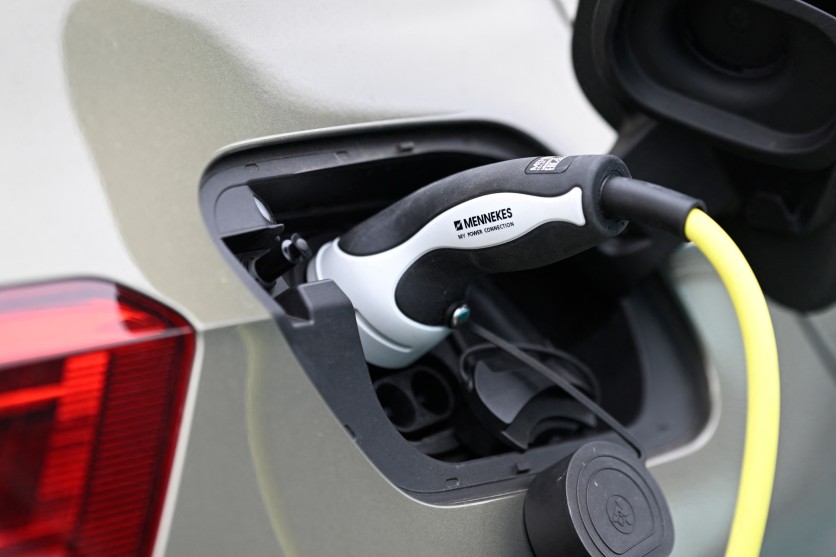
A charging station for electric cars is pictured at a shopping mall in Bochum, western Germany. INA FASSBENDER/AFP via Getty Images
Europe's electric vehicle market shattered its own records in August 2026, with fully electric cars claiming nearly one in three new vehicles sold — a figure so far ahead of analyst projections that it exceeded the full-year forecast that had been set not just for battery-electric vehicles alone, but for the combined plug-in market including hybrids. For car buyers across the continent, that means the economic case for going electric has never been more concrete. For the automakers watching their fleet-emissions ledgers, it means a quarterly compliance math problem quietly got a lot easier.
August Data Shows Europe's EV Transition Accelerating Past Projections
Battery-electric vehicle registrations across 16 key European markets rose 54.2% year-on-year in August 2026, pushing the BEV share of new-car sales to 30.5%, according to data published jointly by E-Mobility Europe, New Automotive, and Fier Automotive. More than 1.67 million fully electric vehicles had been registered across Europe in the first eight months of the year, up 33.1% compared with the same period in 2025.
Those numbers put Europe well ahead of the most optimistic published forecasts. Transport & Environment (T&E), the influential Brussels-based advocacy group, had forecast a 23% BEV share for the European Union over the full calendar year. Research firm Rho Motion had projected roughly 21% across Europe as a whole.
What August delivered wasn't just an overrun — it was a category collapse. Battery-electric vehicles alone were selling at a pace that exceeded what forecasters had predicted for the combined plug-in market. "The priority now is certainty matched by delivery: policymakers and industry working together to sustain this momentum and secure European leadership," said Chris Heron, secretary general of E-Mobility Europe.
Country Breakdown: Germany and France Drive the Numbers
Germany registered 68,980 BEVs in August, delivering a 32.5% BEV market share for the month. That represents a dramatic turnaround from the post-subsidy collapse of late 2023 and early 2024, when Berlin's abrupt cancellation of the Umweltbonus — the subsidy program that had paid out roughly €10 billion (approximately $11.5 billion) supporting approximately 2.1 million vehicles from 2016 to 2023 — sent sales into a sharp reverse.
The 2026 recovery is closely linked to Germany's new €3 billion EV incentive program (approximately $3.46 billion), which took effect retroactively from January 1, 2026, with applications opening through an online portal in May. The program offers payments of between €1,500 and €6,000 (approximately $1,730 to $6,920), with the higher amounts directed to lower-income households — those with taxable annual income below €80,000 (approximately $92,264). Unlike some prior programs, there is no country-of-origin restriction on eligible vehicles.
France went further still in August, achieving a 38.3% BEV market share with 36,159 fully electric vehicles registered — meaning more than one in three new French cars was a BEV. France's social leasing scheme has been a key structural driver. The program, officially called "leasing social de voitures électriques" and now in its third round launched July 2026, allows lower-income households with a taxable reference income below €16,880 to lease an electric car with monthly payments capped at €200 (approximately $231), with no upfront deposit and a minimum 15,000-kilometer (9,321-mile) annual allowance. Entry-level models are available from €94 to approximately €140 per month (approximately $108 to $161). The 2026 round covers 50,000 vehicles and offers government subsidies of €6,500 to €9,500 (approximately $7,497 to $10,957) per vehicle, with higher amounts awarded to cars built with European-manufactured engines and batteries.
Several smaller markets reinforced the breadth of the shift. Norway, long the global leader in EV adoption, maintained a 98.7% BEV market share. Denmark followed at 85.9%, Finland at 52.3%, the Netherlands at 48.9%, Belgium at 46.2%, and Portugal at 36.1%.
Italy, historically a laggard in Europe's EV transition, continued to be one of the fastest-growing markets. Italian BEV registrations roughly doubled year-on-year in the first half of 2026, a turnaround attributable in part to Italy's National Recovery and Resilience Plan, which allocated over €700 million (approximately $808 million) to charging infrastructure, targeting 21,255 new public charging stations — including 7,500 ultra-fast stations with power of approximately 175kW on inter-urban roads. Note: Italy's monthly BEV share showed significant volatility; it fell to 5.9% in July 2026 after incentives expired, before rebounding in August, illustrating the dependence of growth on the availability of purchase support.
When 30% BEV Share Changes the Compliance Math
The August milestone matters beyond headline statistics. Under EU Regulation 2019/631 — Europe's fleet CO2 standard — carmakers must ensure their aggregate new-vehicle sales average no more than 93.6 grams of CO2 per kilometer (WLTP), with fines of €95 (approximately $110) per excess gram-per-kilometer multiplied by total vehicles sold. A fully electric vehicle registers at zero grams; a typical petrol car at around 120 g/km.
At low BEV shares, automakers are forced into expensive coping mechanisms: steeply discounting EVs to hit volume targets, pooling emissions credits with Tesla or Polestar by purchasing compliance certificates at a cost, or steering buyers toward lower-margin models. All three strategies suppress profitability. At a sustained BEV share near 30%, the arithmetic changes significantly. Many OEMs can meet compliance thresholds without those tactics — a structural shift that industry analysis described as a "compliance bill" reduction that can ease pressure on tactics that hurt profits.
The EU Council adopted a three-year averaging provision in May 2025, allowing manufacturers to meet their 2025–2027 emissions targets as a three-year average rather than annually. That provision provides additional breathing room, but months like August 2026 — running 7 percentage points above full-year forecasts for BEV share alone — mean the breathing room is now structural rather than temporary.
Chinese Automakers: Market Force, Policy Risk
No account of Europe's BEV acceleration is complete without examining the competitive pressure exerted by Chinese manufacturers. In the first half of 2026, Chinese car brands collectively registered approximately 663,000 vehicles across Europe — a 107% year-on-year increase — capturing roughly 9.2% of the European new-car market, up from approximately 4.5% in H1 2025. BYD recorded H1 European registrations of approximately 172,964 units, up around 145%. Leapmotor, distributing through its joint venture with Stellantis — in which the Italian-French group holds a 21% stake — soared approximately 558–569% from a smaller base to reach tens of thousands of units, making it the fastest-growing Chinese brand in Europe by percentage.
Chinese automakers can price competitively in Europe even after accounting for the EU's anti-subsidy tariffs — imposed in October 2024 on top of the standard 10% import duty — because of structural cost advantages: vertically integrated battery production, lower manufacturing labor costs, and scale advantages from dominating the world's largest domestic EV market. BYD's combined tariff rate is approximately 27%, SAIC's approximately 45.3%, and Geely's approximately 28.8% — yet even at those levels, Chinese models available for under approximately €20,000 (approximately $23,066) have expanded the addressable buyer pool in segments European manufacturers have struggled to serve profitably.
Chinese manufacturers are responding to the tariff environment by accelerating local manufacturing. Leapmotor is already producing at Stellantis' Zaragoza plant in Spain. BYD is establishing an assembly facility in Hungary. European-manufactured Chinese EVs are not subject to the Chinese-origin tariffs, and in some cases become eligible for local purchase incentive programs — including Germany's 2026 scheme, which contains no country-of-origin restriction.
What European Buyers of Chinese EVs Need to Know
Before purchasing a vehicle from any Chinese-headquartered manufacturer — including BYD, SAIC (MG brand), Geely, Leapmotor, Chery, or Xpeng — European buyers should understand a fixed legal condition that applies regardless of where the vehicle is manufactured, where the company's European headquarters is located, or what its privacy policy states.
China's National Intelligence Law (2017), Article 7, requires all organizations and citizens to support, assist, and cooperate with national intelligence work. China's Data Security Law (2021) and Cybersecurity Law (2017) impose data localization requirements and grant government authorities access to data held by Chinese companies. These are not contractual commitments that can be waived — they are statutory obligations under Chinese law that apply to every company headquartered or ultimately controlled in China.
No independent security audit of any of the Chinese-branded vehicles currently sold in Europe has confirmed the full extent of data collection and transmission. What categories of data modern connected vehicles collect — location history, driving behavior, in-cabin audio, biometric patterns from driver monitoring systems, smartphone contacts synced via Bluetooth — represent a meaningful exposure under these legal conditions.
Practical steps for buyers who proceed: consider network segmentation (keeping the vehicle on a separate Wi-Fi network from home devices), reviewing data-sharing settings in the vehicle's companion app, and consulting independent firmware audit tools before connecting the vehicle to sensitive personal devices.
Why Fuel Economics Are Amplifying the Shift
Europe's 2026 EV acceleration is not solely policy-driven. Energy price dynamics have materially widened the total-cost-of-ownership advantage for electric vehicles. At the start of 2026, energy costs for combustion-engine vehicles rose 12 to 36%, while electricity costs for BEV drivers remained largely unchanged, according to analysis published by the International Council on Clean Transportation in September 2026. The ICCT calculated that in 2025, EVs were already 33% cheaper to operate than petrol-engine equivalents in Europe — and that 2026's oil-price pressure has widened this gap further.
EU average petrol prices reached approximately €1.91 per liter (approximately $8.33 per US gallon) in August 2026, based on the European Commission's Weekly Oil Bulletin.
The consumer organization BEUC found that medium-sized BEVs reached total-cost-of-ownership parity with petrol equivalents for first owners in 2026, with small vehicles expected to follow in 2027.
Infrastructure: The Constraint That Will Determine What Comes Next
The surge in vehicle sales is intensifying pressure on a charging network that remains structurally inadequate relative to 2030 targets. The EU currently has approximately 910,000 publicly accessible charging points — roughly 26% of the 3.5 million the European Commission has set as its 2030 target, according to analysis by Motointegrator and DataPulse Research.
The European Automobile Manufacturers' Association (ACEA) considers the Commission's figure an underestimate: by ACEA's calculation, 8.8 million charging points will be needed to match projected vehicle growth and electrification rates by 2030. Meeting that target would require installing approximately 1.2 million chargers per year — eight times the current annual installation rate of roughly 150,000.
Italy's trajectory illustrates the challenge. As of March 2026, Italy had deployed 78,253 public charging points, a 35% increase from the start of the year. The country's NRRP-funded program is in active tender phases. But with Italian BEV registrations rising rapidly, the ratio of chargers to vehicles remains a live constraint.
The charging gap is also geographically uneven within the EU. Three countries — the Netherlands, France, and Germany — account for approximately 61% of all EU charging infrastructure, leaving long stretches of Eastern and Southern Europe significantly underserved. The EU's Alternative Fuels Infrastructure Regulation (AFIR) mandates fast-charging sites of at least 150kW every 60 kilometers (37 miles) along the Trans-European Transport Network core corridors, but implementation remains uneven.
How Europe's EV Transition Compares to What Was Forecast
The August 2026 data doesn't just represent one strong month — it is the culmination of a trend that has consistently outrun its models throughout 2026. In March, European BEV registrations surged 51.3% year-on-year. In May, market share reached a then-record 23.6% across 17 markets. In June, registrations jumped 39.5% to record levels, with market share crossing 25% for the first time. In July, market share held at 25.7% with 224,266 registrations. August's 30.5% represents a further step change.
At current trajectory, battery-electric vehicles are on course to account for more than a third of European new car sales before the end of 2027, a threshold that appeared years away as recently as early 2025.
What Comes After 30%
"The priority now is certainty matched by delivery: policymakers and industry working together to sustain this momentum and secure European leadership," Heron said in the E-Mobility Europe statement accompanying the August bulletin.
That formulation captures both the opportunity and the risk. Some of the structural forces behind August's record are durable: lithium-ion battery pack costs have fallen from roughly $1,000 per kilowatt-hour in 2010 to below $100 per kilowatt-hour today, crossing the threshold at which BEV purchase prices in key segments can reach parity with petrol equivalents without subsidy. The fuel-cost advantage is a function of volatile global oil markets, not policy.
But subsidy programs expire. Germany's €3 billion (approximately $3.46 billion) scheme runs through 2029. France's social leasing allocations have repeatedly exhausted their budgets within weeks of opening. Italy's NRRP charging deployments face procurement and permitting delays. Chinese OEM localization will reshape competitive dynamics within three to five years. The charging infrastructure gap — requiring an 8x increase in annual installation — will not close without sustained capital allocation from both public and private sectors.
Europe's electric vehicle market is not following a smooth adoption curve. It is accelerating. The question that replaces "will it happen?" is: can the ecosystem — infrastructure, policy, supply chains, and grid capacity — accelerate at the same rate?
Frequently Asked Questions
Why did Europe's BEV market exceed full-year forecasts in a single month?
Several forces converged simultaneously in 2026: Germany relaunched a €3 billion (approximately $3.46 billion) income-targeted EV subsidy with no country-of-origin restrictions; France opened a third round of its social leasing scheme allowing low-income households to lease EVs from approximately €94 per month (approximately $108); Italy continued deploying NRRP-funded charging infrastructure; and fuel price increases through 2026 widened the total cost-of-ownership advantage for EVs to 33% or more over petrol equivalents. The convergence of demand-side incentives, falling hardware costs, and rising fuel prices produced August's 30.5% BEV share — exceeding the full-year forecast for the combined plug-in market.
How does a 30.5% BEV market share affect European automakers' regulatory obligations?
Under EU Regulation 2019/631, automakers pay fines of €95 (approximately $110) per gram of CO2 per kilometer above the fleet-average target of 93.6 g/km, multiplied by total vehicles sold. A BEV registers as zero g/km. When BEV share rises, the fleet average falls, reducing or eliminating fines and the need for costly compliance workarounds like credit pooling with Tesla or steeply discounting EVs to hit volume targets. At sustained BEV shares near 30%, many OEMs cross into compliance without those margin-suppressing tactics — what analysts call a "compliance dividend." The EU's three-year averaging provision (2025–2027), adopted May 2025, provides additional flexibility.
Are Chinese EVs safe to buy in Europe, given Chinese data-sharing laws?
Chinese-manufactured and Chinese-branded vehicles perform well in independent safety tests and offer genuine cost advantages. But buyers should be aware that companies headquartered in China — including BYD, SAIC (MG), Geely, Leapmotor, Chery, and Xpeng — are legally required under China's National Intelligence Law (2017) to cooperate with government intelligence requests, regardless of where the vehicle is manufactured or where the company's European office is located. Modern connected vehicles collect significant data: location history, driving behavior, and data transmitted via connected apps. No independent security audit has fully characterized what Chinese-branded EVs collect and transmit. Practical mitigations include network segmentation, reviewing in-app data-sharing settings, and checking whether independent firmware audits have been conducted for the specific model.
Does Europe now have enough charging infrastructure to support this level of BEV adoption?
Not yet. The EU currently has approximately 910,000 public charging points — about 26% of the 3.5 million the European Commission targets for 2030. The European Automobile Manufacturers' Association puts actual 2030 needs higher, at 8.8 million points, which would require an eight-fold increase in the current annual installation rate of approximately 150,000 chargers per year. The gap is also unevenly distributed: three countries — the Netherlands, France, and Germany — account for approximately 61% of EU chargers, leaving Eastern and Southern Europe significantly underserved. Access to public charging remains a meaningful adoption barrier for buyers without home charging capability.

-
 C114 Communication Network
 -
 Communication Home
