
 Search

Franciscomotors.com
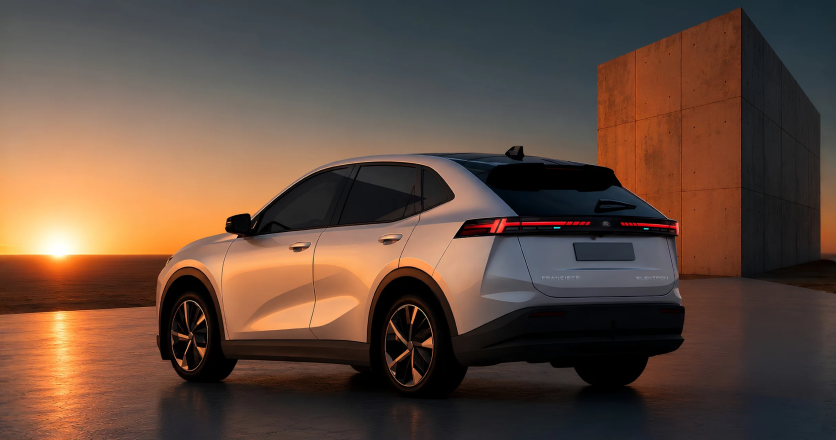
Francisco Motors officially unveiled its first battery-electric SUV on July 27, 2026, launching the Elektron as a five-door compact crossover with a top-tier Deluxe variant priced at ₱1,947,000 — approximately $32,000 USD (exchange rate as of July 27, 2026; conversions are approximate). The company simultaneously opened Founder Orbit, a limited reservation program capped at 1,947 slots at ₱1,947 (about $32) per slot — a deliberate nod to the founding year of a brand that has spent nearly eight decades making Philippine streets recognizable. What the launch does not come with: a confirmed Philippine delivery date, a validated range figure, or a named platform partner.
For readers considering the ₱1,947 reservation: every specification disclosed at launch is explicitly provisional, subject to testing and regulatory validation. The Elektron's range claims — up to 600-plus kilometers (373-plus miles) for the top variant — carry an undisclosed certification cycle. EVs built on Chinese manufacturing platforms routinely publish range figures under the CLTC standard, which can run 15–25 percent higher than the WLTP real-world equivalent used in Europe and widely applied as a global benchmark. Until Francisco Motors discloses which standard applies, the effective range a Philippine driver can expect remains unverified.
Francisco Motors Stakes Its Claim in a Market Growing at Over 120 Percent
The timing is deliberate and market-aware. Battery electric vehicle sales in the Philippines surged more than 120 percent year-on-year in the first quarter of 2026, reaching around 2,289 units among Chamber of Automotive Manufacturers of the Philippines (CAMPI) and Truck Manufacturers Association (TMA) member brands — compared with 1,027 in the same period of 2025. Total electrified vehicle sales for all of 2025 reached roughly 58,905 units, representing about 12 percent of nationwide vehicle sales. The government's long-term roadmap targets approximately 2.5 million EVs on Philippine roads by 2040 under the Electric Vehicle Industry Development Act (EVIDA), or Republic Act 11697.
VinFast emerged as the top BEV brand in the Philippines in Q1 2026 among CAMPI-TMA member brands, selling 1,171 units from March alone. BYD, which held 55 percent of Philippine EV market share by April 2026 despite not being a CAMPI member, ended 2025 with 26,122 units sold — a 446 percent increase year-on-year. Into this accelerating competition, Francisco Motors is inserting not just a vehicle but a cultural claim: the jeepney builder wants to be the first Filipino OEM to compete.
Three Variants, Three Price Points — All Still Pending LTO Homologation
The Elektron launches in three configurations. The entry-level Basic pairs a single motor with a 54.9 kWh battery, provisionally rated for approximately 400 kilometers (249 miles) of range, a top speed of 160 km/h (99 mph), and a 0-to-100 km/h time of 7.7 seconds. It includes a four-speaker audio system.
The mid-tier Fashion steps up to a 63 kWh battery rated for approximately 500 kilometers (311 miles), matches the Basic's 160 km/h (99 mph) top speed, and upgrades the cabin audio to a nine-speaker system.
The flagship Deluxe pairs dual motors in an all-wheel-drive configuration with an 81.5 kWh battery provisionally rated for more than 600 kilometers (373 miles) of range and a top speed of 180 km/h (112 mph), adding a ten-speaker audio system. It carries the ₱1,947,000 ($32,000 USD approximately) price and is the only variant for which Francisco Motors has published a specific retail figure.
All three variants use CCS2 (Combined Charging System 2) — the DC fast-charging standard that is consolidating as the primary protocol across Philippine charging infrastructure — with a claimed fast-charge time of approximately 30 minutes. The Elektron will carry a warranty of up to eight years or 150,000 kilometers (93,210 miles), whichever limit is reached first.
None of these specifications have been validated by Philippine regulatory authorities. The Land Transportation Office homologation process and potential EVIDA compliance review must be completed before retail deliveries can begin.
What "30-Minute Fast Charging" Actually Means
The Elektron's CCS2 charging claim deserves a closer reading before it becomes a deciding factor for buyers. In EV industry convention, a "30-minute fast charge" describes the time required to charge from approximately 20 percent to 80 percent state of charge — the segment of the battery curve where lithium-ion cells accept energy most efficiently. A full charge from near-empty to 100 percent would take substantially longer, as charging rates taper sharply in the upper range to protect battery chemistry.
The Deluxe variant's 81.5 kWh pack at a 100–150 kW DC charger — the range typical of Philippine CCS2 fast-charge installations — would take approximately 35–50 minutes for the 20–80 percent window. Francisco Motors has also flagged a 1 MW-capable "Flash Charging" system linked to its DOMENG AI platform, but infrastructure details for that capability have not been published.
CCS2 is also not compatible with the GB/T charging standard used by some BYD models distributed in the Philippines, which is a practical note for fleet buyers or households considering mixed-brand EV ownership.
How the Elektron Compares to Its Nearest Competition
The Elektron Deluxe lands at ₱1,947,000 ($32,000 USD approximately). For context: the VinFast VF 6 — currently the top-selling BEV brand among CAMPI-TMA members in the Philippines — is priced at ₱1,499,000 to ₱1,699,000 ($24,300 to $27,500 USD approximately). The VF 6's battery is 59.6 kWh, with a range of approximately 460–480 kilometers (286–298 miles). The BYD Atto 3, the dominant force in the wider Philippine EV market, comes in two variants in the Philippines: the Standard Range Dynamic with a 49.9 kWh battery rated for 410 kilometers (255 miles) of range, and the Extended Range Premium with a 60.48 kWh battery rated for 480 kilometers (298 miles).
On paper, the Elektron Deluxe offers more battery capacity and a longer range claim than both immediate competitors, with a commensurately higher price. The Elektron also offers an eight-year / 150,000 km (93,210 miles) warranty — a figure that matches or exceeds the warranty terms offered by most mainstream EV entrants in Southeast Asia. The Basic and Fashion variants, without confirmed pricing, are positioned to compete more directly with the VF 6's price band.
The critical distinction is that VinFast and BYD vehicles on the Philippine market have been through regulatory homologation, are available for delivery, and have documented real-world ownership experience. The Elektron has not yet cleared that gate.
The Platform Francisco Motors Is Not Naming
The Elektron's single most consequential undisclosed detail is not its price. It is the identity of its vehicle platform.
Francisco Motors Chairman Elmer Francisco confirmed to CleanTechnica in May 2026 that "the vehicle platform itself is already proven in real-world conditions and is already operating on the streets in several countries, although still in small quantities." This means the Elektron is not a bespoke ground-up architecture — it is built on an existing platform developed by a third-party partner, most likely in China where the ASEAN-market units will initially be manufactured.
The platform licensing and contract manufacturing model is well-established in the Chinese EV industry: it reduces time-to-market and capital requirements substantially compared with an original architecture, at the cost of differentiation and supply-chain transparency. What it does not provide is independent verification of range, performance, or safety claims until a specific vehicle has been tested under the destination market's certification regime.
Francisco Motors has not named its battery supplier, motor manufacturer, or platform partner. Until that information is public, independent analysis of the Elektron's specifications against other vehicles using the same platform is not possible.
DOMENG, Jeepney.io, and the Platform Vision Beyond the Vehicle
Francisco Motors is not presenting the Elektron as a standalone vehicle sale. Woven into the launch is Jeepney.io, the company's mobility operating platform, and DOMENG — its AI interface layer described as the "command layer" linking vehicles, customers, partners, and services. DOMENG manages reservations, payments, and support requests; the company is explicit that it is not an autonomous driving system and not a substitute for human judgment.
The ₱1,947 Founder Orbit reservation fee is credited toward the eventual purchase price. Francisco Motors is also targeting fleet buyers, local government units, transport cooperatives, and financial institutions alongside individual consumers — a market segment strategy that reflects both ambition and the practical reality that consumer EV volume at this price point remains limited in the Philippines.
Chairman Francisco has stated that achieving 1,000 pre-orders could justify local assembly by 2028, with subsequent phases envisioning export-level manufacturing. The $355 million phased development figure associated with the broader program is a company-stated figure.
Production Timeline: What Exists and What Doesn't Yet
Pilot production for the United States and South American markets is targeted at the company's Santa Clarita, California facility in the second half of 2026. ASEAN-market units — including those intended for the Philippine market — are slated for initial production at a Chinese facility, with no specific delivery date confirmed for Filipino buyers. Localization of parts and final assembly in the Philippines is described as a subsequent phase, with a 2028 target contingent on reaching 1,000 pre-orders.
Francisco Motors LLC was incorporated in Delaware in 2025 — making it a US-registered legal entity, though the Francisco family's automotive heritage and brand identity are entirely Filipino. The underlying Francisco Motors Corporation, founded in 1947, is headquartered in Camarines Norte, Bicol Region, Philippines.
For a buyer placing a ₱1,947 reservation today, the current state of affairs is: Elektron specifications are provisional, the platform partner is unnamed, ASEAN production hasn't begun, LTO homologation is pending, and no Philippine delivery date has been announced. The reservation fee is credited toward purchase but does not guarantee vehicle allocation, pricing, financing, or delivery.
From Jeepneys to Electrons: What the Brand Carries Into This Moment
Anastacio Trinidad Francisco established what would become Francisco Motors in 1947 in Zapote, Las Piñas, starting with a ₱200 painting shop that customized surplus U.S. military jeeps into the extended passenger vehicles Filipinos would come to call jeepneys. His brothers Fernando and Jorge — the latter a mechanical engineer — joined the operation as it grew into a full-scale body builder and eventually into Francisco Motor Corporation, incorporated in 1960. By the late 1970s, FMC annual production reached 5,000 units per year and the company employed 2,000 people across two manufacturing plants. The company also assembled Isuzu vehicles in the 1960s, Mazda trucks and vans in the 1980s, and later Hyundai models.
The number 1,947 runs through the entire Elektron launch identity: 1,947 reservation slots, a ₱1,947 reservation fee, a Deluxe price of ₱1,947,000. Whether the Elektron's provisional specs hold through regulatory validation, and whether production timelines translate into vehicles on Philippine roads, will determine whether that number becomes part of a second chapter or remains a launching date alone.
Frequently Asked Questions
How much does the Francisco Motors Elektron cost, and is the reservation refundable?
The Deluxe variant — the only model with a confirmed retail price — is listed at ₱1,947,000 (approximately $32,000 USD at the July 27, 2026 mid-market exchange rate). The Founder Orbit reservation fee of ₱1,947 (about $32) is credited toward the eventual purchase price but does not guarantee vehicle allocation, a specific price, a delivery date, or financing terms, according to the official Francisco Motors website. Pricing for the Basic and Fashion variants has not been announced.
When will the Elektron actually be available for purchase in the Philippines?
No confirmed delivery date exists for Philippine buyers. Pilot production for the US and South American markets is targeted at the Santa Clarita, California facility in the second half of 2026. ASEAN-market units, including those for the Philippines, are slated for initial production in China — but no completion date has been announced. Local Philippine assembly is a longer-term target, contingent on reaching 1,000 pre-orders, with a 2028 timeline stated by the company. All specifications and timelines remain provisional pending regulatory validation.
What does it mean that the Elektron's range figures are "provisional"?
Francisco Motors states explicitly that all specifications are "subject to testing, regulatory validation, and final confirmation." In practice, this means the range figures — 400 kilometers (249 miles) for the Basic, 500 kilometers (311 miles) for the Fashion, and 600-plus kilometers (373-plus miles) for the Deluxe — have not been validated under a specific certification standard. EVs manufactured on Chinese platforms are commonly tested under CLTC (China Light-duty Vehicle Test Cycle), which produces range figures typically 15–25 percent higher than the WLTP real-world standard used globally. Until Francisco Motors discloses its certification cycle, the real-world range a Philippine driver can expect from the Elektron is unconfirmed.
How does the Elektron's CCS2 charging work with existing Philippine infrastructure?
CCS2 (Combined Charging System 2) is the emerging DC fast-charging standard in the Philippines, found at major highway charging hubs and specialized stations. The Elektron's claimed 30-minute fast charge refers to the 20-to-80 percent state-of-charge window, not a full charge from empty to 100 percent. CCS2 is compatible with VinFast and most internationally marketed BYD variants, but is not compatible with the GB/T charging connector used by some BYD models distributed in the Philippine market. As of July 2026, CCS2 infrastructure is expanding but not yet uniformly deployed nationwide.

-
 C114 Communication Network
 -
 Communication Home
