
 Search

Mars Auto
Mars Auto, a South Korean startup building autonomous-driving software for heavy trucks, says it will release what it calls Tesla-comparable self-driving software this year and aims to automate freight all the way from Korea to the United States.
At a media day in Seoul, CEO Park Il-su said the company will commercialize driverless trucks by 2028 using an end-to-end (E2E), camera-based AI system he likened to Tesla's, according to Seoul Economic Daily — processing visual data through cameras and letting AI make decisions, rather than relying on LiDAR and high-definition maps. Founded in 2017 by KAIST alumni, Mars Auto has real operations to point to, though its most eye-catching framing is its own.
Why Cameras, and Why Trucks
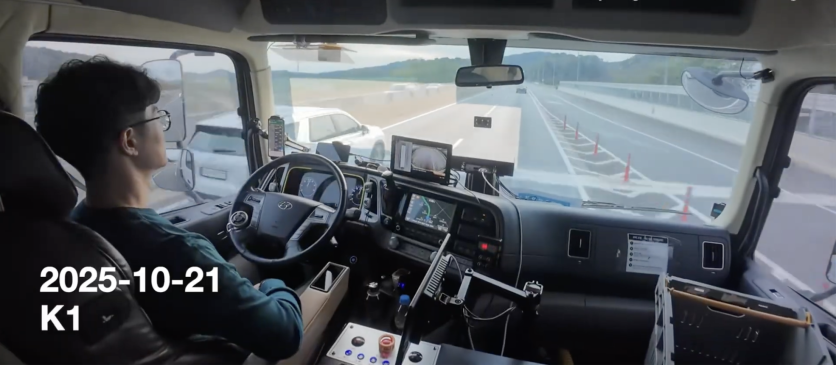
The company's bet rests on two technical arguments. The first is architectural. Most autonomous systems pair LiDAR — laser sensors that build a precise 3D picture — with high-definition maps, and can operate only on routes prepared in advance. Mars Auto instead uses a single neural network that takes raw video from the truck's cameras and directly outputs perception, judgment, and control, with no pre-built map, which it says lets the truck drive roads it has never seen, the way a human does. Mars Auto argues the camera approach wins on both capability and cost: where rivals' sensor setups can run around 350 million won ($229,000) per vehicle, it says its own runs about 10 million won ($6,500).
The trade-off, and the reason this approach is debated, is that cameras alone can struggle in fog, glare, or darkness where LiDAR's active sensing still works — the same camera-only philosophy Tesla uses is currently the subject of a U.S. federal safety investigation. The second argument is about problem choice. Because roughly 98% of a truck's route is highway — a far more uniform and predictable environment than dense city streets — Park said the technology is relatively easier to deploy than robotaxis.
Read more: The Science Behind Self-Driving Cars and Their Sensors
The Track Record Behind the Pitch
Some of what Mars Auto brings is verifiable. The company has accumulated 20 million km of real truck-driving data — collected partly through Korea's postal-logistics support and, early on, from the Euro Truck Simulator game — and 2.5 million km of autonomous driving, with a roster of customers in a Hyundai-anchored auto-parts supply chain. It drew early investment from Kakao Ventures and Kakao Mobility and, in 2019, from Y Combinator, the Silicon Valley accelerator.
Its U.S. ambition is anchored in a "Team Korea" project pairing Mars Auto's technology with Hyundai Mobis as shipper and Lotte Global Logistics and LX Pantos in logistics. Deputy CEO Noh Je-gyeong said Mars Auto recently completed what it calls the world's longest single-route autonomous freight haul — about 3,379 km from the Port of Long Beach to Hyundai Mobis module plants in Alabama and Georgia over three days — carrying Korean-exported auto components, with the truck covering up to 1,300 km a day, roughly 63% more than the U.S. human-driver average. By way of comparison, Noh noted that Aurora, a leading U.S. autonomous-truck company, runs its longest route at around 1,000 miles.
Read more: Tesla Seeks 5,000 Las Vegas Robotaxi Slots With Camera Tech Under Federal Probe
What Comes Next
Mars Auto now plans to bring that trans-Pacific logic home, automating a chain that runs from a Korean parts plant through Busan Port — which handles about 60% of Korea's ocean-export volume — to logistics hubs in the U.S. Having cleared a transport-ministry demonstration exemption and a Korea Transportation Safety Authority evaluation, it plans to start Korea's first paid autonomous-trailer operations at Busan Port with three vehicles in the third quarter, scaling to ten by year-end.
The company also previewed MarsNet 3, its next-generation Level 4 system, which extends camera-only autonomy from highways into general roads without HD maps, with an urban-capable version due by year-end; Park framed its evolution as mirroring how Tesla's FSD expanded from highway autopilot into cities. Alongside it, Mars Auto launched MARS COPILOT, a subscription Level 2 product for long-haul drivers that it says cut fatigue and improved fuel efficiency by about 10% in pilots. The company secured AI-training infrastructure — including Nvidia Blackwell GPUs — through a 2 billion won strategic project backed by Korea's Ministry of Trade, Industry and Energy, and says driver shortages in both Korea and the U.S. are boosting logistics firms' interest.
Frequently Asked Questions
What is Mars Auto?
Mars Auto is a South Korean startup, founded in 2017 by KAIST alumni, that develops autonomous-driving software for heavy trucks. It focuses on middle-mile, long-haul freight and uses a camera-based end-to-end AI system rather than LiDAR and high-definition maps. The company has operated commercial autonomous freight in Korea since 2023 under a regulatory sandbox and expanded to paid U.S. operations in 2024, with a U.S. base in Round Rock, Texas. It has raised funding from investors including Kakao Ventures, Kakao Mobility, and Y Combinator.
Does Mars Auto use LiDAR?
No. Mars Auto uses a camera-based (vision-only) end-to-end AI approach, in which a single neural network interprets video from the truck's cameras to handle perception, decision-making, and control, without LiDAR sensors or pre-built HD maps. The company argues this is cheaper and more scalable — it puts its per-vehicle sensor cost at about 10 million won versus roughly 350 million won for LiDAR-based systems — and lets the truck handle unfamiliar roads. Critics of camera-only autonomy note that cameras can struggle in poor visibility where LiDAR still functions, a debate underscored by an ongoing U.S. federal investigation into Tesla's camera-only system.
What was the world's longest autonomous truck haul?
Mars Auto says it completed the world's longest single-route autonomous freight delivery on record: a roughly 3,379-kilometer run from the Port of Long Beach, California, to Hyundai Mobis module plants in Alabama and Georgia, carried out over three days with a 35-ton truck hauling Korean-exported auto parts. The claim is the company's own, but the run is documented, and the route has since been folded into regular commercial operation. For comparison, Mars Auto says the longest route run by U.S. leader Aurora is around 1,000 miles.
When will Mars Auto have driverless trucks?
Mars Auto targets fully driverless commercial trucking by 2028, a company goal rather than a certainty. In the nearer term, it plans to begin Korea's first paid autonomous-trailer operations at Busan Port with three vehicles in the third quarter of 2026, scaling to ten by year-end, and to release an urban-capable version of its MarsNet 3 system by the end of the year. As with any autonomous-driving timeline, regulatory approval and real-world performance will determine whether the 2028 target holds.

-
 C114 Communication Network
 -
 Communication Home
