
 Search

slate.auto
Slate Auto officially priced its electric pickup truck at $24,950 on Wednesday and opened pre-orders to the public, making it the least expensive new truck on sale in the United States — undercutting the Ford Maverick XL by more than $2,000 at a moment when the American EV market is absorbing the full impact of a vanished federal tax credit. The 180,000-plus people who placed $50 placeholder reservations now have 30 days to convert their spots into $300 non-refundable deposits, or walk away.
The timing is not accidental. Ford killed the F-150 Lightning late last year. New EV sales in the United States fell 27% year-over-year in the first quarter of 2026 to approximately 216,400 units, according to Cox Automotive's Kelley Blue Book. Slate is entering that wreckage with a price tag that requires no government subsidy to reach, a manufacturing model that bypasses much of the capital equipment that makes vehicle factories expensive, and a 10-year warranty announced today that extends to independent repair shops — not just its own service network.
What $24,950 Buys — and What It Does Not
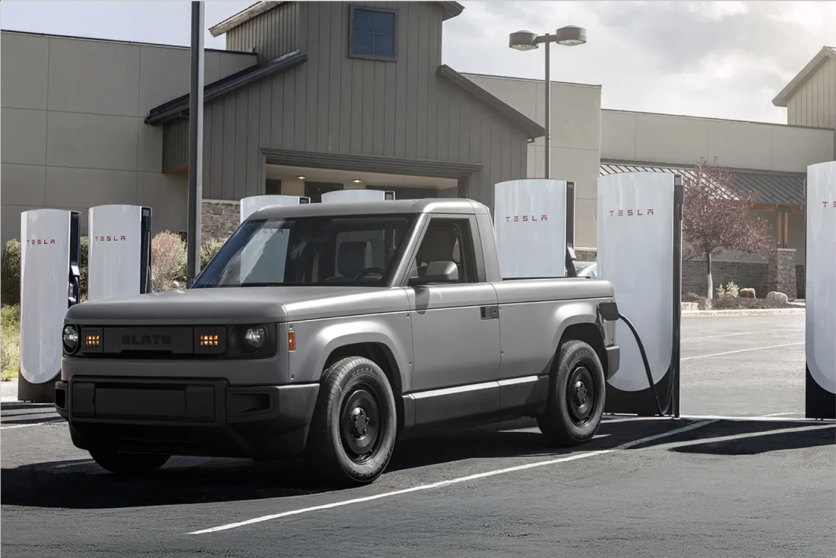
The Slate Truck is a two-seat, rear-wheel-drive electric pickup with a 5-foot bed. It comes in one color from the factory: gray. There is no infotainment screen, no Bluetooth speaker, and no power windows. Hand cranks operate the glass. The HVAC system uses physical knobs. The standard payload rating is 1,550 pounds; tow capacity reaches 2,000 pounds.
Power comes from a 181-horsepower electric motor producing 195 lb-ft of torque — a slight reduction from the 201-horsepower figure cited at the truck's April 2025 debut, reflecting the production-spec tune. The 0–60 mph sprint takes an estimated 8 seconds. A 65 kWh lithium iron phosphate (LFP) battery pack, with 63 kWh usable, delivers a claimed range of approximately 205 miles — a 37% improvement over the 150-mile estimate the company had been citing since its reveal.
DC fast charging through the NACS (SAE J3400) port reaches a maximum of 150 kW, enabling a 20%-to-80% charge in approximately 30 minutes. Level 2 home charging takes 4–8 hours on an 11 kW onboard charger.
What the base price does not include: paint, an infotainment system, power windows, exterior color, or a stereo. The body panels are injection-molded glass-fiber-reinforced polypropylene composite — permanently gray all the way through. Buyers who want color can choose from more than 100 exterior wrap options, with the vast majority priced under $500. A broader accessories catalog of more than 200 items — roof racks, seat covers, stereo systems, light covers — lets owners add features after purchase. Most panels (except the doors) can be swapped out with basic hand tools.
"Slate gives customers the freedom to buy only what they need today and personalize their vehicle as their needs change tomorrow," CEO Peter Faricy said.
Read more: Slate Truck: Bezos-Backed EV Startup Promises Retro Vibes, DIY Kits, But Will Gen Z Buy it?
How Slate Built a Truck for $24,950: LFP, No Paint, 500 Parts
The price is not a rounding error. Slate Auto's cost structure rests on three specific engineering decisions that most automakers have been unwilling to make.
The first is the absence of a paint shop. In conventional vehicle manufacturing, an automotive paint facility is one of the most capital-intensive investments on any factory floor — typically ranging from $200 million to over $500 million upfront for a new installation. Slate's manufacturing strategy eliminates that expense entirely. Because the body panels' gray color runs all the way through the injection-molded polypropylene material, there are no spray booths, no curing ovens, and none of the environmental compliance infrastructure that volatile organic compound regulations require. If a panel gets dinged, the color underneath is the same gray — there is no paint layer to crack through to raw plastic or steel. CEO Peter Faricy has cited approximately $350 million as the figure Slate avoids by building with polypropylene instead of painted steel.
The second decision is the choice of LFP chemistry over the nickel-manganese-cobalt (NMC) formulation used by most premium EV manufacturers. In 2026, LFP battery cells cost approximately $80–100 per kilowatt-hour, compared to $120–150 per kilowatt-hour for NMC. The tradeoff is energy density: LFP packs need more physical space and weight to store the same energy as a comparable NMC pack. That is why the Slate's 65 kWh pack delivers 205 miles where a comparable NMC-equipped vehicle might achieve the same range with a 50–55 kWh pack. LFP also runs roughly 3,000 to 5,000 full charge cycles before significant degradation — versus 1,000 to 1,500 for NMC — meaning the battery is likely to outlast the warranty without replacement for most use patterns. And because LFP contains no cobalt or nickel, its supply chain avoids both the price volatility and the ethical concerns that accompany those materials.
The third decision is radical parts reduction. A conventional pickup truck arrives at a factory assembly line with approximately 2,500 distinct parts to be shipped in from suppliers. Slate's truck uses 500. The engineering team applied Design for Manufacturability and Assembly (DFMA) principles throughout development: the instrument panel went from 27 parts to 7; door panels dropped from 15 to 10. One practical consequence of that simplicity is the truck's stated motivation for omitting infotainment: CCO Jeremy Snyder, a former head of Tesla's global business operations, has noted that 70% of repeat warranty claims at established automakers stem from infotainment systems — precisely because software-heavy touchscreen platforms create unstable environments with compounding failure modes. Removing the screen eliminates the failure mode, not just the cost.
The SUV Option and the Warsaw Factory
Buyers can also order the truck pre-configured as an SUV. The Squareback and Fastback body styles start at $29,950 — a $5,000 premium over the base pickup. Customers can also purchase the conversion kit after taking delivery and retrofit the vehicle themselves, in a process Slate says requires no specialized tools beyond what comes with the truck.
Assembly takes place at a repurposed 1.4-million-square-foot former printing plant in Warsaw, Indiana. Slate plans to invest nearly $400 million in the facility, create more than 2,000 jobs, and generate up to $39 billion in economic contribution to Indiana over 20 years. First deliveries are targeted for Q4 2026, with full production ramp through the end of the year.
The company closed a $650 million Series C round in April 2026, giving it what Faricy called sufficient runway to reach initial production on schedule. Faricy told CNBC on Wednesday that each truck at the $24,950 price is expected to be gross-margin positive from the start, and that the company targets cash-flow positivity by 2027. Slate's break-even production volume sits at approximately 80,000 vehicles annually — just over half of the 150,000-unit annual capacity the Warsaw facility is designed to reach.
Slate sells direct to consumers, bypassing the franchise dealer network — a model pioneered by Tesla and followed by Rivian and Lucid.
Read more: Rivian R2 Orders Open Today: $59,485 Launch Trim Arrives Without Federal EV Tax Credit
Before You Put Down $300, Check Your State
The direct-to-consumer model has a complication the price tag does not mention. All 50 states maintain laws that restrict or prohibit manufacturers from selling vehicles directly to consumers, a legacy of mid-20th-century franchise protections built to shield independent dealerships. For newer EV-only startups that never established franchise networks, most states have carved out exceptions — but the patchwork is uneven.
At least 14 states expressly ban direct manufacturer vehicle sales, and others require case-by-case regulatory determinations. Buyers in those states may find that Slate needs to process transactions as out-of-state purchases, that delivery logistics become more complicated, or that in-state warranty service requires an out-of-area trip. Slate has not yet published a state-by-state availability map. Anyone holding a reservation in a state with known direct-sales restrictions — including Louisiana, Kansas, Nebraska, and several others — should confirm Slate's access in their state before upgrading to the $300 non-refundable deposit.
How the Credit Evaporation Changed the Pitch
When Slate emerged from stealth in April 2025, it presented the truck as a sub-$20,000 vehicle — a figure that required the full $7,500 federal EV tax credit that existed at the time. Congress eliminated that credit, effective September 30, 2025, through the Big Beautiful Bill. The credit is now gone for all new and used EV purchases. Slate maintained that the truck's base price of $24,950 was never contingent on the credit, and that the number did not change in response to its elimination.
That distinction matters to reservation holders who came in expecting something close to $20,000. With the credit gone, the effective price is $24,950 — or higher once destination charges are added. Edmunds director of insights Ivan Drury summarized the market question: "The base pricing is the headline, but the entry-level price point is paired with an unconventional build and a powertrain that is proven harder to sell today. The real question is whether the enticing price alone can overcome that."
State-level incentives can still move the number for some buyers. Oregon's Charge Ahead program can deliver up to $7,500 for qualifying low-income purchasers. Illinois offers up to $4,000. New York's Drive Clean Rebate provides up to $2,000 at point of sale — though availability and eligibility vary, and none of those programs guarantee access to the Slate depending on state franchise law.
What the First Ride Revealed About the Production Prototype
Edmunds published a first ride review today after riding in a prototype at a Slate event this week. The reviewer noted that panel gaps on the prototype were tighter than at earlier sightings, and that overall build quality felt more production-ready. On the road, the truck handled like a small pickup — lighter and less rigid than a body-on-frame Ranger or Tacoma, as expected from a unibody-derived structure with plastic body panels.
The notable caveat was wind noise: at approximately 45 mph, cabin noise was described as obvious if not deafening, with the expectation that highway speeds would be worse. Edmunds noted that some of this may be attributable to prototype panel gaps that could be tightened before deliveries begin in Q4. Whether Slate can close that gap between prototype and production is one of the open engineering questions before Q4 deliveries begin.
Frequently Asked Questions
What does the $24,950 Slate Truck not come with at the base price?
The base price excludes paint, a stereo or infotainment screen, power windows, Bluetooth connectivity, exterior color (the truck comes gray), and destination charges. Buyers who want color add a vinyl wrap, with most options priced under $500. A stereo system is available from the Slate accessories marketplace. Power windows are not available in any trim.
Is the Slate Truck actually the cheapest new truck in America?
Yes, at $24,950 before destination charges, the Slate Truck undercuts the Ford Maverick XL — previously the least expensive new truck — which starts at approximately $27,145 before destination. It is also the cheapest new electric vehicle of any body style currently available for purchase in the United States. The 2027 Chevrolet Bolt SUV, for comparison, starts at approximately $27,600.
When will the Slate Truck be delivered, and who gets one first?
Slate is targeting Q4 2026 for first deliveries. Reservation holders who convert their $50 placeholders to $300 non-refundable deposits within the 30-day window are positioned earliest in the queue. Existing reservation holders pay $250 to upgrade; new pre-order customers pay $300. Whether enough reservations convert to sustain the planned production ramp will be one of the first measurable signals of real market demand.
Can buyers in all 50 states order a Slate Truck directly?
Not necessarily. Slate sells direct to consumers without a franchise dealer network, but state laws vary significantly. At least 14 states expressly ban direct-to-consumer vehicle sales by manufacturers, and others require case-by-case regulatory determinations for new entrants. Slate has not published a confirmed state-by-state access map. Buyers in states with known direct-sales restrictions should verify availability before placing a non-refundable $300 deposit.

-
 C114 Communication Network
 -
 Communication Home
