
 Search


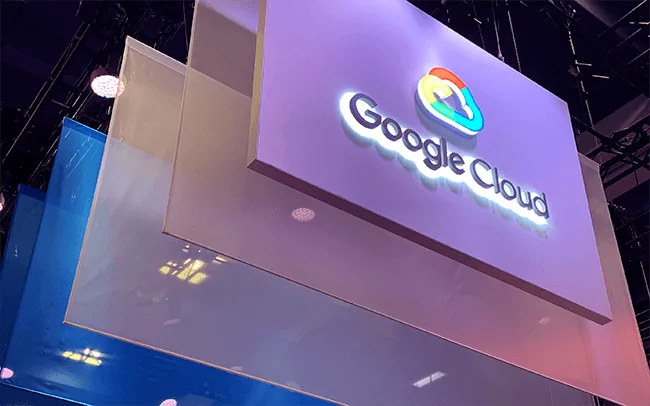
Alphabet reported third-quarter 2026 revenue of $127.6 billion, up 25% year over year. Google Cloud revenue increased 103% to $30.7 billion, supported by enterprise AI infrastructure, AI solutions, core cloud services and TPU system sales. Consolidated operating income increased 30% to $40.6 billion, representing a 31.8% operating margin.
Alphabet Q3 Revenue Surges 25% to $127.6 Billion as Google Cloud Doubles
Google Cloud operating income reached $11.1 billion, compared with $3.6 billion a year earlier, for a 36.2% segment operating margin. Google Services generated $96.3 billion in revenue, up 11%, including $63.4 billion from Search and other services. First-party Gemini model APIs processed nearly 32 billion tokens per minute, more than four times the year-earlier level. The Gemini app reached one billion users.
• Alphabet revenue: $127.6 billion, +25% YoY.
• Google Cloud revenue: $30.7 billion, +103%.
• Google Cloud operating income: $11.1 billion.
• Google Services revenue: $96.3 billion, +11%.
• Consolidated operating income: $40.6 billion, +30%.
• Net income: $26.2 billion, down from $35.0 billion; diluted EPS: $2.12 versus $2.87.
• Other income and expense swung from a $12.8 billion gain to an $8.2 billion expense.
Despite reporting 25% year-over-year revenue growth, Alphabet’s third-quarter results fell short of Wall Street expectations. Revenue of $127.6 billion was slightly below analysts’ consensus estimate of approximately $128 billion, while diluted earnings per share of $2.12 missed expectations of approximately $3.02. The earnings shortfall was driven primarily by an $8.2 billion net non-operating expense, including unrealized investment losses, rather than weakness in the company’s core operations. Investors also weighed Alphabet’s $51.4 billion in quarterly capital expenditures, negative free cash flow of $9.1 billion, and plans to increase infrastructure spending significantly in 2027. The results highlight the tension between rapidly expanding AI infrastructure demand and the substantial capital requirements needed to support that growth.
Investor Call Addendum: CapEx, Cloud Backlog and TPU Expansion
On the October 28 investor call, CEO Sundar Pichai, Google Cloud CEO Thomas Kurian and CFO Anat Ashkenazi provided additional details about infrastructure investment, contracted demand, system distribution and capacity constraints. The following points extend the initial earnings announcement.
| INVESTOR CALL | AI INFRASTRUCTURE TAKEAWAYS | |
| 1. CapEx $195B–$205B | • 2026 guidance unchanged; Q3 CapEx $51.4B; significant increase expected in 2027. |
| 2. Infrastructure mix 65% / 35% | • Technical infrastructure investment split between servers/networking and data centers. |
| 3. Cloud backlog $561B | • Just over 55% expected to convert to revenue within 24 months. |
| 4. Commitments $924B | • Future purchase commitments; separately $152B in pre-commencement leases and other obligations; maximum contractual amounts, some flexible. |
| 5. TPU 8t / 8i 2.7× / +80% | • Claimed training performance and inference price-performance improvements versus prior TPU generation. |
| 6. TPU distribution Oracle / Crux AI | • Complete TPU systems incorporating compute, storage, optical networking and software expanding to customer and third-party facilities. |
| 7. Software TorchTPU | • PyTorch portability developed with Meta. |
| 8. Capacity Third-party compute | • Usage ramps in Q4; expected near-term Cloud margin headwinds. |
| 9. Free cash flow -$9.1B | • Q3 free cash flow reflects CapEx, contracted TPU inventory buildup and $5.2B EC fine payment. |
| 10. Enterprise AI >100M seats | • Knowledge-work AI seats sold across services; nearly 90% of Fortune 100 use Gemini Enterprise. |
| 11. Agent infrastructure Agent Compute Engine | • Secure runtimes, persistent availability, connectors and model efficiency support agentic workloads. |
Infrastructure Economics and TPU Business Model
Alphabet distinguished between building cloud capacity for its own operations and selling TPU systems to outside customers. Management said TPU system inventory is procured against signed contracts; cash outflows occur as inventory is built, followed by revenue recognition and customer receipts upon delivery and billing. TPU system sales are expected to ramp meaningfully in 2027. Product-specific TPU revenue and margins were not disclosed.
Kurian said external TPU deployments can bring AI compute to customer premises where data cannot move to the cloud and can reduce Google’s need to build facilities for those systems. Google also cited customers and ecosystem participants including Anthropic, Apple, Citadel Securities, Jump Trading, Caltech and Physical Intelligence.
One of the most significant disclosures was Alphabet’s distinction between building infrastructure for its own cloud services and manufacturing TPU systems for external customers.
CFO Anat Ashkenazi explained that TPU system sales create a different cash flow cycle from traditional hyperscaler infrastructure investment. Alphabet purchases components and builds inventory against signed customer contracts, then recognizes revenue as systems are delivered and billed.
Kurian added that installing TPU systems in customer data centers or third-party facilities can reduce the need for Google to construct its own facilities to support those deployments.
The distinction matters as Alphabet expands its custom accelerator business. TPU system sales can generate hardware revenue without requiring Alphabet to own every facility in which the systems operate. However, management did not disclose standalone TPU revenue, margins, or system pricing.
Google also described a broader customer ecosystem for its accelerators, including Anthropic, Apple, Citadel Securities, Jump Trading, Caltech, Physical Intelligence, and other AI developers and infrastructure providers.
Analysis: Compute Supply Remains the Constraint
Servers and networking equipment account for the largest portion of Alphabet’s technical infrastructure investment, although management did not separately quantify networking spending. Expanded TPU distribution positions Google as both a cloud operator and a supplier of complete AI computing systems. Third-party compute capacity will help address demand but is expected to pressure near-term cloud margins. The backlog and spending guidance indicate a sustained infrastructure buildout, while the disclosed contractual commitments should not be treated as guaranteed expenditures.
Google Cloud contributed approximately 24% of consolidated revenue, up from approximately 15% a year earlier. Its $7.5 billion year-over-year operating income increase represented most of Alphabet’s $9.3 billion consolidated operating income growth. Demand for AI inference, cloud services and TPU systems is increasing the importance of custom accelerators, memory, networking and data center capacity.
The investor call reinforced the scale of Alphabet’s infrastructure expansion and the financial implications of serving AI workloads.
Three developments are particularly important for the networking and data center infrastructure sectors.
First, networking remains a substantial component of Alphabet’s investment cycle. Servers and networking equipment together accounted for approximately 65% of Q3 technical infrastructure investment. Alphabet did not provide a separate networking expenditure figure, but its disclosure confirms that networking is included in the largest infrastructure investment category.
Second, TPU distribution is evolving beyond the traditional hyperscaler model. By supplying complete accelerator systems incorporating optical networking and software to customers and third-party operators, Google is expanding its role as an AI infrastructure technology supplier.
Third, AI demand continues to exceed immediately available compute capacity. Alphabet’s decision to supplement its infrastructure with third-party compute demonstrates the operational and financial consequences of capacity constraints. Management expects additional spending in 2027, while acknowledging near-term margin pressure and higher depreciation and energy costs.
The combination of a $561 billion Cloud backlog, a $195 billion to $205 billion annual CapEx plan, and expanded external TPU distribution provides a clearer picture of Google’s infrastructure strategy: scale its own cloud capacity while developing TPU systems into a broader commercial computing platform.
Company Profile — Alphabet
| Alphabet Inc. | Company Profile | |
| Headquarters | Mountain View, California |
| CEO | Sundar Pichai |
| Listing | NASDAQ: GOOG, GOOGL |
| Businesses | Google Services, Google Cloud, Other Bets |
| AI Infrastructure | Google Cloud Platform, TPU accelerators, Gemini models |
| Q3 2026 Revenue | $127.6 billion (+25%) |
| Google Cloud | $30.7 billion (+103%) |
Source: Alphabet Q3 2026 earnings release and October 28, 2026 investor call transcript supplied for editorial review.

-
 C114 Communication Network
-
 Communication Home
