
 Search


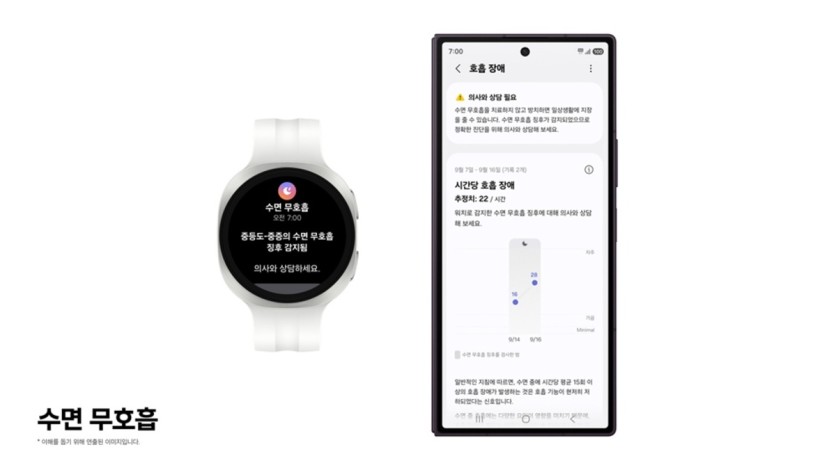
Support Samsung Electronics to improve sleep apnea capabilities using the Galaxy Watch to more systematically manage sleep health. Samsung.com
Samsung Electronics announced Wednesday that South Korea's Ministry of Food and Drug Safety (MFDS) has granted clearance for Sleep Apnea Feature v2.0, making the Galaxy Ring the first smart ring to hold Korean regulatory authorization for obstructive sleep apnea risk detection. The clearance, which extends to the full Galaxy Watch lineup as well, arrives via a software update — no new hardware purchase required for existing owners of a compatible Galaxy Watch or the original Galaxy Ring.
The MFDS determination aligns Korea with its 510(k) submission K261011 Samsung received on July 20, and it rests on a technical upgrade that changes the underlying detection architecture: where the first version of the feature measured blood oxygen saturation alone, v2.0 combines photoplethysmography (PPG) signals with actigraphy — accelerometer-recorded body motion — in a multimodal approach that is both more accurate and, critically, compatible with the Galaxy Ring's sensor set for the first time.
From SpO2 to Sensor Fusion: Why v2.0 Is a Different Algorithm
Samsung's original sleep apnea feature, which received first MFDS clearance in October 2023, operated on a single physiological channel: SpO2, the percentage of oxygen saturation in red blood cells, measured by the Galaxy Watch's dedicated BioActive Sensor. The limitation is structural. SpO2 can signal the oxygen desaturation that accompanies an apneic episode, but it is also sensitive to movement artifacts — a rolling sleeper, a shifting arm position, or sensor displacement will register as signal noise indistinguishable from a genuine respiratory event.
Version 2.0 replaces that single-channel approach with a fusion architecture. The PPG sensor reads changes in blood volume at the skin surface by emitting light and measuring how much returns; the three-axis accelerometer tracks body movement at the same time. The algorithm uses the motion data to contextualize every PPG event: a blood-oxygen fluctuation that coincides with body movement is motion noise; one that occurs during a period of relative stillness is a candidate respiratory event. Layering motion data onto the optical signal is what allows the algorithm to distinguish the signature of an obstructed airway from the signature of someone changing positions.
That fusion architecture also explains why the Galaxy Ring could not participate in the original clearance but can now. The Ring lacks the BioActive Sensor that the Galaxy Watch uses for SpO2 measurement, so it could never generate a v1.0-compatible input. The Ring does carry optical PPG sensors on its inner surface and a built-in accelerometer — exactly the two inputs v2.0 requires. The algorithm revision was, in that sense, also a hardware-independence decision.
There is an additional physical rationale for the Ring's participation that goes beyond mere compatibility. Published research on wearable sensor accuracy has consistently found that finger-based PPG sensors produce higher signal fidelity than wrist-based sensors: the finger has thinner skin, denser capillaries, and stronger blood perfusion at the surface, all of which improve the signal-to-noise ratio of the optical measurement. Samsung's rings place their sensors against the inner surface of the finger, which is the anatomically favorable site. In the v2.0 architecture, the Galaxy Ring is not simply a second-tier participant alongside the Galaxy Watch — it may be the superior PPG input.
How Does Wearable Sleep Apnea Detection Actually Work?
To generate a result, a user must wear their device for at least four hours on each of two separate nights within a ten-day window. The multi-night requirement is not arbitrary caution: obstructive sleep apnea varies in severity across nights depending on sleep position, alcohol consumption, and sleep stage distribution, so a single-night snapshot is an unreliable basis for a risk classification.
The algorithm processes the accumulated PPG and actigraphy data to estimate the number of significant breathing disruptions per hour, producing a metric functionally analogous to the apnea-hypopnea index (AHI) used in formal clinical sleep studies. In accredited sleep labs, AHI is derived from polysomnography — a multi-sensor overnight study measuring airflow, oxygen saturation, brain activity, and muscle tone simultaneously. Consumer wearables cannot replicate that sensor array; what they can do is identify a risk signal consistent with moderate-to-severe OSA by AASM criteria (clinically defined as AHI of 15 or more events per hour) and prompt the user toward a clinical evaluation.
The feature outputs a binary classification — "No signs detected" or "Signs detected" — through the Samsung Health Monitor app on a paired Galaxy smartphone. It is explicitly positioned as a screening tool, not a diagnostic one: a positive reading is a reason to call a doctor, not a substitute for the doctor. Users must be at least 22 years old and must not have a prior OSA diagnosis to activate the feature.
Compatible Galaxy Watch models include the Galaxy Watch 4 series and later, the Galaxy Watch Ultra and Ultra 2, and the Galaxy Watch 9 series announced at Unpacked in July.
Three Years of Regulatory Groundwork — and What Samsung Built Along the Way
Wednesday's MFDS clearance is the most recent milestone in a deliberate multi-jurisdiction regulatory strategy that Samsung began executing in 2023.
The Sleep Apnea Feature made its Korean regulatory debut in October 2023, becoming the first consumer wearable to hold MFDS authorization for this function. That clearance applied only to the Galaxy Watch and only to the SpO2-based v1.0 algorithm. Four months later, the US FDA granted De Novo authorization DEN230041 in February 2024, making the Galaxy Watch the first consumer wearable cleared by that agency for obstructive sleep apnea risk assessment. The feature reached 34 European markets under CE Marking certification in June 2025, and by April 2025, Samsung had partnered with Stanford Medicine on a clinical research collaboration aimed at pushing the technology from periodic screening toward daily management.
The v2.0 algorithm followed a different regulatory sequencing. Samsung's v1.0 was required to use the FDA De Novo pathway because no cleared predicate device existed — consumer wearable sleep apnea screening was a new device category, and De Novo is the correct FDA pathway for novel low-to-moderate risk devices. By obtaining that clearance, Samsung did something consequential beyond its own product line: it established product code QZW, the regulatory category for "software only devices for assessment of obstructive sleep apnea risk." When Samsung submitted v2.0 for review, it could cite its own cleared v1.0 devices as the predicate and use the faster 510(k) submission K261011 pathway. The FDA cleared that submission on July 20, 2026. The same regulatory logic applies to any future competitor seeking to enter the category — they can now pursue 510(k) clearance using Samsung's cleared devices as a predicate, a process that is substantially less burdensome than Samsung's original De Novo application. Samsung's three-year regulatory investment has, inadvertently, lowered the barrier for everyone who follows.
936 Million Reasons the Screening Gap Matters
Consumer sleep apnea screening exists because the clinical pipeline is badly backlogged at its intake point. An estimated 936 million adults between the ages of 30 and 69 worldwide are affected by obstructive sleep apnea, with roughly 425 million in the moderate-to-severe range where the health consequences — hypertension, cardiac arrhythmia, stroke, and daytime cognitive impairment — compound over time without intervention, according to Lancet 2019 OSA prevalence research. AASM data confirm over 80 percent of moderate-to-severe cases remain undiagnosed and untreated, in large part because the primary cardinal symptom — disruptive snoring — is typically reported by a bed partner and frequently dismissed as non-medical, and because formal diagnosis requires a referral, a polysomnography study, and in many healthcare systems, a substantial waiting period.
Consumer screening tools don't remove any of those obstacles. What they do, when validated against clinical reference standards and cleared by regulators, is shift the detection signal upstream: a risk reading on a device the user is already wearing prompts a conversation with a physician that might otherwise never happen. Samsung's collaboration with Stanford Medicine faculty Robson Capasso and Clete Kushida is specifically designed to explore whether this upstream detection can go further still — from periodic screening to continuous daily monitoring and, eventually, to evidence-based management support for patients already diagnosed and on CPAP therapy.
No Other Smart Ring Holds This Clearance — and the Watch Competition Has a Different Gap
The MFDS clearance has a sharply defined competitive implication in the South Korean market. Samsung's Galaxy Watch and Galaxy Ring now enter Korean stores this autumn carrying a health credential that no competing smart ring — from Oura, RingConn, or any other manufacturer — currently holds for obstructive sleep apnea risk assessment, in Korea or anywhere.
The Oura Ring 5 tracks blood oxygen saturation and breathing variations during sleep and markets these metrics as indicators of potential sleep disturbances, but it does not carry MFDS or FDA clearance specifically for obstructive sleep apnea risk detection. RingConn's Gen 2 includes a feature labeled "sleep apnea monitoring" without published regulatory authorization. The distinction matters to consumers: a cleared feature has been evaluated against a clinical reference standard and found to perform within regulatorily defined accuracy bounds; an uncleared feature has not.
In the smartwatch segment, Apple's Apple Watch received FDA clearance for sleep apnea detection notification in September 2024, relying on an accelerometer-based breathing disturbance analysis called Breathing Disturbances measurement that detects wrist-motion patterns associated with apnea events — a different sensor modality from Samsung's PPG + actigraphy approach. As of this article, Apple has not announced MFDS clearance for the Korean market. Samsung therefore holds the clearance it sought in the Korean watch segment as well.
The practical result is that Galaxy Ring users and Galaxy Watch owners in Korea have access to a clinical-grade screening tool that, after a software update, will appear in Samsung Health Monitor at no additional cost.
What Korean Owners Can Expect — and When
Samsung has not announced a specific date for the software rollout in Korea beyond confirming that it follows MFDS clearance. Based on the timeline established by v1.0 — where the app update reached Korean Galaxy Watch owners roughly a quarter after the initial MFDS clearance — the feature may be live in Korea before the end of 2026.
For owners of compatible Galaxy Watch devices (Series 4 and later, Ultra, Ultra 2, and the Galaxy Watch 9 lineup) or the original Galaxy Ring, no hardware action is required. The upgrade will arrive via Samsung Health Monitor app update once Samsung initiates the rollout. Users who have already been using the v1.0 sleep apnea feature on their Galaxy Watch will receive the algorithmic upgrade in the same update.
For users outside Korea tracking the regulatory trajectory: the v2.0 algorithm now holds clearances in both the United States (FDA 510(k) K261011, July 2026) and South Korea (MFDS, October 2026). Whether Samsung will pursue CE Marking expansion for the v2.0 algorithm in Europe and further regional authorizations — following the expansion playbook Samsung used for v1.0 — has not been announced. The pattern established across the first version of the feature suggests that possibility is on Samsung's roadmap.
Frequently Asked Questions
Does the Galaxy Ring's sleep apnea feature work differently from the Galaxy Watch's?
The feature uses the same v2.0 algorithm on both devices, but the sensor input differs slightly. Galaxy Watch models leverage the BioActive Sensor for a broader physiological data stream; the Galaxy Ring relies on its inner-finger optical PPG sensors and accelerometer. Because finger-based PPG sensors have higher optical contact quality and better vascular access than wrist-based sensors, the Ring's sensor placement may offer signal-quality advantages for some users — though both devices meet the accuracy standard required for MFDS and FDA clearance.
What's the difference between what Samsung's feature does and what a sleep clinic does?
A sleep clinic conducts polysomnography (PSG) — a monitored overnight study that simultaneously measures airflow through the nose and mouth, blood oxygen saturation, brain electrical activity, heart rate, and limb muscle movement across all sleep stages. PSG is the definitive diagnostic standard for obstructive sleep apnea. Samsung's feature is a screening tool: it estimates the risk of moderate-to-severe OSA from PPG and motion data alone, outputs a binary result, and prompts users to seek clinical evaluation if signs are detected. A positive Samsung result should lead to a physician consultation and, if warranted, a PSG — not skip that step.
Why did Samsung need separate FDA and MFDS clearances if they use the same algorithm?
Each regulatory jurisdiction independently evaluates whether a medical software product meets its own standards. Samsung's v2.0 algorithm received FDA 510(k) clearance in the US in July 2026 and now MFDS clearance in Korea in October 2026. The fact that both regulators cleared the same algorithm provides independent validation from two separate national authorities — but neither clearance is automatically recognized by the other. The same will apply to any future CE Marking expansion in Europe.
Is there a cost for existing Galaxy Ring or Galaxy Watch users to get this feature?
No. The sleep apnea feature arrives as a software update to the Samsung Health Monitor app on a paired Galaxy smartphone. Owners of compatible devices — Galaxy Watch 4 and later, Galaxy Watch Ultra and Ultra 2, Galaxy Watch 9 series, and the original Galaxy Ring — do not need to purchase new hardware to access the feature once the Korean rollout begins.

-
 C114 Communication Network
-
 Communication Home
