
 Search

Lavamobiles.com
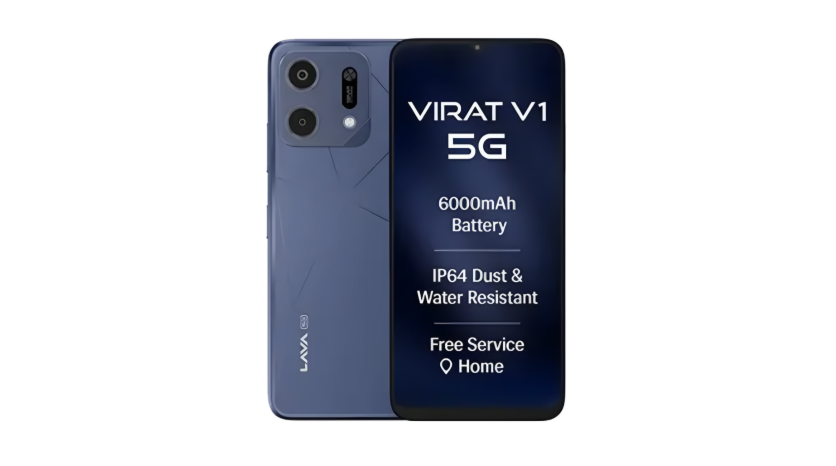
Lava International has launched its new Virat smartphone series in India, pitching something unusual for the sub-₹13,000 (approximately $135 USD) bracket: a 5G handset running full Android 16 — not the stripped-down Go edition — with no preinstalled ads and no bundled bloatware, priced at ₹11,999 (approximately $124 USD, exchange rate as of July 24, 2026; conversions are approximate) at launch. Both phones in the lineup, the Virat V1 5G and the Virat V1, go on sale exclusively through Flipkart and Lava's own website on July 31 at 12 p.m. IST (2:30 a.m. ET). The launch itself happened today, July 24; the purchase window opens one week from now.
The series debuted without the launch-day discounts expiring — Lava is holding the introductory price of ₹11,999 ($124 USD) for the 5G model and ₹8,999 (approximately $93 USD) for the 4G variant through the first sale. Standard retail prices after launch are ₹12,999 (approximately $135 USD) and ₹9,999 (approximately $104 USD) respectively. The Virat series is Lava's first major product line built specifically for online retail, developed in partnership with Flipkart, making this the Noida-based manufacturer's clearest bid yet to compete with Chinese brands in the e-commerce arena where most of India's budget smartphone sales now happen.
The reason a budget phone doesn't come with bloatware-free software is not a software problem — it is a revenue problem. Budget-segment manufacturers, particularly Chinese brands such as Xiaomi, Realme, and Transsion's stable of Indian-market labels (Tecno, Infinix, itel), partially offset hardware costs by signing deals to preinstall third-party apps, ad-serving software, and proprietary app stores. India's IT Ministry proposed mandating the removal of such preinstalled apps in 2023, citing national security concerns about Chinese brand dominance, though that regulation was disputed and never enacted. Lava's willingness to forgo that revenue stream is the structural underpinning of its clean-software pitch — and it comes at a cost.
Lava's FY 2023–24 net income was approximately ₹11.59 crore (roughly $12 million USD) on revenue of ₹3,667 crore (approximately $380 million USD), a net margin of around 0.3%. That is exceptionally thin by any measure. The company's decision to build a "zero bloatware" brand identity is not free: it trades revenue from preinstalled apps for brand equity and, the company is betting, consumer loyalty and volume growth.
How Lava Affords Clean Software at This Price Point
On the hardware side, the key cost tradeoff in the Virat V1 5G is the display. The phone's UNISOC T8200 chipset — manufactured on TSMC's 6nm process, the same fabrication node used in Qualcomm's Snapdragon 695 — is capable of driving a Full HD+ display at 120Hz. Lava uses only an HD+ panel in the Virat V1 5G. That display step-down is likely where Lava recovers the margin lost by dropping preinstalled app revenue. A comparable Chinese-brand phone with FHD+ display and an equivalent chipset would normally retail above ₹15,000 ($155 USD). The HD+ tradeoff brings it to ₹11,999.
What the T8200 Actually Is
The UNISOC T8200 is a mid-range 5G system-on-chip with an octa-core CPU configuration: two ARM Cortex-A76 performance cores running at 2.3GHz and six ARM Cortex-A55 efficiency cores at 2.1GHz, paired with an ARM Mali-G57 MC2 GPU. It supports 5G Dual Carrier Aggregation with 130MHz bandwidth, covers SA and NSA networking modes, and includes Bluetooth 5.4. The 6nm TSMC process means the chip is modern enough to handle 4K video recording and 120Hz display refresh at its supported resolution; it also handles virtual dual-SIM 5G+5G standby.
For context: the T8200 sits in UNISOC's 8-series, which the company describes as focused on "performance leadership" — one tier below its T9-series flagship chips. That positioning matters because it puts the Virat V1 5G's chipset meaningfully above the sub-₹10,000 category, where Qualcomm Snapdragon 4s Gen 2 and MediaTek Helio G88 alternatives typically appear.
One constraint worth naming: Lava's Virat V1 5G pairs this capable chip with a 13MP primary camera rather than the 50MP sensors now common in rival budget phones. The T8200 supports cameras up to 108MP; the device uses only 13MP. That is another hardware tradeoff the spec sheet makes but the marketing language does not highlight.
The 4G Model Is a Fundamentally Different Phone
The Virat V1 (4G) shares the Virat V1 5G's 6.75-inch HD+ display and physical design but diverges at the silicon and software layer in ways that matter more than the connectivity tier difference.
The 4G model runs a UNISOC SC9863A — an eight-core processor first released in November 2018, built on a 28nm process node. That is not 2026-era chip performance; it is six years of manufacturing-process generations behind the T8200. The SC9863A's eight ARM Cortex-A55 cores (four at 1.6GHz, four at 1.2GHz) achieve an AnTuTu benchmark score of approximately 118,000 — roughly half what mid-range 2026 devices score at launch. Users who have run full Android (not Go edition) on SC9863A devices have documented heat and responsiveness issues under load.
This is why the 4G model ships with Android 15 Go rather than full Android 15. Android Go is not merely a lighter version of Android — it is a structurally different OS configuration. Its recent-apps menu is limited to four apps to reduce RAM consumption. Split-screen and picture-in-picture modes are disabled. Full-featured Google apps are replaced with Go editions (Gmail Go, Maps Go, YouTube Go). For a buyer who understands this distinction, the choice between the Virat V1 5G at ₹11,999 ($124 USD) and the Virat V1 at ₹8,999 ($93 USD) is not primarily a 5G vs. 4G decision — it is a decision about which tier of Android experience they are purchasing.
The Virat V1 5G's combination of a modern 6nm chip with full Android 16 is the more significant differentiator.
Virtual RAM: Marketing Arithmetic vs. Real Performance
Both Virat models advertise "4GB RAM expandable to 8GB via virtual RAM." Virtual RAM is a software feature that designates a portion of the device's internal flash storage as a swap area; when the physical 4GB of LPDDR4X RAM fills up, the operating system compresses data from RAM and moves it to this designated storage zone to free space for active apps. The result is that more apps can remain in the background without fully closing.
The performance of virtual RAM is not equivalent to physical RAM of the same size. Flash storage operates at significantly lower speeds than LPDDR4X, which means swap operations — reading back from the storage partition to RAM — introduce latency that physical RAM does not. "8GB RAM" as a marketing claim overstates what buyers receive. A more accurate description is "4GB physical RAM with background-app overflow storage." This caveat applies equally to Chinese-brand phones that use the same technique, but it is worth understanding before purchase.
Is Lava's Bloatware-Free Claim Verifiable?
At the time of launch, no independent security audit of the Virat V1 software build has been published. Lava's claim of zero preinstalled ads and bloatware rests on the company's own assurances and on its broader "clean Android" brand positioning — evident across recent releases including the Agni series. The Virat V1 5G does ship with standard Google apps (Gmail, YouTube, Maps, Google Assistant, Chrome), which are bundled by Google's Android licensing terms and are not Lava-added bloatware, but which some users categorize as unwanted preinstalls. Whether the device installs any third-party sponsored applications or ad-serving SDKs embedded in firmware will become clearer once independent reviews and teardowns are published after July 31 availability.
A brief note on the chipset supplier: UNISOC is headquartered in Shanghai, China, and is a subsidiary of Tsinghua Unigroup. No backdoor or surveillance capabilities have been documented for the T8200 or SC9863A in independent security research, and Lava — as the device manufacturer — controls the software layer above the chipset.
Lava's Flipkart Bet and the Scale of Its Ambition
The Virat series is Lava's first product line built specifically for online retail rather than adapted from an offline-first lineup. Lava has operated for 17 years primarily through physical retail — its own count puts its offline network at over 1.65 lakh (165,000) retail outlets and 1,000-plus distributors. The company reported a 74% jump in online sales volumes in 2025, and the Virat-Flipkart partnership is its direct response to that growth signal.
Sunil Raina, Managing Director of Lava International, said the company aims to reach a wider audience with products "thoughtfully designed for India and built to deliver uncompromising quality and reliability." Flipkart's Vice President of Mobiles, Kanchan Mishra, cited the platform's "Open Box Delivery" feature — which lets buyers inspect packaging on delivery before accepting — as a trust factor paired with Lava's doorstep repair service to give buyers confidence regardless of geography.
In Q2 2025, Counterpoint Research identified Lava as the fastest-growing smartphone brand in India's sub-₹10,000 segment, with 156% year-on-year volume growth. In the full smartphone market, Lava posted 63% year-on-year growth for its smartphone portfolio across 2025, alongside a 25% market share in India's feature phone segment, where it ranks third globally.
Does Lava Have the Brand to Win This Fight?
The company has publicly stated a goal of exceeding 10% market share in India's sub-₹30,000 (approximately $311 USD) smartphone segment within two years. That would represent a substantial climb from its current estimated position outside the top-five, in a market where the five leading brands — vivo, Xiaomi, Samsung, Oppo/OnePlus, and Realme — collectively held about 75% market share in 2024, based on Canalys full-year data. The GSMArena community's immediate reaction to the Virat V1 5G spec sheet captured the challenge in one sentence: "it feels like we are going back to the old days" — a reference to the HD+ display and 4GB physical RAM in a segment where Chinese competitors routinely offer AMOLED and FHD+ at similar prices.
Lava's counter-argument is differentiation through software integrity and after-sales service. Free Service@Home — the company's doorstep repair program — is a meaningful support advantage in Tier 2 and Tier 3 Indian markets where authorized service centers are sparse. And the commitment to full Android 16 rather than a Go edition or a heavily skinned Android skin is a genuine differentiator in the sub-₹12,000 bracket.
Whether India's Flipkart-browsing budget buyer finds that story compelling enough to choose Lava over a Xiaomi Redmi or Realme device with comparable specs but Chinese-brand recognition will be answered when the July 31 sale opens. The clean-software bet is unconventional. Whether it pays off is an open question.
Frequently Asked Questions
What is the difference between the Lava Virat V1 5G and the Lava Virat V1?
The gap is wider than 5G vs. 4G connectivity. The Virat V1 5G uses a UNISOC T8200 chipset built on a modern 6nm process and ships with full Android 16. The Virat V1 4G uses a UNISOC SC9863A — a 2018-era chip built on a 28nm process — and ships with Android 15 Go, a stripped-down OS variant that limits background apps and disables features like split-screen. The 5G model is a meaningful generational step above the 4G model, not just a connectivity upgrade. The ₹3,000 (approximately $31 USD) price difference between their launch prices reflects that gap.
Does the Lava Virat V1 5G really have no bloatware?
Lava's claim is that both Virat phones ship without preinstalled third-party apps or ad-serving software — a practice common in this price range, where manufacturers typically earn revenue by bundling sponsored apps. The phones do include standard Google apps, which come with Android licensing and are separate from manufacturer-added bloatware. Lava has not, as of launch day, had its software build independently audited by a third party. Whether the firmware is genuinely clean will become clearer once independent teardowns are published after the July 31 sale.
Is a UNISOC chipset a good choice in a budget Android phone?
UNISOC is a Shanghai-based Chinese semiconductor company whose chips appear in budget and entry-level devices globally. The T8200 in the Virat V1 5G is a capable 6nm mid-range processor with a modern CPU architecture (ARM Cortex-A76 performance cores), putting it well above entry-level territory. The SC9863A in the Virat V1 4G is a 2018-era 28nm chip, which is less capable and runs warmer — but is an appropriate match for the Android 15 Go operating system that ships with it. No independent security vulnerabilities or surveillance capabilities have been documented for either chipset.
When and where can I buy the Lava Virat V1 5G?
Both models go on sale on July 31 at noon IST (2:30 a.m. ET) exclusively through Flipkart and Lava's official website at lavamobiles.com. The launch-day prices are ₹11,999 (approximately $124 USD) for the Virat V1 5G and ₹8,999 (approximately $93 USD) for the Virat V1 4G. Standard prices after launch are ₹12,999 ($135 USD) and ₹9,999 ($104 USD). Both phones are backed by Lava's Free Service@Home doorstep repair program.
Note: All ₹/USD conversions calculated at 1 USD = 96.54 INR (mid-market rate, July 24, 2026). Conversions are approximate.

-
 C114 Communication Network
 -
 Communication Home
