
 Search

Godox.com
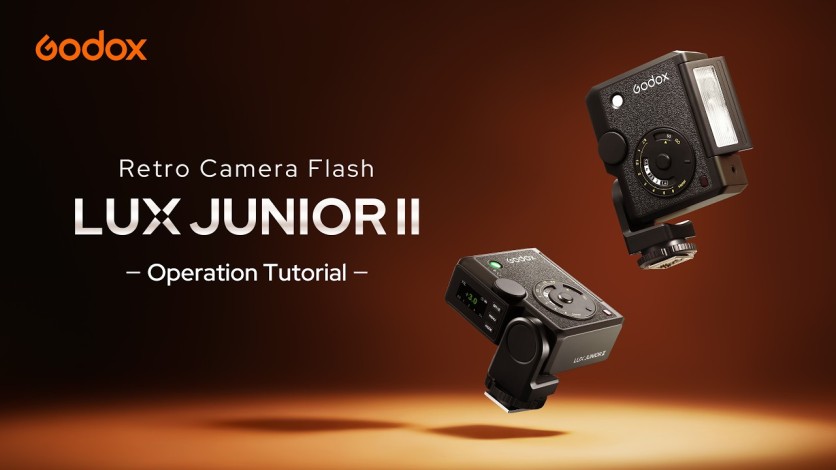
Godox has announced the Lux Junior II, a comprehensive redesign of its retro-styled compact flash that directly addresses all four criticisms reviewers most consistently leveled at the original: no bounce capability, no TTL metering, slow recycle time, and no wireless support. The new flash launches today at $79 — the same price as the Lux Junior II S variant for Sony — and opens for pre-order immediately at B&H Photo, Amazon, and Adorama.
The single most significant engineering change is the dual-axis bounce mechanism, which solves a problem that every other compact flash in the Godox Lux retro lineup — including the more expensive Lux Master — still leaves partially unresolved.
Dual-Axis Bounce Solves the Portrait Photographer Problem
Bounce flash — the technique of directing a flash toward a ceiling or wall so that light reaches the subject softly and indirectly — requires the flash head to move. On a standard single-axis tilt head, the head tilts vertically, which works fine when the camera is in landscape (horizontal) orientation. The moment a street or documentary photographer rotates the camera 90 degrees to shoot in portrait orientation, a tilt-only head becomes useless for bounce.
The Lux Junior II addresses this with a two-axis system: the flash body rotates up to 180 degrees horizontally, while the flash head tilts up to 90 degrees vertically with multiple locking positions. The combination means photographers can bounce light into a ceiling regardless of whether the camera is oriented horizontally or vertically — a capability the original Lux Junior (fixed flash head) lacked entirely and that the Lux Master's tilt-only head only partly addresses.
For street and documentary photographers, who routinely alternate between landscape and portrait frames, this is not a cosmetic upgrade. It changes what the flash can actually do in the field.
What TTL Actually Means for Your Workflow
The Lux Junior II is the first Godox retro compact flash to support full TTL (through-the-lens) automatic metering. Understanding what this changes requires a brief explanation of the technology.
Modern digital TTL flash metering works by firing a low-power pre-flash — a measurement burst invisible to the naked eye — 10 to 150 milliseconds before the main exposure. The camera's metering sensors measure the pre-flash light reflected from the subject through the lens. The camera's processor calculates how much additional output the main flash needs to achieve correct exposure, then sends that instruction back to the flash via the hot shoe's electrical contacts before the shutter opens. The entire exchange happens before the shutter blade moves.
The practical result: a photographer pointing the Lux Junior II at a fast-moving subject in variable light does not need to manually recalculate guide number relationships (the formula GN = distance × f-number at a given ISO) between each shot. The camera handles that calculation automatically. The Lux Junior II implements this via the camera-system-specific protocols — Canon E-TTL, Nikon i-TTL, Fujifilm TTL — through a multi-pin hybrid hot shoe.
Manual power control from full output down to 1/128, multi-flash stroboscopic mode, and flash exposure compensation from -3 to +3 EV are also included.
Why High-Speed Sync Matters Here, and Its Hidden Power Cost
High-speed sync (HSS) allows the Lux Junior II to fire at shutter speeds up to 1/8,000 of a second — far above the 1/200s to 1/250s sync limit of a typical focal plane shutter.
The physics behind HSS involves a trade-off that buyers should understand. A standard flash fires a single burst that lasts roughly 1/1,000 to 1/30,000 of a second — fast enough to expose the entire sensor in one pulse when the shutter is fully open. At shutter speeds above the sync limit, the focal plane shutter's second curtain begins closing before the first curtain has finished opening. A single burst would leave a dark band on the image. HSS works around this by converting the flash into rapid pulses, creating a continuous wash of light as the curtain slit scans across the sensor.
The trade-off: effective flash output drops significantly at high shutter speeds. At 1/8,000s, the subject receives only a fraction of the energy it would receive at 1/250s. Photographers using HSS for outdoor fill flash typically need to move closer to their subject or accept reduced fill intensity. This is a physical constraint of HSS itself — not a Lux Junior II limitation — but it matters more on a compact flash with a modest guide number than on a higher-powered speedlight.
The Lux Junior II also adds front and rear curtain synchronization and flash durations from 1/1,000 to 1/30,000 of a second.
Battery Architecture: What the Move to Lithium-Ion Really Changes
The original Lux Junior ran on two AAA batteries, which kept the flash universally simple but imposed a roughly five-second recycle time at full power — a meaningful constraint for documentary and event work.
The Lux Junior II replaces the disposable system with an integrated 7.4-volt, 700 mAh lithium-ion cell charged via USB-C. Godox rates the battery for up to 400 full-power flashes per charge with recycle times as fast as 1.5 seconds. That is a more than threefold reduction in recycle time — the difference between shooting at a deliberate pace and being able to shoot at the rate events actually happen.
The trade-off is that the battery is integrated, not user-replaceable. On an overnight shoot where charging access is limited, the original's AAA battery convenience disappears. Godox does not publish a rated number of charge cycles, which means the long-term battery degradation curve is unknown until independent testing establishes it.
Wireless Receiver: What It Includes and What It Does Not
The Lux Junior II includes a built-in 2.4 GHz receiver compatible with Godox's established X wireless ecosystem, allowing the flash to be fired remotely from a Godox transmitter.
A critical specification: the flash functions as a receiver only. It cannot transmit to, or control, other Godox flashes. Photographers who want to integrate the Lux Junior II into a multi-light setup must own a separate Godox X wireless trigger — such as the X2T, XPro II, or X3. These transmitters typically retail from roughly $50 to $90, meaning the effective entry cost for wireless use is $130 to $170, not $79.
This is not unusual for a receiver-only flash at this price point, but it is information a buyer needs before assuming the $79 purchase covers a complete wireless workflow.
Sony Variant and What Global Shutter Support Means
Godox is releasing the Lux Junior II in two configurations. The standard model carries a hybrid hot shoe supporting Canon, Nikon, Fujifilm, OM System, and Panasonic TTL protocols. The Lux Junior II S is a Sony-specific version that adds Sony TTL protocol support and dedicated global shutter synchronization on compatible Sony bodies.
Sony cameras with global electronic shutters — sensors that expose all pixels simultaneously rather than scanning from top to bottom — do not have the curtain-slit synchronization constraint that requires HSS on focal plane shutter cameras. The Lux Junior II S provides a direct sync mode for these bodies, allowing standard flash output at high shutter speeds without the power loss that HSS introduces.
Both variants are priced at $79. Each ships with a USB-C charging cable and a set of magnetic color accessories: a full orange filter, a half orange filter, and a magnetic diffuser.
Where Godox Makes the Flash, and What That Means for Your Data
Godox Photo Equipment Co., Ltd. is headquartered in Shenzhen, China. As a company operating under Chinese jurisdiction, Godox is subject to China's National Intelligence Law (2017), which requires all organizations and citizens to "support, assist, and cooperate with national intelligence work" under Article 7. China's Cybersecurity Law (2017) and Data Security Law (2021) additionally require companies to store data domestically and cooperate with government data requests. These obligations apply regardless of where a company's servers are located or what its privacy policy states.
For the Lux Junior II specifically as a hardware device, the practical data risk is minimal. The flash unit has no WiFi, no Bluetooth, no microphone, no camera, and no internet connectivity. It communicates only via a 2.4 GHz radio receiver that fires the flash when triggered. It stores no data and transmits none. The legal framework above applies to Godox as a company and to any Godox app products, not to the flash hardware itself.
Photographers who use the optional Godox Flash app (available on iOS and Android for Bluetooth trigger control) should note that the Apple App Store listing for that app states the developer does not collect data from it — though the Godox KNOWLED app, used for LED products, does store user-generated data in China per its privacy policy. Any future firmware updates or cloud-connected features would carry different risk profiles and should be evaluated at the time they are introduced.
Readers who prefer to avoid any products from companies operating under China's intelligence laws should note that this applies to Godox across its entire lineup, not uniquely to the Lux Junior II.
How the Lux Junior II Fits the Retro Lineup
The Lux Junior II enters a Godox retro portfolio that now includes the Lux Senior, the Lux Master, the Lux Elf, and the Lux Cadet. The Lux Master, announced in April 2024, was the previous high point in modern capability — it includes TTL, a tiltable flash head, a touchscreen interface, and wireless sync. Its tilt head, however, operates on a single axis.
The Lux Junior II now delivers TTL, wireless receiving capability, and dual-axis bounce in a smaller and more affordable body than the Lux Master. The practical distinction is that the Lux Master tilts but does not rotate, and the Lux Junior II does both — at a price likely well below the Lux Master's current retail level.
Decision Summary: What the Lux Junior II Is and Isn't
The Lux Junior II resolves the four most documented criticisms of the original at the original's price point. For street, documentary, and portrait photographers who want bounce flash in both portrait and landscape orientations, TTL automation, a fast recharging battery, and entry into the Godox X wireless ecosystem — all in a compact body that pairs visually with film-era cameras — the specifications make a strong case for pre-ordering.
What the Lux Junior II is not: it is not a high-power flash, and its guide number has not been confirmed in any source at time of publication. Hands-on reviews from independent testers will be needed to verify real-world HSS performance, TTL accuracy across camera systems, and battery longevity after extended use. At $79 in a pre-order window, the purchase is a bet on Godox's track record — which is strong in this price range — rather than on confirmed field performance.
Godox's China headquarters means buyers operate under the legal framework described above, though the hardware itself presents no meaningful data-collection surface. For photographers whose purchasing decisions factor in the national origin of their gear, that context belongs in the calculation alongside the specifications.
Frequently Asked Questions
What specifically is different between the Godox Lux Junior and the Lux Junior II?
The Lux Junior II adds four capabilities the original lacked: a dual-axis rotation mechanism for bounce flash in both portrait and landscape orientations, full TTL automatic exposure metering, a built-in USB-C rechargeable lithium-ion battery (replacing two AAA batteries and cutting recycle time from roughly five seconds to 1.5 seconds), and a 2.4 GHz wireless receiver compatible with Godox X system triggers. The price increases by $10, from $69 at the original's launch to $79.
Does the Godox Lux Junior II work with Sony cameras?
Yes, but through a dedicated variant. The standard Lux Junior II supports Canon, Nikon, Fujifilm, OM System, and Panasonic TTL protocols via a hybrid hot shoe. The Lux Junior II S is the Sony-specific version, adding Sony TTL and global shutter synchronization for compatible Sony bodies. Both variants are priced at $79. Buyers should confirm which variant is appropriate for their camera system at time of purchase.
Do I need to buy anything else to use the Lux Junior II's wireless feature?
Yes. The Lux Junior II includes a 2.4 GHz wireless receiver but cannot function as a wireless transmitter. To trigger it remotely, you need a separate Godox X wireless transmitter such as the X2T, XPro II, or X3. These triggers add roughly $50 to $90 to the effective system cost. The flash can still be triggered directly from the camera's hot shoe without a wireless trigger, and TTL will function in that configuration too.
Is the Godox Lux Junior II a privacy risk because it is made in China?
The flash hardware itself does not collect, store, or transmit any data. It has no internet connectivity, no Bluetooth, and no storage. It is a 2.4 GHz radio receiver and a flash tube. Godox as a company operates under Chinese law, including the National Intelligence Law (2017), which obligates companies to cooperate with government intelligence requests. That legal framework applies to Godox's apps and services, not to the hardware device. Photographers who use the optional Godox Flash app should review its privacy practices separately.

-
 C114 Communication Network
 -
 Communication Home
