
 Search

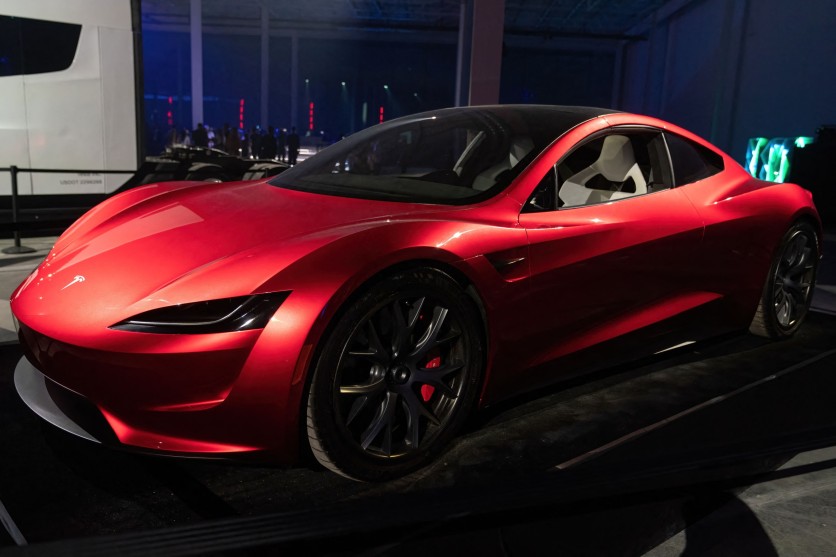
The Tesla Roadster is on display at the Tesla Giga Texas manufacturing facility during the "Cyber Rodeo" grand opening party on April 7, 2022 in Austin, Texas. SUZANNE CORDEIRO/AFP via Getty Images
The Federal Aviation Administration quietly filed a Temporary Flight Restriction over SpaceX's McGregor, Texas engine test site on September 18 — two days ago — banning aircraft below 10,000 feet through October 2. That single filing tells readers almost everything about what Tesla is about to show: the October 1 Roadster reveal will take place at or near the SpaceX campus, not in a hotel ballroom, and whatever Tesla is planning to put on stage is loud, energetic, or explosive enough to warrant a federal no-fly zone.
That context matters because it lends specific physical credibility to the claim at the center of this entire unveil: that the Roadster's optional SpaceX Package — internally codenamed A71 — is not marketing language. It is a real cold-gas propulsion system, built by the same engineers who design attitude-control hardware for crewed spacecraft, and it does something no previous automobile has done: it generates thrust that bypasses the fundamental physics constraint that limits how quickly every wheeled vehicle can accelerate. The Electrek report confirming the A71 codename, citing The Information, established this in June 2026.
What Reservation Holders Need to Know Before October 1
Tesla reopened reservations for the Roadster on September 18, requiring an initial $5,000 by credit card followed by a $45,000 wire transfer within 10 days to fully secure a place in line. The full $50,000 is described as refundable in Tesla's reservation agreement before any purchase agreement is signed, though some prior reservation holders — including tech YouTuber Marques Brownlee — made the deposit hard to recover for Brownlee after eight years of waiting, according to Electrek's reporting. The base Roadster is priced from $200,000, the Founders Series at $250,000, though neither figure has been officially updated since 2017 and both may change by the time production begins.
Tesla is targeting production at Gigafactory Texas in 2027 or 2028. The October 1 gathering is a reveal, not a delivery date. Prediction markets on Polymarket currently price the probability of a Roadster delivery by December 31, 2026 at just 4.5%, with the 2027 delivery window at 61%.
Why Tire Physics Makes the SpaceX Thruster Genuinely New
Every wheeled vehicle — regardless of how much power its drivetrain produces — accelerates at the rate its tires can transmit force to the road. This is called the traction circle, and it represents an absolute ceiling on acceleration determined by the friction coefficient between rubber and asphalt. At peak acceleration above roughly 1g, even the stickiest street tires begin to slip. The Rimac Nevera, the Croatian electric hypercar that set 23 performance records at the Automotive Testing Papenburg facility — including a 1.74-second 0-to-60 mph time on road-legal Michelin Cup 2 R tires — is arguably approaching that ceiling. Tesla's claimed 1.1-second target with the SpaceX Package would require approximately 2.5g peak acceleration — well above what grip alone allows.
Cold-gas thrusters sidestep this entirely. The A71 system mounted on the Roadster fires thrust directly against the chassis, not through the wheels. Newton's third law still applies, but the reaction force is decoupled from the tire-road interface. Whether the car is about to spin its wheels is irrelevant to a thruster pulse.
The system works by storing ultra-high-pressure compressed gas — nitrogen or compressed air — in composite-overwrapped pressure vessels (COPVs), the same class of high-pressure tanks SpaceX uses in Dragon capsules and Falcon 9 upper stages. When a solenoid valve opens, gas expands through the nozzles at near-supersonic or supersonic velocity, generating thrust without any combustion. The Mach diamonds spotted by watcher Joe Tegtmeyer — the bright, repeating interference rings visible in the teaser exhaust plumes — are a characteristic signature of supersonic nozzle flow and indicate the system is operating at the pressures and geometries SpaceX engineering routinely uses for actual spacecraft. More detail on cold-gas thruster mechanics is available from the Wikipedia entry on spacecraft propulsion.
As a cold-gas system rather than a combustion engine, the A71 has substantially lower specific impulse — roughly 70 to 75 seconds for nitrogen, compared to 300 or more for hydrazine monopropellants used in spacecraft thrusters. What that means practically: the thruster delivers intense, brief bursts rather than sustained push. Each pulse draws down the stored gas supply. The Roadster SpaceX Package replaces the rear seats with the pressure vessel and compressor hardware, and the finite gas supply will require recharging between spirited uses.
The Hard Engineering Problem Behind Nine Years of Delays
The A71 system is the most convincing explanation for why a car Tesla promised to deliver in 2020 has not shipped nine years later. Tesla VP of Vehicle Engineering Lars Moravy has previously described the SpaceX thruster integration as "one of the hardest parts of the Roadster program." Former Tesla president Jon McNeill — who ran Tesla from 2015 to 2018 and now co-leads DVx Ventures — said in August 2026 that the Roadster's delays are tied to SpaceX "hovering technology" and framed the project as a mechanism for deepening the Tesla-SpaceX institutional bond beyond simply making a fast car. "I don't know if we're going to see flying, but we may see hovering in this demo," McNeill said.
The specific engineering challenge that gets the least attention in press coverage is the pressure vessel itself. COPVs have a documented failure history in the SpaceX program: a COPV in a Falcon 9 upper stage failed during liquid oxygen loading in September 2016, destroying the Amos-6 satellite payload on the pad at Cape Canaveral. Adapting that same class of hardware for a consumer automobile — which must survive crashes, thermal extremes, and regulatory safety certification with no existing framework for road-going high-pressure gas systems — is not a solved problem. It may be the most important unsolved problem on the A71 program. Musk himself acknowledged at the All-In Summit on September 14 that "success is not guaranteed, but excitement is."
Tesla and SpaceX engineers presented Musk with an early internal demo of the A71 system in late April 2026, according to The Information's sources — four people with knowledge of the program, as reported by Electrek — which first published the internal code name. That demo date, more than anything else, explains the succession of slipped timelines: if the system was still in internal demonstration phase in late April, a June or August public event was always unrealistic.
What Has Changed Since 2017
The car that will roll onto the stage at McGregor on October 1 is expected to be substantially different from the sinuous red concept that surprised the audience at the 2017 Tesla Semi event. Earlier plans to base the production Roadster on Model S Plaid platform components were abandoned; what Tesla is now developing is described by multiple sources, including Reuters, as an all-new carbon-fiber hypercar. The teaser imagery — an angular, extremely wide rear body with a full-width red light bar, a deep aerodynamic wing, and four thruster plumes visible on the underbody — reads as a significant departure from the fluid supercar lines of the original concept, pointing instead toward the hard-edged "Cyber" design language Tesla has applied to its recent vehicles.
Tesla will present two variants. The standard Roadster is expected to use a conventional all-electric powertrain and be the car most reservation holders will eventually receive. A separate, limited-edition SpaceX Roadster — featuring the A71 system — is reportedly not expected to be street-legal and will likely be operated remotely during demonstrations because of the noise levels and compressed-gas discharge involved. Its price, when announced, is expected to be substantially higher than the standard model and possibly north of seven figures, according to earlier reporting that compared the concept to Ferrari's closed-track XX Program vehicles.
Is Competing With Rimac Still the Point?
When Tesla revealed the Roadster concept in 2017, the claimed figures — 1.9 seconds to 60 mph, a 250 mph (402 km/h) top speed, and over 620 miles of range — were genuinely shocking. The Rimac Nevera has since claimed 23 production-car records, including an independently verified 1.74-second 0-to-60 mph time on road-legal rubber at the Automotive Testing Papenburg facility in Germany. Other electric hypercars from Pininfarina and BYD's Yangwang brand have narrowed the gap further. The performance terrain Tesla mapped out in 2017 is no longer empty.
The cold-gas thruster is Tesla's answer to this: not incremental improvement on existing performance metrics, but a category-defining capability that competitors do not have. The Rimac Nevera is bounded by tire physics. The SpaceX Roadster is not.
That is the central claim October 1 will need to demonstrate. Musk's comment at the All-In Summit — "We actually need an audience to vouch for the fact that this is not AI" — reflects awareness that a decade of missed promises has eroded the company's credibility on the Roadster specifically. The audience at McGregor on October 1 functions as a verification mechanism, not just a promotional event. What Tesla shows in person cannot be dismissed as a render.
FAA No-Fly Zone Confirms McGregor as Venue
The FAA Temporary Flight Restriction — TFR 6/3825, issued by the Fort Worth Center — covers a roughly 1.5-mile radius around SpaceX's McGregor engine test site to an altitude of 10,000 feet, effective September 18 through October 2. The window encompasses October 1.
McGregor is located about 20 minutes from central Waco, which is where Tesla's event invitations direct reservation holders. The TFR makes the operational picture more specific than the invitation alone conveyed: the main demonstration is almost certainly taking place at the SpaceX test campus itself, not at a venue in Waco's city center. A cold-gas thruster demo conducted on a remote, federally restricted site makes sense. Operating a remotely piloted car discharging high-pressure nitrogen at speed within 20 feet of an audience in a hotel parking lot does not.
Is Tesla on the Road to Credibility or Another Missed Deadline?
The Roadster has now missed at least nine publicly stated timelines, beginning with the original 2020 delivery promise. Musk set April 1, 2026 at the November 2025 shareholder meeting — explicitly noting the date gave him "deniability" — and that date came and went without an event. The October 1 reveal carries one structural advantage over its predecessors: it now has a federal document attached. A flight restriction cannot be wished away after the fact.
What the reveal will not answer, even if it goes perfectly: when reservation holders will receive their cars, what the production Roadster's final specifications will be, whether the thruster system will ever receive road-use certification in the United States, and how many thruster activations a full charge of the pressure vessel provides in real-world use.
The answers to the mechanical questions — the COPV size, the gas fill time, the number of thruster pulses per charge — may be the most practically useful engineering details the October 1 event could surface. They are also the least likely to appear in a reveal designed for maximum spectacle. After nine years of waiting, the world will finally see what Tesla has actually built on October 1 — and then, depending on the details, another round of waiting will begin.
Frequently Asked Questions
What is a cold-gas thruster, and why is it different from a normal car's powertrain?
A cold-gas thruster generates thrust by expelling highly pressurized gas — nitrogen, in the Roadster's case — through a nozzle at near-supersonic or supersonic speed. No combustion occurs: the energy comes entirely from the stored pressure in the tank. The critical difference from a car's electric motor is that thruster force acts directly on the vehicle chassis rather than through the wheels. This means it does not depend on tire grip. Every conventional vehicle — no matter how powerful — can only accelerate as fast as rubber can transmit force to asphalt. Cold-gas thrust bypasses that constraint entirely for the duration of the burst.
Will Tesla actually deliver the Roadster in 2026, and when can reservation holders expect their cars?
Almost certainly not in 2026. Tesla's own internal production targets are 2027 or 2028 at Gigafactory Texas, with the 2027 window currently estimated at 61% probability by Polymarket prediction markets. The October 1 event is a reveal — formally comparable to a traditional auto show debut — not a delivery event or a production commitment. Reservation holders should treat the reveal as the beginning of a new phase of anticipation, not its conclusion.
Why is there a federal no-fly zone over the SpaceX McGregor site around the October 1 reveal date?
The FAA issued Temporary Flight Restriction 6/3825 over SpaceX's McGregor, Texas engine testing campus, banning aircraft below 10,000 feet from September 18 through October 2. Aviation observers have tied this directly to the Roadster reveal. The restriction is consistent with a high-energy demonstration — likely the A71 cold-gas thruster system — that requires exclusion of drones and low-flying aircraft for safety reasons. A routine new-car reveal at a hotel venue would not require federal airspace control.
Is the Roadster's thruster-equipped SpaceX Package actually going to be road-legal?
Reports from multiple sources, including The Information and Electrek, indicate the limited-edition SpaceX Roadster with full A71 thruster hardware is not expected to be street-legal, at least initially. It will likely be operated remotely during demonstrations because of the noise levels and compressed-gas discharge involved. The standard Roadster — which most reservation holders would eventually receive — uses a conventional all-electric powertrain. There is currently no regulatory framework in the United States for a consumer vehicle equipped with spacecraft-derived cold-gas propulsion hardware, and certifying one for public roads would be a novel regulatory challenge.

-
 C114 Communication Network
 -
 Communication Home
