
 Search

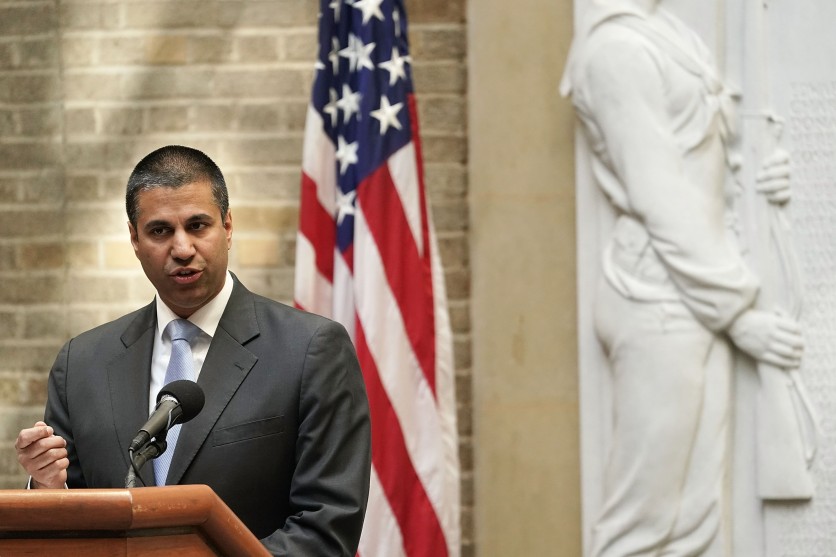
Federal Communications Commission Chairman Ajit Pai speaks during a forum April 18, 2018 in Washington, DC. Alex Wong/Getty Images
The wireless spectrum fight that will determine how fast Americans get 6G — and how much bargaining power the United States brings to a landmark global treaty conference in China next year — erupted into open industrial warfare this week when two competing industry factions published back-to-back technical reports on the same block of government-controlled radio frequencies, according to reporting by Inside Towers.
On Wednesday, CTIA, the wireless carriers' trade group led by former FCC Chairman Ajit Pai, released its 4.4 GHz band report, calling the 4.4–4.94 GHz band — currently used almost exclusively by federal agencies — a "cornerstone of the spectrum pipeline" that should be cleared of federal incumbents, auctioned to commercial carriers, and put to work for 5G and 6G at the highest legal power levels. The following morning, Valo Analytica — whose founders helped build some of America's most sophisticated spectrum-sharing systems — published a competing analysis commissioned by the Spectrum for the Future Coalition, arguing that existing automated coordination tools can bring commercial use to the same band faster and without displacing the federal missions that depend on it.
The same-day escalation is not simply a technical disagreement. It is the latest move in a years-long industrial war between the nation's wireless carriers and cable operators over who controls the spectrum that will decide which industry wins the fixed broadband competition of the next decade.
How the 4.4 GHz Band Works — and Why Everyone Wants It
The 4.4 GHz band (technically 4,400 to 4,940 MHz) occupies a position in the radio frequency spectrum that engineers describe as a sweet spot for next-generation wireless. Mid-band signals — generally from 1 GHz to 6 GHz — travel far enough to cover large geographic areas while carrying enough data capacity to serve dense urban populations. That contrasts with millimeter-wave signals above 24 GHz, which offer extreme speed over very short distances, and low-band signals below 1 GHz, which blanket wide areas but carry relatively little data.
Within the mid-band range, the 4.4 GHz band has a specific technical advantage over the other major candidate for 6G capacity — the 7 GHz band. A Rysavy Research technical report from July 2026 found that commercial radio equipment capable of operating in the 4.4 GHz range using 128-transmit/128-receive (128T128R) massive MIMO antenna arrays is already available and deployable today. The equivalent equipment for 7 GHz — which would require 256T256R configurations — does not yet exist commercially and is unlikely to arrive until around 2030. At 4 GHz, signals also penetrate buildings significantly better than at 7 GHz, a crucial advantage for dense urban coverage.
The band's appeal is further compounded by its scale. With up to 400 MHz (0.4 gigahertz) of contiguous bandwidth potentially available, it is far larger than the narrower slices carriers have been deploying in recent years. CTIA's report, citing Accenture analysis it commissioned, projects that U.S. networks will need 820 MHz of additional mid-band spectrum to prevent demand shortfalls as wireless traffic — which grew an estimated 20% over the past year — continues to accelerate under AI load. Without that capacity, the Accenture analysis warns, roughly one-third of future wireless demand could go unmet, threatening an estimated $1.4 trillion in economic output. (These projections were commissioned by CTIA and have not been independently verified by a third party.)
The 4.4 GHz band is currently used by at least 15 federal agencies, including the Department of Defense, the Department of Justice, wildfire surveillance programs, nuclear emergency response teams, and border security operations, according to NTIA's band study documentation. Moving those users out of the band — or convincing them to share it — is the central engineering and policy challenge.
What Is Spectrum Sharing — and Why It Works Here
The core technical dispute between the two reports is about which access model — exclusive licensed auction or shared access using automated coordination — is the right framework for the 4.4 GHz band.
Under the exclusive licensing model CTIA advocates, the federal government would relocate incumbent agencies to other frequencies, clearing the band entirely for commercial auction at full power. Carriers would then purchase exclusive geographic licenses, much as they did in the 3.5 GHz C-band auction.
The sharing alternative, which the Spectrum for the Future Coalition's report supports, uses two proven technical mechanisms already operational in other bands: Automated Frequency Coordination (AFC) and Dynamic Protection Areas (DPAs).
AFC works by maintaining a real-time database of registered federal incumbent users and their geographic locations. When a commercial device seeks to transmit, it queries the AFC system, which uses propagation modeling to calculate which frequencies and power levels are safe to use at that location without interfering with any federal user. The system approves only "no-harm" transmissions — devices that would cause interference are either blocked or directed to a different channel. AFC is already operational today in the 6 GHz band, where it coordinates commercial Wi-Fi 6E and Wi-Fi 7 deployments around more than 70,000 fixed federal microwave links with no documented interference.
DPAs define geographic exclusion zones, expressed as radius distances, around federal users with specific operational sensitivities. When a sensor detects an incumbent transmission within a DPA's footprint, commercial devices in that area are instructed to suspend or reduce power. DPAs are the primary protection mechanism for the Citizens Broadband Radio Service (CBRS) band (3.55–3.7 GHz), where more than 440,000 commercial base stations now operate alongside Navy shipborne radar systems and other military incumbents without a single documented interference incident.
The Spectrum for the Future Coalition's argument is that AFC and DPA mechanisms sophisticated enough to protect radars at 3.5 GHz and microwave links at 6 GHz can also protect the more varied federal mission uses at 4.4 GHz — enabling commercial deployments at medium power levels in areas where federal users are not active, without requiring billion-dollar relocation programs that could take a decade to complete.
CTIA's counter-argument is that the federal missions at 4.4 GHz — nuclear emergency response, drone control systems, wildfire surveillance — are categorically more mission-critical than the CBRS precedents, require protection even at low interference levels that AFC and DPAs might miss, and that only full clearing provides the large contiguous spectrum blocks carriers need to deploy 400 MHz-channel equipment, according to CTIA's September 2026 report.
Why the Fight Is Really about Broadband, Not Just Wireless
The framing of this fight as a technical debate about the right spectrum-sharing architecture obscures the economic reality driving both sides.
Wireless carriers — AT&T, Verizon, and T-Mobile, all represented by CTIA — have spent the past three years watching cable operators aggressively compete for broadband subscribers using fixed wireless access services. Fixed wireless broadband, which uses licensed spectrum to deliver home internet without a physical cable, is the fastest-growing broadband category in the United States. Every additional megahertz of licensed mid-band spectrum the carriers acquire is another avenue to expand fixed wireless capacity and compete with cable's legacy coaxial and fiber networks.
Cable companies have recognized this dynamic and responded accordingly. NCTA — The Internet & Television Association, the cable industry's primary lobbying body — responded to CTIA's earlier AI spectrum demand report in May 2026 by calling it "a report that warns about surging wireless traffic — while arguing to take away spectrum from the Wi-Fi networks carrying 90 percent of that traffic," adding that it repackages a stale anticompetitive agenda. Charter and Comcast, NCTA's two largest members, currently offload the majority of their mobile service traffic onto Wi-Fi — meaning they benefit directly from every additional block of unlicensed or shared spectrum and are harmed by every exclusive license that gives carriers more fixed wireless capacity.
The Spectrum for the Future Coalition's membership — which includes NCTA, Charter, rural broadband providers, and aviation interests — is not, structurally, a federal-mission-protection coalition. It is a cable-adjacent coalition whose financial interests align with a sharing outcome that limits carrier fixed wireless expansion, dressed in the vocabulary of federal incumbent protection and spectrum efficiency.
This does not mean the sharing coalition is wrong on the merits. The technical case for AFC and DPA-based coordination is real, and the CBRS precedent is genuinely relevant. But readers evaluating the competing reports should understand that neither CTIA nor the Spectrum for the Future Coalition is arguing from pure technical neutrality. CTIA's economic projections are from analysis it commissioned. The sharing coalition's insistence that clearing would take "tens of billions of dollars" and a decade is also self-interested advocacy, and CTIA disputed the characterization of federal use intensity in the band.
A Conflict That Matters Internationally
There is an additional reason why the U.S. cannot afford to let this fight drag on indefinitely: the clock toward the World Radiocommunication Conference 2027 (WRC-27) is ticking.
WRC-27 is scheduled for October 18 to November 12, 2027, in Shanghai, China — and the band at the center of the U.S. domestic dispute is explicitly on its agenda at the international treaty conference. WRC-27 Agenda Item 1.7 asks member nations to consider technical conditions for licensed mobile use in the 4,400–4,800 MHz range. WRC decisions are international treaties; a global licensed mobile identification for 4.4 GHz would catalyze chipset and handset investment in every major market and reduce equipment costs for any country that subsequently deploys services in the band.
China has been the most aggressive advocate for licensed mobile allocations in these frequencies. More than 50 countries have already backed a 4.4 GHz mobile designation consistent with CTIA's preferred outcome.
European NATO member states have been more resistant. The 4.4–4.8 GHz range is used by NATO militaries for aeronautical, maritime, and land communications systems, and a TechUK spectrum document prepared for WRC-27 planning describes IMT identification in the band as facing "challenging prospects" in Europe because of military use. Aviation interests add another complication: the 4.2–4.4 GHz range immediately below the proposed IMT allocation hosts radio altimeters, the safety-of-life instruments that measure aircraft height above terrain during approaches. The FCC's own WRC-27 working documents note that retrofitting the global aviation fleet would require ICAO standardization timelines that extend well beyond WRC-27 itself — making identification "premature" in the aviation community's view.
The practical effect is that every additional month the United States spends internally divided between clearing and sharing is a month in which the U.S. government cannot project a coherent position to its negotiating partners before sitting down at a conference hosted by the country most aggressively pushing the 4.4 GHz IMT agenda.
NTIA Holds the Decision
Both reports were aimed squarely at the NTIA, which is expected to begin its formal 4.4 GHz study in late September. The agency cleared all 15 agency study plans for the band in July 2026 — the last bureaucratic prerequisite before substantive technical analysis can begin.
NTIA operates under two intersecting mandates: the Working Families Tax Cut Act, passed by Congress, requires it to identify 500 MHz of federal spectrum for commercial use within five years; a December 2025 presidential memorandum on 6G leadership directed the agency to move urgently on the 4.4 GHz band specifically. Congress explicitly listed shared federal and non-federal use among the options NTIA must evaluate — the statutory provision the sharing coalition has been highlighting at every turn.
CTIA has called for NTIA to complete its band study within 60 days, identify spectrum for commercial use by 2028, and have the FCC conduct an auction by 2030. The Spectrum for the Future Coalition argues NTIA should conduct a full evaluation of multiple access models before committing to any framework.
There is an irony embedded in the carrier side's timeline pressure. Ajit Pai, the CTIA president and CEO who is now the most prominent voice for licensed 4.4 GHz auctions, was the FCC Chairman who in 2020 presided over the agency's decision to open 6 GHz for unlicensed Wi-Fi — a 1,200 MHz allocation using effectively the same resource management logic his current coalition partners are now invoking to resist exclusive licensing at 4.4 GHz. The arguments Pai made in 2019 and 2020 against locking up 6 GHz for exclusive licensed use closely mirror the arguments the sharing coalition is making about 4.4 GHz today.
NTIA also recently launched Spectrum.gov, a public dashboard tracking the progress of its spectrum repurposing pipeline — a transparency measure that gives both factions, and the public, visibility into the study process before the agency announces findings.
What Neither Side Is Admitting
The most valuable insight these competing reports reveal is not which technical model is correct — it is what each faction has chosen not to say.
CTIA's report does not acknowledge that its primary economic projections come from its own commissioned analysis rather than independent research. It does not discuss the aviation radio altimeter conflict in the adjacent band, which the FCC's own working documents describe as an unresolved obstacle to timely international IMT identification. And it does not note that the 440,000-base-station CBRS precedent, which it acknowledges implicitly, was built on the same DPA architecture the sharing coalition is proposing to extend to 4.4 GHz.
The Spectrum for the Future Coalition's report does not acknowledge the structural competitive dynamic that explains why cable operators are the dominant funding constituency for sharing advocacy. It presents sharing primarily as a technical and national security argument without naming the fixed wireless competition threat that gives cable operators their financial motivation. And it does not engage with CTIA's point that the specific mission-critical nature of some 4.4 GHz federal uses — nuclear emergency response, drone control — may genuinely exceed what AFC and DPA protection can reliably guarantee at commercial deployment scale.
NTIA will have to disentangle the legitimate technical disagreements from the self-interested advocacy when it begins its formal study. The agency's study may ultimately point toward a hybrid outcome — portions of the band cleared for exclusive licensed use, portions preserved for shared access — a structure that would give both sides something and neither side everything.
What is already clear is that the domestic fight the dueling reports crystallized this week will shape how much leverage the United States brings to a treaty conference in Shanghai — hosted by the nation that is most enthusiastically pushing the outcome CTIA says it wants, and most likely to benefit if American uncertainty about the band's future prevents a united U.S. position from forming in time.
Frequently Asked Questions
What is the difference between exclusive licensed spectrum and spectrum sharing?
Under exclusive licensing, a single company purchases the right to use a specific block of frequencies in a geographic area at high power levels, with no other users permitted. Spectrum sharing allows multiple users — including both federal agencies and commercial operators — to use the same frequencies simultaneously, coordinated by technical systems that prevent interference. Tools like Automated Frequency Coordination (AFC) and Dynamic Protection Areas (DPAs) manage sharing in real time, granting commercial access only in locations and at power levels verified not to interfere with incumbent users. The Citizens Broadband Radio Service (CBRS) in the 3.55–3.7 GHz band is the largest deployed example: more than 440,000 commercial base stations operate alongside Navy radar systems using DPA protection, without a documented interference incident.
Why is the cable industry in this fight about wireless spectrum?
Cable companies' primary broadband business — delivering home internet over coaxial or fiber networks — faces its fastest-growing competitor in fixed wireless access, which wireless carriers deliver using licensed mid-band spectrum. Every new block of licensed spectrum acquired by AT&T, Verizon, or T-Mobile expands their capacity to offer home broadband that competes directly with cable internet subscriptions. The cable industry therefore has a direct financial interest in outcomes that either limit exclusive carrier licensing or channel spectrum into unlicensed and shared frameworks where carriers cannot dominate access. The Spectrum for the Future Coalition — whose membership includes NCTA, Charter, and rural broadband providers — represents this interest, even as it frames its position in terms of federal mission protection and spectrum efficiency.
What is WRC-27, and why does it matter for U.S. spectrum policy?
The World Radiocommunication Conference 2027 (WRC-27) is an international treaty conference convened under the International Telecommunication Union (ITU), scheduled for October through November 2027 in Shanghai, China. Every three to four years, the WRC revises the Radio Regulations, the binding international treaty that governs how spectrum is allocated globally. WRC-27's Agenda Item 1.7 specifically considers whether to add a licensed mobile designation to the 4.4–4.8 GHz frequency range — the same band at the center of the current U.S. domestic fight. A global licensed mobile identification would catalyze investment in compatible chipsets and handsets worldwide, reducing equipment costs and accelerating 6G deployment for any country that deploys services in the band. The United States has not finalized its WRC-27 negotiating position, and internal industry disagreement over the band's future complicates the government's ability to project a coherent stance before the conference begins in China.
Will the NTIA study settle the licensing vs. sharing question?
The NTIA study, expected to begin in late September, is a technical and engineering analysis — not a final policy decision. Its output will be a determination of which portions of the 4.4 GHz band can be repurposed for commercial use, under what conditions, and at what cost to federal incumbents. The FCC would then decide how to structure any commercial access — through auction, sharing rules, or some hybrid. Historically, NTIA studies have taken 12 to 24 months to complete, meaning a preliminary determination for 4.4 GHz is unlikely before 2027. CTIA has called for a 60-day study period and an FCC auction by 2030; the sharing coalition has urged a thorough multi-framework evaluation before any model is locked in. Congress explicitly required NTIA to evaluate shared federal and commercial use among its options, which the sharing coalition has been citing as a statutory mandate to give sharing a genuine hearing.

-
 C114 Communication Network
 -
 Communication Home
