
 Search

Samsungdisplay.com
Samsung Display has entered full-scale commercial production of a tandem OLED laptop panel that exceeds the brightness ceiling of every conventional OLED panel currently sold — and the K-Display 2026 trade show, which opens in Seoul on Wednesday, is where buyers and partners will see it in person for the first time, according to the company's official announcement. The timing is deliberate: Samsung announced the production launch on Monday, two days before the exhibition floor opens, precisely to make the panel the headline technology at South Korea's only display-industry-focused international show.
The Lenovo Yoga Pro 9i Aura Edition (16", Gen 11) is already in buyers' hands as the world's first laptop certified to the new VESA DisplayHDR True Black 1400 standard, having earned that distinction on July 8, per Samsung Display's press release. ASUS, Dell Technologies, and MSI are expected to follow with their own True Black 1400 machines from the second half of this year through 2027.
VESA Sets the Bar at 1,400 Nits — and Samsung Clears It by 200
The Video Electronics Standards Association introduced DisplayHDR True Black 1400 on July 8, 2026, as the highest tier in its DisplayHDR True Black certification program. To earn the badge, a display must achieve peak brightness of at least 1,400 nits at a 10% On Pixel Ratio (OPR) — meaning over a patch representing one-tenth of the screen — while holding black levels at or below 0.0005 nits. The spec also mandates a full-screen sustained brightness of 700 nits, a floor the previous True Black 1000 tier did not require at the same level.
That 700-nit full-screen figure — not the headline 1,400-nit peak — is the number that determines whether a display remains legible beside a window on a bright afternoon. Peak figures are always measured over a small bright patch; full-screen brightness is what governs sustained real-world use across an entire white document or lit workspace.
Samsung Display's panel exceeds the peak certification threshold by a meaningful margin: it reaches 1,600 nits at the panel level, more than 40% above the 1,100-nit ceiling of conventional single-stack OLED panels. The new tier itself represents a 40% increase in peak brightness requirement over the prior top certification, True Black 1000.
Read more: Samsung 4K 360Hz QD-OLED Panel Debuts at Computex: Resolves Gaming Monitor Tradeoff
How Tandem OLED Hits 1,600 Nits — and Lasts Twice as Long
The architecture behind that brightness is fundamentally different from the single-layer OLED design that has defined laptop displays for the past several years. Conventional OLED panels drive a single organic emissive layer — forcing high current through it to reach high brightness. Higher current density accelerates organic material degradation, which is why aggressive brightness modes on single-stack OLED panels reduce their operational lifespan.
Tandem OLED stacks two organic emissive layers separated by a charge-generating layer (CGL). Both layers emit light simultaneously, each contributing to total brightness. Because the electrical load is distributed across two stacks, each layer runs at lower current density than a single-stack panel would require to reach the same luminance level. The result is that the panel can reach significantly higher peak brightness than a single-stack panel at the same current — or achieve the same brightness as a single-stack panel while running each layer at lower current, preserving material lifetime. Samsung's data puts the practical lifespan benefit at more than twice the longevity of a conventional OLED panel under typical laptop operating brightness conditions.
Materials science contributes alongside architecture. Samsung has applied newly developed organic emissive materials to its tandem OLED design; the efficiency and stability of organic emitters directly determine how much brightness a panel can sustain at a given power level and how long the materials hold up. The company has not publicly disclosed the specific chemistry of the new materials, which is standard competitive practice in the panel industry.
K-Display 2026: Three Days in Seoul's Gangnam District
K-Display 2026 opens Wednesday at the COEX Convention & Exhibition Center in Seoul's Gangnam district, running through Friday, July 24. The exhibition marks the show's 25th consecutive year; it has run since 2001 and remains the only display-industry-focused international exhibition held in South Korea, per the official K-Display profile. Sponsors for this year's edition include Samsung Display, LG Display, Konica Minolta, and SEMES, with backing from the Korea Display Industry Association (KDIA), the Seoul Metropolitan Government, and South Korea's Ministry of Trade, Industry and Energy.
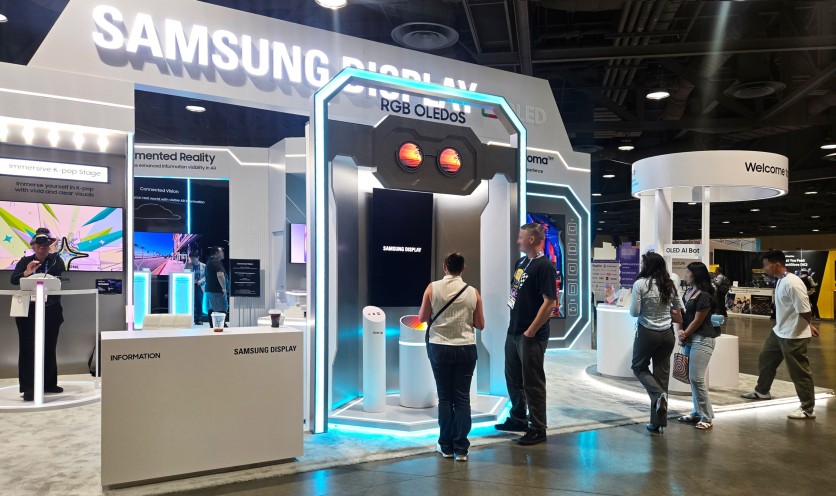
Exhibition hours are 10 a.m. to 5 p.m. on Wednesday and Thursday, and 10 a.m. to 4 p.m. on Friday, at Hall C. Attendance is free for pre-registered visitors. Samsung Display's tandem OLED panel will be displayed in an "Ultimate Performance Showcase" zone at its booth, with video content focused on professional creator use cases — video editing, image review — to let visitors evaluate picture quality directly, according to Samsung Display's announcement.
Display Business Forum: Two Days of Roadmap Presentations
Running today and tomorrow at COEX Room 401, the 2026 Display Business Forum draws approximately 450 professionals from industry, academia, and research, organized by the Korea Display Industry Association. Simultaneous Korean-English interpretation is provided throughout. The program focuses on four pillars: global strategy keynotes, next-generation display technologies, a materials and components showcase, and networking.
Today's keynote session opens with LG Display's Chief Technology Officer, Young-seok Choi, presenting on tandem OLED architecture as a driver of OLED expansion — a signal that LG Display is pursuing its own commercial tandem OLED roadmap for laptops, in direct competition with Samsung Display. He is followed by BOE's Vice Chief Strategy Officer, Bai Shi, presenting on display's role in IoT, and by David Hsieh of Omdia with an OLED market overview.
The afternoon today covers AR/VR/XR business trends — featuring presentations from Leia Inc., RAONTECH, and VIRNECT — and concludes with a deep Micro LED session that runs seven presentations from executives at TrendForce, PlayNitride, AUO, VueReal, Porotech, Sanan, and SapienSemiconductors.
Tomorrow's program opens with Samsung Display's own keynote: Cheol-lae Roh, Head of the AX Research Center and Executive Vice President, presenting on display technology in what Samsung is calling the "AX era" — the company's internal framing for its AI-accelerated product transition. He is followed by Chung-Chun Lee, Vice President at Visionox's BU5 unit, and by Yoshio Tamura of Counterpoint Research with a flat-panel display market overview. The afternoon covers AI-mobility display trends before shifting to a dense materials session covering quantum-dot and organic emitter chemistry — with presentations from LG Display, SK trichem/SK Materials JNC, Kyulux, Merck, Qnity, Samsung Display, and Seoul National University's Prof. Tae-Woo Lee on perovskite emitter commercialization strategies.
Read more: ASUS ROG Tandem RGB OLED Monitors Ship: 1,000 Nits, 480Hz, and a Known Dark-Scene Limitation
Korean Panel Fabs Defend Premium Tier While Chinese Rivals Watch
K-Display 2026 arrives as a direct expression of the strategy South Korean panel makers are executing to hold their premium position: win on materials science, architecture, and certification milestones that Chinese manufacturers — led by BOE — have not yet matched in laptop OLED specifically. BOE's presence at the forum program as a speaker, alongside Samsung Display and LG Display, underscores the degree to which K-Display now serves as a rare venue where direct and indirect competitors present their technology roadmaps from the same stage.
The breadth of the Business Forum's agenda reflects a deliberate push into application segments — automotive, AI manufacturing, XR — where Korean fabs see structural advantages over lower-cost rivals. The premium laptop panel market is one of the clearest expressions of that strategy: a product category defined not by cost competition but by achievable brightness, lifespan, and certification-level differentiation that requires years of organic materials research and development. Samsung's tandem OLED True Black 1400 panel, and the Lenovo machine already shipping with it, give Korean display supply chains a concrete product-level milestone to point to.
For OEM procurement teams and premium laptop shoppers, the supply chain message is straightforward: True Black 1400-certified laptops from Lenovo are already available, and equivalent machines from ASUS, Dell, and MSI are expected before the end of the year. The technology is not a roadmap item — it is in commercial production now.
Frequently Asked Questions
What is VESA DisplayHDR True Black 1400, and how is it different from previous OLED standards?
VESA introduced DisplayHDR True Black 1400 on July 8, 2026, as the highest tier in its DisplayHDR True Black certification program for emissive displays. To qualify, a panel must achieve at least 1,400 nits of peak brightness measured over a 10% screen window, maintain black levels at or below 0.0005 nits, and sustain 700 nits of full-screen brightness. The prior top tier, True Black 1000, required 40% less peak brightness and did not set the same full-screen floor. The full-screen 700-nit requirement is the more significant addition for real-world use: it ensures the display stays legible in well-lit environments, not just during HDR peak highlights.
What laptops currently support True Black 1400 certification, and when will more arrive?
As of July 2026, the Lenovo Yoga Pro 9i Aura Edition (16", Gen 11) is the only laptop certified to True Black 1400, having earned the certification on July 8. It features a 16-inch 3.2K PureSight Pro tandem OLED display rated at 1,600 nits peak brightness with a 120Hz variable refresh rate. ASUS, Dell Technologies, and MSI are all named as incoming Samsung Display tandem OLED customers, with products expected from the second half of 2026 through 2027, though no specific model names have been confirmed.
What is the difference between tandem OLED and regular OLED in a laptop display?
A conventional single-stack OLED panel drives one organic emissive layer to produce light, requiring higher current density to achieve high brightness — which accelerates material degradation over time. Tandem OLED stacks two organic emissive layers with a charge-generating layer between them; both layers emit simultaneously, distributing the electrical load. The practical result is that tandem OLED panels can reach substantially higher peak brightness (1,600 nits versus roughly 1,100 nits for single-stack) while extending the panel's operational lifespan — Samsung claims more than twice the longevity of a conventional OLED panel at typical laptop brightness settings.
Why does K-Display matter to display professionals and OEM buyers?
K-Display is the only display-industry-focused international trade show held in South Korea, and it brings together panel makers (Samsung Display, LG Display), Chinese competitors (BOE), materials companies, and equipment suppliers from the full supply chain alongside OEM hardware buyers — all in the same venue for three days. For procurement teams, it is one of the few occasions when competing panel makers simultaneously reveal their technology roadmaps. For analysts, the sessions on tandem OLED expansion, Micro LED commercial timelines, and automotive display forecasts represent the most concentrated public disclosure of display industry strategy outside of SID and CES. K-Display 2026 runs July 22–24 at COEX in Seoul.

-
 C114 Communication Network
 -
 Communication Home
