
 Search

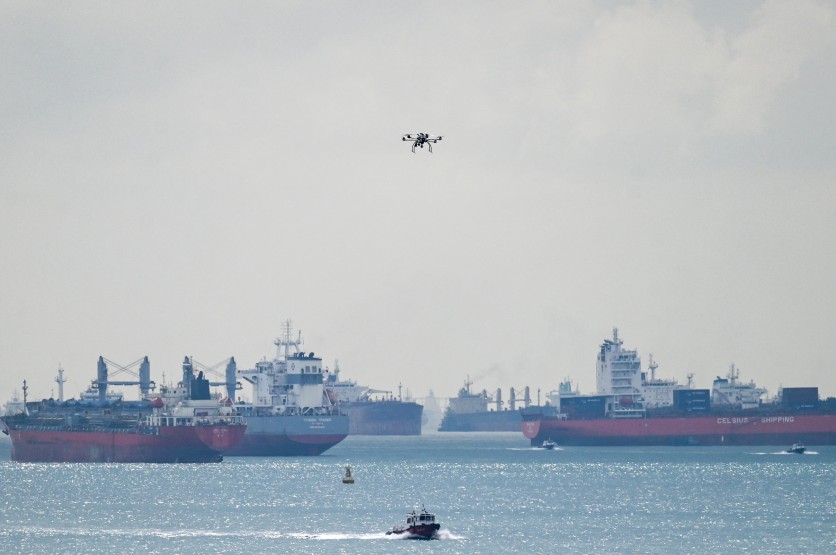
This picture shows vessels anchored as a drone flies along the Singapore straits eastern anchorage in Singapore on April 21, 2026. Roslan RAHMAN/AFP via Getty Images
Three Saronic Corsair autonomous surface vessels struck a submarine and ship maintenance facility at Iran's Bandar Abbas Naval Base on July 12, 2026 — the first time American forces have used unmanned sea drones for a kinetic attack — and the Pentagon has not said whether a human authorized the terminal approach or a machine made that call on its own. CENTCOM confirmed the strike on July 13 with a video post on X.
U.S. Central Command confirmed the operation on July 13, posting 25 seconds of cockpit-view footage shot from inside one of the approaching Corsairs. The silent clip shows a yellow maintenance gantry and a Ghadir-class Iranian midget submarine suspended beneath it, growing steadily in frame until the screen went dark. CENTCOM described the strike as part of a broader offensive targeting "dozens" of Iranian military assets — including air-defense systems, coastal radar installations, and the small-boat forces that have been attacking commercial shipping in and around the Strait of Hormuz since the conflict began in February.
That broader offensive context matters, but it is the autonomy question that will determine whether the Bandar Abbas strike becomes a historical footnote or a doctrinal inflection point. U.S. military policy on autonomous weapons — formalized in DoD Directive 3000.09, last updated in January 2023 — distinguishes between systems that select and engage targets independently ("autonomous weapon systems") and systems that navigate to human-designated targets ("semi-autonomous weapon systems"). If Corsairs were pre-programmed with a target location and detonated on arrival, they functioned under DoDD 3000.09 as sophisticated guided munitions. If their onboard AI selected the final aim point during the terminal approach without real-time human input, the U.S. military may have crossed a threshold it has spent a decade promising Congress and international partners it would not cross silently. CENTCOM has not disclosed which occurred.
What Hit Bandar Abbas and Why
The target was not a ship at sea. Iranian naval forces had pulled a Ghadir-class midget submarine from the water for maintenance, suspending it beneath the yellow gantry visible in CENTCOM's footage — which meant the strike damaged not only the vessel but the infrastructure required to return it to operational status. Destroying a submarine in dry dock degrades a navy's maintenance cycle; destroying the gantry it hangs from extends that degradation indefinitely. The choice of target was deliberate and aimed at long-term capacity reduction, not a single-platform kill, as Army Recognition Group analysis of the strike confirmed.
The three Corsairs approached the naval pier from separate directions under autonomous control before converging and detonating. USNI News reported the CENTCOM footage shows a low-speed, uncontested approach — no intercept, no countermeasure, no defensive fire visible before impact. Whether that reflects a gap in Iranian harbor defenses, the Corsair's reduced-radar composite hull design, or the element of operational surprise, CENTCOM has not said. The launch platform, approach route, and degree of real-time human supervision during the terminal phase all remain classified.
A named U.S. defense official told USNI News the operation was conducted directly under CENTCOM authority — not under the U.S. Navy or Task Force 59, the 5th Fleet's dedicated unmanned systems unit. That command structure indicates the Corsair capability has transitioned from an experimental maritime platform to an asset available for direct operational tasking by joint combatant command structures. It is a significant institutional distinction: Task Force 59 was stood up in 2021 as an experimental unit integrating AI and unmanned systems into fleet operations; running the Bandar Abbas strike through CENTCOM rather than TF59 signals that the technology has graduated out of the experimental command framework entirely.
Machine or Weapon? What DoD Policy Says About the Terminal Approach
DoD Directive 3000.09 defines three categories of autonomous military systems. An autonomous weapon system, once activated, can select and engage targets without further human intervention — what the policy calls "human out of the loop." A human-supervised autonomous system allows human operators to monitor and halt engagement but can act without further input once activated. A semi-autonomous weapon system — including guided missiles and "fire and forget" munitions — engages only targets pre-selected by a human operator.
The policy does not prohibit any of these categories outright, but it requires that autonomous and human-supervised autonomous weapon systems undergo a senior-level review — involving the Under Secretary of Defense for Policy, the Vice Chairman of the Joint Chiefs, and the Under Secretary of Defense for Research and Engineering — before fielding. In cases of "urgent military need," the Deputy Secretary of Defense can waive that review. The FY2026 National Defense Authorization Act now requires congressional notification of any such waiver.
The Center for Strategic and International Studies noted in its analysis that the phrase "human in the loop" does not actually appear in DoDD 3000.09 — the operative standard is "appropriate levels of human judgment over the use of force," which the policy itself describes as a flexible, context-dependent concept. A Corsair that received a pre-programmed target coordinate from a human operator before launch, navigated there using its mission-level AI, and detonated on arrival may satisfy DoDD 3000.09's "appropriate human judgment" standard without any real-time human involvement in the terminal phase.
What remains unknown — and what DoD has not disclosed — is which of these descriptions fits what actually happened at Bandar Abbas. The Army Recognition Group's post-strike analysis noted that the operation "confirms combat use of an autonomous-capable vessel, it does not establish that lethal action was conducted without human authorization." That gap between what the footage shows and what the policy requires is precisely what Congress, legal scholars, and allied governments will now demand to understand.
The Corsair: Built to Be Expendable and Decisive
The Saronic Corsair is a 24-foot autonomous surface vessel manufactured by Saronic Technologies, an Austin, Texas defense startup. Its published specifications — a range exceeding 1,000 nautical miles, a payload capacity of 1,000 pounds, and a top speed above 35 knots — are independently confirmed across multiple sources including USNI News, Naval News, Stars and Stripes, and Sandboxx. The vessel's composite hull is designed to reduce radar signature, a deliberate engineering choice for a platform that must approach defended harbors without triggering intercept.
The guidance stack uses what Saronic describes as "mission-level autonomy" — adaptive navigation, multichannel communications, and purpose-built, military-grade AI systems rather than commercial off-the-shelf components. The company has said that choice produces substantially more precise terminal approaches than commercial guidance systems would. The same hull that struck Bandar Abbas on July 12 had, in June, rescued two U.S. Army AH-64 Apache helicopter pilots downed near the Strait of Hormuz — the first known personnel recovery at sea performed by an uncrewed vessel. The Corsair is designed to do both.
Saronic confirmed in a statement after the strike that forces used the "military variant" of the Corsair platform, distinct from a baseline commercial design. The company said it was "proud that our technology supported this mission and helped to keep the brave men and women of the U.S. armed forces safe."
By May 2026, Saronic had publicly disclosed producing at least 300 Corsairs. Sandboxx reported the company reached a production capacity of 1,000 vessels per year by March 2026, with plans to expand to 2,000 annually from a new facility in Franklin, Louisiana.
Read more: Naval Maritime Startup Saronic Raises $55 Million to Build Autonomous Ships for Defense
Prototype to Production: How Saronic Got There
Saronic was founded in 2022 by former Navy SEAL Dino Mavrookas alongside co-founders Rob Lehman, Vibhav Altekar, and Doug Lambert. The company unveiled the Corsair in October 2024 and reached a production-ready product within a year. The Navy formalized a relationship through an Other Transaction Agreement worth more than $392 million in 2025. By December 2025, Secretary of the Navy John Phelan was publicly crediting the arrangement at the Reagan National Defense Forum: "Prototype to production in under 12 months. This is now the standard."
Capital followed the contract. A $175 million Series B closed in July 2024 at a $1 billion valuation, led by Andreessen Horowitz. A $600 million Series C followed in February 2025. A $1.75 billion Series D closed in March 2026, led by Kleiner Perkins, at a valuation of $9.25 billion. The fundraising timeline tracks almost exactly with the Navy's escalating confidence in autonomous naval systems during the Iran conflict.
Saronic is also competing at the higher end of the Navy's unmanned ambitions. In late May 2026, the Navy selected Saronic as one of seven companies to advance to the at-sea testing phase of the Medium Unmanned Surface Vessel Marketplace program. Saronic's entry — the Marauder, a 180-foot vessel — recently launched its first hull at the Franklin, Louisiana shipyard. Companies completing at-sea testing, set to conclude by October 2026, are eligible for a $15 million award and follow-on production contracts.
A Doctrine Born in the Black Sea
The Bandar Abbas strike traces its doctrinal lineage to Ukraine, where autonomous surface vessels spent the better part of three years demonstrating that cheap, expendable boats could dismantle a far larger conventional navy. Beginning with the first multi-USV attack on Sevastopol harbor in October 2022, Ukrainian forces — using Magura and Sea Baby designs — penetrated Russian naval defenses repeatedly, damaging or sinking more than two dozen warships and ultimately forcing the Black Sea Fleet to withdraw from occupied Crimea. The campaign showed that a country with virtually no traditional navy could achieve strategic sea denial through autonomous attrition. Saronic's founders built the company in the direct shadow of that conflict.
The tactical geometry at Bandar Abbas mirrors those Ukrainian raids: multiple vessels approaching from different vectors, a fortified naval port penetrated without risking a single sailor, a maintenance facility rather than a ship at sea rendered inoperable. Where Ukraine used commercially sourced communications and improvised guidance, the U.S. deployed a purpose-built military system with AI-driven autonomy and, CENTCOM implies, substantially greater precision.
The countermeasure picture also warrants attention. Russia developed anti-USV capabilities over the better part of three years in the Black Sea — dedicated helicopter anti-drone units, electromagnetic jamming, boom nets, dazzle camouflage, and escort ships for high-value transits. Iran's failure to intercept three Corsairs on a low-speed approach to a guarded naval pier suggests Tehran has not yet built comparable defenses. Whether that advantage persists as Iran studies the footage CENTCOM itself released is a question that will shape the Corsair's tactical utility in any follow-on operations.
Inverting Iran's Own Doctrine
Iran's navy has long relied on a "swarm" concept: masses of small, fast patrol boats armed with anti-ship missiles, rocket launchers, and limpet mines, overwhelming adversaries through numbers rather than individual platform capability. Using autonomous surface vessels to strike a fortified Iranian naval port directly — without risking human operators — inverts that doctrine. The Center for Strategic and International Studies has documented Iranian unmanned systems accounting for approximately 71 percent of Iran's recorded strike total since the conflict began in February 2026.
Saronic co-founder Rob Lehman told The War Zone before the strike's details were public: "Autonomous systems are now perceived as real credible capabilities rather than a science and technology kind of sideshow where we're desperately trying to prove that the tech can play a role in these types of operations."
The transition of the Corsair capability from experimental to operational — and from Task Force 59's command to direct CENTCOM tasking — represents the kind of institutional endorsement that historically unlocks accelerated procurement across an entire technology class. The key unanswered question is whether that acceleration is now happening without a corresponding acceleration in the policy frameworks that govern when and how machines make lethal decisions on America's behalf.
Frequently Asked Questions
Has the United States ever used a fully autonomous weapon in combat before?
Not openly. Prior U.S. autonomous weapon deployments — such as GARC drone boat patrols during Operation Epic Fury in March 2026 — were surveillance and domain awareness missions, not kinetic strikes. The Bandar Abbas strike on July 12, 2026, is the first confirmed American use of sea drones for a one-way attack. However, whether the Corsair functioned as an autonomous weapon system (selecting its aim point independently) or a semi-autonomous one (navigating to a human-designated target) under DoD Directive 3000.09's definitions has not been disclosed by CENTCOM or the Pentagon. That distinction is the core legal and doctrinal question left open by the operation.
What is the Saronic Corsair and how does it work?
The Corsair is a 24-foot autonomous surface vessel built by Saronic Technologies in Austin, Texas. It carries a 1,000-pound payload, travels at over 35 knots, and has a range exceeding 1,000 nautical miles — enough to reach a target from well beyond the horizon without a nearby launch ship. Its guidance uses what Saronic calls "mission-level autonomy": purpose-built, military-grade AI systems for navigation and adaptive course adjustment, not commercial off-the-shelf components. The same modular hull can carry sensors, logistics equipment, electronic warfare systems, or explosive warheads, making it a multi-mission platform. Saronic is producing more than 1,000 of them per year as of early 2026.
Does U.S. policy require a human to pull the trigger on autonomous sea drones?
Not precisely. DoD Directive 3000.09 — the governing U.S. policy on autonomous weapons — does not require a human to manually trigger each engagement. It requires "appropriate levels of human judgment over the use of force," which the policy itself defines as a flexible, context-dependent standard. Commanders and operators must authorize the mission, target, and operating parameters, but real-time human control of the terminal approach is not explicitly mandated for all weapon systems. Whether the Corsair at Bandar Abbas operated within those parameters — or whether its terminal phase required a DoDD 3000.09 senior-level review or waiver that the public has not been told about — is the specific accountability gap this strike opens.
What happens next in the Strait of Hormuz?
The Bandar Abbas strike was part of a broader CENTCOM offensive on July 12 targeting dozens of Iranian military assets, following Iran's renewed attacks on commercial tankers and the IRGC's fourth closure of the Strait of Hormuz. President Trump announced on July 13 that the U.S. would reinstate its blockade of Iran and serve as "guardian" of the strait. The operational picture as of July 14 remains that the conflict between the U.S. and Iran is ongoing, the strait is contested, and Saronic's Corsair fleet — now with a confirmed combat record — is in production at scale. The Marauder, Saronic's 180-foot follow-on vessel, is currently in at-sea testing with a contract award expected by October 2026.

-
 C114 Communication Network
 -
 Communication Home
