
 Search

Ncsu.edu
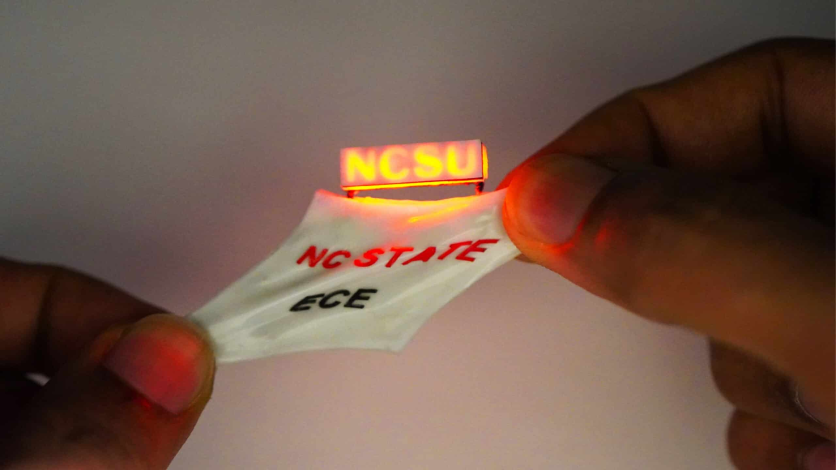
A team of engineers at North Carolina State University and Rice University has demonstrated a stretchable, biodegradable battery that draws its electrolyte directly from ambient humidity — and can power a wireless Bluetooth health monitor continuously for 30 hours — eliminating the toxic and flammable liquid electrolytes that have caused wearable battery failures, burns, and product recalls for years. The results were published July 1 in Science Advances study, making this the most significant publicly available advance in non-toxic flexible power for IoT devices in recent memory.
The battery replaces every one of the major drawbacks of conventional wearable batteries: it is non-toxic, flexible, biodegradable, and — counterintuitively — more reliable in storage than the liquid-electrolyte cells it is designed to replace. It is also the first demonstrable flexible battery platform to incorporate a moisture-triggered self-destruct mechanism capable of obliterating embedded CMOS electronics within three minutes, a capability with direct implications for covert surveillance hardware.
Air Is the Electrolyte: How the Chemistry Works
The moisture-activated battery uses a magnesium anode and a silver/silver chloride cathode — a chemistry with roots in World War II-era military reserve batteries, where seawater activated Mg/AgCl cells for torpedoes and emergency radios. What is new here is the activation medium and the delivery mechanism.
Between the electrodes sits a cellulose membrane packed with lithium chloride salts. LiCl is highly hygroscopic — it absorbs water vapor directly from the surrounding air. As humidity dissolves the salt crystals, the membrane generates an aqueous electrolyte in place, creating the ion-conducting medium that allows charge to flow. The battery produces no current while sealed in packaging; it activates only when exposed to air, giving it indefinite shelf life in storage and eliminating the leakage risk that is inherent to any pre-loaded liquid electrolyte cell.
"Our battery eliminates toxic and flammable electrolytes because it's essentially running on salt water," said Amay Bandodkar, assistant professor of electrical and computer engineering at NC State and co-corresponding author. "And since it only activates once it's exposed to ambient air, it remains inactive while within sealed packaging, giving it an extended shelf life."
The measured performance: approximately 1.6 V open-circuit voltage, roughly 52 mAh/g specific capacity, and about 81 mWh/g specific energy — figures that the researchers say compete with commercial coin-cell batteries.
One constraint worth naming: the Mg/AgCl chemistry is a primary cell design — meaning the battery is single-use rather than rechargeable. That is an important engineering boundary for applications requiring repeated cycling. The team did not report rechargeable variants in this paper, and the biodegradable composition is particularly suited to the single-use disposable-sensor market where rechargeability is not a requirement.
Pangolin Scales Solve the Stretchability Problem
The chemistry alone does not explain the advance. The harder engineering problem in flexible battery design has always been the tradeoff between stretchability and energy density.
The dominant approach in stretchable batteries for the past decade uses serpentine interconnectors — spring-shaped conductive pathways that maintain electrical continuity when the device bends or stretches. The tradeoff is real: as the device stretches, gaps open between the active material layers, reducing the fill factor and with it the energy density. More stretch means more dead space.
The NC State-Rice team solved this with a structural design borrowed from the pangolin — the only mammal whose skin is covered in large keratin scales. Pangolin scales sit in a densely overlapping pattern, each scale resting in the center of six neighbors, creating a hexagonal tile arrangement that allows the animal to curl and bend without exposing gaps. The same principle, applied to battery cell layers, eliminates most of the dead space that serpentine designs create.
"Mechanics plays a central role in making these batteries both stretchable and practical," said Raudel Avila, assistant professor of mechanical engineering at Rice and co-corresponding author. "Our modeling revealed how bioinspired stacking and stretchable interconnectors can redistribute deformation throughout the battery, preserving performance under bending, twisting and stretching while minimizing the empty space that typically reduces energy density."
The result is a battery that can be bent, twisted, and stretched without degrading its capacity — and without the fill-factor penalty that prior stretchable designs accepted as unavoidable. The pangolin-scale architecture is not chemistry-specific: it is a geometric and mechanical principle that could, in principle, be applied to other flexible electrochemical platforms as the field develops rechargeable and solid-state variants.
30 Hours Powering a Real Medical Wearable
Performance claims for flexible batteries are easy to manufacture and hard to contextualize. This team ran a real device.
The moisture-activated battery was used to power a wireless Bluetooth pulse oximeter — continuously — for up to 30 hours, as confirmed in the NC State press release. That runtime is squarely within the range of conventional batteries used in commercial health wearables today, and it was achieved without any pre-loaded liquid electrolyte, on a flexible substrate that can conform to a wrist or chest wall.
"This battery is far more than an academic proof of concept; it is a practical energy source capable of powering everyday IoT and medical devices," said Abraham Vázquez-Guardado, assistant professor of electrical and computer engineering at NC State and co-corresponding author. "That level of performance proves this battery technology is ready to power a whole new generation of electronic devices and applications."
The broader significance for medical device developers: conventional lithium-ion batteries are classified as hazardous materials. Their toxic and flammable electrolytes create real regulatory burden and documented safety risk. In 2022, the Fitbit Ionic recall documented at least 115 reports of batteries overheating in the U.S., with 78 confirmed burn injuries including second- and third-degree burns. The MAB eliminates the chemistry that drives those failures. Its biocompatible, biodegradable materials also address the growing regulatory pressure on electronic waste disposal: both the EPA and the EU have introduced new battery recycling and disposal requirements for lithium-ion cells, requirements the MAB would not trigger.
"Additionally, the battery is lighter than many existing commercially available batteries and is made of biocompatible and biodegradable materials, making it a viable non-toxic alternative to lithium-ion batteries," said Rajaram Kaveti, postdoctoral researcher at NC State and lead author of the study.
Moisture-Triggered Kill Switch Destroys Electronics in 3 Minutes
The most striking application in the paper has nothing to do with healthcare. Embedded alongside the battery in a wireless gas sensor prototype is a moisture-harvesting anti-tamper mechanism capable of physically destroying the device's electronics the moment someone attempts to access or disable it.
The kill switch stores a dry mixture of aluminum and iodine powder inside a sealed compartment within the device housing, covered by the same type of moisture-harvesting cellulose membrane that powers the battery. Under normal operating conditions the powder is completely inert. When pressure is applied to the housing — as it would be if an adversary tried to open, remove, or disable the sensor — the compartment seal is breached, the dry powder contacts the moisture already harvested from ambient air, and a rapid exothermic chemical reaction engulfs the device in flames, destroying it completely.
In proof-of-concept testing, the researchers demonstrated that a complete MAB-powered wireless gas sensor — including its embedded CMOS electronics — was obliterated within three minutes of trigger activation, as documented in the NC State press release.
The practical application for covert intelligence-gathering hardware is clear. A surveillance sensor that destroys its own electronics on tamper is a meaningfully different security proposition from a device that can be captured, disassembled, and reverse-engineered. It should be noted that any commercialization of this kill-switch design for defense or intelligence applications would likely require review under U.S. export control regulations, including the International Traffic in Arms Regulations — a dimension the research paper does not address, but that defense contractors and government partners would need to navigate before deployment.
Regulatory Timing Makes This Particularly Relevant
The paper's publication lands at an inflection point in wearable device regulation. The FDA issued FDA general wellness guidance in January 2026 that relaxes oversight requirements for low-risk general wellness wearables — reducing barriers to market for non-medical-claim flexible sensors. That guidance explicitly addresses noninvasive physiological sensing products of the type the MAB is designed to power.
Simultaneously, escalating regulatory requirements for lithium-ion battery disposal — at the EPA, which is developing new RCRA rules for Li-ion waste management, and in the EU, which imposed 65 percent recycling efficiency targets for lithium batteries as of December 2025 — are raising the operational cost of deploying Li-ion in disposable sensor applications. A battery whose primary materials are cellulose, magnesium, silver, and salt sidesteps most of this regulatory complexity entirely.
What This Is and What It Isn't Yet
The moisture-activated battery demonstrated in this paper is a primary-chemistry, single-use power source. It is not rechargeable in its current form, and the specific minimum humidity threshold at which it maintains full performance across environmental conditions is not specified in publicly available materials. The team's claim that it functions "even in climates as dry as the desert" needs independent confirmation across the range of relative humidity levels that deployed IoT devices routinely encounter.
What has been demonstrated is this: a non-toxic, stretchable, biodegradable battery platform capable of delivering coin-cell-competitive energy density without liquid electrolytes, confirmed to power a real Bluetooth medical device for 30 hours, with a built-in anti-tamper kill switch that works. That combination has not been demonstrated before in a single platform, published in a peer-reviewed journal, with independently verifiable performance numbers.
The research was supported by NC State's ASSIST Center Industry Seed Fund and Chancellor's Innovation Fund, as well as by Rice University's ENRICH office. Co-first authors are NC State graduate student Akshay Bhardwaj, postdoctoral scholar Ayemeh Bagheri Hashkavayi, and Rice Ph.D. student Pei Liu. Additional NC State co-authors include Bhavya Jain, Adrian Rodriguez-Kattan, Mahaboobbatcha Aleem, Baha Erim Uzunoğlu, Gurudatt N.G., Bünyamin Şahin, and Veena Misra.
Frequently Asked Questions
How does a moisture-activated battery differ from a conventional lithium-ion cell?
A conventional lithium-ion battery contains a pre-loaded liquid electrolyte — typically a lithium salt dissolved in an organic solvent — that is flammable, toxic, and requires hermetic sealing to prevent leakage. The moisture-activated battery developed by NC State and Rice University has no pre-loaded liquid. Instead, a cellulose membrane packed with lithium chloride salts absorbs water vapor directly from ambient air, creating the electrolyte in place when the device is needed. The result is a battery that is inert in sealed packaging, activates on exposure to air, produces no toxic or flammable chemicals, and is made from biodegradable materials including cellulose and magnesium. It uses a magnesium-silver/silver chloride electrochemical couple rather than lithium-ion intercalation chemistry.
Why does the pangolin-scale design matter for energy density?
Most stretchable batteries solve the flexibility problem with serpentine interconnectors — spring-shaped conductors that keep the circuit intact as the device stretches. The tradeoff is that stretching opens gaps between the active material layers, reducing the fraction of the battery's volume that is actually generating charge (the "fill factor"). The pangolin-inspired overlapping-scale architecture distributes mechanical deformation differently: densely tiled layers slide and flex relative to each other, allowing the battery to stretch and bend without creating the dead space that serpentine designs require. That makes the pangolin-scale approach potentially applicable to other flexible battery chemistries beyond the moisture-activated design demonstrated here — it is an architectural principle, not just a feature of this specific battery.
Does the self-destruct kill switch create any export control issues?
The kill switch operates by breaching a sealed compartment containing dry aluminum and iodine powder when physical pressure is applied to the device housing. Contact with the harvested moisture triggers an exothermic reaction that destroys the device's electronics within minutes. The researchers demonstrated this on a wireless gas sensor, framing it as a capability for covert surveillance hardware. Any commercial development of this feature for defense, intelligence, or military applications would likely require evaluation under U.S. export regulations, including the International Traffic in Arms Regulations. The paper itself does not address this regulatory dimension, and it would need to be resolved before such a system could be manufactured for export or deployed by government contractors.
When can consumers or medical device manufacturers expect to see this battery in products?
No commercial timeline was announced with this publication. The research appears in Science Advances as a laboratory demonstration, and the NC State ASSIST Center — an NSF Engineering Research Center that has spun out 10 startups from its research — does work with industry partners on technology translation. Several engineering questions remain open before commercial deployment, including characterization of performance across the full operating humidity range, manufacturing scalability of the pangolin-scale stacking architecture, and regulatory pathway for any medical-device applications. The 30-hour runtime in a real Bluetooth oximeter is a meaningful proof-of-concept milestone, but the path from laboratory result to certified commercial product typically spans years.

-
 C114 Communication Network
 -
 Communication Home
