
 Search


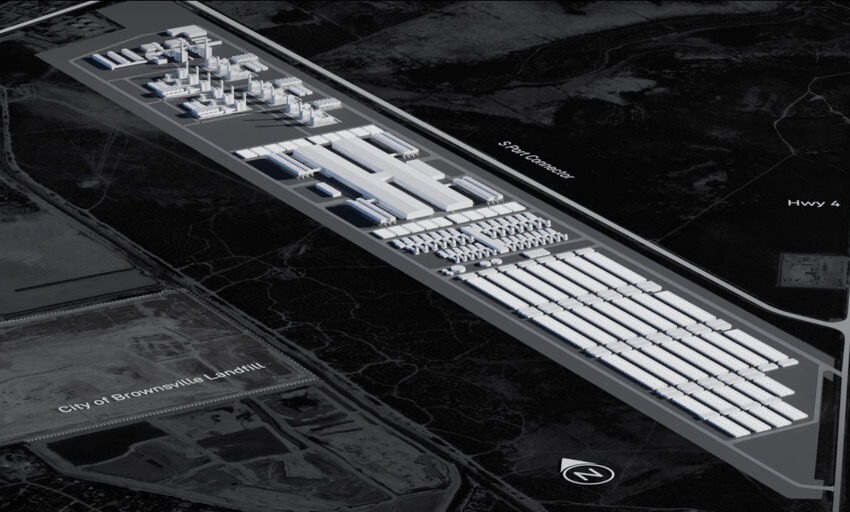
SpaceX has unveiled plans for more than $74 billion in AI supercomputing investments across two major U.S. facilities, including a new installation near Starbase in South Texas and a second campus in Cochise County, Arizona. Announced November 12 under the company’s Building the Future initiative, the projects expand SpaceX’s computing infrastructure ambitions, combining large-scale AI training facilities with dedicated energy infrastructure, regional utility investments, and technologies intended to support future space-based computing.
The Texas project represents an investment of up to $24 billion in new supercomputing infrastructure on SpaceX-owned property near the Port of Brownsville and the city’s landfill. The facility will train frontier AI systems for applications including medical research, emergency response, advanced manufacturing, and national security. SpaceX says the installation will generate its own electricity independently of the public grid. The company is also committing $220 million to expand regional water and wastewater infrastructure, with projects designed to add approximately 20 million gallons per day of capacity. More than 3,000 construction jobs have already been generated, and the facility is expected to support more than 500 permanent positions once operational.
In Arizona, SpaceX is pursuing a roughly $50 billion supercomputing campus in Cochise County, potentially creating 5,500 construction jobs and 1,000 permanent positions. The company is working with local electric cooperatives on an energy infrastructure plan that would leverage existing renewable resources and could reduce electricity bills for cooperative members by as much as 20%, according to SpaceX. Unlike the Texas installation’s proposed independent power system, the Arizona project involves cooperation with regional electricity providers. SpaceX also plans to use dry cooling, with no industrial groundwater consumption or new wells currently planned. The project is seeking approval, and SpaceX has not disclosed accelerator suppliers, network architecture, or commissioning schedules for either campus.
“We’re advancing two extraordinary projects: a major new supercompute facility at Starbase in the Rio Grande Valley in Texas, and a second campus in Cochise County, Arizona.”
— SpaceX, Building the Future, November 12, 2026
| SpaceX Supercomputing Expansion | November 12, 2026 | |
| Combined planned investment | $74B+ |
| New campuses | 2 |
| Construction employment | 8,500+ reported or projected across both projects |
| Permanent employment | 1,500+ projected |
| TEXAS | STARBASE / BROWNSVILLE | |
| Investment | Up to $24 billion |
| Power | • On-site generation independent of the public grid |
| Water investment | • $220 million committed • $40 million already provided |
| Water capacity | • Approximately 20 million gallons/day of additional capacity: 8 million from potable reuse and 12 million from brackish-water treatment |
| Site | • Approximately 444 acres of privately owned land disannexed from Brownsville to Starbase |
| Employment | • More than 3,000 construction jobs generated • More than 500 permanent jobs projected |
| ARIZONA | COCHISE COUNTY | |
| Investment | Approximately $50 billion |
| Energy | • Local electric cooperative partnerships • Existing renewable resources and grid infrastructure |
| Electricity bills | • Up to 20% potential reduction for cooperative members, according to SpaceX |
| Cooling | • Dry cooling; no industrial groundwater consumption or new wells planned |
| Employment | • Approximately 5,500 construction and 1,000 permanent jobs projected |
| Status | • Seeking regulatory/local approval |
| Source: SpaceX, November 12, 2026. Investments, jobs, cost savings and infrastructure benefits include planned or projected values, not confirmed completed outcomes. | |
Analysis
The November 12 announcement provides a geographic and infrastructure roadmap for SpaceX’s expansion into large-scale AI computing. It also connects terrestrial AI training capacity to the company’s longer-term plans for orbital data centers. SpaceX identifies the Brownsville installation as a platform for developing and testing technologies for future space-based computing, although it has not disclosed the precise technical relationship between the terrestrial systems and a prospective orbital compute architecture.
Power infrastructure is a central distinction between the projects. In Texas, SpaceX proposes dedicated on-site electricity generation that would not draw from the public grid. Local reporting identifies the development as including a gas-fired power plant, with tax agreements due for consideration in December. In Arizona, the company is pursuing a cooperative-based energy model incorporating existing renewable resources and regional grid infrastructure. Both approaches entail engineering and regulatory considerations including generation capacity, transmission, reliability, air emissions and permitting. The November 12 company announcement does not specify the electrical capacity of either campus.
Water management is another major component. The $220 million Brownsville commitment would support approximately 8 million gallons per day of potable water reuse and 12 million gallons per day of additional brackish-groundwater treatment capacity. SpaceX says the facilities will remain publicly owned and that it will receive neither preferential water access nor water rights. In Arizona, the proposed dry-cooling architecture would reduce dependence on industrial water consumption, with different thermal-management tradeoffs from evaporative cooling.
The announcement fits into SpaceX’s broader infrastructure strategy, which includes its Terafab semiconductor manufacturing initiative in Grimes County, Texas. The company’s November 12 statement describes Terafab as a $100 billion advanced-chip project. That separately announced initiative must not be conflated with the $74 billion planned for the two new supercomputing campuses. Nor should the $40 billion NVIDIA equipment lease commitment previously disclosed be added to the campus commitments as though the underlying expenditures were necessarily distinct.
Unanswered technical questions include accelerator selection, installed GPU/XPU counts, high-speed Ethernet or other scale-out interconnects, optical transceiver demand, storage architecture, rack power density, cooling equipment, and construction milestones. The projects remain subject to relevant approvals. Local officials in Arizona have scheduled a December 9 hearing, and Starbase officials are considering tax arrangements for the Texas project. Investment totals cannot yet be converted reliably into compute capacity or networking equipment demand.
| COMPANY PROFILE | SPACEX | |
| Company | Space Exploration Technologies Corp. |
| Headquarters | Starbase, Texas |
| Founded | 2002 |
| Leadership | Elon Musk, founder and CEO |
| Operations | Launch and spacecraft systems; Starlink satellite connectivity; Super Intelligence computing and software |
| AI infrastructure | Colossus terrestrial AI systems; proposed Texas and Arizona supercompute campuses; Starmind orbital-compute roadmap |
| Semiconductor roadmap | Terafab advanced logic, memory, packaging and testing campus planned in Grimes County, Texas |
| Website | spacex.com |
| FOLLOW OUR SPACE COVERAGE | |
| • We’re tracking satellite networks, orbital AI infrastructure and space-based computing. Converge Digest Space Coverage |

-
 C114 Communication Network
-
 Communication Home
