
 Search


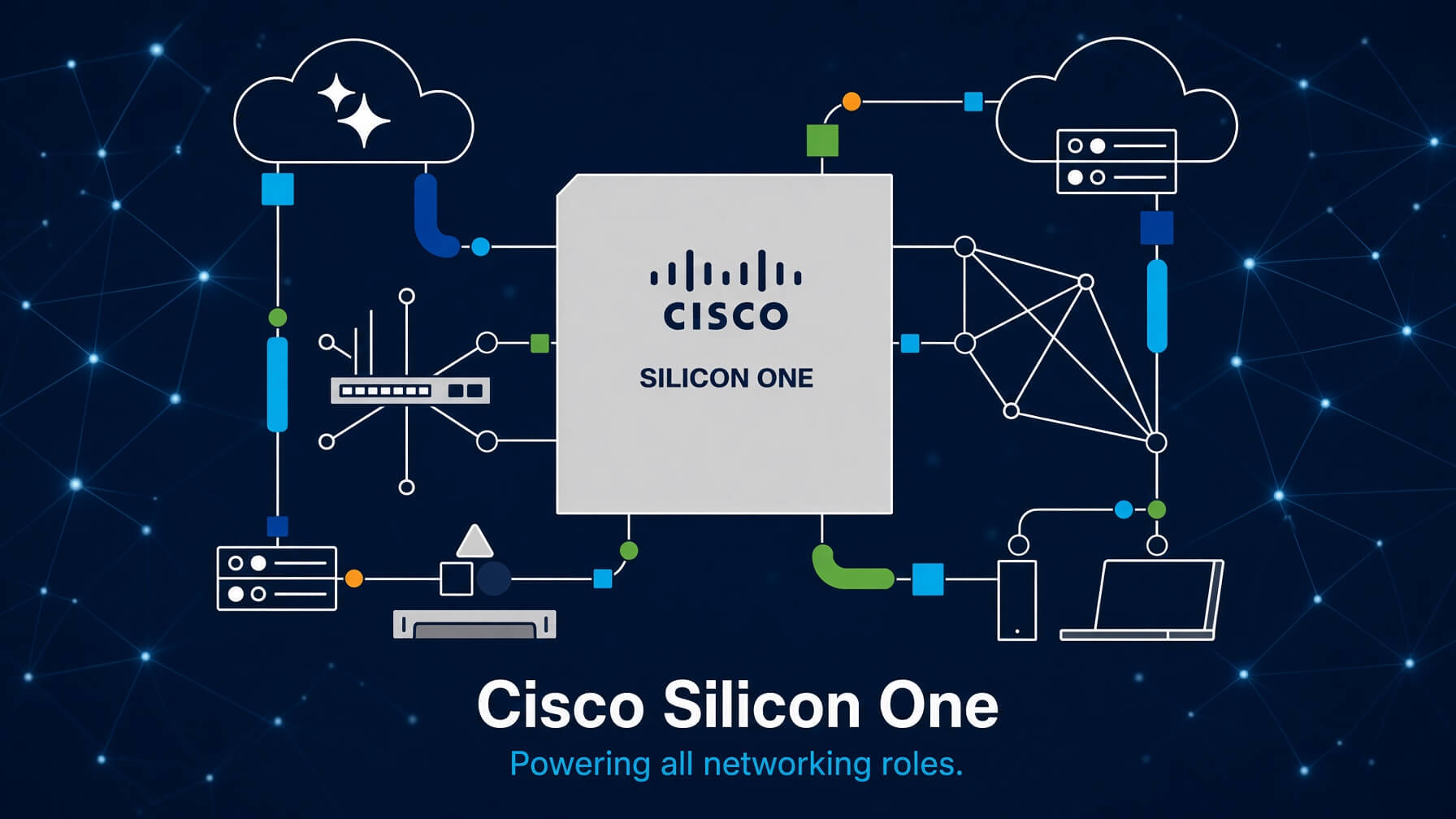
Cisco reported record quarterly revenue of $18.5 billion for its first quarter of fiscal 2027, an increase of 24% year over year, as accelerating AI infrastructure deployments, hyperscaler spending and a broad enterprise networking refresh drove its strongest revenue growth in more than 15 years. Networking revenue surged 43% to $11.1 billion, while non-GAAP earnings per share rose 40% to $1.40. Cisco raised its fiscal 2027 revenue outlook to $74.8 billion–$75.8 billion and increased its expectation for AI infrastructure revenue from hyperscalers to approximately $9 billion, more than twice the fiscal 2026 total.
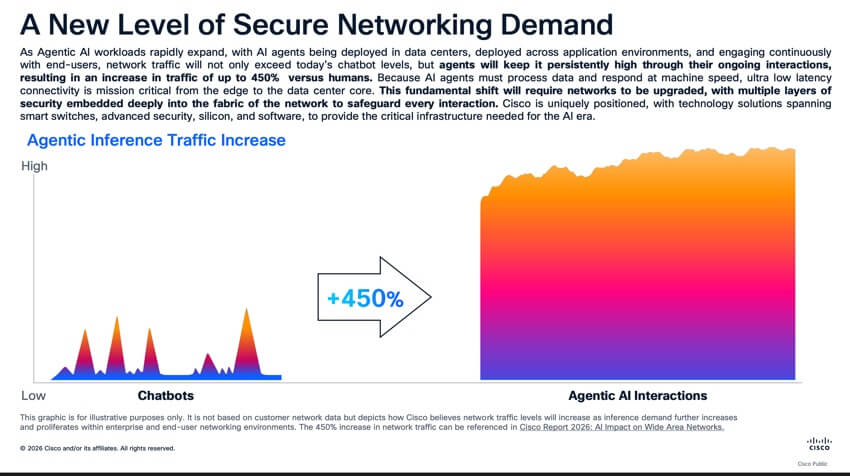
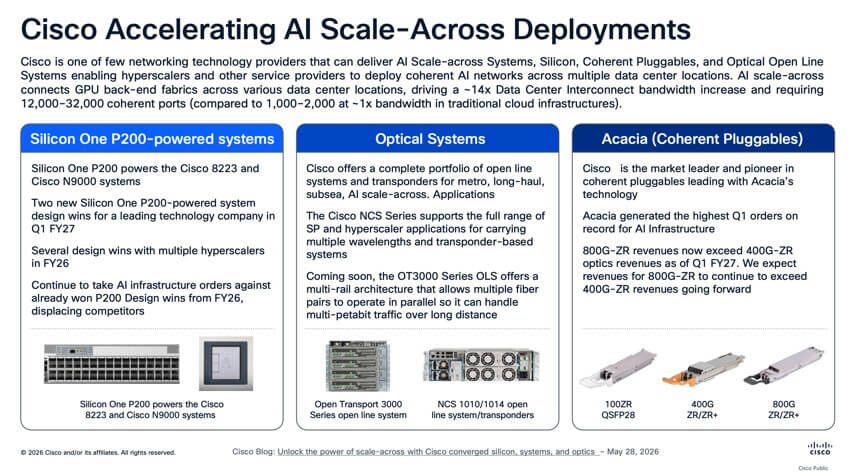
The most consequential development is Cisco’s growing participation in AI infrastructure across hyperscale clusters, neocloud and sovereign AI deployments, and enterprise data centers. The company secured three additional AI infrastructure design wins, bringing its total to 18 over the past five quarters. Two involved Silicon One P200-powered systems for data center interconnect and Scale Across applications, while the third involved optics for Scale Out networking. Cisco also reported that revenue from its Acacia 800G-ZR coherent optics exceeded 400G-ZR revenue for the first time.
Enterprise infrastructure spending provided another growth engine. Campus networking orders increased 14%, data center switching orders posted double-digit growth, and industrial IoT orders rose approximately 50%. Wi-Fi 7 represented more than 60% of wireless access-point orders, contributing to demand for multigigabit Ethernet switching. Cisco estimates a broader networking refresh opportunity exceeding $100 billion, although this is an addressable-market estimate rather than a contracted backlog. Total product orders increased 21%, including 47% growth in the service provider and cloud customer market.
Chuck Robbins, Cisco’s Chair and CEO, said: “We are in the very early stages of a multi-year networking supercycle, and we’re confident in our ability to continue capturing the multi-billion-dollar opportunity it represents for Cisco.”
| Cisco Q1 FY2027 | Key Financial and Infrastructure Trends | |
| Record revenue | $18.517 billion, +24% YoY |
| Networking | $11.132 billion, +43% YoY; 60% of total quarterly revenue |
| Profitability | GAAP EPS $1.14 (+58%); non-GAAP EPS $1.40 (+40%); non-GAAP operating margin 37.8% |
| AI infrastructure | ~$9B FY27 hyperscaler AI revenue forecast; 3 new design wins, 18 in five quarters |
| Networking orders | Total product orders +21%; networking orders +28%; campus +14%; industrial IoT approximately +50% |
| Optical shift | 800G-ZR coherent optics revenue surpassed 400G-ZR in Q1 FY27 |
| Guidance | FY27 revenue $74.8B–$75.8B; non-GAAP EPS $5.47–$5.53 |
Revenue Mix and Growth
Networking accounted for approximately 60% of quarterly revenue, up from roughly 52% one year earlier. Revenue growth was concentrated in hardware infrastructure even as Cisco continued to expand security, collaboration and observability offerings.
| Q1 FY2027 | Revenue by Business | |
| Networking | $11.132B | +43% YoY |
| Security | $2.120B | +7% |
| Collaboration | $1.136B | +8% |
| Observability | $279M | +2% |
| Services | $3.850B | +1% |
| Total | $18.517B | +24% |
| Chart 1 | Cisco Revenue Growth by Business | |||
| Networking |
| ||
| Collaboration |
| ||
| Security |
| ||
| Observability |
| ||
| Services |
| ||
| YoY growth, Q1 FY2027. Horizontal bars use fixed table cells rather than CSS/JavaScript. | |||
Guidance and Financial Outlook
Cisco raised its full-year guidance to $74.8 billion–$75.8 billion in revenue and $5.47–$5.53 in non-GAAP EPS. The annual midpoint implies about 19% revenue growth and 27% non-GAAP EPS growth. Q2 guidance calls for $18.0 billion–$18.2 billion in revenue. The company returned $3.66 billion to shareholders in Q1.
| Financial Outlook and Operating Metrics | |
| FY27 guidance | Revenue $74.8B–$75.8B; GAAP EPS $4.38–$4.44; non-GAAP EPS $5.47–$5.53 |
| Q2 FY27 guide | Revenue $18.0B–$18.2B; non-GAAP EPS $1.34–$1.36; non-GAAP operating margin 36%–37% |
| Margin | Non-GAAP gross margin 65.6% vs. 68.1% a year ago; product gross margin 63.7% vs. 67.2% |
| Cash flow | Operating cash flow $4.357B; dividends and repurchases $3.656B |
| Recurring revenue | ARR $32.7B, +4%; RPO $46.2B, +8% |
| Supply exposure | Inventory $6.384B vs. $3.395B YoY; purchase commitments $21.883B vs. $8.321B YoY |
Cisco’s November 12 investor presentation highlighted 18 AI infrastructure design wins over five quarters and double-digit data center switching order growth in nine of the past eleven quarters. The company described Scale Across as a new networking and optics opportunity, with high-port-count coherent DCI in its illustrative architecture. The presentation also reported record Acacia AI infrastructure orders. These are presentation disclosures, not quotations from the live earnings-call Q&A.
| Investor Presentation | Infrastructure Signals | |
| AI design wins | Three Q1 awards: two P200-powered Scale Across/DCI systems and one Scale Out optics; 18 wins across five quarters |
| Silicon One | P200 51.2 Tbps; G300 102.4 Tbps; broader architecture adoption targeted by FY2029 |
| Scale Across | Cisco architecture illustration: ~14× DCI bandwidth and 12,000–32,000 coherent ports versus traditional 1,000–2,000 |
| Acacia optics | Record Q1 AI infrastructure orders; 800G-ZR revenue exceeds 400G-ZR revenue |
| Campus refresh | Wi-Fi 7 >60% of access-point orders; new campus switching products |
| Hardware economics | Product non-GAAP gross margin -3.5 percentage points YoY; operating margin +3.4 points YoY |
| Scope | Presentation dated November 12, 2026. Live investor-call Q&A transcript was not supplied; no Q&A remarks are attributed here. |
| Chart 2 | Hyperscaler AI Infrastructure Revenue | |||
| FY2026 |
| ||
| FY2027 forecast |
| ||
| Values in US dollars: approximately $4B FY2026 actual and approximately $9B FY2027 management forecast. FY2027 is NOT realized revenue; excludes neocloud, sovereign and enterprise AI. | |||
Analysis: AI Infrastructure Is Reshaping Cisco’s Growth Strategy
Cisco’s first-quarter results highlight a structural shift in its business as AI infrastructure becomes a major driver of networking demand. The company’s forecast of approximately $9 billion in fiscal 2027 hyperscaler AI revenue, more than double fiscal 2026, reflects growing adoption of high-performance Ethernet switching, Silicon One processors and optical interconnects. Cisco secured three additional AI infrastructure design wins during the quarter, bringing its total to 18 over five quarters. Its Silicon One architecture is increasingly central to this strategy, spanning Scale Out networking within AI clusters and Scale Across connectivity between data centers. Cisco plans to extend Silicon One adoption across its high-performance networking portfolio by fiscal 2029, creating a common silicon foundation for hyperscale and enterprise infrastructure.
Scale Across networking represents a particularly important opportunity for Cisco’s optical business. As GPU clusters expand across multiple facilities, networking requirements increasingly extend beyond traditional data center interconnect. Cisco estimates that distributed AI architectures could require approximately 14 times the interconnect bandwidth of conventional cloud deployments in its illustrative scenario, potentially increasing coherent port requirements from 1,000–2,000 to 12,000–32,000. This creates demand for higher-capacity coherent optics, advanced congestion management and optical transport systems. Cisco reported that Acacia’s 800G-ZR revenue exceeded 400G-ZR revenue for the first time, while its Silicon One P200 secured two additional design wins for data center interconnect and Scale Across applications. The combination of switching silicon, coherent pluggables and open optical transport systems positions Cisco to address multiple layers of distributed AI networking infrastructure.
Enterprise modernization provides a second major growth engine beyond hyperscale AI. Campus networking orders increased 14%, data center switching orders grew by double digits, and industrial IoT orders rose approximately 50%. Wi-Fi 7 represented more than 60% of wireless access-point orders, accelerating demand for multigigabit Ethernet switching. Cisco estimates that its broader network refresh opportunity exceeds $100 billion, with next-generation campus switches still representing less than 10% of campus switching orders. Meanwhile, neocloud, sovereign cloud and enterprise AI deployments are expanding demand for Nexus switching, security and observability. These markets diversify Cisco’s AI infrastructure opportunities beyond hyperscalers, although the company has not separately quantified their expected AI revenue.
The financial results also reveal how this infrastructure transition is changing Cisco’s business economics. Networking revenue increased 43%, substantially outpacing Security, Collaboration, Observability and Services, but non-GAAP product gross margin declined from 67.2% to 63.7%. Despite that compression, non-GAAP operating margin expanded to a record 37.8%, reflecting operating expenses growing considerably more slowly than revenue. Inventory reached $6.4 billion, while inventory purchase commitments increased to $21.9 billion, indicating a substantial expansion of supply commitments alongside demand. Looking ahead, Cisco’s performance will depend on converting hyperscaler design wins into production revenue, sustaining the campus refresh cycle, expanding its optical and silicon footprint, and preserving profitability as high-volume AI networking becomes a larger share of its business.
| Company Profile | Cisco Systems | |
| Headquarters | San Jose, California, United States |
| Public company | NASDAQ: CSCO; founded 1984 |
| Leadership | Chuck Robbins, Chair and Chief Executive Officer |
| Core platforms | Silicon One, Cisco 8000, Nexus, Catalyst, Acacia coherent optics, security, Splunk observability |
| Markets | Hyperscalers, neoclouds, sovereign clouds, enterprises, service providers, campus and industrial networks |
| Website | cisco.com |
We’re tracking AI infrastructure and data center networking developments. Follow ongoing coverage at Converge Digest AI Infrastructure.

-
 C114 Communication Network
-
 Communication Home
