
 Search


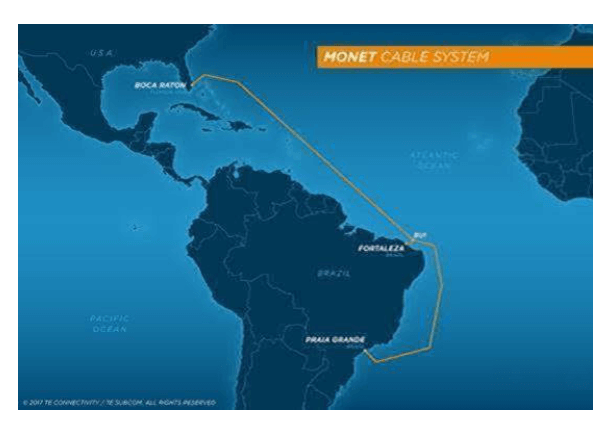
Zayo now has three separate subsea paths between the United States and Brazil. The company has activated capacity on the Monet cable system, which adds to its existing U.S.–Brazil routes on Seabras-1 and GlobeNet. Zayo says the new route strengthens the Miami–São Paulo corridor and gives customers more resiliency and routing options into Brazil. It is aimed at cloud and AI providers, multinational enterprises, financial institutions, carriers and content companies operating across the Americas. Zayo places the activation within its Zayo Global Reach business.
In Brazil, the route connects directly into Zayo's metro fiber ring in São Paulo. That ring links Equinix's SP2, SP3 and SP4 data centers and B3, Brazil's principal stock exchange. In the United States, the route connects into Zayo's North American network. Zayo highlights the MIAX Sapphire exchange in Miami and its ultra-low-latency Spread Networks route between Chicago and New York, along with more than 1,400 data centers, 400 metro markets and 90,000 on-net enterprise locations. Zayo cites TeleGeography data showing that international bandwidth demand in Latin America grew at a 34% compound annual rate from 2020 to 2024.
Zayo did not disclose how much capacity it activated or whether it holds wavelengths, spectrum or a fiber pair. It also did not say which Monet consortium member supplied the capacity, which terminal equipment lights it, or any contract terms. Monet is a 10,556-km, six-fiber-pair system owned by Algar Telecom, Angola Cables, Antel and Google. It lands at Boca Raton, Florida, and at Fortaleza and Santos, Brazil. The consortium declared it complete in May 2018 with an initial design capacity of at least 64 Tb/s. Zayo describes the new route as a Miami–São Paulo corridor but has not said how it backhauls traffic between those cities and Monet's landing stations.
"Customers are under pressure to move data across regions with more scale and less risk," said Sowmyanarayan Sampath, CEO of Zayo. "Zayo connects more North American data centers and key markets than any other provider. We're building on our reach by investing in cross-border routes and in-market infrastructure where customers need more capacity, more diversity, and stronger access to growth markets."
| Key Points: Zayo Adds Monet as Third U.S.–Brazil Route |
| THE ACTIVATION• Zayo has activated capacity on the Monet subsea cable system • Its third diverse U.S.–Brazil route, alongside Seabras-1 and GlobeNet • Positioned as diversity for the Miami–São Paulo corridor • Capacity amount, capacity type (wavelengths, spectrum or fiber pair) and supplying consortium member not disclosed |
| BRAZIL END• Connects directly into Zayo’s São Paulo metro fiber ring • Links Equinix SP2, SP3 and SP4 data centers • Reaches B3, Brazil’s principal stock exchange |
| U.S. END• Ties into Zayo’s North American network, including MIAX Sapphire in Miami • Access to Zayo’s ultra-low-latency Spread Networks route, Chicago to New York • More than 1,400 data centers, 400 metro markets and 90,000 on-net enterprise locations |
| THE MONET CABLE• 10,556 km, six fiber pairs, SubCom open-cable design • Lands at Boca Raton, Florida, and Fortaleza and Santos, Brazil • Owned by Algar Telecom, Angola Cables, Antel and Google • Declared complete May 2018; initial design capacity of at least 64 Tb/s |
| DEMAND CONTEXT• Latin American international bandwidth demand grew at a 34% CAGR, 2020–2024 (TeleGeography, as cited by Zayo) • Target customers: cloud and AI providers, multinational enterprises, financial institutions, carriers and content companies |
Analysis
For a carrier selling into Brazil, a third route matters because each additional cable system adds physical separation. Separate systems on separate paths make it less likely that a single cable fault or landing-station problem takes down all of a customer's U.S.–Brazil capacity. Monet's landings set it apart from Zayo's other two routes. It comes ashore at Boca Raton in Florida and at both Fortaleza and Santos in Brazil, and its Santos landing serves the São Paulo market. Zayo's release does not compare the three paths or say whether the Monet capacity has its own backhaul into São Paulo and Miami. Those are the details that determine how much real diversity a customer gets. The financial-network references point to one target market: São Paulo's B3 exchange on the Brazil end, and MIAX Sapphire and the Spread Networks Chicago–New York route on the U.S. end. Zayo has not published latency figures for the new route.
Monet's open-cable design lets each owner pick its own terminal equipment and resell capacity, so the cable carries several carriers' traffic. In 2022 Sparkle activated spectrum on Monet as one of its diversified routes between North and South America. In September, Angola Cables said it is deploying Ciena WaveLogic 6 Extreme across Monet and SACS, with 800G client interfaces planned on Monet. Zayo's activation adds another reseller on a nine-year-old cable whose usable capacity is now set mainly by the terminal equipment upgrades. Without a capacity figure, Zayo's share cannot be sized. Newer capacity is also on the way. In January, V.tal announced Synapse, a 16-fiber-pair, roughly 9,700-km SDM cable from São Paulo to Tuckerton, New Jersey. Google is building out its Americas Connect mesh through the Caribbean.
For Zayo, the activation is a rare international move after a year focused mostly on North America. That work included closing the Crown Castle Fiber Solutions acquisition in May, a long-haul build program of more than 15,000 route miles, and AI-corridor expansion work with NVIDIA. This is also one of the first network announcements since Sowmyanarayan Sampath took over as CEO on September 1. His quote frames the activation as part of investing in "cross-border routes and in-market infrastructure." The open question is whether Zayo extends the same approach to other Latin American markets or keeps it to the U.S.–Brazil corridor.
| Company Profile: Zayo |
| OVERVIEW• Independent fiber and digital infrastructure provider based in Denver, Colorado; founded in Boulder, Colorado, in 2007 • Long-haul and metro fiber, wavelengths, dark fiber, Ethernet, managed services and international connectivity through Zayo Global Reach • Privately held; agreed in 2019 to be acquired by a consortium led by Digital Colony and EQT in a transaction valued at $14.3 billion |
| NETWORK SCALE• 224,000 route miles and 32 million fiber miles across North America, after the Crown Castle Fiber Solutions deal • More than 400 metro markets; more than 1,400 data centers and 90,000 on-net enterprise locations reachable • U.S.–Brazil subsea routes: Seabras-1, GlobeNet and now Monet |
| LEADERSHIP• Sowmyanarayan Sampath, CEO since Sept. 1, 2026 (previously CEO of Verizon Consumer and Verizon Business) • Steve Smith, former CEO, remains on the Board; Kevin Turner, Chairman • Alissa Clousing, Managing Director, Zayo Global Reach |
| 2026 MILESTONES• May 2026: closed acquisition of Crown Castle’s Fiber Solutions business, adding about 90,000 route miles and 40,000 on-net enterprise locations • Aug 2026: AI network backbone expansion with NVIDIA; long-term Corning fiber supply agreement • Nov 2026: Monet capacity activated as third diverse U.S.–Brazil route |
| WEBSITE• zayo.com |
We’re tracking Zayo’s network expansion, from North American long-haul and metro fiber to international subsea routes. See Converge Digest Zayo coverage.

-
 C114 Communication Network
-
 Communication Home
