
 Search


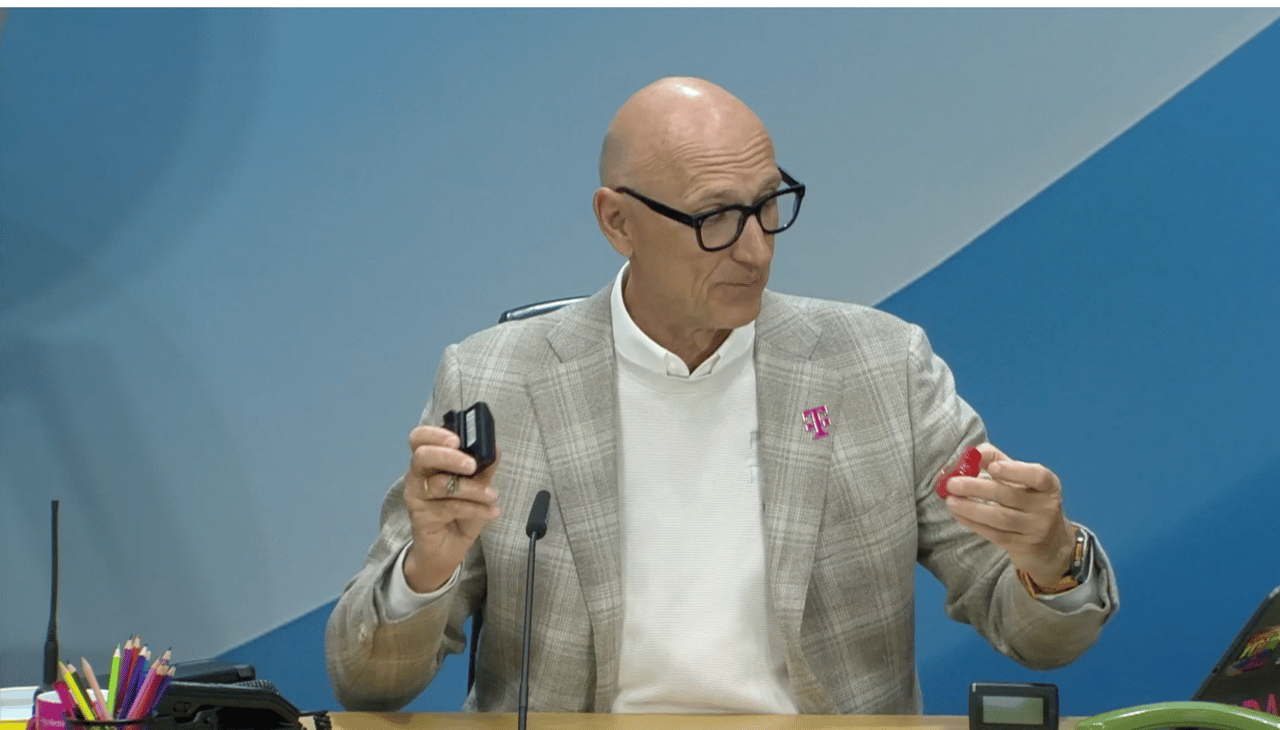
Timotheus Höttges, Deutsche Telekom's boss, says picking on 5G networks is unfair when Chinese technology is so pervasive.(Source: Deutsche Telekom)
In an ideal world, Timotheus Höttges would have bought the chips for his AI data center in Munich from a European company to ensure it ticked all the boxes for sovereignty, he told reporters in February. Short of choices, Deutsche Telekom's CEO opted instead for America's Nvidia, whose own CEO Jensen Huang is now suspected of having had an affair with a Chinese spy. Yet if sovereignty is such an important consideration in AI, observers may wonder why it is apparently so unimportant to the telco in 5G.
For years, Europe's biggest telco has extended 5G coverage and added 5G capacity in Germany, the region's largest economy, by sourcing network products from Huawei, a Chinese vendor seen in European Union (EU) circles as a threat to security. The concern is that Huawei, under Chinese government orders, could use software "backdoors" in those network products to snoop on European communications or even sabotage 5G infrastructure. Huawei has long denied the claims, pointing to a lack of evidence. But it has not been able to change the direction of policy at the EU, which is trying to introduce much tougher anti-Huawei legislation.
Under forthcoming rule changes by the EU as well as Germany's government, Höttges could find that maintaining any relationship with Huawei becomes much harder. Previously, EU officials had merely advised member states to avoid "high-risk vendors," interpreted as a euphemism for Chinese companies, when building 5G networks. But since the start of this year, the EU has been working on an update of the Cybersecurity Act (CSA) that would make avoidance of Huawei a mandatory requirement.
Höttges has previously justified Deutsche Telekom's continued reliance on the Chinese vendor with reference to Germany's own classifications. Until now, national authorities have designated only the "core," the brain of the 5G infrastructure, as critical, along with the management system for controlling and updating the radio access network (RAN).
No other RAN components have been treated as critical parts. Deutsche Telekom, accordingly, took steps to remove Huawei from the core and, more recently, to develop a substitute for Huawei's RAN management system. But it has not been forced to contemplate a removal of the Huawei RAN and has stubbornly refused to do so.
Chinese tech everywhere
Unfortunately, German authorities have recently shown they may no longer be in alignment with Höttges. Last month, the Bundesnetzagentur, which regulates Germany's telecom industry, filed a new draft regulation with the European Commission that reclassifies the entirety of the RAN.
Using the technical jargon of "gNodeB" to refer to a 5G basestation, it stated that "all functions of the gNodeB are to be classified as a critical function, as material impairments of the same have an impact on availability, confidentiality, integrity and authenticity." Earlier this month, the German government was reported by Handelsblatt to have followed up by drafting plans for a comprehensive ban on Huawei.
None of that appears to have brought a softening in Höttges' tone. The update of the CSA will cost the European telecom industry as much as €40 billion (US$45 billion) and have the opposite effect to what European officials had intended, he told equity analysts last week on Deutsche Telekom's latest earnings call when asked to comment on reports of a Huawei ban.
"They will lose resilience because we will lose time for the latest and most modern technology," he said. "So, therefore, I'm fighting against it. I think there is no necessity to push that forward. But there's nothing more to say at that point in time. There might be some political discussion left of this in Germany."
Lovers of logical fallacies might also have fun with his retort about China's commercial influence being even more pervasive outside telecom. "I hear a lot of discussion that people are saying, by the way, 80% of the energy market and solar market is now dominated by Chinese vendors and the software for the solar panels is Chinese," he said.
"So, is this a security risk for energy supply?" he continued, possibly to a collective nodding of heads by China's critics. "We have a double-digit growth for cars from China now in Europe. These cars are fully steered with software from China," Höttges elaborated, while a few listeners conceivably imagined traffic collisions in Berlin remotely engineered from Beijing.
"So, I do not know why we are now focusing only on the mobile network here in Germany, where we have no incidents and no kind of access to the infrastructure from the outside," said Höttges. "I think the industry will be facing a lot of investments, and they will lose time to market on 6G."
The management system fudge
Even so, Deutsche Telekom has made efforts to replace Huawei's 5G core and RAN management system precisely because they are perceived to have vulnerabilities that a more hostile China could exploit. Developed by Deutsche Telekom and French systems integrator Capgemini, the substitute will be used to control and configure the rest of Huawei's RAN. Germany's other big telcos, which are similarly reliant on Huawei, are to use the same technology, as previously reported by Light Reading and now confirmed by Höttges.
"We made good progress on developing that software," he said. "By the way, we have resold – are reselling – the software to Vodafone and to Telefónica here in Germany. So, they are helping us to reimburse for the cost. So, therefore, this is on its way. There are no kind of other discussions going on. To my knowledge, even the 36 months of rip and replace are more or less off the table." That final remark dismissed the possibility of a ban requiring operators to replace Huawei's RAN within three years, the timeline proposed by the EU.
But these measures would no longer be enough for the Bundesnetzagentur, following its reclassification of the entire RAN, and not just its management system, as a critical technology. Several security and network professionals within the telecom industry have also privately voiced skepticism that replacing only the RAN's management system would address the alleged threat. Operators would be retaining Huawei's basestation software, which could theoretically include backdoors for spying or sabotage.
Whether a third-party management system can be married to Huawei's RAN is also in doubt. In an open RAN, built with standardized, non-proprietary interfaces, operating one provider's RAN with another's management system should be easier. But Huawei remains opposed to the concept of open RAN. The expectation of German telcos seems to be that it will be prepared to expose RAN information to the new management system using an interface called OSSii, which predates the open RAN concept. The alternative would be Huawei's full removal.
Nokia's affair with Huang
Tougher German government legislation would be welcomed by Huawei's European and Asian rivals. According to the latest estimates from Strand Consult, a Danish analyst company, Huawei accounts for roughly 58% of Germany's 5G RAN footprint, or about 46,000 sites. Previous 4G-era data compiled by Strand showed it was responsible for about two-thirds of Deutsche Telekom's RAN, 55% of Vodafone's and around half of Telefónica's. Ericsson served the rest of the footprint for Deutsche Telekom and Vodafone, while Nokia was Telefónica's other vendor. John Strand, the firm's CEO, reckons a Huawei swap-out would cost no more than €2.5 billion ($2.8 billion).
In what seemed like preparations for a possible ban, Deutsche Telekom struck a deal with Nokia two years ago to replace Huawei at 3,000 sites, a relatively small percentage of its network. Since then, however, it appears to have made exceedingly slow progress. Last month, a spokesperson confirmed that Nokia had reached 1,000 sites in 2025 and was "on track" to hit the target of 3,000 in 2027.
That plan was based on the rollout of Nokia's purpose-built 5G products. Yet the Finnish vendor's resources are today being channeled into products grounded on Nvidia's graphics processing units (GPUs), the same type of chips that Deutsche Telekom buys for its AI data center in Munich. Operators involved in trials remain concerned about the potential energy cost of those GPUs. And Nokia has indicated that its latest purpose-built 5G product, using custom silicon from Marvell Technology, will be the last it ever develops. The various risks implicit in all this are unlikely to make Deutsche Telekom any less resistant to a Huawei ban.
News that Huang is now being investigated by Nvidia's own board over his alleged affair with a Chinese government spy represents a further complication for telcos. He has admitted unfaithfulness to his wife and could be forced to relinquish the CEO job. In that scenario, and amid signs of an AI slowdown, his successor might not share his enthusiasm for expansion into a RAN market generating as little as $35 billion in overall product revenues last year – and a much smaller amount from sales of chips. Achieving technical sovereignty looks impossible in AI. In the RAN, it is not getting easier.

-
 C114 Communication Network
-
 Communication Home
