
 Search

Tesla.com
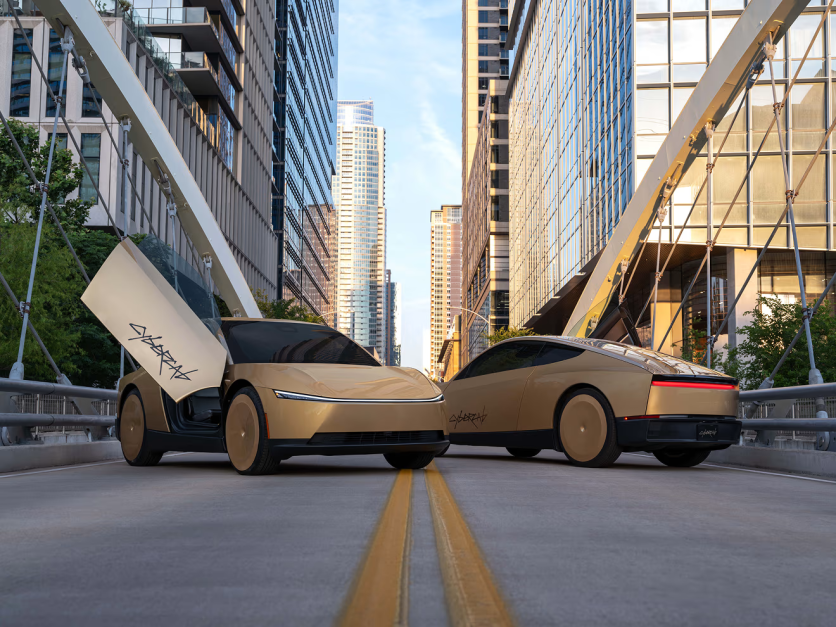
Tesla's fully driverless Cybercab is set to open for public viewing in two of China's largest cities today, with simultaneous exhibits scheduled at the Huamao Tesla Experience Center in Beijing and at HKRI Taikoo Hui's north hall in Shanghai. The Beijing display runs through September 27; Shanghai's through September 21. Both are static showcases only — visitors can walk around the vehicle, but it will not carry passengers and no commercial service in China is planned. The timing is not accidental: Tesla's own Q3 2026 deadline for securing full regulatory approval to deploy its Full Self-Driving software commercially in China expires September 30 — thirteen days from today.
A Vehicle Built for a World That Does Not Exist in China Yet
The Cybercab looks like no other production car on the road because it was never designed to share its controls with a human. There is no steering wheel, no accelerator or brake pedal, and no conventional rearview mirrors. A pair of butterfly-style doors open upward into a two-seat cabin containing only passenger seating and a 22-inch central touchscreen — Tesla's largest in-vehicle screen. All driving is handled by Tesla's autonomous software stack, which processes feeds from eight high-definition cameras arranged for full 360-degree coverage. The vehicle weighs 1,412 kg (3,113 lbs), carries a 47.6-kWh battery pack, and produces 163 kW from its electric motor. In laboratory testing, Tesla has recorded a range of 673 km (418 miles) with energy consumption of around 10.2 kWh per 100 km. At commercial scale, the company projects an operating cost of approximately $0.20 per mile — roughly half the figure it cited at the 2024 "We, Robot" unveiling — supported by the vehicle's stripped-down two-seat format, low sensor bill-of-materials, and a parallel-assembly manufacturing process called "Unboxed" that builds subassemblies simultaneously before final integration.
How Tesla's Cameras See Without Sensors — and Why That Matters Here
The Cybercab's technical architecture is the source of its sharpest competitive differentiation and its most debated vulnerability. Where virtually every major rival — Waymo, Baidu Apollo Go, Pony.ai, WeRide — relies on a combination of LiDAR, radar, and cameras to build its picture of the world around the vehicle, Tesla discarded radar from its entire lineup in 2021 and removed ultrasonic sensors in 2022. The Cybercab carries that architecture to its logical conclusion: eight cameras, an AI inference chip (Tesla's AI4, shared with current Model 3 and Model Y), and an end-to-end neural network that translates raw 2D image data into real-time driving decisions with no intermediate sensor-fusion step.
The engineering logic is coherent. Sensor fusion requires every LiDAR pulse, radar return, and camera frame to be reconciled into a single world model in real time, with each sensor operating in its own coordinate system at its own latency. When those inputs disagree — as they can in complex urban environments — the system must arbitrate, introducing its own error surface. Tesla's pure-vision approach sidesteps this entirely: one network, one data type, one unified output. As of August 21, 2026, Tesla's FSD system had accumulated over 13.6 billion cumulative miles of real-world driving data to train that network — a training set that no simulation library or manually-labeled dataset approaches in scale.
The constraint is geometric. LiDAR measures distance to objects with the precision of laser physics. Cameras infer depth from visual cues — parallax, object sizing, learned context — which is robust in conditions the training data covers well and degrades in conditions it does not: heavy rain, glare, unusual lighting, and settings that do not resemble the predominantly North American and European roads on which the network was trained. China's urban environment — dense with scooters, pedestrians, construction diversions, and a dense system of bus lanes with variable operating hours — is not a setting the system knows as deeply as Austin, Texas. Musk has acknowledged in public remarks that China's bus-lane rules alone, which change by hour of day and trigger automatic fines, represent one of the company's most significant localization challenges for FSD.
The Competitor Tesla Is Entering — Already Occupied
The China robotaxi market Tesla is exhibiting into is not an open field. Baidu's Apollo Go service has been running fully driverless commercial rides in Wuhan, Beijing, Chongqing, Shenzhen, and more than twenty cities nationwide — a scale roughly sixty-seven times the size of Tesla's current Austin Cybercab fleet of 45 registered vehicles.
Pony.ai, listed on Nasdaq since November 2024 and backed by Toyota, operates seventh-generation autonomous vehicles across Beijing, Shanghai, Guangzhou, and Shenzhen. It is targeting more than 3,000 vehicles in 2026, up from fewer than 1,000 at the end of 2025. WeRide, founded in Guangzhou in 2017, is commercially operational in China and has expanded internationally into the UAE.
Each of these competitors uses the sensor-fusion architecture — LiDAR, radar, cameras — that Tesla deliberately rejected. Each also has something more significant: commercial-operating permits from Chinese city authorities, granted through a multi-step licensing system that requires documented safety performance on Chinese roads, in Chinese traffic conditions, under Chinese regulators. Tesla has none of those permits. It does not yet have regulatory approval for even supervised commercial operation in China. Goldman Sachs projected in a 2025 research note that China's robotaxi market could grow roughly 700 times from 2025 levels to approximately $47 billion by 2035. The company showcasing its vehicle in shopping mall displays is not yet competing for a share of that market.
What FSD Actually Is in China Right Now
Tesla launched a supervised version of its self-driving software in China in May 2026 — but Chinese authorities require the company to market it under a different name. "Full Self-Driving" cannot be used in China for any Level 2 driver-assistance system, since Chinese law prohibits the terms "fully automatic" or "autonomous driving" for software that requires constant driver supervision and hands-on control. Tesla accordingly rebranded the feature as "Tesla Assisted Driving," or TAD, for Chinese customers.
What TAD represents in practice is a Level 2 system: the driver must remain attentive and in control at all times. Footage from Guangzhou roads circulating in August 2026 showed the system handling dense downtown urban driving with 3D navigation maps, but the software's legal classification in China is the same as a conventional driver-assistance feature — not a step toward autonomous commercial operation.
The path to full commercial deployment requires a separate and higher approval: full regulatory clearance to deploy FSD unsupervised, which is the prerequisite for any Cybercab robotaxi service in China. During Tesla's Q1 2026 earnings call in April, CFO Vaibhav Taneja stated the company was targeting that approval by the end of Q3 2026 — a deadline that closes September 30. That target had already slipped once: Musk had projected approval around February or March 2026; it did not materialize. Whether September 30 holds is the single most consequential near-term variable for Tesla's China autonomous strategy, and the answer will be known within days of the Cybercab exhibits' opening.
TAD is available in China as a one-time purchase at 64,000 CNY, a structure that diverges from Tesla's US market, where the one-time FSD purchase option was discontinued in February 2026, leaving subscription as the only option. A monthly subscription for TAD has not been introduced in China.
Does China's Data Law Create a Structural Barrier?
The regulatory hurdle is not purely procedural. It has a structural dimension that the exhibit does not address: an autonomous driving system that learns through real-world data encounters a specific legal problem in China. Chinese regulators have since 2021 required Tesla to store all data collected by its Chinese fleet in Shanghai, making it illegal to transfer that data to Tesla's US-based engineering and training teams without explicit government approval. Since Tesla's end-to-end neural network improves through continuous ingestion of driving data — and since Chinese road conditions (scooter density, bus-lane complexity, road markings) require localized training to improve — the inability to export that data limits how quickly the system can learn Chinese roads.
Tesla's response has been to invest in a Shanghai AI training hub, opened in early 2026, to process Chinese road data locally. Separately, China's Ministry of Industry and Information Technology has begun drafting auto data export rules that could create a legal framework for limited data transfer. Musk, according to reports from his April 2024 Beijing visit, sought explicit government approval for data transfer as part of his FSD lobbying push. Whether that approval has advanced in the months since remains publicly unconfirmed.
Why Tesla Is Still Showing Up — Sales and Brand
Tesla is not in China just to demonstrate a driverless car. Its near-term problem in the country is ordinary vehicle sales. Retail deliveries in China fell 12.43% year-on-year in August 2026 to 50,047 vehicles — the third consecutive monthly decline, according to data compiled by the China Passenger Car Association. Model Y fell 25.76% compared with the same month in 2025. The broader 2025 full-year trajectory was also under pressure, even as Tesla delivered approximately 432,704 vehicles in China during the first nine months of last year.
The Cybercab's market role in this context is closer to what the Cybertruck tour served in 2024 — a technology halo that reinforces Tesla's brand identity as a company building things no one else has built. Even as a static exhibit, the Cybercab communicates a version of the future that Chinese competitors, however operationally mature their robotaxi networks, have not given consumers a chance to stand next to in a shopping mall.
Steve Shi, a manager at Juchen Auto Trade, a China-based car service firm, noted in remarks to the South China Morning Post that the tour "will convince thousands of visitors at Tesla showrooms that the company remains a global leader in autonomous driving," regardless of the competitive gap on commercial deployment.
That framing does real work for a company that derives a meaningful share of its premium pricing from the perception that it leads in technology. Matching the Cybercab showcase to the closing days of the Q3 FSD approval window is not subtle: if approval comes through before September 30, the exhibit becomes the announcement's backdrop. If approval slips again, the exhibit is the story instead.
Exchange rate as of September 17, 2026; conversions are approximate.
Frequently Asked Questions
How does Tesla's vision-only system actually build its picture of the world around the vehicle?
The Cybercab's eight cameras generate overlapping fields of view covering the full 360 degrees around the vehicle. Tesla's AI4 chip runs an end-to-end neural network — a single model trained on the full input-to-output chain from raw camera pixels to steering and braking commands. Rather than computing explicit 3D point clouds the way LiDAR does, the network infers depth from visual cues: the relative sizes of known objects, motion parallax between frames, and learned statistical patterns from 13.6 billion real-world miles accumulated in the fleet. The tradeoff is that it cannot geometrically measure distance the way laser physics can — making low-visibility and out-of-distribution scenarios more challenging than they would be for a sensor-fusion system.
Can Tesla's Cybercab give rides in China?
Not yet. The exhibits in Beijing and Shanghai are static displays only — no rides, no commercial operation, no sales. Tesla has made clear the events are technology showcases. Before the Cybercab could operate commercially in China, Tesla would need full regulatory approval to deploy its autonomous software without driver supervision, which remains pending. Tesla's CFO stated the company was targeting that approval by the end of Q3 2026 — September 30 — a deadline that closes days after the Beijing exhibit opens.
How does the Cybercab compare to Chinese robotaxi competitors like Baidu Apollo Go?
In commercial operational scale, China's domestic operators are significantly ahead. Baidu Apollo Go is active across more than twenty Chinese cities, operating under fully driverless commercial permits. Pony.ai and WeRide are similarly permitted and operating commercially. All three use sensor-fusion architectures — combining LiDAR, radar, and cameras — in contrast to Tesla's camera-only approach. Tesla's advantage is its neural network's training scale (13.6 billion global fleet miles) and its lower sensor cost; its disadvantage in China is that it lacks both commercial permits and deep training data specific to Chinese road conditions. Pony.ai alone is targeting more than 3,000 vehicles in 2026.
Why does China's data law complicate Tesla's autonomous driving plans specifically?
Tesla's end-to-end neural network gets better by ingesting real driving data from its fleet. China requires all data collected by vehicles operating on Chinese roads to be stored within China and prohibits its export without explicit government approval. Since Tesla's training infrastructure is primarily in the United States, this creates a localization problem: the system cannot learn Chinese roads as efficiently as North American ones without either building a full training pipeline in China or obtaining data-export approval from Beijing. Tesla opened a Shanghai AI training hub in early 2026 and has sought data-transfer authorization. Until that problem is fully resolved, the architectural gap between what the system knows about Chinese roads and what its competitors know will persist.

-
 C114 Communication Network
 -
 Communication Home
