
 Search

3m.com
When Microsoft's infrastructure engineers race to bring new AI GPU clusters online, the limiting factor is rarely the chips themselves. Sometimes it is a speck of dust invisible to the naked eye.
That unglamorous physical reality sits at the center of a strategic partnership announced July 15 between 3M (NYSE: MMM) and Microsoft (NASDAQ: MSFT). Azure became the first announced hyperscale cloud provider to deploy 3M's Expanded Beam Optical (EBO) technology across its data centers, a move that could meaningfully accelerate how quickly Microsoft brings AI compute capacity online at a moment when demand for that capacity is outpacing the company's ability to build it.
The deal is bilateral. In exchange, 3M will adopt Microsoft's AI and digital platforms — including Copilot and Microsoft Fabric — to transform its own internal business operations in areas including customer service, finance, and sales. Each company becomes a marquee customer of the other, as detailed in 3M's official press release.
Fiber Contamination Is a Real Bottleneck in AI Clusters
To understand the operational significance, it helps to know what makes high-density fiber connections so difficult to maintain at hyperscale.
Traditional optical connectors work by pressing two polished fiber end-faces directly together, allowing light to jump across the junction. The problem is physics: this design requires near-perfect alignment and pristine surfaces. A standard multimode optical fiber core is roughly 50 microns across — the diameter of a human hair. A speck of dust at that scale can scatter or partially block the light signal, as Fluke Networks explains in its technical overview. In a typical enterprise data center, a contaminated port is a minor inconvenience. In an AI training cluster containing tens of thousands of fiber connections, the same problem multiplies into delays and costly rework.
There is also a labor dimension. Plugging in a conventional fiber connector involves an inspection-and-cleaning routine that takes roughly three minutes per port. Across a hyperscale installation with thousands of connections, that adds up to days of skilled technician time. According to 3M's own testing data, completing a multi-fiber installation with conventional MPO connectors can take eight or more hours; the same installation using EBO took about one hour.
How Expanded Beam Optics Eliminates the Cleaning Step
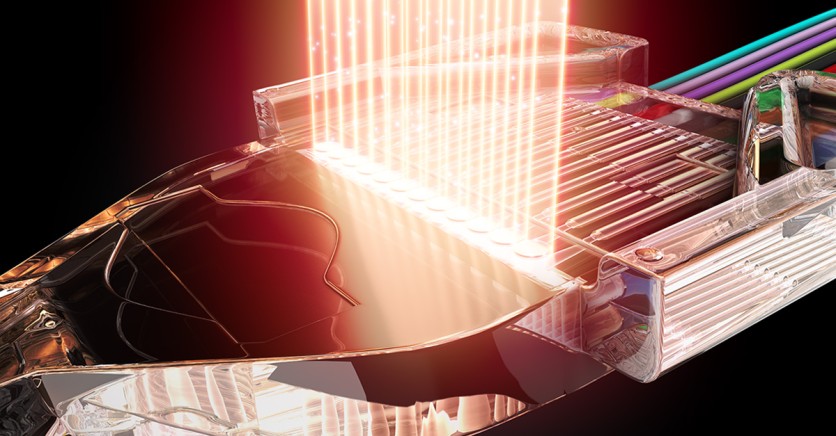
3M's EBO technology takes a fundamentally different physical approach. Rather than pressing fiber ends together, EBO places a precision collimation lens at the face of each connector. When the connector transmits light, the first lens expands the outgoing beam and makes the light rays parallel — a process called collimation, as ConnectorSupplier.com explains in its technology overview. The beam travels across a small air gap to the receiving connector, where a matching lens refocuses it into the receiving fiber.
Because the fiber ends never actually touch, contamination behaves differently. A dust particle that would block most of the path through a 50-micron fiber core blocks only a tiny fraction of a beam that has been expanded to as much as 150 times the core diameter, according to a technical explainer published by NorthPennNow in April 2026. The result: engineers can insert EBO cables without the inspection-and-cleaning routine, reducing per-connector plug-up time to roughly 30 seconds.
3M's specific design for high-density data center applications uses what the company calls mirror-reflection collimation with an anti-reflective vapor coating — an approach distinct from the ball-lens expanded beam connectors used in military tactical cables since the technology's origins in the 1970s, as Rosenberger OSI details in its connector technology analysis. The ferrule is genderless, meaning any two EBO connectors can mate without distinct male/female designations, simplifying inventory management in high-volume deployment environments.
A single EBO interconnect cable can carry 12 to 144 fibers, supporting configurations from individual rack connections to backbone data center runs.
What Azure Customers Should Know
It is worth stating clearly what this deal is and what it is not.
There are no announced changes to Azure services, pricing, regions, customer hardware requirements, or APIs. This is data center infrastructure plumbing. Azure customers using the platform today will not experience a new interface or feature as a result of the EBO deployment.
What they may experience over time — if the technology delivers at scale — is faster expansion of GPU capacity and new regions, as Microsoft reduces the installation friction that has historically slowed AI cluster builds. At a company that reported a commercial cloud backlog of $625 billion in early 2026, with demand from OpenAI alone accounting for roughly 45 percent of that figure, the pace of physical infrastructure buildout is a material constraint. A technology that cuts per-port installation time by a factor of six directly addresses that constraint at the physical layer.
Microsoft's own early deployments showed the technology's potential to reduce network deployment timelines in certain environments, with reliable signal performance under real-world operating conditions where dust exposure and routine handling are unavoidable, as the Microsoft Newsroom announcement confirms.
Read more: Microsoft's Azure Capacity Crunch Highlights Growing Dependence on OpenAI
EBO's Engineering Tradeoffs: What the Technology Gives Up
Every engineering tradeoff has a cost, and EBO is no exception.
Expanded beam connectors introduce higher insertion loss than physical-contact alternatives. A standard multimode physical-contact LC connector achieves a maximum insertion loss of around 0.15 dB; a comparable multimode expanded beam connector can reach 2.0 dB, according to Fluke Networks' technical comparison. For shorter intra-rack and intra-cluster runs — the distances typical inside an AI training cluster — that loss is acceptable within the optical power budget. For longer-reach data center interconnects, the math is tighter.
The lens-based design also limits the range of wavelengths that can travel through the connector without distortion, making EBO incompatible with wavelength division multiplexing (WDM) applications. WDM is a technique that sends multiple wavelengths of light through a single fiber to multiply bandwidth; its absence as an EBO option restricts the technology's applicability in contexts where WDM is used for long-haul or high-capacity segments.
EBO connectors are also physically larger than conventional LC or MPO connectors, which can pose challenges in extremely space-constrained rack configurations.
These limitations matter for understanding where EBO fits in the data center stack. The technology is well-suited for high-density, short-reach, frequently-mated connections inside AI GPU clusters — where the labor savings dominate — and less suited for long-reach or WDM-dependent applications.
Why Industry Standardization Changes the Calculus
The Microsoft deployment does not stand alone. On May 12, 2026, 3M announced it had joined a newly formed Multi-Source Agreement (MSA) dedicated to creating open, interoperable specifications for EBO connectivity in AI data center infrastructure, as covered in the 3M investor relations press release. Oracle serves as co-chair. The coalition also includes AMD, Arista Networks, Cisco, Meta, Molex, Amphenol, TE Connectivity, Sumitomo, and more than a dozen other firms, according to the PRNewswire announcement.
The MSA matters beyond its membership list, and this is the structural implication that the partnership headline understates. A bilateral arrangement between Microsoft and 3M would mean Azure is dependent on a single supplier for a critical infrastructure component — exactly the kind of vendor lock-in that hyperscalers are institutionally reluctant to accept. An open MSA means the EBO connector specification belongs to the industry, not to 3M alone. Multiple manufacturers can build to the same standard. Azure is not locked in; it can source from whichever EBO-compliant supplier offers the best combination of price, quality, and lead time.
Oracle's Rajagopal Subramaniyan, who co-chairs the MSA, put the operational case directly: the strict connector hygiene requirements imposed by traditional physical-contact connectors slow network builds and add ongoing maintenance overhead, and EBO technology can overcome those bottlenecks while enabling more resilient cluster topologies and future rack-scale optical architectures.
This is why Azure's adoption is significant beyond its immediate effect on one company's buildout speed: it provides the reference customer a new technology ecosystem needs before other hyperscalers can justify the transition at scale.
3M's Supply Chain Is Already Scaling
3M is not waiting on adoption to pick up. On March 16, 2026, the company announced a major expansion of U.S. manufacturing capacity for EBO, with an investment that more than doubles production output to meet accelerating demand from hyperscalers and data center operators. The expansion includes new advanced manufacturing equipment and additional production space.
Alex An, vice president of 3M's data center vertical business, described the investment as responding to demand from customers who understand the technology's benefits amid infrastructure scaling that is proceeding at an unprecedented pace.
Inside the Enterprise AI Side of the Deal
Beyond the fiber story, 3M is deploying Microsoft's AI capabilities across its own enterprise operations — a distinct but parallel part of the agreement.
3M will use Microsoft Fabric, Dynamics 365, and Copilot in customer service, finance, sales, and marketing to simplify processes and improve decision-making, as the joint announcement from both companies confirms. A concrete early example involves the newly launched Microsoft Frontier Company, which is deploying engineers to help 3M's Global Business Services team automate customer order management. The project is building an AI agent-driven workflow to handle credit checks, delinquency assessments, and system updates, with human-in-the-loop controls and a custom monitoring dashboard for real-time approvals. The companies say the workflow is expected to reduce manual effort, improve process consistency, and accelerate cash flow.
Jon Van Wyck, 3M's executive vice president and chief strategy officer, described AI as a powerful tool for accelerating growth and improving customer experiences, and framed the Microsoft collaboration as advancing both 3M's enterprise operations and the broader infrastructure required for AI.
What Azure's Move Signals for Other Hyperscalers
Microsoft's EBO adoption gives the technology something no amount of engineering validation can substitute: a publicly committed reference deployment at hyperscale. Amazon Web Services, Google Cloud, and Oracle Cloud — the other tier-one hyperscalers — are watching a direct competitor commit to a physical infrastructure approach that claims to cut fiber installation times significantly.
The more-than-$2-billion optical interconnect market opportunity that the Microsoft/3M partnership opens now has a credible case for why the next hyperscaler to adopt EBO is gaining a buildout speed advantage over those still relying on traditional physical-contact fiber, as Redmond Magazine's coverage of the deal notes.
Fiber has already emerged as a strategic constraint in AI infrastructure. As GPU clusters push network architectures beyond 400G and 800G toward 1.6T, the physical layer — long treated as a utility — has become a deployment-critical variable, according to Data Center Frontier's analysis of the AI optical infrastructure landscape. The connector at the end of every cable matters at a scale nobody designed for ten years ago.
Read more: GitHub's AI Agent Crisis Forces Microsoft to Tap AWS as Outages Break Enterprise SLAs
Frequently Asked Questions
What is expanded beam optical technology and how does it differ from conventional fiber connectors?
Expanded beam optical (EBO) connectors use a lens at each connector face to expand and collimate the outgoing light beam before it crosses an air gap to the receiving connector, where a matching lens refocuses it into the receiving fiber. Unlike conventional physical-contact connectors, which press polished fiber end-faces together under spring pressure, EBO connectors never touch at the junction. That contactless design makes the connection far less sensitive to dust and contamination, because a particle of debris blocks only a small fraction of the expanded beam rather than potentially blocking most of the 50-micron fiber core. The practical result is that EBO connectors can be installed and mated without the inspection-and-cleaning step that traditional connectors require in hyperscale environments. The tradeoff is higher insertion loss and incompatibility with wavelength division multiplexing (WDM) applications, as Fluke Networks details in its technical explainer.
Why does fiber contamination matter so much specifically for AI data centers?
AI training clusters require far more fiber connections per compute node than legacy data centers — some analyses place the ratio at ten to thirty-six times more fiber connections than conventional cloud setups, according to Global Data Center Hub's infrastructure analysis. Each GPU must communicate with thousands of other GPUs simultaneously, generating enormous east-west traffic that flows through dense optical interconnects. At that density, even a modest contamination problem at individual ports multiplies into a deployment and maintenance burden that directly affects how quickly new AI capacity can be brought online. The contamination issue is compounded by tight tolerances on newer high-speed standards: as networks move toward 800G and 1.6T, maximum allowed insertion loss shrinks, making any contamination-induced signal degradation more consequential, as AFL Hyperscale's fiber validation analysis documents.
What does the EBO Multi-Source Agreement mean for hyperscalers evaluating this technology?
The MSA is the structural reason a broader industry transition to EBO is plausible rather than just a 3M sales proposition. An MSA creates a shared open specification that multiple manufacturers — including Amphenol, Molex, TE Connectivity, Sumitomo, and others — can build against, producing interoperable products. For a hyperscaler evaluating EBO, this means the connector standard does not depend on a single supplier's production capacity, pricing, or continuity. Azure can source EBO-compliant connectors from the vendor that offers the best price and lead time at any given time, just as it does with standard MPO connectors today. Without the MSA, the technology would carry a single-vendor lock-in risk that most hyperscalers are institutionally reluctant to accept at infrastructure scale, as the 3M investor relations announcement of the May 2026 MSA formation explains.
Does Azure's EBO deployment change anything for Azure customers today?
No — not immediately. There are no announced changes to Azure services, service regions, pricing, or customer-facing hardware requirements as a result of this deployment. The EBO rollout is an infrastructure decision that affects how quickly Microsoft can physically install and expand its AI data center capacity, not what customers can access through Azure APIs, portals, or services. The indirect benefit to customers — faster expansion of GPU capacity and new regions — would materialize over time as Microsoft's buildout timelines improve, as Microsoft's official announcement of the partnership confirms.

-
 C114 Communication Network
 -
 Communication Home
