
 Search


Nvidia.com
Six weeks after DLSS 5 Neural Rendering launched, independent community benchmarks published October 18 show that Nvidia's official October update outperforms the pre-release DLL that modders had been using by up to 90% in The Witcher 3 — a gap so large it effectively makes the pre-launch testing feel like a different product.
That figure, measured by GamingOptimized posted benchmarks October 16 on X, is the most striking data point from what has been a remarkable six-week optimization sprint. For any RTX 50-series GPU owner who turned off DLSS 5 Neural Rendering after launch-day numbers disappointed — or who dismissed it after watching the modder testing produce erratic results in August — the case for enabling it again just became significantly stronger.
What made the October update unusually easy to evaluate is that Nvidia shipped the new DLL with both models included in this DLL. Preset A contains the original September model; Preset B contains the October refinement.
Read more: DLSS vs FSR in 2026: Which GPU Upscaling Tech Delivers Better FPS and Image Quality?
How Community Testing Put a Number on Nvidia's Claims
When Nvidia released the October 16 DLSS 5 update for NBA 2K27, the company published its own performance figures: the new model is twice as fast as the September version and ten times faster than the March 2026 prototype shown at GTC. Those are first-party claims in a natively supported game, which means they're useful but not the whole picture.
Modder Renan Maniero extracted the new version 310.9.16.0 build from NBA 2K27 and made it available for community testing in unsupported games on October 16, allowing direct A-versus-B comparisons without swapping files.
GamingOptimized ran those comparisons across multiple games using RenoDX and OptiScaler — the tools that inject DLSS Neural Rendering into games without native support — and posted results the same day. The Witcher 3 produced the headline figure: up to 90% better performance with Preset B versus Preset A. Other games showed gains in the 40% range. Results vary by title, as the degree of improvement depends on how the game's rendering pipeline integrates with the injected model, but the directional finding was consistent across everything tested. Tom's Hardware's October benchmark results documented these findings in detail.
PC Gamer's October update testing on an Asus ProArt P16 laptop running Nvidia's RTX Spark (Blackwell GPU + Grace Arm CPU) found the October update delivered approximately 25% better performance at 1440p in NBA 2K27 itself — a more conservative number, reflecting a natively-integrated scenario rather than injected-DLL testing. At 1080p, average frame rates climbed from 143 fps with the original model to 168 fps with the October update, compared with a native (DLSS-off) baseline of around 227 fps.
Why a Smaller AI Model Is Better on a Consumer GPU
The engine behind the performance jump is a straightforward engineering trade-off — one that anyone who has run a large language model on a laptop will recognize immediately.
Nvidia's Neural Rendering model processes every frame in real time, just as an LLM must load and process its weight matrices for every token it generates. Both tasks require dedicated memory, and both are constrained by hardware with a fixed, non-upgradable budget. A consumer RTX 5080 has 16 GB of GDDR7; that memory has to serve the game engine, textures, ray tracing data, and the DLSS NR model simultaneously. Scaling up the model by adding parameters is not viable when it competes for space with the game itself. RTX 50-series memory budget constraints make efficiency the only viable path for improvement.
Nvidia's solution was to make the model more efficient rather than larger. Nvidia's official October DLSS update shrinks the parameter count by 24% — to roughly 118 million — while simultaneously cutting 4K VRAM usage by 20% and doubling the speed at which the model processes each frame. This was achieved through a combination of what Nvidia describes as systematic pipeline optimizations and neural model refinements — engineering shorthand for retraining the model with more constrained targets, using techniques similar to the distillation and quantization methods that have made commercial LLMs smaller without sacrificing output quality.
The VRAM reduction matters practically. Games that were previously at risk of exhausting VRAM headroom when DLSS 5 was enabled now have more breathing room, which is particularly relevant at 4K — the resolution where the model's memory footprint was highest relative to available budget.
The speed gain has a specific hardware explanation. Nvidia's RTX 50-series (Blackwell) GPUs have fifth-generation Tensor Cores run FP8 — eight-bit floating point — operations in native hardware. Each halving of numerical precision from FP16 to FP8 approximately doubles Tensor Core throughput, which is why the Neural Rendering model runs dramatically faster on Blackwell than on older architectures.
What the Leaked Build Actually Was — and Why the Gap Is So Large
To understand why the 90% gap between the leaked build and the October model is plausible, it helps to know what the leaked build actually was.
The DLL that modders found in NBA 2K27's early-access files in August 2026 — version 310.8.0.0, dated August 26 — was an unfinished pre-release build that Nvidia never intended to ship publicly. At 158 MB and containing approximately 148 million FP8 parameters, it was the largest DLSS DLL ever released and contained model weights that reflected the state of development several weeks before launch.
Testing by Compusemble's August benchmark in Control (enthusiast Dan Mateescu, online handle Compusemble) on August 27 found that the leaked build dropped frame rates on an RTX 5070 Ti from 71 fps to 35 fps at 4K — a performance penalty of roughly 51%. A separate test on Compusemble also tested on RTX 5090 saw fps fall from 91 to 50, a drop of about 45%. Neither figure reflected what an official integration would deliver, because the leaked DLL ran without engine-level artistic controls, semantic masking, or the developer tuning that ships in a properly integrated build.
The September 3 official launch in NBA 2K27 improved on the leaked build substantially — Nvidia's own data shows the technology had improved more than five times over the March GTC prototype by launch day. The October update then doubled that again, bringing the cumulative improvement since March to roughly ten times. What the 90% community benchmark measures is specifically the gap between the October model and the pre-release DLL — which was, in effect, an unoptimized prototype that the community had been treating as a release candidate.
Who Can Run DLSS 5 Right Now, and Who Will Have to Wait
DLSS 5 Neural Rendering remains exclusive to Nvidia's RTX 50-series (Blackwell) GPUs in its official form. The hardware requirement is rooted in those fifth-generation Tensor Cores: the Neural Rendering model is built around FP8 inference, and Blackwell is the first consumer GPU generation with native hardware-level FP8 acceleration. RTX 40-series (Ada Lovelace) GPUs have fourth-generation Tensor Cores with FP8 capability — but via a software path without dedicated per-tensor scaling hardware — making them capable of running the model, but with meaningfully lower efficiency.
Nvidia confirmed RTX 40 support is coming. In a statement to The Verge, Nvidia spokesperson statement to Verge: "Our current focus is on optimizing performance for the GeForce RTX 50 Series, with model updates expected later this fall. Once RTX 50 Series performance is more fully tuned, we plan to work on expanding official support to the GeForce RTX 40 Series." That support will arrive with limited per-element artistic controls rather than the full suite available on RTX 50 hardware.
RTX 30-series and earlier cards have no announced official support path. The community has pushed DLSS 5 mods to Ampere and even Turing hardware, but RTX 30-series cards lack the FP8 compute path entirely, forcing the model to fall back to FP16 — roughly doubling the already-substantial compute cost. Early tests on RTX 30-series hardware with the modded DLL showed performance dropping as low as 4 fps in some scenarios. For practical purposes, RTX 30 and older owners should not plan around DLSS 5 Neural Rendering.
The modding community has also extended DLSS 5's reach in another direction: Daniel Blanco's AMD neural rendering port, which launched September 3 alongside the official Nvidia release, reached version 0.8.0 and now supports Super Resolution, Frame Generation, Ray Regeneration, and the new Neural Rendering model across three generations of Radeon GPUs. Real-world results on AMD hardware remain mixed — Reddit testers reported frame rates of roughly 55 fps at 1440p at maximum settings with 3x frame generation — but the project demonstrates the breadth of interest in DLSS 5 technology well outside Nvidia's own hardware ecosystem.
What Is DLSS 5, Really? A Brief Explainer for Anyone Who Tuned Out the Controversy
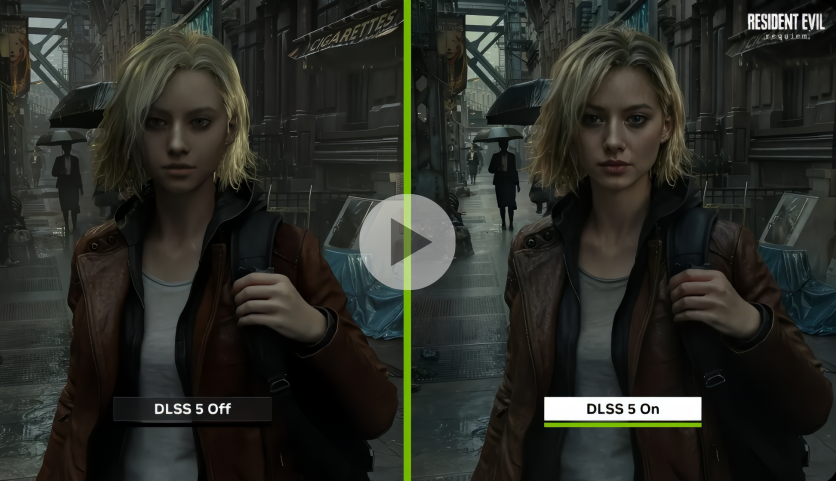
DLSS 5 Neural Rendering is a different kind of technology than the DLSS versions that came before it. DLSS 1 through 4.5 all worked by reconstructing or upscaling a lower-resolution frame to a higher one — using AI to fill in missing pixels from data the game engine had already calculated. DLSS 5 operates at the end of the rendering pipeline and adds new pixel-level detail that the engine never calculated at all.
Specifically, the model takes the game's rendered color data and motion vectors and uses a neural rendering pass to inject photorealistic lighting and material detail — light through translucent ear cartilage, subsurface scattering through skin, fine-shadow micro-detail in fabric — that physical-based rendering at real-time frame budgets cannot produce. The result, when developer tuning is done correctly, is that the game looks materially more cinematic without the game engine doing additional rendering work.
The controversy at launch was about that "when developer tuning is done correctly" clause. The initial GTC demonstration, and the leaked DLL that followed, showed DLSS 5 altering game characters in ways developers had not approved — what critics called an "AI filter" that changed artistic intent. The official implementation in NBA 2K27, which ships with semantic AI masking and per-element artistic controls, is a more controlled product than the leaked build suggested.
The RTX 50 Optimization Pattern — and Why RTX 40 Owners Should Calibrate Expectations
For RTX 40-series GPU owners watching this trajectory, the pattern behind DLSS 5's October update is worth understanding.
Nvidia has followed an identical strategy with every major DLSS generation since DLSS 3 Frame Generation in 2022: launch the feature exclusively on the newest hardware, optimize it rapidly over the following weeks, then expand support to the prior generation once the new GPU line's commercial launch is well underway. DLSS 3 Frame Generation launched RTX 40-only in September 2022; RTX 30 modding appeared shortly after, and official expansion followed later. DLSS 4 Multi Frame Generation launched RTX 50-only in January 2025; RTX 40 support arrived with Nvidia confirming a timeline. DLSS 5 is following the same arc.
The "later this fall" timeline for RTX 40 support puts official availability somewhere between the current date and end of 2026. When it arrives, the model RTX 40 owners will get will be the optimized October version (or a subsequent refinement), not the demanding September launch version. The exclusivity period functions as paid optimization time — the RTX 50 install base bears the highest overhead cost while Nvidia engineers tune the model for each Blackwell SKU, then the improved model rolls out to Ada with reduced expectations around per-element artistic controls.
That framing matters for the decision facing RTX 40 owners: the October data suggests DLSS 5 will be a meaningfully better product by the time it officially reaches Ada Lovelace hardware than it was on September 3.
What's Ahead: RTX Remix, Hogwarts Legacy, and a New Frame Generation Mode
The October 16 update was accompanied by a broader DLSS 5 expansion timeline. RTX Remix DLSS 5 October 23 — Nvidia's modding-focused rendering layer used for community remaster projects like the Fallout 4 and Mirror's Edge efforts — is scheduled to gain DLSS 5 support on October 23, opening Neural Rendering to games that are not commercially supported and have never received official Nvidia integration.
Hogwarts Legacy is confirmed for DLSS 5 support on November 5, and Where Winds Meet will receive it in late November. Those titles, unlike NBA 2K27, are visually demanding photorealistic games where DLSS 5's promise of materially enhanced lighting and material detail will face a more meaningful test than a basketball simulation.
Nvidia's app beta also introduced a new Preset C mode for DLSS Frame Generation on both RTX 40 and RTX 50 hardware, offering up to 35% better frame generation performance at a modest image quality trade-off compared with the current standard preset.
For RTX 50-series GPU owners who had DLSS 5 on their list of things to revisit once the technology matured, October 16 is the date that warranted revisiting.
Frequently Asked Questions
How much does DLSS 5 actually hurt gaming performance right now?
With the October 2026 model, the performance cost is roughly half what it was at the September launch. Nvidia's own figures showed a 50–60% performance penalty at launch; the October update halved that by making the neural rendering model run twice as fast. In PC Gamer's RTX Spark testing, NBA 2K27 at 1080p ran at around 168 fps with DLSS 5 enabled versus roughly 227 fps without it — a penalty of about 26%. The cost varies significantly by game, resolution, and which parts of the scene the neural rendering is applied to.
Can I use DLSS 5 in games that don't officially support it?
Yes, with caveats. Modder Renan Maniero extracted the official October DLL from NBA 2K27, making it available for injection into other games via tools like OptiScaler and RenoDX. Community testing shows this works in many titles, with The Witcher 3 showing the most dramatic improvement in recent benchmarks. The important caveats: DLL injection carries anti-cheat risk in online multiplayer games, the results without native developer integration may differ from what an official port would deliver, and you are using officially published software outside its intended use — Nvidia has not commented on this practice.
Is DLSS 5 coming to my RTX 40 GPU, and when?
Nvidia has officially confirmed RTX 40 (Ada Lovelace) support is coming, once RTX 50 optimization work is complete. The company stated that model updates are expected "later this fall." RTX 40 support will include limited artistic controls compared with the full RTX 50 implementation, because the per-element tuning tools require the specific Tensor Core capabilities of Blackwell. No specific date has been announced. RTX 30-series and older hardware has no announced official support path.
What does the Nvidia DLSS 5 performance improvement actually mean technically?
Nvidia reduced the Neural Rendering model from roughly 155 million parameters to 118 million — a 24% reduction — while simultaneously retraining it to maintain or improve output quality. Smaller models require less VRAM (down 20% at 4K) and complete their inference pass faster on the hardware's FP8 Tensor Cores. FP8, the 8-bit floating point format native to Blackwell's fifth-generation Tensor Cores, delivers roughly twice the inference throughput of FP16 — which is why RTX 50 GPUs handle the model more efficiently than older architectures and why RTX 30-series cards, which lack any FP8 hardware path, struggle severely with even modded DLSS 5.

-
 C114 Communication Network
-
 Communication Home
