
 Search


JOSH EDELSON/gettyimages.com
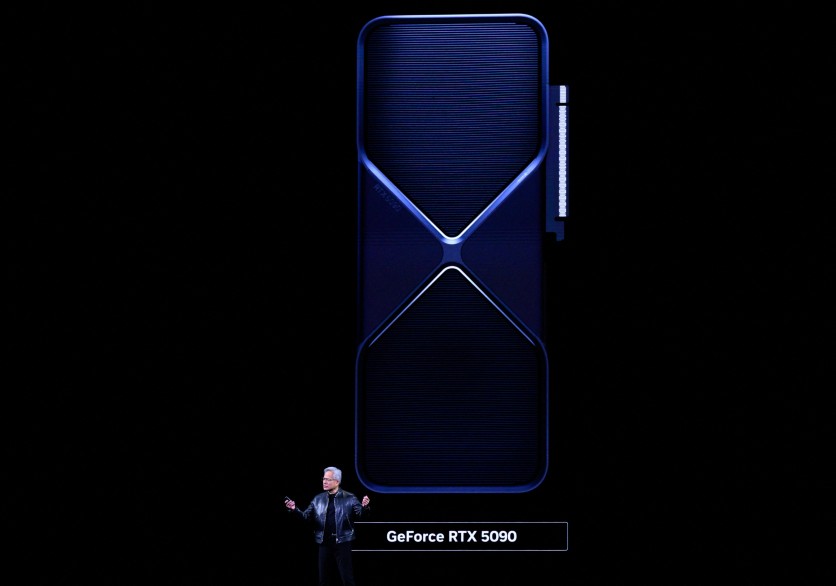
Nvidia's top executive for consumer graphics stepped forward this week to deny that the GeForce RTX 5090 has been discontinued — but his statement addressed only one of the two questions the market has been asking, and the harder question remains unanswered. Nvidia SVP Jeff Fisher denied the card's end-of-life status at the company's RTX Spark launch party in Taipei on October 16. Micro Center still classifies RTX 5090 graphics cards as "Not Carried." B&H Photo still notified at least one customer that their waitlisted card had been marked "discontinued." Secondary market prices for the card stood at $4,795 for the best available resale deal as of October 2026 — 2.4 times its $1,999 launch price — with new listings on Amazon reaching $5,258.
What the Denial Does — and Does Not — Address
On October 16, Nvidia Senior Vice President of Personal Computing Jeff Fisher told Taiwanese media at the company's RTX Spark launch party in Taipei that the RTX 5090 "has definitely not been discontinued." Fisher acknowledged constrained supply-chain capacity and said Nvidia was doing everything it could to bring products to market, adding: "Nvidia will continue shipping it. This is very important." Taiwan's Central News Agency independently corroborated Fisher's remarks, citing the same event.
What Fisher did not address: the specific claim from hardware leaker MEGAsizeGPU that Nvidia has stopped allocating GB202 chips to add-in-board (AIB) partners for consumer GeForce cards. That allocation claim is separate from EOL status. A product can remain "not discontinued" on paper while no new units are reaching retailers — which is essentially what the retail evidence now shows. Notebookcheck noted in its coverage of the denial that Fisher's comments do not fully explain the reported allocation changes or the disappearance of RTX 5090 models from retail listings. German publication PC Games Hardware subsequently reported that multiple independent sources from retail, distribution, and Nvidia's own partner network had confirmed an end to new GB202 allocations for GeForce graphics cards.
How 'Not Carried' Became the Phrase of the Week
The cascade of retail signals began on October 10, when hardware leaker MEGAsizeGPU, posting under the account @Zed__Wang, stated on X that all future GB202 supplies were now RTX Pro exclusive. A separate leaker, @hongxing2020, cited a factory notice reading: "According to a notification from the factory, Nvidia will no longer manufacture any RTX 5090 models, including the D variants. Going forward, the highest-end GeForce graphics card will be the RTX 5080 24GB, while the RTX 5080 16GB version will be discontinued." This claim originated from a factory notice that Tom's Hardware reported October 10, 2026. MEGAsizeGPU has not confirmed the specific second claim about model discontinuations.
By October 15, Micro Center had changed RTX 5090 availability status on numerous models from "Out of Stock" to "Not Carried" — a meaningful distinction in retailer terminology. "Out of Stock" means a restock is expected. "Not Carried" means the retailer no longer intends to stock that product. A community report published by The FPS Review documented a customer's visit to Micro Center on October 9, describing staff physically removing RTX 5090 cards from display shelves before the "Not Carried" status appeared online. The Micro Center location in Tustin, California, remained an exception, still offering an Asus ROG Astral Edition 20 as part of a limited-edition bundle.
At B&H Photo, at least one customer received a notice on a waitlisted Gigabyte RTX 5090 AORUS XTREME WATERFORCE updating its status to "discontinued." Nvidia's own US and UK Marketplace pages had also stopped showing the RTX 5090 in their GPU selector — the card had been clearly visible on Nvidia's Marketplace as recently as June 2026 according to Wayback Machine records.
In the UK, RTX 5090 inventory at major retailers dropped sharply, pushing prices above £5,000 (approximately $6,614 USD), more than triple the card's UK MSRP of £1,799 (approximately $2,380 USD), according to reports on European GPU pricing in October 2026.
Read more: GPU Prices Jump Again as AMD Radeon Loses Its Last Affordability Buffer
Why GB202 Is Worth More in a Workstation Than in a Gaming PC
Understanding why the leaker claims are economically credible requires knowing what GB202 is. It is Nvidia's largest Blackwell gaming die, manufactured by TSMC on its 4N process. The same silicon powers the $1,999 GeForce RTX 5090 in a cut-down 21,760-core configuration with 32GB of GDDR7 memory — and the RTX Pro 5500, a professional visualization card using the same 21,760-core count paired with 84GB of GDDR7 for AI workloads.
The RTX Pro 6000, built on the full 24,064-core version of GB202 and loaded with 96GB of GDDR7, is priced at approximately $15,000. Every wafer allocated to a $15,000 pro card instead of a $1,999 gaming card generates roughly seven and a half times the revenue per unit — even more when accounting for the secondary-market pricing environment that has pushed RTX 5090 consumer transactions well above MSRP.
The RTX 5090's 32GB configuration also uses a 512-bit memory bus with 16 individual 2GB GDDR7 chips, making it one of the most memory-intensive products in consumer electronics. In a market where GDDR7 supply is constrained by AI infrastructure demand competing for the same fabs at Samsung, SK Hynix, and Micron, the margin math on redirecting GB202 dies to professional products is straightforward: less memory per unit on a per-card basis would actually be required for some Pro configurations, and the revenue per unit is dramatically higher.
Nvidia has done this before. Ada Lovelace's AD102 die powered both the RTX 4090 and the professional RTX 6000 Ada. Ampere's GA102 served both the RTX 3090 and the A6000. A shared die serving both gaming and professional lines is not unusual; what is unusual is the market condition that makes reallocating that die to the professional side economically dominant.
Read more: NVIDIA RTX 50 GPU Shortage: Supply Cut 20%, Prices Climbing, No Desktop Refresh Confirmed
Secondary Market Prices Show a Card Effectively Gone From Consumer Reach
The GPU market tracker GPUPoet's October 2026 report found the RTX 5090's best available resale deal at $4,795 — a 23% increase from August 2026 and 2.4 times the card's $1,999 MSRP. New listings on Amazon for the same card reached $5,258, meaning secondary-market resellers were actually undercutting new retail — itself a signal that institutional or bulk buyers have driven new retail prices beyond what individual consumers will pay. Price tracking across major marketplaces showed RTX 5090 listings starting at approximately $6,033, with average pricing substantially higher. Premium limited-edition variants such as the MSI RTX 5090 Lightning Z — a card with a factory price above $5,000 — appeared on secondary markets at asking prices between $7,800 and $15,000.
One independent analysis noted that some AI buyers in sectors not subject to export restrictions had been purchasing RTX 5090 units at retail for local inference workloads — a dynamic that contributed to both the supply squeeze and the secondary market price spiral.
Micro Center's prior policy of requiring photo ID and a no-export pledge to purchase an RTX 5090 — a measure that predated the current shortage wave — now reads as a preview of what the broader retailer response eventually became: an effective prohibition on purchase.
What a Rumored RTX 5080 24GB Means for Gamers Who Cannot Wait
The leaker reports accompanying the GB202 allocation claim included a specific successor proposal: a GeForce RTX 5080 with 24GB of GDDR7, using higher-density 3GB GDDR7 modules instead of the current RTX 5080's 2GB modules, targeted at Q1 2027. That same shortage of 3GB GDDR7 modules has been cited as the reason Nvidia's RTX 50 Super refresh was deprioritized earlier in 2026.
If the rumored RTX 5080 24GB faces the same 3GB GDDR7 module constraint, its Q1 2027 window is optimistic. Nvidia has not confirmed the product exists. RTX 60 series production, previously reported to begin mass production in late 2027, has been pushed by multiple analysts to 2028 by analyst forecasts.
For buyers hoping for an accessible gaming flagship at Nvidia's $1,999 tier or below: the supply evidence and the Fisher denial together produce a portrait of a card that officially exists, is officially not being discontinued, and is nevertheless effectively inaccessible at anything approaching its launch price.
Frequently Asked Questions
Is the RTX 5090 discontinued?
Officially, no. Nvidia SVP Jeff Fisher said on October 16, 2026, at the company's RTX Spark launch event in Taipei, that the RTX 5090 "has definitely not been discontinued" and that Nvidia will continue shipping it, acknowledging supply constraints. However, the denial addresses end-of-life status, not the specific claim that Nvidia has stopped allocating GB202 dies to AIB partners for new GeForce consumer production. Retailers including Micro Center have changed RTX 5090 listings to "Not Carried" rather than "Out of Stock," and B&H notified at least one customer of a "discontinued" status on a waitlisted card. Fisher's statement does not explain those retail designations.
Why is the RTX 5090 listed as "Not Carried" at Micro Center?
Micro Center changed the availability status of most standalone RTX 5090 models from "Out of Stock" — which implies a restock is coming — to "Not Carried," which means the retailer no longer intends to stock the product. The change coincided with reports that Nvidia had stopped allocating its GB202 chips to add-in-board partners for consumer GeForce production, choosing instead to redirect that silicon to higher-margin RTX Pro workstation and data center cards. Nvidia has not issued a specific statement addressing the retailer status change or the GB202 allocation question; Fisher's denial covered EOL status only.
What is replacing the RTX 5090 if Nvidia stops making it?
No confirmed replacement has been announced. Leaker reports from @hongxing2020 and subsequent outlet coverage suggest Nvidia may be preparing a GeForce RTX 5080 24GB — using higher-density 3GB GDDR7 modules to increase VRAM from the current 5080's 16GB to 24GB — targeted at Q1 2027. Nvidia has not confirmed this product. The RTX 60 series, built on the next-generation Rubin architecture, is not expected before late 2027 at earliest, with some analysts projecting 2028. Until then, the current RTX 5080 (16GB) would be the practical ceiling of Nvidia's consumer gaming lineup.
How much does an RTX 5090 actually cost right now, and when is the MSRP coming back?
As of October 2026, the best available resale deal for an RTX 5090 was approximately $4,795 — 2.4 times the $1,999 MSRP — with new retail listings on Amazon reaching $5,258 and marketplace averages around $6,033. Premium configurations were available at asking prices up to $15,000. Nvidia SVP Jeff Fisher acknowledged supply constraints and stated the company was working to bring products back to market, but gave no timeline for a return to MSRP availability. Based on the structural conditions — GDDR7 supply constraints expected to persist through 2030 per memory industry forecasts, and GB202 silicon competing with higher-margin professional products — there is no credible near-term basis for expecting MSRP RTX 5090 availability to return.

-
 C114 Communication Network
-
 Communication Home
