
 Search

TapIn
Artificial intelligence is rapidly transforming how content is created online. From text and images to video and customer interactions, AI tools are enabling businesses and creators to generate more content than ever before, and at a fraction of the time and cost.
But as content becomes increasingly abundant, some technology leaders believe a new challenge is emerging: how to identify what actually matters.
For more than a decade, digital platforms have competed for attention. Success was measured through views, clicks, watch time, impressions, and follower counts. The more attention a platform captured, the more valuable it became.
Today, however, the internet is entering a new phase. AI is making content creation easier and more accessible, but in the process, it is also creating unprecedented amounts of digital noise.
As feeds become saturated with AI-generated content, experts say the next frontier may not be creating more information; it may be helping people participate more meaningfully in online experiences.
"Most of the internet has been optimized for attention, but real value is created through participation," said Omer Luzzatti, CEO and Co-Founder of TapIn. "TapIn is built to change that, giving communities the tools to engage, contribute, and share in the value they create."
The challenge is particularly visible in live digital environments. Whether it's creator communities, livestreams, virtual events, gaming platforms, or brand activations, large-scale conversations often become difficult to navigate as participation increases. Valuable insights can be buried beneath thousands of comments, questions, and reactions.
This growing issue has become known by some in the industry as a signal-to-noise problem: how do platforms surface the most relevant contributions while maintaining authentic interaction?
A growing number of companies are now exploring AI's role in solving that challenge.
Rather than generating additional content, these platforms are using AI to organize conversations, identify recurring themes, and surface valuable contributions, helping communities engage more effectively at scale. The shift reflects a broader evolution in how digital engagement is being measured.
Historically, platforms have been optimized for passive consumption. Users watched, liked, shared, and moved on. Increasingly, however, creators, brands, and community operators are looking for ways to encourage active involvement instead.
The trend is especially visible among creator-led communities, where audience members are seeking greater influence over the experiences they participate in. Interactive Q&As, community-driven discussions, live polling, collaborative events, and direct audience feedback are becoming increasingly common features across digital platforms. As a result, participation itself is beginning to emerge as a meaningful metric.
According to Luzzatti, the question is no longer just how many people showed up; it's how many people contributed. This philosophy is helping shape the next generation of community technology platforms.
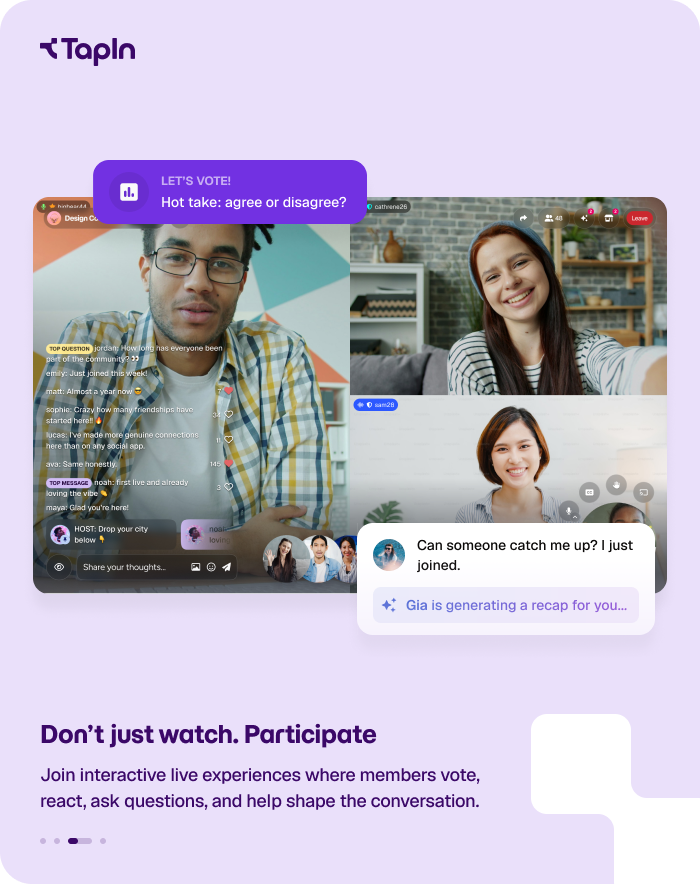
Formerly known as Gigaverse, TapIn recently launched a rebrand that reflects its focus on participation-driven experiences. The platform uses AI to help organize and structure live interactions by clustering duplicate questions, surfacing high-signal contributions, moderating conversations, fact-checking comments and discussion topics, and supporting multilingual engagement across communities.
The company is also expanding beyond creator-focused experiences by offering infrastructure and white-label solutions for organizations seeking to build their own participation-based communities. The broader trend extends well beyond any single platform.
As AI-generated content becomes increasingly difficult to distinguish from human-created content, many technology leaders believe participation may also play an important role in establishing trust online. Real-time interactions, collaborative discussions, and active community engagement create signals that are significantly more difficult to automate or fabricate.
In that sense, participation may become more than an engagement strategy. It may become part of the internet's trust infrastructure.
Attention remains a foundational part of the digital economy. Platforms will continue to compete for visibility, reach, and audience growth. But as AI makes content increasingly abundant, attention alone may become a less meaningful measure of value.
What differentiates communities in the years ahead may be their ability to turn presence into active involvement. The next phase of digital engagement is likely to be defined not by how many people are watching, but by how many are participating, collaborating, and helping shape the experience itself.
For platforms, creators, and brands alike, the next competitive advantage may not be attracting larger audiences but giving those audiences a meaningful way to contribute.

-
 C114 Communication Network
 -
 Communication Home
