
 Search

Motorola.com
Motorola India confirmed on June 19, 2026, that the Motorola Edge 70 Fusion is now available in a fourth storage configuration: 12GB RAM paired with 512GB of internal storage. The new tier, released alongside an exclusive Orient Blue finish, arrives at two prices depending on where you shop — ₹38,999 on Motorola India's official channels and ₹36,999 on The Tech Outlook Flipkart — giving buyers who were priced out of the existing 12GB / 256GB tier a direct path to more room without switching to a different device. For the tens of millions of Indian smartphone buyers who shop in the ₹30,000 to ₹45,000 bracket, this is a practical decision point that did not exist a week ago.
What Is New and What Has Not Changed
The hardware underneath is identical to every other Edge 70 Fusion variant. Motorola has added storage capacity, a new color, and a new price tier — nothing more. The 6.78-inch AMOLED display with a 144Hz refresh rate and 5,200-nit peak brightness is unchanged. The Snapdragon 7s Gen 4 chipset, the 50MP Sony LYTIA 710 main sensor with optical image stabilization, the 13MP ultrawide, the 32MP front camera, the IP68/IP69 dual water-resistance rating, and the MIL-STD-810H military durability certification are all carried over from the existing lineup.
A note on pricing: Motorola India's official announcement, posted on X on June 19, listed the 12GB / 512GB variant at ₹38,999. Flipkart's product listing shows ₹36,999. As of publication, the Motorola India website had not yet listed the new variant. Buyers checking both channels before purchasing will find a ₹2,000 gap that Motorola has not publicly explained. Buyers should verify the current price on the specific platform before completing a purchase.
The new variant is available via Flipkart, Motorola's official website, and major retail stores across India, in Orient Blue alongside the existing Pantone Silhouette and Pantone Blue Surf color options.
Read more: Motorola Edge 70 Fusion Leak Hints at 144Hz Refresh Rate, Two Colorways, 50MP Camera, More
How a 7,000mAh Battery Fits Inside an 8mm Phone
The detail most reviews treat as a spec number rather than an engineering story is the 7,000mAh silicon-carbon battery. At 8mm thick and 193 grams, the Edge 70 Fusion is not a chunky battery phone — and that combination is not accidental.
Traditional smartphone batteries use graphite as the anode material, the part of the cell where lithium ions are stored during charging. Graphite has been the industry standard for more than three decades, but it is approaching its theoretical limits: it can only store a fixed amount of lithium relative to its volume. Silicon can store roughly ten times as many lithium ions per gram as graphite — but pure silicon swells dramatically as it absorbs lithium, cracking the electrode and degrading the cell after relatively few charge cycles.
The silicon-carbon composite anode solves that tradeoff. By embedding silicon nanoparticles within a carbon matrix, manufacturers allow the silicon to expand during charging while the carbon structure buffers the expansion and maintains electrode integrity over hundreds of cycles. The practical result: a silicon-carbon cell stores 40 to 55 percent more energy in the same physical volume as a comparable graphite cell. Applied to a slim smartphone chassis, that gap is the difference between a 4,500mAh battery at 8mm and a 7,000mAh battery at 8mm. The Edge 70 Fusion takes the latter option and adds 68W TurboPower wired fast charging to minimize the time that capacity needs to be replenished.
Independent battery testing has recorded PCMark benchmark scores for this phone in the range of 17 hours — a result that sits well above the typical 8 to 12 hours recorded by graphite-chemistry mid-rangers in the same price bracket. That is not a theoretical advantage; it is a number that determines whether your phone makes it through a full workday, a commute, and an evening without touching a charger.
Why India's Mid-Range Market Makes This Variant Strategically Significant
India is the world's second-largest smartphone market, and the ₹20,000 to ₹45,000 mid-range bracket is where the volume and the loyalty are fought over. Camera specifications have become the dominant purchase driver among Indian buyers under 35, but storage anxiety runs a close second among buyers who use their phones for four or more years before upgrading.
The existing 12GB / 256GB tier at ₹32,999 has sold since March, but 256GB is a ceiling that heavy users hit faster than they expect: a 4K video clip recorded at 30 frames per second occupies roughly 375MB per minute, and modern photo processing apps store multiple copies — raw captures, processed edits, and cloud cache — that compound quickly. The new 512GB variant directly targets that segment of the market without requiring a new device. For Motorola, this is shelf position management: the Edge 70 Fusion now covers a spread from ₹26,999 (8GB / 128GB) to ₹38,999 (12GB / 512GB), giving a buyer considering the device at every entry point a reason to spend a little more rather than look at a competing brand.
The launch also precedes Amazon Prime Day India, confirmed for July 4, 2026 — the first major mid-year sale event where a freshly listed product with full retail availability benefits most from consumer traffic.
Sony LYTIA 710: World's First Smartphone Implementation, With Caveats
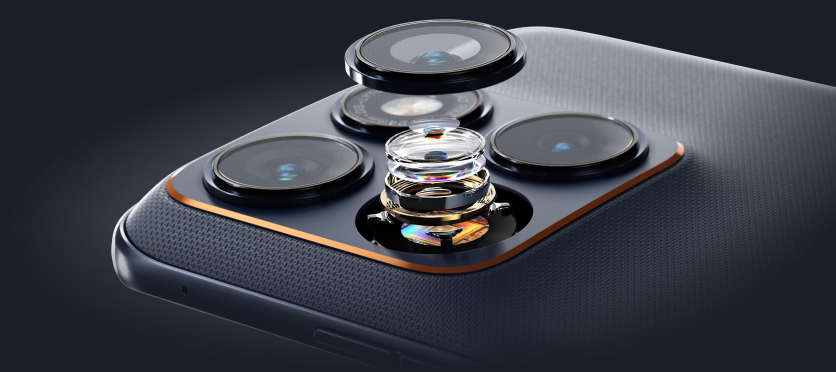
The primary camera sensor in the Edge 70 Fusion is the Sony LYTIA 710 — the world's first implementation of this sensor in a shipping smartphone, a distinction Motorola established at the device's global debut at MWC 2026 in Barcelona in March. The LYTIA 710 is a 50MP sensor with a 1.0μm pixel pitch that uses Sony's Ultra Pixel Technology to bin four pixels into a single 2.0μm effective pixel for low-light shots. The f/1.8 aperture and optical image stabilization work alongside Motorola's motoAI Photo Enhancement Engine to apply real-time texture processing and motion detection.
The LYTIA 710 is not a zoom sensor and does not include periscope telephoto capability — that hardware is reserved for the higher-priced Edge 70 Pro series. The Fusion's dual-camera rear configuration covers wide-angle versatility and everyday shooting well but will not satisfy buyers whose primary use case is optical zoom. A design detail worth noting: the global variant of the Edge 70 Fusion ships with the older Snapdragon 7s Gen 3, not the Gen 4 found in the India model. Buyers comparing reviews from UK or European outlets to the Indian purchase should confirm which chipset the reviewed device carries.
Limitations Worth Knowing Before You Buy
The Edge 70 Fusion does not have a microSD card slot — the 512GB variant addresses storage limits in part, but the fixed internal capacity remains the ceiling. Video recording tops out at 4K at 30fps; buyers who specifically need 4K at 60fps for post-production work will need to look elsewhere in this price range.
On software updates, the five-year security patch commitment and three major Android OS upgrades are competitive for this price range. The phone shipped with Android 16 in March 2026 and has not yet accumulated a track record for patch delivery speed that buyers can evaluate.
What Buyers Should Know About Motorola's Ownership
Motorola Mobility is a wholly-owned subsidiary of Lenovo Group, which is headquartered in Beijing and operates under Chinese jurisdiction. China's National Intelligence Law (2017), Article 7, requires all organizations operating under Chinese jurisdiction to "support, assist, and cooperate with state intelligence work." China's Cybersecurity Law (2017) and Data Security Law (2021) further require cooperation with government data requests.
No confirmed backdoor in the Motorola Edge 70 Fusion has been publicly documented. No comprehensive independent security audit of this specific device is publicly available. Lenovo has consistently denied sharing user data with the Chinese government. Legal scholars have noted that Article 7's practical enforcement scope is contested and its application to commercial smartphone data is not settled.
What is structural: if the Chinese government were to request data from Lenovo, Chinese law would require Lenovo to cooperate — regardless of where the user is located or where Motorola's servers are sited. That obligation exists independent of Motorola's privacy policy. For most consumers using the phone for photography, streaming, and messaging, the practical exposure is comparable to standard smartphone data risk from any global manufacturer. Buyers who process sensitive professional data on their phone should weigh this legal context alongside all other factors.
Steps that reduce — but do not eliminate — this structural risk include reviewing app permissions regularly, using a VPN for sensitive connections, and keeping the device on a segregated network profile from sensitive home or work infrastructure.
Frequently Asked Questions
What is the price of the Motorola Edge 70 Fusion 12GB 512GB in India?
Two prices are currently listed. Motorola India's official June 19 announcement confirmed ₹38,999, while Flipkart lists the same variant at ₹36,999. Buyers should verify the current price on their preferred platform before purchasing, as the Motorola India website had not yet listed the variant as of the announcement date.
Is Motorola Edge 70 Fusion available on Flipkart in India?
Yes. The 12GB / 512GB configuration is listed as available on Flipkart. All four memory variants — 8GB / 128GB, 8GB / 256GB, 12GB / 256GB, and 12GB / 512GB — are available through Flipkart, Motorola's official website, and major retail stores across India.
Why does the Motorola Edge 70 Fusion battery last longer than most mid-range phones?
The Edge 70 Fusion uses a silicon-carbon composite anode rather than the graphite anode found in standard lithium-ion batteries. Silicon stores roughly ten times as many lithium ions per gram as graphite, allowing a 7,000mAh cell to fit inside an 8mm chassis — a combination that graphite chemistry cannot achieve at that profile. The result is reported battery life well above what comparable graphite-chemistry phones in this price range deliver.
Is the Motorola Edge 70 Fusion made by a Chinese company?
Yes. Motorola Mobility is a wholly-owned subsidiary of Lenovo Group, headquartered in Beijing. China's National Intelligence Law (2017) requires Lenovo to cooperate with Chinese government intelligence requests. No confirmed backdoor or data breach involving this specific device has been publicly documented, and Lenovo has denied sharing user data with the Chinese government.

-
 C114 Communication Network
 -
 Communication Home
