
 Search

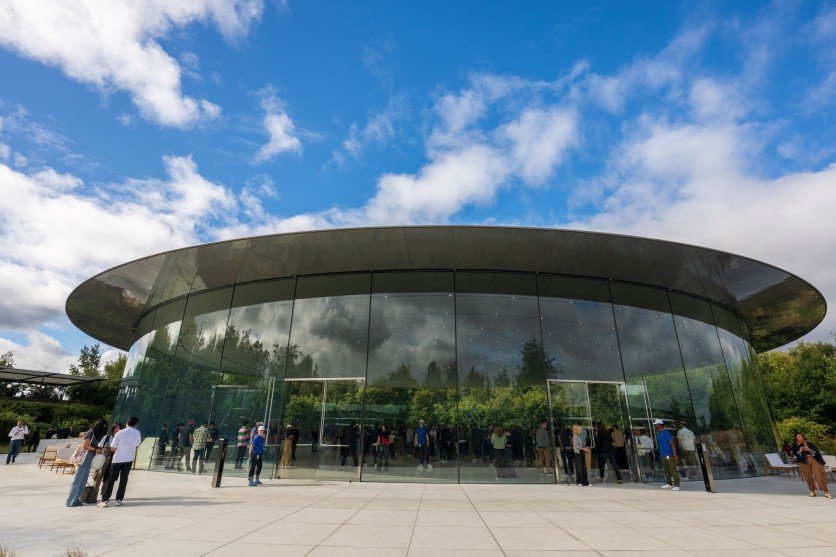
View of the Steve Jobs Theater on the Apple Park campus in Cupertino, California, on September 9, 2025. NIC COURY/Getty Images
Apple has approved Poke, an AI assistant built by Palo Alto's The Interaction Company of California, as the first AI agent approved to operate on its Messages for Business platform, the startup confirmed Thursday, June 4. For the roughly one billion people who use iMessage, the change means a person can now text a stand-alone AI agent inside Apple's Messages app the same way they message a contact or a company. It arrives four days before Apple is expected to unveil a more conversational Siri at its Worldwide Developers Conference, and it is the clearest sign yet that Apple is opening one of the most-used surfaces on the iPhone to outside artificial intelligence.
Until now, Messages for Business was reserved for partner companies such as airlines, retailers, and hotel chains to talk with their own customers through iMessage. It had never admitted an independent, third-party AI agent. Poke's clearance changes the category of software the channel will carry, and it sets a template — and a price — for any developer that wants to follow.
Poke Becomes First Apple-Approved Messages for Business AI Agent
Poke launched publicly in March 2026 and is designed to make an AI assistant feel as simple as sending a text. It can help with daily planning, calendar management, health and fitness tracking, smart-home control, and photo editing, all through conversation rather than a dedicated app. The company says it has relayed about 100 million messages across its existing channels, which include SMS, Telegram, and, in some markets, WhatsApp. With Apple's approval, iMessage joins that list.
Getting in was not automatic. According to the reporting, Apple required Poke to verify it could offer live human support, to clearly identify its agent as AI, and to submit testimonials from its messaging providers. Poke also reworked its interface to Apple's specifications, swapping inline links for link previews and adopting Apple's style guide for buttons and other elements. Co-founder Marvin von Hagen said the review took a couple of months and that any other company should expect a similar timeline.
How Apple Routes Business Agents: Approved MSPs and a Server-to-Server REST API
The approval is more interesting for how the plumbing works than for any single feature. A developer cannot connect an agent to Messages for Business directly. Apple's developer documentation specifies that all traffic flows through an Apple-approved Messaging Service Provider, or MSP, which implements a server-to-server REST API: Apple's service receives a customer's message, posts it to the MSP's endpoint, and the MSP routes the response back. Apple says it has integrated with more than 20 such providers.
Two design decisions shape what an agent on this channel can and cannot do. First, a human fallback is mandatory. Apple's own guidance states it will not approve a deployment that uses virtual agents exclusively, which is why Poke had to prove it could escalate to live support — a built-in brake on a fully autonomous bot. Second, the channel is built to limit what the business learns about the user. Rather than handing over a phone number, email, or iCloud identity, Apple passes the business an anonymized "opaque ID" that is unique to each conversation, leaving it to the user to decide whether to share anything more.
That sanctioned path is a deliberate contrast to how AI assistants reached iMessage before. A separate commercial layer, exemplified by the startup Linq and its blue-bubble iMessage API, lets companies send messages that look identical to ordinary personal texts. Poke itself grew up on that kind of infrastructure. The Messages for Business route trades the personal-looking blue bubble for Apple's branded, clearly-labeled business interface — the engineering cost of operating with Apple's blessing rather than around it.
What Data Can Poke See Through iMessage?
The opaque-ID system means the Messages for Business channel withholds a user's real contact details from the agent's operator by default. The broader privacy question sits one layer up, in what Poke does as an assistant. To deliver features like email alerts and calendar management, Poke relies on users connecting their own accounts, which gives the agent visibility into personal data well beyond a single text thread.
That places Poke in the same category as other account-connected AI agents, and it inherits their central unsolved weakness. The OWASP Gen AI Security Project ranks prompt injection as the top LLM security risk for 2026, because large language models struggle to separate trusted instructions from untrusted content. Security firms have documented "indirect" attacks in which a hidden instruction buried in an incoming email can steer a connected assistant into leaking data, sometimes with no action by the user. Apple's human-escalation requirement and conversation-scoped identifiers reduce some exposure on the messaging layer, but they do not address injection risk in the data an agent ingests on a user's behalf.
Per-User Fee Undercuts Meta's Contested WhatsApp AI Charge
The deal also establishes a business model. Von Hagen said Apple bills Poke on a per-user basis — Apple, in his words, will "charge us per user on the platform" — and that the rate is well below what Meta levies, though he declined to disclose figures. The comparison is pointed. After EU pressure, Meta agreed to let rival assistants onto WhatsApp for a per-message WhatsApp fee ranging from €0.0490 to €0.1323 per non-template message, a structure the European Commission has preliminarily found has effects equivalent to an outright ban given how many messages an AI conversation consumes.
A per-user charge behaves differently from a per-message one: it caps a developer's exposure as conversations grow long, which matters for a chatty assistant. It also turns Apple's approval process into a gatekeeper with a recurring revenue stream attached, a familiar dynamic for anyone who has watched the App Store. Von Hagen framed Poke's first-mover status partly as a matter of trust, contrasting his company's emphasis on quality with growth-at-any-cost tactics elsewhere in consumer tech.
Approval Precedes Apple's WWDC Siri Overhaul
The timing is the subtext. Apple's WWDC 2026 keynote is scheduled for Monday, June 8, at 1 p.m. ET, where the company is expected to detail a Siri revamp at WWDC that turns the assistant into a more conversational, context-aware agent, reportedly drawing on Google's Gemini models. Letting an outside agent into iMessage days earlier reads less like a coincidence than a low-risk experiment: a controlled way for Apple to observe how third-party agents behave on its turf, collect a per-user fee, and learn before it repositions Siri as an agent of its own. Apple was not immediately available for comment, and von Hagen said he is not privy to the company's plans for the platform.
Frequently Asked Questions
What is Poke?
Poke is a text-based AI assistant from The Interaction Company of California, launched publicly in March 2026. It handles tasks like daily planning, calendar management, health tracking, smart-home control, and photo editing through ordinary messaging rather than a separate app.
What can Poke do on iMessage?
Inside Apple's Messages app, users interact with Poke by texting it, the same way they would message a business. It responds conversationally and can carry out the assistant tasks it supports elsewhere, now within Apple's branded Messages for Business interface.
Is Poke safe to use?
The Messages for Business channel hides a user's phone number and email from the agent's operator, passing only an anonymized per-conversation ID. The larger consideration is that assistants like Poke connect to personal accounts to function, which exposes them to prompt-injection attacks that security researchers consider an unsolved risk for any account-connected AI agent.
Does Apple charge for AI agents on Messages?
Yes. Apple bills Poke on a per-user basis, which the startup says is significantly lower than Meta's per-message fee for third-party AI on WhatsApp. Apple has not disclosed pricing publicly.

-
 C114 Communication Network
 -
 Communication Home
