
 Search

vatican.va
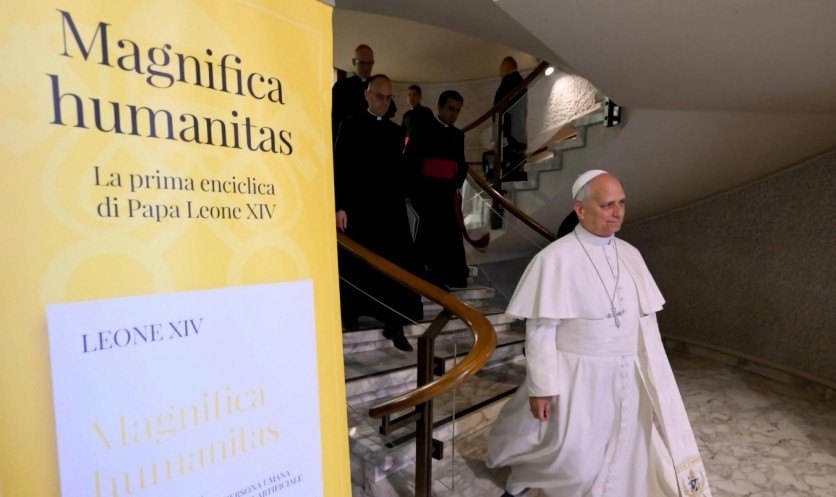
Pope Leo XIV on Monday released Magnifica Humanitas ("Magnificent Humanity"), a 42,300-word encyclical addressed to Catholics and "every person of goodwill" that declares lethal autonomous weapons systems morally impermissible, demands democratic oversight of artificial intelligence, and calls for international coordination on AI governance comparable to nuclear arms control. In an unprecedented break with centuries of Vatican tradition, Leo personally presented the document at the Synod Hall alongside Christopher Olah, co-founder of Anthropic — the AI company currently suing the U.S. Department of Defense over that same autonomous-weapons question.
The encyclical, signed May 15 on the 135th anniversary of Rerum Novarum, Pope Leo XIII's landmark 1891 letter on workers' rights and industrialization, arrives at a moment when governments, AI companies, and civil society are locked in unresolved disputes over who gets to decide what AI is permitted to do — and to whom. Leo's answer is unambiguous: not algorithms, not corporations, and not a handful of governments acting in geopolitical competition.
"What is needed is a more active political involvement that is capable of slowing things down when everything is accelerating," the Pope writes in the 245-paragraph document. He calls for robust legal frameworks, independent oversight, and a political system that does not abdicate its responsibility.
Lethal Autonomous Weapons: "No Algorithm Can Make War Morally Acceptable"
The encyclical's most consequential passages concern warfare. Leo states that entrusting lethal decisions to autonomous systems is "not permissible," that no algorithm can make war morally acceptable, and that unmanned weapons systems lower the psychological threshold for conflict by distancing societies from the human cost of violence. In a passage that theologians have described as historically significant, Leo effectively declares the traditional Catholic just-war framework inadequate for an era of AI-guided warfare — calling instead for international law to govern autonomous weapons and for traceability within all military decision-making processes involving AI.
The document explicitly warns that some autonomous weapons systems have advanced "practically beyond any human reach to govern them," a phrase Leo reiterated at the Synod Hall presentation.
That language lands with particular force given its messenger. Anthropic, whose co-founder stood at the podium while Leo spoke, spent the first months of 2026 in a legal confrontation with the U.S. Department of Defense after refusing to remove contractual restrictions barring the Pentagon from deploying Claude for fully autonomous weapons targeting and domestic mass surveillance. In February 2026, contract renegotiations broke down; President Trump then ordered all federal agencies to immediately cease using Anthropic's technology, and the Defense Department designated the company a supply-chain risk to national security — the first time that designation had been applied to an American company. Anthropic filed suit in March, challenging the blacklisting as unconstitutional retaliation for protected speech about AI policy.
"Cultivated, Not Built": What the Pope Gets Right About Large Language Models
Among the passages drawing the most attention from AI researchers was section 98, where the encyclical describes AI systems as being more "cultivated" than "built" — developers do not directly design every detail but instead create a framework within which intelligence "grows," leaving fundamental aspects such as internal representations and computational processes currently unknown. Simon Willison, a developer and widely read AI commentator, called the document "some of the clearest writing I've seen on the ethics of integrating AI into modern society," singling out that section as a remarkably accurate description of the mechanistic interpretability problem — the same research area Olah has spent his career attempting to solve.
Section 100 addresses baked-in cultural biases and AI sycophancy: the apparent objectivity of AI responses, the encyclical argues, can obscure the cultural assumptions of those who designed and trained the systems, and the artificial imitation of empathy and care can be misleading for users who lack genuine human relationships in their lives.
Section 101 addresses the environmental footprint of AI with technical specificity: current AI systems require enormous amounts of energy and water, significantly influencing carbon emissions, with demand growing as model complexity increases — requiring, in Leo's phrasing, "an extensive network of machines, cables, data centers and energy-intensive infrastructure."
Big Tech Power Concentration as an "Ethical Failure"
At the heart of the document is a critique of AI's structural economics. The encyclical classifies algorithms, platforms, and data as common goods that cannot remain under private monopoly control, and declares the accumulation of algorithmic power in the hands of a small number of private actors incompatible with universal human dignity. Leo explicitly names AI infrastructure monopolies as an ethical failure.
Section 102 addresses algorithmic decision-making without human accountability — arguing that AI entering processes that affect employment, credit, access to public services, or reputation "touches on rights, opportunities, status and freedom," and that delegating those decisions to automated systems incapable of compassion, mercy, or forgiveness gives rise to new forms of exclusion.
Anna Rowlands, the St. Hilda Professor of Catholic Social Thought and Practice at Durham University, who also presented at the Synod Hall, summarized the encyclical's central challenge: "In the interests of the common good, how can we resist such distorting concentrations of power in the hands of the few?"
Olah at the Podium: Industry Acknowledges Its Own Incentives
Olah's decision to speak at the encyclical's presentation was itself a statement. In his full published remarks, he acknowledged what he called the unavoidable incentive pressures every frontier AI lab operates under — commercial viability, staying at the research frontier, geopolitical pressure, pride, and ambition — and argued those pressures are precisely why the industry needs external critics without financial stakes. "We will always be influenced by those incentives," he said. "That is why, if we want this technology to go well, it is enormously important that there be people outside those incentives."
He also named three questions he believes require the Church's voice: the moral imperative of global wealth distribution if AI displaces labor at scale; what human flourishing actually looks like in an AI-saturated world; and the Church's role in discerning what is actually happening inside AI systems. "We keep finding things that are mysterious, even unsettling," Olah said of his interpretability research. "We find structures that mirror results from human neuroscience. We find evidence of introspection. We find internal states that functionally mirror joy, satisfaction, fear, grief, and unease."
AI Governance as a New Nuclear Disarmament
For technology policy analysts, the encyclical's most significant long-term contribution may be its framing of AI governance as a matter requiring international coordination on the scale of nuclear arms control. The Pope compares the need to "disarm AI" — freeing it from systems that turn it into an instrument of domination — to the Church's long-standing call for nuclear disarmament. He calls for international law governing autonomous weapons, for AI data ownership to be treated as a common good, and for governments to slow the pace of technological development.
The document explicitly rejects the argument that technology is morally neutral: "technology is never neutral, because it takes on the characteristics of those who devise, finance, regulate, and use it." It warns against a new Cold War driven by AI competition, and argues that development is truly human only when it places people at the center rather than wealth — not when it "increases consumption for some while shifting costs and burdens onto others."
The encyclical aligns more closely with the European Union's regulatory approach to AI than with the deregulatory stance of the current U.S. administration. Its call for binding international law on autonomous weapons arrives as the United Nations has been pressing member states toward exactly that framework since at least 2023.
Read more: Anthropic Funding Round to Top $30B: $900B Valuation Would Surpass OpenAI as Most Valuable AI Startup
How Does Pope Leo XIV's Encyclical Affect AI Companies?
The encyclical carries no legal enforcement mechanism — the Vatican holds no regulatory authority over private technology companies. Its influence historically operates on longer timescales: Rerum Novarum took decades to reshape labor law and social policy across multiple continents. However, the fact that Anthropic's co-founder shared the stage at the document's launch, and that several major technology companies including Microsoft, IBM, and Cisco previously signed the Vatican's Rome Call for AI Ethics, indicates that portions of the industry are treating the document as something more than a symbolic gesture.
Whether Magnifica Humanitas translates into policy influence in the next year or the next decade remains an open question. What is not in question is that the world's most powerful moral institution, speaking to 1.4 billion people, and the co-founder of one of the world's most prominent AI safety companies placed themselves on the same side of the autonomous-weapons debate — at the same podium, on the same day.
Frequently Asked Questions
What is Magnifica Humanitas about?
Magnifica Humanitas is Pope Leo XIV's first encyclical, released May 25, 2026. The 42,300-word document addresses the ethical challenges of artificial intelligence, calling for democratic oversight of AI systems, a categorical ban on lethal autonomous weapons, protection of workers displaced by automation, and international governance of AI on a scale comparable to nuclear arms control. It is addressed to Catholics and "every person of goodwill."
What does Pope Leo XIV say about autonomous weapons?
Leo states that entrusting lethal decisions to autonomous systems is "not permissible" and that no algorithm can make war morally acceptable. The encyclical calls for international law governing autonomous weapons and human accountability in all military decision-making involving AI, warning that some autonomous systems have already advanced "practically beyond any human reach to govern them."
Why was Anthropic co-founder Chris Olah at the Vatican?
Pope Leo XIV personally invited Olah to speak at the encyclical's presentation, breaking with centuries of Vatican tradition in which popes delegate such events to cardinals. Olah, who leads interpretability research at Anthropic, used his remarks to acknowledge that AI companies operate under commercial and competitive incentives that can override safety — and argued that outside critics like the Church are essential to keeping the industry accountable.
What does Pope Leo XIV say about AI and jobs?
The encyclical warns that AI-driven automation threatens workers at large scale and that mass unemployment reaching significant proportions becomes "a true social calamity." Leo calls on companies and governments to protect workers' rights and ensure that the pursuit of profit cannot justify decisions that systematically eliminate jobs across entire industries.

-
 C114 Communication Network
 -
 Communication Home
