
 Search

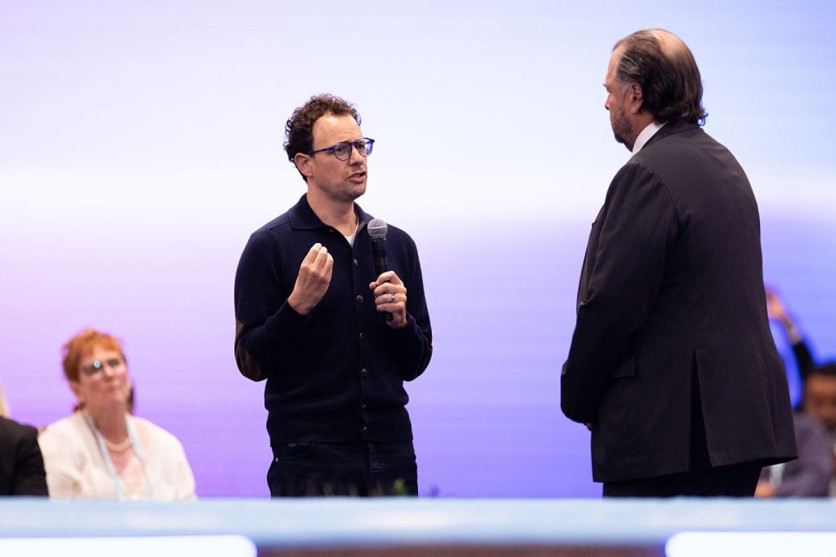
Anthropic CEO Dario Amodei, left, speaks with Salesforce CEO Marc Benioff during the keynote address at Salesforce's Dreamforce conference at the Moscone Center on September 15, 2026 in San Francisco, California. Dreamforce is an annual event that highlights the company's technologies and encourages professional networking. Benjamin Fanjoy/Getty Images
Salesforce used its Dreamforce 2026 keynote on Tuesday to declare its own interface obsolete — and then ship two products built on that premise. AIforce, a live architecture layer that routes Salesforce's data, permissions, and business logic into external AI environments without requiring workers to open Salesforce, launched Tuesday alongside Koa, the company's first purpose-built CRM reasoning model, built on NVIDIA's Nemotron framework using Group Relative Policy Optimization (GRPO) reinforcement learning — the same training technique powering OpenAI's o-series and DeepSeek-R1.
Salesforce Turns Itself Into Plumbing
The strategic argument behind AIforce is deceptively simple: most workers already have an AI tool they prefer. Salesforce is no longer competing to be that tool — it is positioning itself as what those tools pull from.
Every request flowing through AIforce inherits the requesting user's existing Salesforce sharing rules, permission sets, and business logic — no separate permission framework required and, Salesforce says, no business data retained by the external model provider after inference completes.
"AI is creating an interface revolution," Marc Benioff, Salesforce's Chair and CEO, said in prepared remarks at the keynote. "We are combining model intelligence with all the context that customers have built into Salesforce to create an intelligent, dynamic, composable system that is securely governed, built with Zero Data Retention, and designed to work with the core systems that already run your business."
AIforce launched with three initial products. Claudeforce extends Salesforce's partnership with Anthropic by embedding Salesforce data and workflow execution directly inside Claude via a prebuilt Model Context Protocol (MCP) server. It includes 37 prebuilt sales skills covering prospecting, pipeline hygiene, and deal management, plus a separate Claude Code plug-in with more than 40 developer-focused skills. Deloitte, GitLab, and Legora ran early pilots; the product is now in public beta.
Slackforce applies the same architecture inside Slack. Its centerpiece, Slackforce Surfaces, lets teams pull live Salesforce data — account histories, case updates, pipeline stages — into interactive interfaces that multiple users can act on without leaving the collaboration platform. It also enables Slackbot, a new AI assistant, and Slack CRM, which logs Salesforce records directly from Slack prompts.
Agentforce Coworker, the third launch product, is an AI teammate embedded in Salesforce's Lightning interface that reasons across accounts, activity history, and historical data, then acts under existing permissions. Salesforce disclosed that more than 100,000 users activated Coworker during its first 35 days of pilot — with Fulton Bank moving from zero to more than 20 production use cases within weeks, serving approximately 3,000 users.
How MCP Removes the Custom Integration Tax
The architecture underlying AIforce runs on the Model Context Protocol, an open standard originally developed by Anthropic and now widely adopted across the AI ecosystem. MCP solves a specific problem: before it existed, every AI-to-enterprise integration required a bespoke connector — custom authentication, custom data format, custom API calls — built separately for each pairing of AI tool and business system. MCP replaces that per-integration sprawl with one standard that any MCP-compatible AI client can speak and any enterprise platform can expose.
Salesforce's Headless 360 architecture exposes more than 60 MCP tools covering Salesforce data access, workflow execution, approval routing, and record management. Any agent running in Claude, ChatGPT, Cursor, Amazon Quick, or Gemini Enterprise can dynamically discover and invoke those capabilities at runtime, without a developer building a custom integration — because the MCP server handles discovery, authentication, and capability-description automatically.
Patrick Stokes, Salesforce's President of Applications and Marketing Solutions, described the layering this way: "Headless 360 is really the raw MCP servers, the raw APIs, the exposure of those things from Salesforce; AIforce is a step above it. March was like the raw materials, or the raw ingredients, and AIforce is like the chocolate chip cookie that comes out of the oven."
What AIforce Puts at Risk in Your Org
Here is the finding Salesforce's keynote did not name: AIforce's security guarantee is only as strong as your org's existing sharing model — and most production Salesforce environments have permission configurations that were never designed for the access volume that agentic AI will generate.
An independent post-keynote architecture analysis put it directly: "Your sharing model, exactly as it stands today, is about to be exercised by more requests from more surfaces than it was designed for." That assessment identified three questions every keynote skips as the ones that actually determine whether AIforce deployments succeed: who can access which records (not in theory — in practice, after years of profile clones and permission sets added for projects that ended), what happens when two connected systems disagree on the same data point, and what specific actions the agent is explicitly prohibited from taking.
Separately, a Salesforce Ben analysis found that 63% of employees who used AI in the prior year pasted sensitive company data into personal chatbots, including source code, customer records, and internal documents — often bypassing the very governance infrastructure Salesforce Admins had configured. AIforce closes some of that gap by routing requests through governed Salesforce permissions rather than uncontrolled personal AI accounts. It opens a different risk: agents that can do everything a permissioned user can do, at the scale and speed of software.
The data on enterprise AI deployments broadly underscores the implementation gap. According to data from IDC and Lenovo, 88% of enterprises with agent initiatives never ship to production. Gartner separately reports that more than 40% of agentic AI projects are cancelled due to escalating costs and inadequate risk controls. AIforce's out-of-box permission inheritance solves the integration complexity that kills early pilots — but it transfers, rather than eliminates, the governance burden.
Koa: What a CRM Reasoning Model Is, and Why GRPO Changes the Equation
Koa is the product Salesforce needs AIforce to justify. A live interface layer that lets any AI tool query Salesforce data is only as useful as the reasoning quality of the AI doing the querying — and general-purpose frontier models, however capable, were not trained to understand the specific structure of enterprise CRM workflows.
Koa was built by post-training NVIDIA's Nemotron 3 Super — an open-weights model with publicly accessible architecture — on a proprietary synthetic dataset drawn from nearly three decades of Salesforce CRM deployments. No actual customer data was used; Salesforce instead generated synthetic scenarios representing the reasoning and tool-use requirements of CRM work across more than 14 industries, including financial services, manufacturing, travel, and healthcare. Each scenario paired a persona with a specific enterprise task and mapped the agent's actions alongside the tool calls required to complete them.
The post-training pipeline applied two techniques in sequence. First, Supervised Fine-Tuning (SFT) aligned the model to known-good CRM responses. Then, Group Relative Policy Optimization (GRPO) — a reinforcement learning technique in the same family as methods used for OpenAI's o-series and DeepSeek-R1 — trained the model to execute multi-step CRM tasks by comparing outcomes across candidate action sequences and reinforcing the ones that reached the right result. The infrastructure ran on NVIDIA NeMo RL, NeMo Gym, and NeMo AutoModel.
What distinguishes Koa from a general-purpose model handling CRM tasks is not the base architecture but the training target. Frontier models learn to generate plausible text about opportunity updates, case routing, and follow-up scheduling because that text appears in their training data. Koa learns to execute those tasks as reasoned, multi-step workflows because that is what GRPO reinforcement learning optimizes for — the right action sequence, not just the plausible response.
On Salesforce's internal CRM benchmark — a suite of real-world tasks including updating opportunities, routing cases, and scheduling follow-ups — the company says Koa already matches or exceeds leading frontier model performance while producing three times fewer errors. That benchmark is Salesforce's own proprietary evaluation, not an independent third-party audit. Rohan Kumar, Salesforce's President of Platform and Engineering, described the model as still in its "early innings," with 1-800Accountant, Baxter Credit Union, Engine, Formula 1, UChicago Medicine, and Xero among its current Koa pilot customers.
Salesforce controls Koa's model weights and runs inference entirely within its own infrastructure, meaning customer data does not cross a third-party trust boundary during an agent's reasoning chain. Koa is available to select pilot customers now inside Agentforce; general availability in US regions is expected during Winter 2026.
Jensen Huang, founder and CEO of NVIDIA, joined Benioff onstage at the keynote. "AI is creating a much larger opportunity for software," Huang said. "Every company needs useful AI, tailored to its knowledge, expertise, and work. NVIDIA Nemotron open models give Salesforce the foundation to turn decades of enterprise expertise into specialized AI with Koa, creating a CRM model that can reason and securely take action."
Siemens Test Case: From Unread Leads to 132 Countries
The most concrete evidence Salesforce presented for the agentic enterprise model came from its expanded partnership with Siemens. Before deploying Agentforce, Siemens was receiving more than 2,500 unqualified inbound leads per month with no efficient system for identifying which warranted seller attention. Two AI agents now work together inside Sales Cloud to engage incoming prospects, qualify them, and route stronger opportunities to Siemens' approximately 18,000 sellers across 132 countries — resulting in 100% lead engagement where previously the volume was unmanageable.
The deeper Siemens integration targets aftermarket services — an area where industry analysis suggests revenue can grow roughly six times faster and carry approximately four times the margin of new-equipment sales. By connecting Salesforce Agentforce with Siemens Teamcenter Service Lifecycle Management, a field technician can identify the correct spare part for a specific machine before arriving on site, while a sales representative can confirm that a proposed equipment upgrade is technically manufacturable — without waiting for engineering to respond manually.
Cloud Neutrality as Architecture: AWS and Google
Salesforce's simultaneous announcement of expanded partnerships with both AWS and Google Cloud on the same day carries a deliberate signal: the company is not aligning with either cloud, it is making the cloud choice irrelevant.
On the AWS side, Salesforce business context is now natively available inside Amazon Quick — AWS's enterprise AI agent — via MCP, enabling Quick to query pipeline data, account summaries, and service cases without custom integration work. In return, AWS agents including the DevOps Agent are being embedded directly into Slack, with Security, FinOps, and Partner Central agents expected in Slack by autumn 2026. Agentforce customers gain access to models from Anthropic, NVIDIA, and OpenAI through Amazon Bedrock, with Zero Data Retention applied at the Bedrock layer.
The Google Cloud expansion connects Agentforce and Gemini Enterprise through the same MCP standard, exposing thousands of Salesforce capabilities to Gemini agents handling sales, service, finance, and advertising workflows. Tableau governance and row-level security are enforced at the protocol level rather than inside the agent — meaning the access controls travel with the data, not with the specific AI client requesting it. Hyperforce, Salesforce's cloud infrastructure layer, is expected to begin migrating selected US customers to Google Cloud infrastructure in the fourth quarter of 2026, with North America general availability planned for November 2026. Commerce Cloud merchants will be able to surface products in Google Search and the Gemini app beginning in fall 2026, with Google's Universal Commerce Protocol enabling shoppers to complete purchases through Google surfaces while merchants retain control of payments and compliance through Commerce Cloud.
The architecture's implication for enterprise buyers: if Salesforce makes both the cloud and the model interchangeable, the durable investment is neither the cloud contract nor the AI subscription — it is the quality of the Salesforce org itself. The data, the permissions, the encoded business logic, and the workflow configurations built over years of deployment become the one layer that is not swappable.
What Seven Named AI Agents Actually Mean
Beyond AIforce and Koa, Salesforce pre-released a portfolio of seven job-ready agents in the days before Dreamforce. Six are generally available now: Casey handles customer service across voice, SMS, WhatsApp, and digital channels using existing Salesforce knowledge and case data; Paige manages IT and HR service requests; Carter focuses on e-commerce; Marshall handles supply chain and back-office orchestration; Piper qualifies inbound sales leads and books meetings; Fin manages complex customer experience workflows. Hunter, focused on outbound sales prospecting, is currently in pilot with general availability expected in November 2026.
The portfolio's significance is practical rather than architectural: named agents with specific job functions and stated availability dates are more immediately deployable than platform capabilities that enterprises must configure from scratch. They are also the most concrete test of whether the 88% enterprise agent failure rate begins to shift, since pre-built agents with defined scope and measurable job outcomes reduce the configuration burden that kills most agentic AI projects before they reach production.
Why Your Salesforce Org Is Now a Security Perimeter
The Adecco Group's announcement of an Agentforce Coworker rollout across more than 40 countries — following a pilot in the UK and France — illustrates both what AIforce makes possible at scale and what it requires before that scale is responsible. The sequence Adecco used — narrow pilot, verified results, then controlled expansion — is the opposite of the failure pattern that produces cancelled agentic AI projects.
For enterprise IT and security teams evaluating AIforce, the practical checklist that independent Salesforce architects recommend begins before any product adoption: audit who can actually see what in the existing org (not what the sharing model was designed to show, but what it currently shows after years of drift); identify every MCP client already pointed at the org, since Headless 360 is already live and the surface is already exposed; reconcile data that exists in multiple systems with conflicting values, since a reasoning model resolves disagreements silently rather than flagging them; and write an explicit refusal set before building any agent prompt — an enumerated list of what the agent is not permitted to do, with a test confirming each refusal actually fires.
Salesforce now holds approximately 20.7% of the global CRM market by revenue, according to IDC data, in a market that surpassed $80 billion in 2025. What AIforce changes is not that share — it is what the Salesforce platform is. The interface was one of the most consistent moats in enterprise software for more than two decades. Salesforce has voluntarily removed it, betting that the data, permissions, and business logic underneath it are a more durable competitive asset than the screen on top.
Frequently Asked Questions
What is Salesforce AIforce, and how is it different from Agentforce?
AIforce is a live architecture layer that exposes Salesforce data, business logic, workflows, permissions, and governance to AI interfaces outside Salesforce's own user interface — meaning workers can query and act on CRM data through Claude, Slack, Amazon Quick, Gemini Enterprise, or any MCP-compatible AI tool without logging into Salesforce itself. Agentforce is Salesforce's AI workforce layer — the autonomous agents that do the work. AIforce is the architecture that lets those agents, and third-party AI tools, reach the data they need to operate. Think of AIforce as the foundation that makes Agentforce available everywhere rather than only inside the Salesforce UI.
How does Koa's GRPO training make it different from GPT-4 or Claude for CRM work?
General-purpose frontier models were trained on broad internet text, which includes content about CRM workflows — but not the structured experience of actually executing them. Koa was post-trained using Group Relative Policy Optimization (GRPO) reinforcement learning on synthetic scenarios specifically representing multi-step CRM task completion: updating an opportunity through its stages, routing a support case to the right tier, scheduling a follow-up against an account's activity history. GRPO trains the model by comparing candidate action sequences and reinforcing those that complete the task correctly — making Koa more effective at step-by-step CRM execution than a model that has only learned to generate plausible text about those tasks. Salesforce's own benchmark shows Koa producing three times fewer errors than frontier alternatives on CRM-specific tasks, though that benchmark has not been independently audited.
What should enterprise IT teams do before enabling AIforce in their Salesforce org?
Before expanding your Salesforce org's surface area to AI interfaces through AIforce or Headless 360, independent Salesforce architects recommend three foundational steps: audit your actual current sharing model against who is still at the company and what they should be able to see (permission drift is common in mature orgs); run an inventory of any MCP clients already connected to your org, since Headless 360 was live before Dreamforce and may already be active; and resolve data conflicts between Salesforce and connected systems before agents begin querying them, since a reasoning model will produce a confident answer from whichever system it consults first rather than flagging a discrepancy. The governance work comes before the product adoption.
Does AIforce mean Salesforce can now see data I send to Claude or Amazon?
Salesforce's Zero Data Retention architecture means that business data routed through external model providers via AIforce is used only to generate the requested response and is not retained by those providers after inference completes. Salesforce itself hosts Koa within its own infrastructure and controls Koa's model weights, so CRM data queried through Koa does not cross a third-party trust boundary. For third-party models accessed through AIforce — Claude, Bedrock-hosted models, Gemini Enterprise — Zero Data Retention applies at the integration layer. Users whose compliance obligations require confirmation of these data-handling commitments should review the specific data processing agreements with each provider.

-
 C114 Communication Network
 -
 Communication Home
