
 Search

Samsung.com
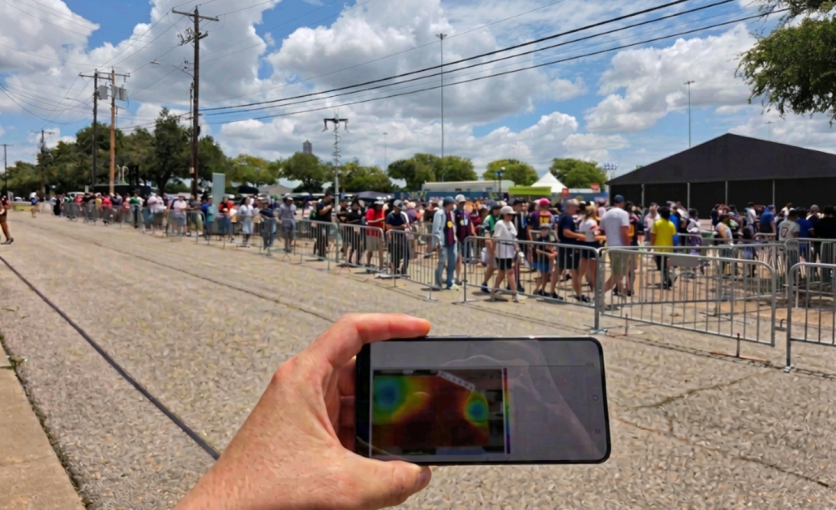
Tens of thousands of soccer fans packed Dallas, Texas for one of the year's marquee international football events, jostling for food stalls and open space, posting highlights, streaming replays. Somewhere above them, bolted to a Verizon Cell-On-Wheels, a Citizens Broadband Radio Service (CBRS) radio unit was doing something no commercial carrier network had previously demonstrated: turning the crowd's own radio environment into a real-time crowd map, using the same 5G signals the fans were using to scroll their feeds.
On September 14, 2026, Samsung Electronics and Verizon announced the successful completion of what both companies describe as the industry's first AI-powered Integrated Sensing and Communication (ISAC) trial ever conducted on a virtualized Radio Access Network (vRAN) — and they ran it live, at scale, in a real event environment, without any additional hardware beyond what already existed on the network. The result was a near-real-time crowd density heatmap, surfaced to phones and a tablet, showing organizers which areas were filling up and which had room.
The announcement is the clearest signal yet of what 6G's most consequential feature may actually look like in practice — and why the wireless industry's race to build it is also producing a governance question that nobody has answered yet.
What ISAC Is, and Why the Dallas Trial Matters
Integrated Sensing and Communication is, at its conceptual core, a design approach that allows the same radio hardware and spectrum serving your data connection to simultaneously function as a kind of radar. Traditional cellular networks are purpose-built for one job: moving data between devices and towers. ISAC changes the premise by combining both sensing and communication within the same system, using the same hardware, the same spectrum, and the same transmitted signals simultaneously. The 3GPP standardization body responsible for global cellular standards has been formalizing ISAC's technical foundations across multiple work streams since 2022.
What the Dallas trial demonstrated is that this is not a laboratory curiosity awaiting 6G deployment — it is achievable today, on existing commercial infrastructure, with a software update rather than a truck roll.
The trial's architecture was deliberately lean. Samsung integrated its commercial AI-powered vRAN (Virtualized Radio Access Network) and vCore software with an ISAC application, deploying the entire stack on its Network in a Server (NIS) platform — a single server that consolidates all network functions and edge-AI compute into one box. That software configuration allowed the ISAC trial to draw on an active commercial 5G network without any additional equipment.
The sensing itself worked as follows: a CBRS radio unit — Citizens Broadband Radio Service, covering a 150-megahertz (MHz) slice of the 3.5 GHz spectrum in the United States — mounted on a Verizon Cell-On-Wheels (COW) mobile tower acted as a passive sensing receiver. Using 40 MHz of that CBRS spectrum, it captured variations in the radio channel from six Samsung Galaxy smartphones that served as known reference transmitters in the crowd. Samsung's NIS platform then analyzed those channel fluctuations in near-real time, using accelerated compute to extract crowd density patterns, visualized as a heatmap updating continuously as people moved.
The system identified no individuals. Per both companies' disclosures, the crowd sensing demo measured crowd density — the number of people in a given area at any given time — and no personal information was captured or stored about any individual attendee.
How Verizon's Software-First Network Bet Made This Possible
The Dallas milestone is inseparable from a strategic decision Verizon made years earlier: building one of the world's largest commercial virtualized networks rather than sticking with traditional hardware-bound radio infrastructure. That software-defined foundation turned out to be exactly what ISAC requires — because ISAC is itself a software capability layered onto radio hardware that already exists.
Yago Tenorio, Chief Technology Officer and Senior Vice President of Technology Development at Verizon, framed the payoff directly: the carrier's early investments in flexible, software-driven vRAN architecture gave it the agility to engineer and trial 6G concepts like ISAC over existing infrastructure, with the field trial proving that the network of the future will do far more than transfer data — it will actively perceive and respond to its environment.
Ji-Yun Seol, Executive Vice President and Head of Product Strategy for Samsung Electronics' Networks Business, described the Dallas trial as a demonstration of what "forward-thinking operators" can unlock by adopting software-driven, AI-powered vRAN early — the agility to introduce new capabilities like ISAC from day one, using the commercial network already running.
Charlie Zhang, Executive Vice President at Samsung Research America, whose team contributed the AI-driven ISAC solution, called it "a significant leap forward in integrating AI-driven sensing capabilities into network infrastructure, showcasing the transformative potential of 6G technologies."
Does the Industry Know What to Do With This Technology?
The operating heatmap served three distinct stakeholder groups during the Dallas event. Attendees could identify less congested food and service areas. Event organizers gained real-time visibility into crowd distribution, enabling faster resource deployment. Security and public safety teams could detect emerging overcrowding conditions before they escalated — a capability with obvious implications for crowd crush prevention at high-density events.
Whether ISAC becomes a universal feature of 6G networks or remains a specialized enterprise capability is a question the market has not settled. ABI Research's 6G Networks and Infrastructure 2Q 2026 market data projects that ISAC-enabled radio deployments will reach 2.6 billion by 2034 — driven by aggressive Asia-Pacific growth and rapid integration of sensing capabilities into first-phase 6G RAN deployments.
At the same time, ABI Research Senior Research Director Dimitris Mavrakis has said publicly that complete ISAC systems — ones that fully integrate sensing and communication at commercial grade — are unlikely to materialize until after 2033, with commercial ISAC deployment waiting until 6G achieves critical mass. The Dallas trial is a pre-standard proof of concept, not a commercial product. The gap between "this works on 40 MHz of CBRS spectrum with six reference phones" and "this scales across a national network" is substantial.
What Nobody in That Crowd Consented To
The Dallas trial measured crowd density, not individual identities, and both companies disclosed that explicitly. But the technology the trial validated is not permanently limited to density measurements.
Academic researchers at TU Dortmund University and Linköping University published a detailed analysis of ISAC privacy challenges in a May 2026 preprint, classifying the data that future ISAC systems could collect into three escalating levels. Level 1 is location and environment data — crowd density, movement patterns, floor plan inference — which is what the Dallas trial measured. Level 2 is behavioral data: user posture, gait characterization, gestures, physical activity. Level 3 is physiological data: breathing frequency, heart rate, and biometric identification at millimeter-wave and sub-terahertz frequencies. Each higher level becomes technically accessible as 6G systems move to higher radio frequencies and wider antenna arrays. Their research on ISAC privacy identifies consent, transparency, data ownership, and bystander-exposure as core unresolved challenges.
The researchers also highlighted a structural consent problem that separates ISAC from conventional surveillance technology: passive sensing at the cellular level can detect and measure anyone within range of an antenna, regardless of whether they carry a mobile device. A person without a smartphone walking through a 6G coverage area may still be sensed.
Germany's Conference of Independent Data Protection Authorities addressed this concern directly in a June 2026 position paper, warning that ISAC could introduce privacy risks comparable to invisible video monitoring, but with significantly broader capabilities, and that individuals would have little practical way to know when they were being scanned or to provide meaningful consent. The conference's June 2026 press release on ISAC confirmed the issuance of a formal position paper on ISAC and data protection at the federal and state level.
In the United States, no federal framework currently governs what commercial cellular operators are permitted to do with ISAC-derived sensing data. The 3GPP standardization body's ongoing work on ISAC explicitly includes security and privacy dimensions — the TR 33.777 study on Security and Privacy Aspects of ISAC is active — but those are technical standards, not regulatory law.
Where Is the 6G Standards Work Right Now?
The 3GPP body responsible for global cellular standards has been formalizing ISAC's technical foundations across multiple work streams. TR 22.837 — the Release 19 feasibility study that identified more than 30 ISAC service requirements and use cases, including object and intruder detection, trajectory tracking, public safety, rainfall monitoring, and health monitoring — was finalized in 2024. Release 20 architecture work for 5G-Advanced ISAC is now active, with SA2 completing a study on core network support for ISAC (TR 23.700-14) and normative specification work underway (TS 23.137). Parallel studies cover the security and privacy aspects (TR 33.777) and RAN technical procedures for sensing (TR 38.765).
ETSI launched an Integrated Sensing and Communications Industry Specification Group (ISG ISAC) in November 2023, tasked with coordinating pre-standard research across European and global initiatives, with explicit scope covering privacy and security aspects of sensing data in the 6G framework.
6G's commercial launch remains projected for approximately 2030. The Samsung–Verizon Dallas trial is ahead of the standards curve, validating a real-world implementation while comprehensive 6G ISAC specifications are still being written.
Samsung's Global ISAC Strategy and the Growing 6G Ecosystem
The Dallas trial is not Samsung's first ISAC field demonstration, and Verizon's September 14 announcement was part of a larger set of moves. On the same day Samsung and Verizon disclosed the Dallas results, Verizon also announced that nine new technology industry leaders had joined the Verizon 6G Innovation Forum: Amazon Web Services, NVIDIA, Intel, Cisco, Keysight Technologies, MediaTek, Palo Alto Networks, Rohde & Schwarz, and VIAVI Solutions. The additions bring critical multi-disciplinary capabilities across cloud services, advanced silicon and accelerated computing, network security, and independent testing to the consortium. Details on all nine new Forum members were disclosed in Verizon's September 14 announcement.
The Verizon 6G Innovation Forum was founded in September 2025, initially uniting Ericsson, Samsung Electronics, Nokia, Meta, and Qualcomm Technologies. The forum aims to establish an open, diversified, and resilient 6G ecosystem while ensuring global alignment with standards bodies. Dedicated 6G Labs in Los Angeles serve as hubs for collaborative research, prototyping, and field trials. Details on the Forum's founding membership were announced September 22, 2025.
Verizon's September 14 disclosure also included a Qualcomm-led drone and vehicle safety tracking demo conducted at Qualcomm's San Diego campus — a separate ISAC trial that used 100 to 400MHz of millimeter-wave spectrum and four synchronized Transmission and Reception Points (TRPs) to simultaneously track an airborne target and moving ground vehicles while maintaining uninterrupted 5G Standalone communications for a ground-based phone user. Full details on the Qualcomm ISAC drone trial appeared in the same Verizon announcement.
Verizon's CTO noted that the carrier views the 2028 Summer Olympics in Los Angeles — with the company's dedicated 6G Lab already established there — as the ultimate proving ground on the road to commercial 6G deployment.
Samsung has also advanced ISAC research through collaborations outside the US. In May 2026, the company signed an ISAC research agreement with South Korean carrier LG Uplus on ISAC technology for 6G. In June 2026, Samsung completed an AI-powered network optimization trial with Japan's KDDI on a commercial 5G Standalone network.
How Do You Sense Crowds With a Cell Tower?
Understanding why the Dallas trial was technically significant requires understanding what "passive bistatic sensing" means in a cellular context — because it is different from what most people picture when they hear "sensing."
The trial did not use new sensors. The CBRS radio unit mounted on the COW was operating in receive mode — listening to the radio environment, not emitting a dedicated sensing signal. The six Samsung Galaxy smartphones in the venue were transmitting their normal uplink data signals to the network. What the Samsung NIS platform was analyzing was how those transmissions changed as bodies moved through the space — how the radio channel's characteristics (signal strength, phase, multipath reflections) varied as people walked between the phones and the tower.
This technique, sometimes called passive bistatic radar sensing, uses the communication signal itself as the illuminating source and detects changes in how that signal arrives at the receiver. It requires no additional spectrum, no dedicated sensing transmitter, and no opt-in by the people being sensed. Its primary limitation is resolution: detecting crowd density is achievable on 40 MHz of CBRS spectrum; detecting individual gait or physiological signals requires the wider bandwidths and higher carrier frequencies that full 6G mmWave and sub-terahertz systems will eventually provide.
That is why the Dallas trial is simultaneously a proof of concept and a constraint map. It proved the architecture works at Level 1 (density sensing) on today's commercial infrastructure. It also demonstrated the ceiling: at 40 MHz of CBRS spectrum in the mid-band, you get crowd counts, not identities or heartbeats. The jump to Levels 2 and 3 requires the spectrum and hardware that 6G will eventually deploy — and the privacy frameworks that the standards bodies, regulators, and industry have not yet written.
Frequently Asked Questions
What is ISAC, and how is it different from a regular cellular network?
A standard cellular network has one job: moving data between your phone and a tower. Integrated Sensing and Communication (ISAC) extends that same hardware and spectrum to a second job — sensing the surrounding environment using the radio waves that the network already transmits and receives. Instead of building dedicated radar or camera infrastructure, an ISAC-enabled cell tower can detect crowd density, movement patterns, and — at higher frequencies in future 6G systems — potentially behavioral and physiological data. The key engineering insight the Dallas trial validated is that on a software-defined vRAN, this sensing capability can be deployed as a software update, without any new physical equipment.
Does the ISAC sensing system identify individual people?
In the Dallas trial, no. Samsung and Verizon both stated explicitly that the crowd sensing demonstration measured only crowd density — the number of people in a given area — and that no information was obtained about the identity of any individual. However, the broader technology is not permanently limited to density measurements. Academic researchers have documented that future 6G ISAC systems operating at millimeter-wave and sub-terahertz frequencies could infer individual gait, posture, gestures, and physiological data including breathing frequency and heart rate — all without any device requirement on the people being sensed. The Dallas trial demonstrated the current floor of capability, not the eventual ceiling.
What does this mean for privacy — do I have to opt in to be sensed?
For the Dallas trial, no opt-in was required or requested from attendees. One of the structural features of passive ISAC sensing is that anyone within the coverage area of a sensing-enabled antenna can be measured, regardless of whether they carry a mobile device. Germany's Conference of Independent Data Protection Authorities issued a June 2026 position paper warning that ISAC could constitute a form of invisible monitoring with no practical mechanism for consent. In the United States, no specific federal framework governs what commercial cellular operators can do with ISAC-derived sensing data. The 3GPP standards body is actively studying ISAC security and privacy requirements (TR 33.777), but technical standards are not the same as regulatory law.
When will 6G networks with ISAC be commercially available in the US?
Commercial 6G launch is projected for approximately 2030 industry-wide. ABI Research projects that ISAC-enabled radio deployments will reach 2.6 billion globally by 2034, driven by Asia-Pacific growth and first-phase 6G RAN deployments. However, ABI Research has also cautioned that complete, commercially mature ISAC systems are unlikely to materialize until after 2033, after 6G achieves critical mass in deployments. The Dallas trial is a pre-standard proof of concept that demonstrates viability on today's vRAN infrastructure; the path from 40 MHz of CBRS spectrum on a single COW to national-scale sensing deployment involves substantial standardization, regulatory, and commercial work still ahead. Verizon has identified the 2028 Summer Olympics in Los Angeles as its near-term proving ground for next-generation network capabilities, as detailed in Verizon's September 14, 2026 announcement.

-
 C114 Communication Network
 -
 Communication Home
