
 Search

Alpinecars.com
Days after the last petrol-powered A110 left the Dieppe factory, Alpine has unveiled the development mule for its third-generation electric sports car — and its debut at the Goodwood Festival of Speed starting Thursday will be the first public test of whether a purpose-engineered EV can genuinely replace one of the most driver-focused cars of the past decade.
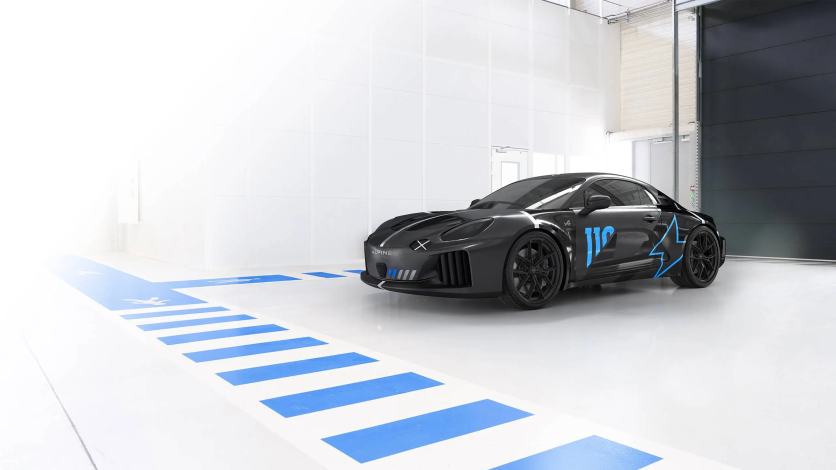
The prototype, named the A110 FUTURE, will make daily hillclimb runs at Goodwood from July 9 through July 12, giving engineers and enthusiasts a live read on the dynamics of the Alpine Performance Platform before the electric A110 launch timeline.
Alpine ended production of the current A110 on July 1, 2026, with the 28,701st example — an A110 R 70 in Alpine Blue — rolling off the Dieppe line in Normandy. Across both generations since the factory opened in 1969, the site has produced 35,450 A110s in total. The A110 FUTURE mule takes to Goodwood's famous hill just eight days after that final car was built.
Why EV Weight Distribution Is the Central Engineering Challenge
The core tension in building a performance EV is one Alpine engineers have made explicit: batteries are heavy, and their placement determines how a car handles. A conventional EV "skateboard" layout places a large, flat battery pack across the entire floor, optimizing packaging efficiency and energy density at the expense of engineering discretion over front-to-rear weight balance. For a family sedan or SUV, that tradeoff is acceptable. For a mid-engine sports car defined by its 40/60 front-to-rear weight distribution, it is not.
The current petrol A110 weighs approximately 1,102 kg (2,430 lbs). A comparable electric vehicle using a standard skateboard platform would add roughly 450 kg — nearly eliminating the light-car handling advantage that made the A110 a class benchmark and drew the praise of engineers including Gordon Murray and the A110, who liked the current model enough to purchase one.
Independent engineering research published in MDPI's Sensors journal has confirmed that rear-biased weight distributions of 40/60 specifically benefit rear-wheel-drive sports car dynamics: rear wheels lock later under braking, load transfers dynamically toward the front during corner entry, and the car has a natural tendency toward controllable oversteer. These are the handling characteristics the A110 is known for, and they are the characteristics most at risk in a straightforward EV conversion.
How the Alpine Performance Platform Addresses the Problem
The Alpine Performance Platform (APP) makes a specific structural choice: instead of a single floor-spanning battery, it splits the pack into two separate units, positioning one in the front of the car and one at the rear. This placement is designed from the outset to preserve the 40/60 weight distribution rather than accommodate it as an afterthought.
Both packs use a cell-to-pack architecture, eliminating the intermediate module layer that conventional battery packs use. In a traditional design, individual lithium-ion cells are grouped into modules, which are then assembled into the larger pack housing. Cell-to-pack removes the module step entirely, bonding cells directly into the pack structure. The benefit is meaningful: lower weight, reduced bulk, and higher energy density by eliminating inactive housing material between cells. Alpine says the high-energy-density cells in the APP are specifically chosen to minimize pack mass.
The electrical architecture runs at 800 volts — the same nominal voltage used by the Porsche Taycan, Hyundai Ioniq 5/6, and Kia EV6 — rather than the 400V systems found in most mainstream EVs. At 800V, the same power output requires half the current of a 400V system. Lower current means thinner, lighter cables, substantially less heat generated during fast charging and hard driving, and the ability to sustain peak performance through repeated acceleration without the thermal throttling that limits most performance EVs after sustained track use.
At the rear, a dual e-motor 3-in-1 e-axle packages both electric motors, the reduction gearbox, and the inverter into a single integrated housing. The inverter uses silicon carbide (SiC) semiconductors rather than conventional silicon. SiC's wider electronic bandgap — approximately three times that of silicon — allows it to switch current at significantly higher frequencies, dissipate less heat, and operate more efficiently across the power range. In practical terms, SiC inverters generate less waste heat than silicon-based alternatives, which simplifies cooling, reduces weight in the thermal management system, and allows faster, more precise torque control at the rear axle. The combination of dual motors and SiC-enabled precision creates the conditions for torque vectoring and EV dynamics between the two rear wheels — the mechanism most likely to deliver the playful, controllable oversteer the current A110 is celebrated for.
The suspension is fully aluminum, following the weight philosophy of the current model. Alpine says new integrated braking and steering systems complete the platform — language consistent with brake-by-wire and steer-by-wire approaches that enable more precise software-defined handling calibration.
What Cell-to-Pack Costs at the Service Bay
The efficiency gain from cell-to-pack architecture comes with a documented tradeoff that Alpine's press materials do not address directly. When cells are bonded directly into the pack without modular intermediary housings, repairing or replacing individual cell groups becomes difficult or impossible without replacing the entire pack. In modular pack designs, a faulty module can be swapped out; in cell-to-pack designs, a failed cell group typically means a full pack replacement, which in high-performance EVs can run to significant cost.
Alpine is reportedly exploring a replaceable battery pack design specifically to address this concern, according to reporting by evo magazine. The goal would be to allow buyers to upgrade to improved battery chemistry as it becomes available, and to avoid the steep depreciation associated with non-serviceable battery degradation in high-performance EVs. Alpine has not officially confirmed this as a production feature of the A110 FUTURE. The production car's serviceability architecture remains an open question.
What the Goodwood Debut Actually Proves
The A110 FUTURE is a development mule, not the finished car. Its body borrows the silhouette of the outgoing model with modifications including flared front and rear fenders (signaling a wider track), a side-mounted charging port, a blockier rear end, and a transparent quick-release hood. These details hint at the production car's direction without committing to final design.
What the Goodwood runs will actually test is the APP platform's dynamic behavior under real-world conditions — specifically whether the split-battery weight distribution and torque-vectoring rear axle deliver the handling character Alpine is promising. The hillclimb course at Goodwood, running 1.16 miles with 300 feet of elevation change, is a genuine engineering test, not a display circuit.
Alpine has released no power figures, no confirmed curb weight, no battery capacity, and no official range estimates for the production A110. What is confirmed is the architecture: 800V, split cell-to-pack battery, rear dual e-motor with SiC inverter, full aluminum suspension. Third-party estimates put the production car in the 480 hp range with Alpine A110 target weight specs of 1,400 to 1,500 kg — still meaningfully heavier than the current model's 1,102 kg, but substantially lighter than most performance EVs.
The production car is expected to debut in late 2026 or early 2027, with deliveries beginning in early 2027, also built at the Dieppe factory. The APP platform will also underpin a roadster version of the A110 and a new A310 — a 2+2 sports coupe positioned to take on the Porsche 911, with an expected debut around 2028.
Goodwood 2026: Alpine's Biggest Show Yet
Alpine's presence at this year's Goodwood Festival of Speed will be its most extensive to date, extending well beyond the A110 FUTURE. The full current lineup — including the A290 electric hot hatch and the A390, a 470-hp five-seat sport fastback — will join the mule both on the hillclimb and at the Alpine stand.
Thursday, July 9 will host the Alpine Moment, a Brand Parade that brings together the A110 FUTURE alongside landmark A110 models from across the decades, tracing the car's arc from 1960s rally icon to electric pioneer. An E20 Formula One show car will provide the demonstration run finale. Both of Alpine's current F1 drivers — Pierre Gasly and Franco Colapinto — will be on site throughout the four-day event, alongside Academy and reserve drivers Nina Gademan, Paul Aron, and Alex Dunne. Interactive simulators, driver talks, signing sessions, and lunchtime DJ sets are planned daily.
First staged in 1993, Goodwood regularly brings more than 600 cars and motorcycles to its hill across the four-day event.
Frequently Asked Questions
Is the Alpine A110 FUTURE a production car?
No. The A110 FUTURE is a development mule — a rolling engineering testbed disguised in a modified version of the outgoing A110's body. It is built to validate the Alpine Performance Platform hardware under real-world driving conditions. The production car is expected to debut in late 2026 or early 2027, with deliveries beginning in early 2027. No official power, weight, range, or price figures have been confirmed for the production version.
What makes the Alpine Performance Platform different from a standard EV architecture?
Most EV platforms place a single large battery pack flat across the car floor in a "skateboard" layout — which optimizes packaging efficiency but gives engineers limited control over weight distribution. Alpine's platform splits the battery into two separate cell-to-pack units, placing one in the front and one in the rear, specifically to maintain the 40/60 front-to-rear weight balance that defines the current A110's handling character. The 800V electrical architecture and silicon carbide inverters enable sustained peak performance and precise torque control without the thermal throttling that limits most performance EVs under hard driving.
Will the cell-to-pack battery be hard to repair or replace?
Cell-to-pack designs — which bond cells directly into the pack without an intermediate module layer — are known to be more difficult to service than modular pack designs. If a cell group fails, full pack replacement is typically required rather than a module swap. Alpine is reportedly exploring a replaceable battery pack design for the A110 to address this concern and avoid the steep depreciation associated with non-serviceable EV batteries, but this has not been officially confirmed as a production feature. Buyers considering the A110 should confirm the pack replacement and warranty terms before purchase.
When will the new Alpine A110 electric go on sale?
Alpine expects to reveal the production version of the electric A110 in late 2026, with customer deliveries beginning in early 2027. The car will be built at Alpine's historic Dieppe factory in Normandy, France — the same site that produced all 28,701 examples of the second-generation A110 that ended production on July 1, 2026.

-
 C114 Communication Network
 -
 Communication Home
