
 Search

iMoD Official
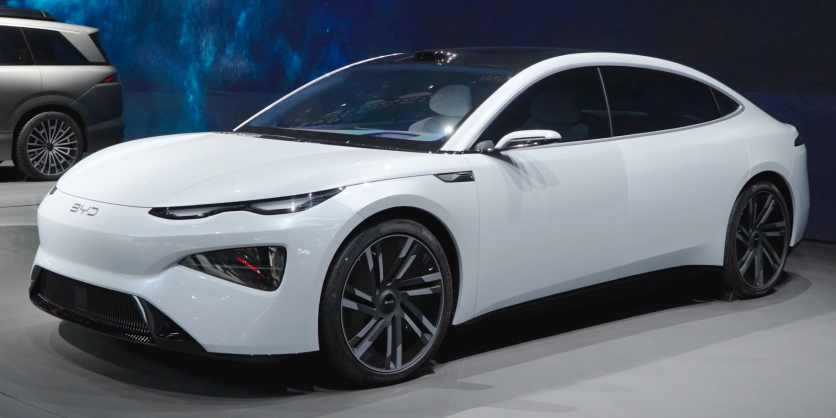
BYD's new flagship sedan accumulated approximately 65,000 committed orders within 30 hours of launching in China last Thursday — a pace that signals genuine consumer demand, not pre-launch marketing noise. The Seal 08 arrived priced at 196,900 yuan (roughly $29,000) and carries specifications that directly pressure Western premium sedans costing two to three times as much. Before any purchase decision, buyers outside China need to weigh one structural legal condition that no privacy policy can override.
65,000 Orders in 30 Hours Signal Real Demand, Not a Paper Launch
BYD opened blind pre-orders for the Seal 08 on June 12, and by the time the car officially went on sale July 2, approximately 40,000 committed orders had already accumulated, according to channel estimates compiled by BYD researcher Andy Ding via the Chinese financial platform Xueqiu. More than 20,000 additional orders followed in the hours after pricing was announced on launch night, pushing the 30-hour total to approximately 65,000 units.
The order mix is itself informative. Pure-electric variants captured more than 65% of all orders, and within that group the all-wheel-drive Flagship Long Range trim — the 785 km (CLTC) configuration — was the most popular choice, despite also carrying the longest delivery wait. BYD's current Seal 08 production capacity stands at roughly 8,000 units per month, meaning the initial order book alone represents an eight-month delivery queue at full output.
That demand velocity is consistent with BYD's broader June 2026 momentum. The company sold 403,472 new-energy vehicles at wholesale in June, up 5.46% year-over-year, while overseas deliveries hit a record 175,349 units, a 94.73% year-over-year surge. BYD's stock gained 15.56% in the week following the Seal 08 launch and the June export record, recovering from a 52-week low hit on June 30.
What BYD Seal 08 Delivers for $29,000
Six variants are available, split evenly between pure-electric and plug-in hybrid powertrains. The base entry price of 196,900 yuan ($29,030 at current rates) applies to both the 775 km EV Premium and the 400 km PHEV Premium. The lineup tops out at 239,900 yuan ($35,360) for the AWD Long Range EV Flagship.
Every trim ships with BYD's God's Eye B advanced driver-assistance system, which includes a roof-mounted LiDAR sensor and supports city navigation on autopilot (CNOA), highway navigation on autopilot (HNOA), automatic emergency braking, auto-parking, and remote parking. That suite requires an additional-cost upgrade to access on many Western rivals. All variants also come with rear-wheel steering, delivering a minimum turning radius of 4.95 meters.
The interior features dual zero-gravity front seats with heating, ventilation, and massage, a 15.6-inch touchscreen, a 12.3-inch digital instrument cluster, and a 26-inch augmented reality head-up display. All variants carry BYD's second-generation Blade Battery. Higher trims add the DiSus-A closed dual-chamber air suspension with road-preview sensors, which is not included in the base trims.
At 5,150 mm in length with a 3,030 mm wheelbase, the Seal 08 is 180 mm longer than the Tesla Model S.
The AWD pure-electric configuration delivers 510 kW (634 hp) and reaches 100 km/h in 3.3 seconds. The plug-in hybrid AWD variant covers the same sprint in 3.8 seconds. BYD claims a PHEV combined driving range of 1,660 km (CLTC) by combining a 1.5-liter turbocharged engine with a 268 hp electric motor.
How Blade Battery 2.0's 8C Flash Charging Works
The headline capability — 400 km of range added in five minutes of charging — is not marketing language. It reflects a specific set of engineering decisions in BYD's second-generation Blade Battery that are worth understanding before comparing the Seal 08 to anything else on the market.
Mainstream EVs charge at rates between 3C and 4C. Tesla's V4 Supercharger supports approximately 5C. The Blade Battery 2.0's Short Blade format supports an 8C peak charge rate and 16C peak discharge rate — the technical reason a 10%-to-70% state-of-charge refill takes five minutes rather than twenty.
BYD achieves this through what it calls the "FlashPass" Ion Transport System, which combines three co-engineered components. The "Flash-Release" cathode uses a directionally engineered, multi-level particle-size architecture that enables rapid deintercalation — the process of releasing lithium ions from the cathode during charging — at high current. The "Flash-Flow" electrolyte uses AI-optimized ion-pathway design to maximize ionic conductivity. The "Flash-Intercalate" anode uses a multi-dimensional lithium-insertion site construction that allows 360° high-speed ion intercalation, and the system additionally features a breakthrough SEI (Solid Electrolyte Interphase) layer engineered at the molecular level to be simultaneously ultra-thin and highly dense, allowing ions through at high speed while maintaining chemical stability across charging cycles. BYD has passed a simultaneous Flash Charging and Nail-Penetration Test over 500 cycles with no thermal runaway, and a forced-short-circuit test of four cells simultaneously, with no fire or explosion up to temperatures exceeding 700°C.
The 8C rate is only physically possible on an 800V platform. At the Seal 08's peak charging power of 1,500 kW, an 800V system requires approximately 1,875 amps of current. At a conventional 400V architecture, the same power would demand nearly 3,750 amps — beyond what any production charging cable can safely carry. The 800V platform does not just enable faster charging; it is a prerequisite for it.
BYD is also deploying the infrastructure to make this relevant. The company had built more than 7,000 Flash Charging stations across 325 cities in China as of the Seal 08's launch date and is targeting 20,000 by year-end.
BYD Seal 08 Range: CLTC vs. Real World
The 905 km figure that appears in every BYD headline for the Seal 08 Long Range RWD configuration is a CLTC rating. The China Light-Duty Vehicle Test Cycle uses lower average speeds and lighter acceleration profiles than the WLTP standard used in Europe or the EPA cycle used in the United States — it consistently produces range figures 20–30% higher than what the same vehicle achieves under WLTP conditions.
For the 92 kWh Long Range RWD Seal 08, an independent WLTP estimate by MotorWatt (March 2026) puts the figure at approximately 715 km (444 miles). Real-world mixed driving — the kind a European or North American driver would actually experience — typically yields 75–85% of the WLTP figure, suggesting a practical range of roughly 536–608 km (333–378 miles) for mixed-use driving. At sustained highway speeds of 120 km/h, that drops further to an estimated 465–536 km (289–333 miles).
Those are still competitive figures. The Mercedes-Benz EQS 450+ — which starts at well above $100,000 in North American trim — claims 926 km WLTP (575 miles) with its 122 kWh battery. The Seal 08's 715 km WLTP estimate falls below that benchmark. The comparison becomes more complicated at the AWD level: the Seal 08 AWD delivers 785 km CLTC, which translates to roughly 565–600 km WLTP — still within striking distance of the EQS at roughly a quarter of the price.
One genuine advantage of BYD's LFP Blade Battery chemistry is that it tolerates daily charging to 100% without significant degradation over time, unlike NMC chemistry used by many Western rivals. A Seal 08 owner's stated 905 km range is available on every charge.
Read more: BYD Launches ParkPay In-Car Parking Payments on Android Automotive OS for Europe
What BYD Seal 08 Still Cannot Do
Production constraints are the most immediate limitation. At approximately 8,000 units per month — a figure confirmed by channel tracking as of the launch week — the Seal 08 cannot absorb 65,000 orders without a 2–3 month delivery backlog for most configurations. The AWD Long Range Flagship trim carries the longest wait. Buyers in China willing to accept that timeline are effectively locked in; international buyers cannot yet purchase the Seal 08 at any price.
The Flash Charging capability that differentiates the Seal 08 from every Western rival requires BYD's proprietary 800V Flash Charging infrastructure. While BYD has begun deploying Flash Charging stations in Europe for the Denza Z9 GT, the Seal 08 has not been confirmed for sale in any international market, meaning its Flash Charging capability is unavailable to buyers outside China. At standard 150 kW DC chargers, the Seal 08 charges like a conventional EV — useful but not transformative.
On the ADAS front, BYD's God's Eye B system — which powers the LiDAR-equipped autonomous features — depends on map coverage and regulatory approval in each operating jurisdiction. City Navigation on Autopilot (CNOA) functionality, which is available in China from day one, requires separate validation for European and other international markets. BYD has not confirmed CNOA availability timelines for any market outside China.
The EU market faces a layered cost structure that erodes the price advantage. Pure-electric BYD imports currently carry a 17% punitive tariff on top of the standard EU rate, for a combined approximately 27%. The European Commission is also examining the plug-in hybrid tariff exemption that has allowed PHEV models to enter at a lower duty rate. BYD is building production capacity in Hungary, with a plant in Szeged on track to begin vehicle assembly in the fourth quarter of 2026 — a move designed to reduce tariff exposure over time, but one that has not yet delivered vehicles.
BYD's benchmark figures for the Seal 08 are self-reported and reflect Chinese testing standards. No independent Western government evaluation of the Seal 08's performance at production scale had been published as of this article's writing. Independent audits of prior BYD models — including ADAS performance and battery degradation — have sometimes found gaps between claimed and real-world performance.
China Data Law Applies Regardless of Server Location
The BYD Seal 08 is a connected vehicle. It continuously collects GPS location history, driving behavior, LiDAR sensor data, camera imagery, infotainment usage data, and smartphone data mirrored through the vehicle's connectivity system, including contacts, app preferences, and cellular identifiers. That data is transmitted through BYD's connected-vehicle architecture to backend servers.
BYD's European head Michael Shu stated publicly at the FT's Future of the Car conference that European customer data remains within Europe, processed through Google Cloud. BYD also passed China's voluntary automotive data security assessment in December 2025, covering 43 models.
These assurances do not resolve the structural legal condition. China's National Intelligence Law (2017), Article 7, states that all organizations and citizens shall support, assist, and cooperate with national intelligence work in accordance with the law. This obligation applies to BYD as a Chinese company regardless of where data is stored, regardless of GDPR compliance, and regardless of what BYD's privacy policy states. The obligation is a condition of operating under Chinese law — not a contested claim that BYD can waive.
Additionally, China's Cybersecurity Law (amended January 1, 2026) and Data Security Law (2021) impose data localization requirements and provide the Chinese government authority to access "important data" on national security grounds. Security researchers at PlaxidityX demonstrated in October 2025 that personal data — including contact lists with relationship metadata, healthcare provider information, and cellular identity codes (IMSI, IMEI) — could be extracted from the infotainment unit of a 2023 BYD ATTO 3 without any active network intrusion, because the data was stored unencrypted. The researchers also confirmed ongoing transmission to Chinese servers via a pre-installed GSM modem. That finding led to CVE-2025-7020.
The US Department of Commerce's January 2025 final rule bans the sale or import of connected passenger vehicles from China-controlled companies effective model year 2027, explicitly including vehicles manufactured domestically in the US. That rule applies to BYD.
Buyers in markets where BYD does sell the Seal 08 can take partial steps: avoiding smartphone sync to the infotainment system reduces some data exposure, and the EU Data Act (effective September 2025) gives connected-vehicle users the right to request access to their collected data. Neither measure changes the legal framework under which BYD operates.
Read more: BYD Canada Confirms Late 2026 Retail Push: Chinese Intelligence Law Applies to Owners
What Western Rivals Can Still Charge Extra For
The Seal 08's order volume and pricing have already prompted comparisons to a slow-motion disruption of the premium EV segment. BYD's ability to price a 634 hp, LiDAR-equipped, 800V sedan at $29,000 is not the result of cutting corners — it is the result of vertical integration and production scale that Western automakers cannot currently replicate.
BYD manufactures approximately 75% of its vehicle components in-house, including battery cells, power management chips, and vehicle software. This eliminates the supplier margin that Western OEMs pay to companies like LG Energy Solution, Qualcomm, or Bosch for equivalent systems. The Blade Battery 2.0's R&D costs are amortized across a lineup that sold over 4 million vehicles in 2025. That cost structure allows BYD to put its most advanced battery platform into a $29,000 sedan and a $100,000+ hypercar in the same quarter.
What established premium automakers retain is an ecosystem built over decades: charge network density in markets where BYD has none, regulatory approval for ADAS features in markets where BYD is still validating, resale value data and residual value guarantees, and established servicing infrastructure. A Mercedes-Benz EQS or BMW i7 buyer gets a known quantity in a known market; a Seal 08 buyer in Europe or elsewhere gets better specs at a fraction of the price, with infrastructure and service-network depth that is still being built.
The Seal 08's 65,000-order debut in China establishes that this tradeoff resonates strongly with buyers who trust BYD's existing ecosystem. Whether it resonates with the same force in markets where that ecosystem is not yet in place — and where the data-law framework is a live concern — is a question BYD's next 12 months of international sales will answer.
For any buyer outside China considering the Seal 08 when and where it becomes available: the vehicle's technical specifications are genuinely competitive at the stated price. The CLTC range figures require an international-standard adjustment of roughly 20–25% before comparing to WLTP-rated rivals. The Flash Charging capability requires BYD's proprietary infrastructure to be relevant. And China's National Intelligence Law imposes a legal data-sharing obligation on BYD that no privacy policy, server location, or certification can dissolve — a fixed condition of the decision, not a footnote.
Frequently Asked Questions
What is the BYD Seal 08's real-world range outside China?
BYD's 905 km figure for the Long Range RWD Seal 08 is a CLTC rating, measured under China's test cycle, which uses lower speeds and lighter acceleration than international standards. An independent WLTP estimate (MotorWatt, March 2026) puts the 92 kWh Long Range RWD model at approximately 715 km (444 miles). In real-world mixed driving, expect roughly 536–608 km (333–378 miles); on sustained highway runs above 120 km/h, the range drops further. These figures are still strong for the segment but roughly 20–25% below the CLTC headline.
How does BYD's 5-minute Flash Charging actually work, and can buyers outside China use it?
The Seal 08's Flash Charging relies on BYD's second-generation Blade Battery in Short Blade format, which supports an 8C peak charge rate — roughly double what the fastest widely available third-party DC chargers currently deliver. The chemistry achieves this through a "FlashPass" Ion Transport System that combines a directionally engineered cathode particle structure, AI-optimized electrolyte, and a high-speed anode ion-insertion architecture that allows rapid charging without sacrificing durability. This speed is only possible on an 800V platform, which BYD has deployed in the Seal 08. The catch: 5-minute charging requires BYD's proprietary Flash Charging stations, which number more than 7,000 in China as of the launch date, with a target of 20,000 by year-end. The Seal 08 has not been confirmed for international sale, so its Flash Charging capability is not available to buyers outside China. At standard 150 kW DC chargers, the Seal 08 charges at a conventional rate.
Does China's data law apply to BYD vehicles driven outside China?
Yes. China's National Intelligence Law (2017), Article 7, requires BYD as a Chinese company to support and cooperate with Chinese intelligence authorities on demand. This obligation applies regardless of where the vehicle is driven, where BYD stores data, or what BYD's privacy policy states. BYD's European head has said European data stays in Europe on Google Cloud, and BYD passed China's own voluntary data security assessment. Neither assurance overrides the statutory legal obligation. Separately, security researchers found in October 2025 that personal data in the infotainment system of a 2023 BYD ATTO 3 was stored unencrypted and transmitted to Chinese servers via an embedded GSM modem. The US has banned Chinese connected vehicles from sale effective model year 2027 partly on these grounds.
Is the BYD Seal 08 available to buy outside China?
Not at launch. The Seal 08 went on sale exclusively in China on July 2, 2026. BYD has not confirmed export timelines, pricing, or regulatory approval for the Seal 08 in any international market. BYD's broader international expansion is ongoing — overseas sales hit a record 175,349 units in June 2026 — and the company is building its first European manufacturing plant in Szeged, Hungary, targeting a fourth-quarter 2026 production start. Whether the Seal 08 specifically will be part of that export push has not been announced as of this writing.

-
 C114 Communication Network
 -
 Communication Home
