
 Search

System76.com
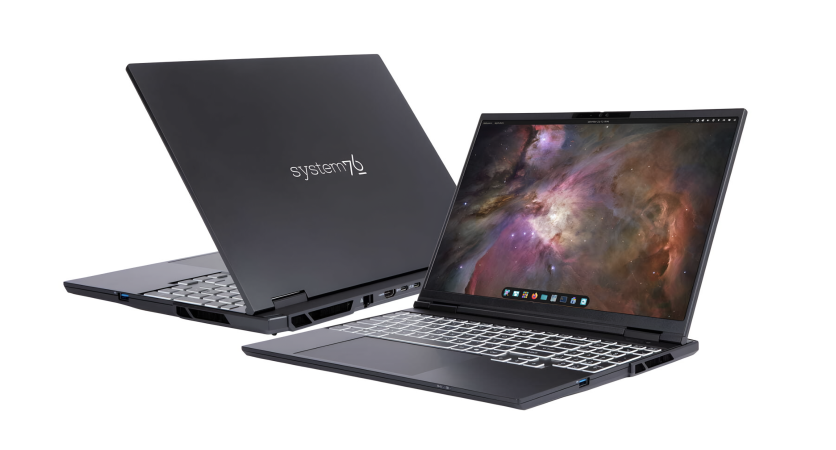
System76 unveiled the Adder Pro on July 4, a 15.3-inch Linux gaming laptop that weighs 1.53 kg — nearly a kilogram lighter than the company's current RTX 5070-capable machines — and pairs Intel's latest Panther Lake processor with discrete Nvidia GeForce RTX 5060 or RTX 5070 Laptop graphics. The machine ships in mid-July with no price announced, running Pop!_OS 24.04 LTS or Ubuntu 26.04 LTS out of the box.
For Linux developers and power users who have long had to choose between portability and discrete GPU performance, the Adder Pro closes that gap directly. Until now, System76's RTX 5070-capable Oryx Pro 16 weighed around 2.25 kg, and the Adder WS 15 came in at approximately 2.4 kg. The new machine sheds close to 900 grams from those options in a chassis that measures 34.37 × 26.19 × 1.98 cm — under 20 mm thin. Full specs are available on System76's Adder Pro teaser page.
Panther Lake and the 18A Node: More Than a Benchmark Number
The Core Ultra 7 356H at the heart of the Adder Pro is built on Intel's 18A manufacturing process, and that detail carries weight beyond the spec sheet. The 18A node is the first sub-2nm-class process designed and manufactured in the United States, produced at Intel's Fab 52 in Chandler, Arizona. It introduces two foundational engineering advances: RibbonFET, Intel's first new transistor architecture in more than a decade — a gate-all-around design that allows more precise control over electrical switching — and PowerVia, an industry-first backside power delivery system that moves power routing to the bottom of the silicon wafer. By decoupling power and signal layers, PowerVia reduces electrical resistance and contributes to the roughly 15% better performance-per-watt Intel claims versus its prior process node. These details are confirmed in Intel's October 2025 Panther Lake architecture announcement.
For the Linux and developer community, the significance is that every Panther Lake laptop that ships and performs as claimed is also a live data point for external foundry customers — Apple, Amazon, and others — evaluating whether to trust Intel 18A manufacturing with their own silicon. The Adder Pro, a niche product in laptop market terms, is a real-world test of a US semiconductor manufacturing bet with geopolitical and supply-chain stakes well beyond gaming.
The 356H itself is a 16-core chip with four Cougar Cove performance cores boosting to 4.7 GHz, eight Darkmont efficiency cores at up to 3.7 GHz, and four additional low-power efficiency cores. Intel omitted hyper-threading from Panther Lake by design, meaning the chip runs the same number of threads as it has cores — a deliberate tradeoff for better per-core power efficiency on the 18A node. Notebookcheck's benchmarks for the Core Ultra 7 356H note the 356H has enough compute headroom to edge past the AMD Ryzen AI 9 HX 370 "Strix Point" APU found in many competing compact systems.
The 356H also carries an NPU 5 neural processing unit rated at up to 50 TOPS platform figure — clearing Intel's Copilot+ PC threshold for on-device AI inference without cloud connectivity.
Read more: SteamOS NVIDIA Support Confirmed: Valve Has a Growing Team but AMD Builds Work Now
RTX 5060 or RTX 5070, Both With GDDR7 — and a Key Caveat
Buyers configure the Adder Pro with either an Nvidia GeForce RTX 5060 or RTX 5070 Laptop GPU. Both options carry 8 GB of GDDR7 memory — the seventh-generation graphics memory standard that uses PAM4 signaling at approximately 1.1 volts, delivering higher per-pin bandwidth than GDDR6X at meaningfully lower power draw. That thermal efficiency matters in a 1.53 kg chassis where every watt of saved GPU power is headroom the chassis doesn't need to dissipate.
The RTX 5070 Laptop option promises roughly 15% better performance than the 5060 with adequate cooling, though System76 has not yet confirmed the GPU power limits for either configuration. Notebookcheck's RTX 5070 Laptop benchmarks confirm that performance for this GPU class is heavily dependent on TDP settings. Until the machine ships and independent reviewers can test it, direct performance comparisons with other RTX 50-series laptops remain speculative. The 8 GB GDDR7 allocation is sufficient for 1080p and 1440p gaming today, though it may become a constraint at the Adder Pro's native 1600p resolution as post-2026 AAA titles demand more VRAM — the June 2026 Steam Hardware Survey shows the 16 GB VRAM tier growing steadily.
What Can Pop!_OS Do With an RTX 5070 That SteamOS Cannot (Yet)
The Adder Pro ships with Pop!_OS 24.04 LTS, and the NVIDIA GPU situation on Pop!_OS differs fundamentally from that on SteamOS. Pop!_OS is a conventional, mutable Linux distribution — users can install, update, and maintain NVIDIA's proprietary drivers using standard package management, and Pop!_OS 24.04 ships with NVIDIA Driver 585 as a supported configuration. SteamOS, by contrast, is an immutable OS where the root filesystem is read-only; Valve must package NVIDIA drivers inside its update images, a process that requires deep cooperation with NVIDIA and is not expected to complete before late 2026 at the earliest.
For Adder Pro buyers, this means NVIDIA RTX 5070 gaming on Pop!_OS is a solved problem today, not a roadmap item.
A Glossy OLED in a Landscape of Matte Panels
The display deserves particular attention, because System76 made an uncommon choice. The Adder Pro uses a 2560×1600 OLED panel running at 165 Hz with 100% DCI-P3 color coverage and a 16:10 aspect ratio — and it is finished with a glossy coating rather than the matte anti-glare treatment that the vast majority of portable gaming and professional laptops use.
The reason for that choice is fundamental to how OLED panels work. A matte anti-glare coating is a diffusion layer applied over the display glass; it scatters reflected ambient light, which reduces glare but also slightly diffuses the light coming from the display itself, reducing perceived contrast and color saturation. An OLED panel without that coating delivers its native image quality directly — blacks that are literally off, contrast that is essentially infinite, and colors exactly as the panel produces them. The physics of glossy versus matte OLED display coatings are well documented in display technology literature.
The tradeoff is that a glossy display reflects the surrounding environment more visibly. In a brightly lit office or outdoors, those reflections are intrusive. In the controlled environments where many Linux developers and creative professionals work — and in darkened gaming setups — the glossy finish is a meaningful image quality upgrade. System76's choice signals that the Adder Pro is designed for those environments, not for café or commute use.
Paired with the COSMIC desktop environment's Wayland-native compositor, the combination has additional technical implications: Wayland compositors can directly control OLED panel behavior — refresh rate switching, HDR signaling, per-monitor scaling — in ways that X11-based desktop environments cannot. COSMIC, written in Rust for memory safety and built exclusively on Wayland from its first release, is the first Linux desktop environment purpose-built to take full advantage of what a modern OLED display pipeline can do.
Read more: Steam Hardware Survey June 2026: Windows 11 Tops 70%, AMD Closes In on Intel
Open Firmware Means Auditable Firmware
Every System76 laptop running coreboot ships with firmware that users can inspect and modify. For the Adder Pro, this means the low-level initialization code that sets up the processor, memory controller, and I/O fabric before the operating system loads is open-source — a meaningful distinction from the proprietary UEFI implementations found in virtually every Windows-centric OEM laptop. System76's open firmware documentation details how the coreboot-based stack is structured.
One specific consequence matters for gaming performance: System76 has implemented NVIDIA Dynamic Boost in coreboot, allowing the system to dynamically share up to 25 additional watts between the CPU and GPU depending on which subsystem needs it more during a given workload. On a proprietary UEFI laptop, that power-sharing logic lives in a closed binary. On the Adder Pro, it lives in auditable firmware code — a distinction that matters to security-focused developers and organizations with hardware supply-chain requirements.
The coreboot implementation also disables Intel's Management Engine on supported models, reducing the amount of closed firmware running on the hardware. Firmware flashing requires physical presence at the device; a randomly generated confirmation number must be typed before any firmware update proceeds.
Memory, Storage, and Connectivity
The Adder Pro supports up to 96 GB of dual-channel DDR5 at 5600 MHz across two SO-DIMM slots — enough headroom for memory-intensive development workloads, containerized environments, and AI model inference running locally on the NPU or GPU. Primary storage is handled by an M.2 2280 PCIe Gen 4 slot supporting up to 4 TB, with a secondary M.2 2242 expansion slot available for additional capacity.
The I/O layout covers two USB 3.2 Gen 2 Type-C ports with DisplayPort 1.4 support (one of which handles charging), two USB 3.2 Gen 1 Type-A ports, HDMI, Gigabit Ethernet, Wi-Fi 7, Bluetooth 6, a 2-in-1 audio jack, and a 5-megapixel webcam with a physical privacy shutter. The system runs on a 60 Wh battery and draws from a 230 W adapter.
Context: System76's Broader Panther Lake Push
The Adder Pro launches alongside a refreshed Lemur Pro, which also moved to Panther Lake in early July. The Lemur Pro — available in 14-inch and 16-inch configurations — targets the opposite end of the portability spectrum: up to 18 hours of battery life (the longest System76 has ever offered), multi-core performance gains of up to 50% over its predecessor, and a starting price of $1,999 for the base configuration. Phoronix reported the Lemur Pro launch on July 1, 2026.
The two machines serve different users, but together they represent System76's most comprehensive hardware refresh in recent memory — a Panther Lake rollout that covers both ultraportable productivity and discrete-GPU gaming performance in a single generation.
The Adder Pro has not yet gone on sale; System76 is accepting email notifications on the product teaser page and confirms mid-July availability. Pricing remains undisclosed. Given the RTX 5070 GPU option, glossy OLED panel, and high-capacity memory support, the machine is unlikely to reach the market at a budget price point — but for Linux developers and power users who have been waiting for gaming-class GPU performance in a sub-1.6 kg Linux-native chassis, the Adder Pro is the first machine that closes that gap without requiring a Windows installation or a cumbersome dual-boot setup.
Frequently Asked Questions
Does Pop!_OS support NVIDIA RTX 5070 Laptop GPU drivers out of the box?
Yes. Pop!_OS is a standard, mutable Linux distribution — unlike immutable operating systems such as SteamOS, it supports the installation and management of NVIDIA's proprietary drivers through normal package management. Pop!_OS 24.04 ships with NVIDIA Driver 585 as a tested configuration, and System76 provides firmware and driver support specifically validated for their hardware. NVIDIA GPU gaming on Pop!_OS is supported now, not pending a future update.
What is Intel 18A and why does the Core Ultra 7 356H's use of it matter?
Intel 18A is a 1.8nm-class manufacturing process fabricated at Intel's Fab 52 in Chandler, Arizona — the most advanced semiconductor node ever designed and manufactured in the United States. It introduces RibbonFET gate-all-around transistors (Intel's first new transistor design in over a decade) and PowerVia backside power delivery. The result is up to 15% better performance-per-watt than Intel's prior node, which is part of why Panther Lake can deliver competitive CPU performance in a 1.53 kg chassis. The 18A process is also strategically significant: Intel is using it to compete with TSMC for external foundry customers, meaning every successful Panther Lake chip shipped is a validation of US-based advanced semiconductor manufacturing.
Is 8 GB of GDDR7 sufficient for gaming at the Adder Pro's native 1600p resolution?
For current gaming workloads, 8 GB GDDR7 is adequate at 1080p and 1440p, with GDDR7's higher bandwidth helping maintain frame rates at quality settings. At the Adder Pro's native 2560×1600 resolution, some demanding 2026 titles may approach the 8 GB limit, particularly with higher texture settings. The June 2026 Steam Hardware Survey shows the 16 GB VRAM tier growing as a share of gaming systems, suggesting that 8 GB may become a constraint for the highest-fidelity settings in titles released over the machine's useful life. For most gaming workloads and all developer use cases today, 8 GB GDDR7 is not a limiting factor.
Why did System76 choose a glossy OLED finish rather than matte anti-glare?
A glossy OLED display delivers the panel's native image quality without the softening effect of a diffusion (anti-glare) coating. On an OLED panel — where black pixels are fully off — the result is higher perceived contrast, more accurate colors, and richer visual output in controlled lighting environments. The tradeoff is increased reflections in bright ambient conditions. System76's choice reflects a design decision oriented toward developer offices and gaming setups rather than outdoor or café use. The glossy finish pairs naturally with the COSMIC desktop's Wayland-native compositor, which can directly control HDR output and per-monitor scaling on the OLED panel in ways that older X11-based desktops cannot.

-
 C114 Communication Network
 -
 Communication Home
