
 Search

Bimos.co.kr
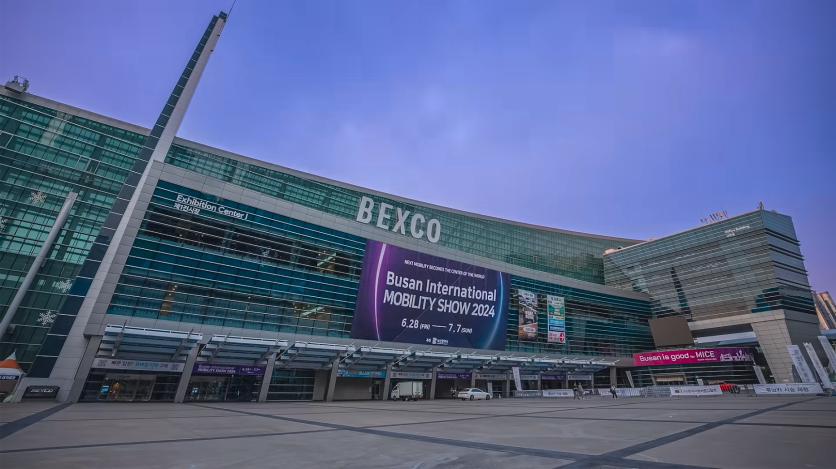
The 13th Busan International Mobility Show opened its press day at BEXCO in Busan, South Korea on Friday, June 26, kicking off a ten-day run that continues through July 5. The show's central moment arrived early: Hyundai pulled the covers off the eighth-generation Avante — the compact sedan sold globally as the Elantra — for its first appearance anywhere in the world, while BYD stepped onto a Korean auto show floor for the first time with the domestic debut of its DM-i plug-in hybrid technology. Together, the two launches crystallize the competition that will define South Korea's automotive market in the second half of this decade: Hyundai defending home turf, and China's largest electric vehicle maker testing whether Korean consumers will follow price and technology over national brand loyalty.
What Changed in the 2027 Hyundai Elantra
The eighth-generation Avante, internally coded CN8, arrives roughly six years after the current model debuted in April 2020. The redesign is significant on multiple levels. Externally, the car adopts flared wheel arches, flush door handles, and an aesthetic inspired by the IONIQ V, moving away from the sharp origami surfaces of the outgoing generation toward a more conventionally upscale, retro-futuristic character. A quarter window reappears and the roofline flattens — both signals that the car is growing. It is longer and wider than its predecessor.
The powertrain update is equally substantial. A naturally aspirated 2.0-liter gasoline engine delivers 147 horsepower, up 25 horsepower from before, while a 1.6-liter hybrid unit produces 155 horsepower using Hyundai's updated TMED-II system. That hybrid includes a new regenerative braking calibration and a Stay Mode function that allows occupants to run the air conditioning and infotainment from the battery while parked — behavior previously reserved for fully electric vehicles.
Pleos Connect and the Elantra's New Infotainment Architecture
The cabin represents the most technology-forward interior Hyundai has ever placed in a compact sedan. Pleos Connect, delivered through a 14-inch touchscreen, runs an Android-based platform that supports native third-party application integration. Its generative AI voice assistant, Gleo AI, responds to multi-step natural language commands and controls vehicle functions conversationally. The new Avante is also the first Hyundai product to carry Navigation-based Smart Cruise Control 2, which automatically decelerates at intersections and specified road segments before returning to the set speed.
Hyundai Motor President Jose Muñoz described the new Avante as "a model that presents a new standard for its class, balancing distinctive design, interior space, safety, and digital experience." Korean order books are expected to open in the third quarter of 2026, with the North American 2027 Elantra — priced by analysts at roughly $26,000 to $30,000 — expected to reach US showrooms in early 2027.
BYD's Korea Debut: DM-i Hybrid and What It Means for Domestic Brands
BYD's appearance at BIMOS marks the first time the Shenzhen-based automaker — the world's largest electric vehicle manufacturer by volume — has exhibited at a major Korean auto show. Its focus here is not electric vehicles but the DM-i platform, its Dual Mode-intelligent plug-in hybrid system, which pairs a high-efficiency gasoline engine with a high-performance electric motor powered by BYD's proprietary battery technology. The DM-i technology is expected to power the Sea Lion 6, a mid-size SUV preparing for its Korean market launch later in 2026.
The strategic logic is deliberate. Korea's plug-in hybrid market is expanding, and BYD is betting that a proven hybrid system will give Korean buyers a lower-risk entry point than a pure-electric purchase from a brand they have limited familiarity with. Industry analyst Professor Moon Hak-hoon of Osan University's Department of Future Electric Vehicles described the Busan show as "a platform to observe Hyundai Motor Group's market defense strategies alongside the domestic market approaches of foreign brands like BYD."
What makes BYD's arrival structurally different from other foreign entrants — and what Korean consumers should understand before a purchase decision — is the legal framework governing any connected vehicle built by a Chinese company. China's National Intelligence Law of 2017 requires in Article 7 that all organizations and citizens shall support, assist, and cooperate with state intelligence work in accordance with the law. The obligation applies to BYD as a Chinese company regardless of where its vehicles operate or where their data is stored. The Cybersecurity Law of 2016 — amended and in force as of January 2026 — further requires that network operators, a category that includes connected vehicle platforms, provide technical support and assistance to public security and national security organs. Security researchers at PlaxidityX demonstrated in October 2025 that personal data from a 2023 BYD Atto 3, including GPS location history and contacts, could be extracted from the infotainment unit because data was stored unencrypted. BYD holds R155 and R156 international cybersecurity certifications; those certifications govern how the company manages its own practices and cannot override the compelled-access obligations imposed by Chinese national law. BYD has publicly denied unauthorized government access to vehicle data.
Read more: BYD Canada Confirms Late 2026 Retail Push: Chinese Intelligence Law Applies to Owners
BYD's XUANJI A3 Chip: The Autonomous Driving Architecture Behind the Brand
While BYD's BIMOS exhibit centers on hybrid technology, the company entered the show backed by a significant autonomous driving capability announced last month. On May 28, 2026, BYD unveiled the XUANJI A3 at its Intelligence Strategy Launch event — China's first mass-produced automotive-grade chip built on a 4-nanometer fabrication process.
The 4nm process node means transistors are spaced just four nanometers apart, enabling billions of them to fit on a chip the size of a fingernail. BYD's automotive-grade 4nm process is described by the company as roughly equivalent in effective performance density to a consumer-grade 2nm chip. The result: faster processing, lower heat output, and better energy efficiency than older automotive processors. The XUANJI A3 features a 16-core CPU, delivers 420,000 DMIPS of computational throughput, and carries 273 GB/s of memory bandwidth. Each chip produces approximately 700 TOPS (trillion operations per second); in the three-chip configuration BYD plans to deploy in its forthcoming Level 3 and Level 4 vehicles, total computing power exceeds 2,100 TOPS per vehicle. The platform reduces power consumption per TOPS by 20% compared with competing chips, and BYD's proprietary software algorithms double computing utilization compared with the previous generation. The chip forms the heart of XUANJI Architecture 2.0 — a central computing platform that integrates cockpit, ADAS, and core powertrain control into a single domain, cutting inter-system latency to 8 microseconds.
Level 3 autonomous driving under the SAE J3016 classification means the vehicle can handle steering, acceleration, and braking in defined conditions without human monitoring, but requires the driver to take over when the system reaches its operational limits. Level 4 means no human intervention is needed within a defined operational design domain. BYD plans to pair the chip with its God's Eye Autonomous Driving platform, which uses thousand-line-plus LiDAR and high-speed snapshot cameras with ten layers of system redundancy. The XUANJI A3 is already in mass production, though the specific vehicles it will power have not yet been named for the Korean market.
For competitive context: Nio's Shenji NX9031 chip uses a 5nm process with 546 GB/s bandwidth; Li Auto's Mach M100 Ultra delivers 1,280 TOPS per chip. BYD's XUANJI A3 at approximately 700 TOPS per chip is not the highest single-chip compute figure in the field, but BYD's vertical integration — 7,000 chip engineers, four R&D bases, five wafer fabs, and 24 years of internal semiconductor development — gives it full-stack control over an autonomous driving pipeline that no other automaker in the class currently matches end to end.
Kia's PV5 Electric Van Expands Into Seven Configurations
Kia used its 2,040-square-meter booth to demonstrate the breadth of its purpose-built vehicle platform. Three new PV5 variants debuted: the PV5 Passenger 7-seater with a 2-2-3 seating configuration, the Passenger Prime, and the Cargo High Roof. Alongside those production-direction models, Kia showed industry-specific collaboration vehicles including an ice cream truck, an AI-equipped patrol car, a mobile bank vehicle, and a school bus — all built on the same PV5 architecture. The broader EV lineup on display included the EV3, EV4 GT, EV5, EV6 GT, and EV9, plus the Vision Metamorphosis concept car.
Genesis Brings Magma Performance Direction to Asia
Genesis, Hyundai Group's luxury division, made its first Asian presentation of the Magma GT Concept and the GMR-001 Hypercar real-car design model, arriving in Busan weeks after the brand's performance program gained visibility at the 24 Hours of Le Mans. The booth also showed the GV60 Magma, electrified GV70 and G80, and the GV80 Black Coupe — collectively framing Genesis's intent to develop a credible high-performance identity alongside its mainstream luxury lineup.
European and American Brands Enter Korea for First Time
Ineos Grenadier made its first Korean public appearance with the Fieldmaster Edition and the "Gray Cap," a collaboration model with Macau. RAM presented the 2026 Ram 1500 in Limited and RHO trims — the truck's first showing in the Busan region. BMW Group Korea displayed 13 models across the BMW, MINI, and BMW Motorrad brands, anchoring its exhibit on the newly launched iX3 all-electric SUV, which is built on the Neue Klasse platform and is the first BMW to integrate Amazon Alexa+. The lineup also included the BMW i7 M70 xDrive Performance Two-Tone Edition, the All-Electric MINI JCW Ace Man, and the BMW M 1000 RR.
Air and Sea Mobility Join Land Vehicles at BEXCO
Topf Mobility exhibited the Bellis Electro electric aircraft, which holds Asia's first safety certification in its category, and operated on-site experience flights. Angelux presented an electric-propulsion two-seater semi-submersible, the BeeChar amphibious aircraft, and the Fire Angel heavy-lift fire-suppression drone.
How Does BIMOS 2026 Compare to the Largest Auto Shows?
BIMOS 2026 marks the show's 25th anniversary and is expected to draw more than one million visitors over its ten-day run. Its scope, however, reveals a structural gap relative to global benchmarks: Auto Shanghai, now regarded by industry experts as the most important global auto exhibition, hosts between 1,500 and 2,000 exhibitors. BIMOS 2026 features approximately 150 exhibiting companies and is running without three notable domestic brands — Mercedes-Benz Korea, Renault Korea, and KG Mobility — whose absence Kim Pil-soo, an automotive technology professor at Daelim University, cited as evidence that traditional auto shows face an identity challenge in an era when manufacturers increasingly prefer digital launches and dedicated brand events.
"To revitalize the Busan International Mobility Show, establishing a specialized technical identity focused on AI, autonomous driving and software-defined vehicles is fundamental," Kim told the Korea Times.
The show's parallel programming reflects an attempt to broaden beyond cars: the first week runs concurrently with the Korea Camping Car Show; the second week hosts AutoManuf, Robot Expo, and Big Tech Show events. Satellite exhibits across Busan include a historical vehicle display at Domoheon — featuring a 1933 Ford truck fire engine, a 1955 Sibal automobile (Korea's first domestic car), a 1950 Studebaker Champion, and a 1959 Mercedes-Benz 190 SL — and automotive art at the "VELOCITY (Afterimage of Speed)" exhibition.
Public admission opens June 27 and runs through July 5. Exhibition halls at BEXCO are open 10:00–18:00 on weekdays and 10:00–19:00 on weekends. Tickets and schedules are available at bimos.co.kr.
Frequently Asked Questions
What cars made their global debut at the 2026 Busan Mobility Show?
The eighth-generation Hyundai Avante — sold internationally as the Elantra — received its first public appearance anywhere in the world at BIMOS 2026 press day on June 26. Genesis also made the Asian premiere of its Magma GT Concept and GMR-001 Hypercar design model. Kia introduced three new PV5 electric van variants making their first appearance at any show.
What is new about the 2027 Hyundai Elantra?
The eighth-generation model is larger and more powerful than its predecessor, with a naturally aspirated 2.0-liter engine producing 147 horsepower (up 25 horsepower) and a 1.6-liter hybrid producing 155 horsepower. Its new Pleos Connect infotainment runs on an Android-based platform with a 14-inch touchscreen and a generative AI assistant called Gleo AI. The hybrid gains a Stay Mode function that allows climate control and infotainment to run from the battery while parked. Korean sales are expected in the third quarter of 2026; the US 2027 Elantra is projected to arrive in early 2027 at roughly $26,000 to $30,000.
Is BYD at the 2026 Busan auto show, and what is it showing?
Yes — BIMOS 2026 marks BYD's first appearance at a major Korean auto exhibition. The company is presenting its DM-i plug-in hybrid technology, which pairs a high-efficiency gasoline engine with an electric motor. The DM-i system is expected to power the Sea Lion 6, a mid-size SUV planned for the Korean market. Prospective buyers should be aware that BYD, as a Chinese company, is legally subject to China's National Intelligence Law of 2017, which requires all organizations and citizens to cooperate with government intelligence requests — an obligation that applies to connected vehicle data regardless of where the vehicle operates.
When does BIMOS 2026 open to the public?
The press preview was held on June 26, 2026. Public admission begins June 27 and runs through July 5. Exhibition halls at BEXCO are open 10:00–18:00 on weekdays and 10:00–19:00 on weekends. Advance tickets are available at bimos.co.kr.

-
 C114 Communication Network
 -
 Communication Home
