
 Search

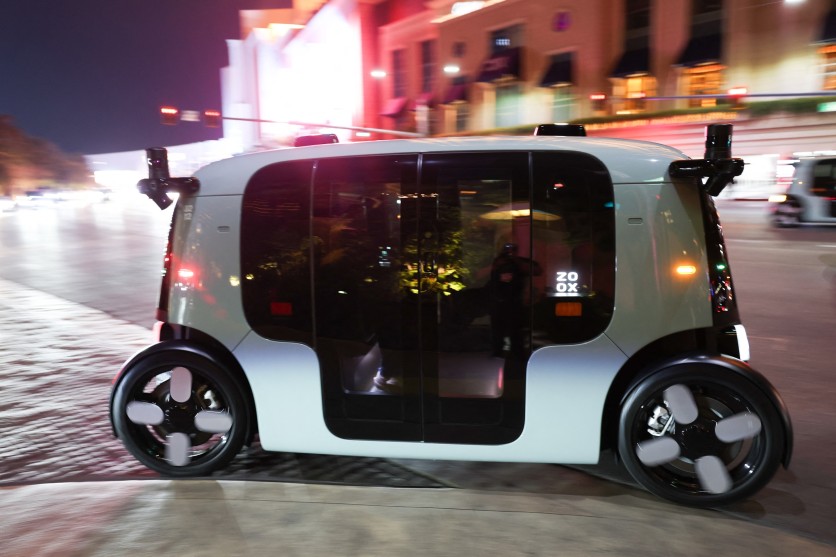
A Zoox electric autonomous robotaxi turns onto a street during the annual Consumer Electronics Show (CES) in Las Vegas, Nevada on January 7, 2026. Patrick T. Fallon/Getty images
Amazon's Zoox unveiled a production-intent redesign of its signature driverless robotaxi on June 24, refining the interior and exterior of a vehicle that already has a factory ready to build 100 units a week — and still cannot charge a single rider until the National Highway Traffic Safety Administration says it can. The updated "toaster," as riders have nicknamed the cube-shaped pod, is the vehicle Zoox plans to roll off its Hayward, California assembly line and into commercial service later this year, pending one federal decision that has been in review since a public comment period closed in April.
For the more than 500,000 people who have tried Zoox's free service in Las Vegas, San Francisco, Austin, and Miami since September 2025, the redesign signals that the company intends to charge them for a ride eventually. Whether that happens in 2026 depends entirely on a federal ruling that NHTSA has not yet published.
What Changed in the Production-Intent Model
The core architecture of the Zoox robotaxi is unchanged. The vehicle remains a cube-shaped, bidirectional electric pod with four-wheel steering, 40 cameras, radars, lidars, and infrared sensors, capable of carrying four passengers at speeds up to 75 miles per hour. There is no steering wheel, no brake pedal, and no front seat reserved for a human driver. The face-to-face carriage seating that Zoox calls its defining feature has been the vehicle's layout since the company revealed the concept in December 2020.
What changed is everything a rider actually touches.
Inside, Zoox added more padding and ergonomic shaping to seats and headrests and switched to a lighter interior palette — aloe-green upholstery paired with stone-grey flooring and trim. The lighter palette serves a practical purpose beyond aesthetics: the contrasting surfaces make it easier to spot items left behind, such as phones or keys, inside what is otherwise a small, enclosed space. Other interior updates include ridged fluting on the wireless charging pad to keep devices from sliding, enlarged cupholders, and a more prominent touchscreen.
Outside, the company repositioned the vehicle's bidirectional reflectors — the indicators that tell riders, law enforcement, and other road users which end of the symmetrical vehicle is which — and added color-rotation capability to make the distinction clearer. More meaningfully, the door panel now includes a new speaker and microphone with two-way audio, giving riders a direct line to Zoox support staff and enabling clearer voice communication with emergency responders at the scene.
TechCrunch reported the full list of changes. Chris Stoffel, Zoox's director of robot industrial design and studio engineering, described the goal as a cabin that does not demand a rider's attention. "The updates we've made to this iteration of our purpose-built robotaxi continue to further distinguish the Zoox experience from anything else available today," he said.
How the Vehicle Actually Works: Sensor Fusion at All Four Corners
The Zoox robotaxi is, in hardware terms, a supercomputer on wheels. Its sensor architecture — 14 cameras, 20 radars, 8 LiDARs, and long-wave infrared sensors — is mounted symmetrically at all four corners of the vehicle, providing an overlapping field of view that extends beyond 150 meters in every direction, as Amazon Science has documented. The full sensor suite must cover all four corners precisely because of the vehicle's bidirectional design: since there is no fixed front or back, the system must perceive and respond equally in either direction of travel at all times.
Multiple NVIDIA GPUs process that sensor data in real time, fusing inputs from cameras, LiDAR, radar, and infrared into a single coherent picture of the vehicle's surroundings, as NVIDIA's engineering blog describes. The raw data flows through a perception engine, a prediction module, and then into planning and control systems — the pipeline that decides whether to accelerate, brake, or steer through an urban intersection. If glare blinds the cameras, radar can confirm obstacle position independently; if a bicyclist is behind a bush that blocks the LiDAR, radar can still detect them through the vegetation.
The vehicle's four-wheel steering, supplied by German automotive systems company ZF, provides an 8.6-meter (28.2-foot) turning circle, as Futurride reported at the vehicle's 2020 reveal. That is tight enough for the vehicle to pull directly to a curbside pickup spot and exit forward in either direction without reversing — a meaningful operational advantage in the dense urban environments where Zoox deploys. A 133-kilowatt-hour battery is rated to power the vehicle for up to 16 hours per charge.
The Zoox system is L5-capable by Zoox's own designation — meaning the vehicle can, in principle, operate without human intervention in any scenario — but in practice it operates as an SAE Level 4 system, restricted to specific geo-fenced Operational Design Domains in cities where Zoox has mapped the road environment in sufficient detail. Simulation data underpinning the AI stack runs on Amazon Web Services infrastructure; when Zoox's engineers modify the driving control system, the resulting changes are validated through hundreds of hours of CPU and GPU simulation time on AWS before deployment.
The Hayward Factory Is Running. Federal Law Is Not Done Yet.
The redesign announcement is as much a manufacturing story as a design one. Zoox opened its Hayward production facility in June 2025 with a stated capacity that could eventually reach 10,000 vehicles per year at full scale. The production-intent designation for the new model means Zoox believes the design is locked in for volume manufacturing, not merely prototyping — and the company says it can build up to 100 vehicles per week, as TechCrunch confirmed.
That production readiness is running ahead of its legal authorization. Zoox is seeking a commercial exemption from NHTSA under the Part 555 exemption process, which would allow it to operate up to 2,500 vehicles per year that do not comply with eight Federal Motor Vehicle Safety Standards written for human-driven vehicles, as the Federal Register notice sets out. Those eight standards cover equipment that is functionally obsolete in a vehicle with no human driver: windshield defogging and wiping systems, certain lighting controls, rear-visibility mirrors, light vehicle brake systems, occupant protection standards calibrated for driver seating, glazing materials, and crash protection systems designed for front-row occupants.
Zoox argues its automated driving system meets or exceeds the underlying safety performance required by each standard even without the physical equipment those standards mandate. NHTSA accepted Zoox's petition, published it for public comment on March 11, 2026, received 119 comments, and closed the comment period on April 10, 2026. As of this writing, the agency has not published its ruling.
Transportation Secretary Sean Duffy, who has described the Trump administration's deregulatory posture toward autonomous vehicles as a priority, called Zoox's petition "a major milestone towards providing the American AV industry with a streamlined pathway to scaled commercial deployment of novel AV fleets" at a March 2026 forum, as Hunton Andrews Kurth's analysis of the event confirms. His endorsement signals a favorable regulatory climate but does not bind the agency's decision.
There is a broader context the exemption petition alone does not capture. NHTSA is simultaneously running three separate rulemakings to amend the FMVSS standards themselves for ADS-equipped vehicles, targeting FMVSS 102, 103, and 104 for modification in proposals published in March 2026, as NHTSA's own press release describes. If those rulemakings succeed, some of the equipment requirements Zoox needs exempted would simply cease to apply to driverless vehicles, making individual exemption petitions unnecessary. The 2,500-vehicle-per-year exemption cap, which is set by statute, would remain — but the number of standards requiring exemption would shrink. Zoox's petition is not merely a gate to cross; it is a marker of where the regulatory architecture stands before the rules themselves are rewritten.
A Safety Record That NHTSA Has Already Noticed
The NHTSA exemption decision will be made against a background that includes Zoox's own accident history. As of March 2026, NHTSA had logged 123 accidents involving Zoox vehicles in autonomous mode, per Wikipedia's Zoox accident record — a figure that covers incidents of varying severity, most without injury but some involving property damage and minor harm to people.
Since launching public rides in Las Vegas in September 2025, Zoox has issued three separate software recalls. The first, in March 2025, addressed unexpected hard braking that had caused two motorcyclists to rear-end Zoox test vehicles. A second recall in May 2025 covered 270 vehicles after a Las Vegas collision in which a Zoox robotaxi failed to correctly predict the path of an approaching passenger car. A third recall in December 2025 addressed 332 vehicles after Zoox documented 62 instances in which its vehicles crossed a center lane line or blocked crosswalks near intersections — a pattern the company self-reported to NHTSA, as TechCrunch's reporting on the December recall describes.
On January 17, 2026, a Zoox robotaxi in San Francisco struck the door of a 1977 Cadillac Coupe DeVille as its driver, street ambassador Jamel Durden, opened it into the path of the approaching vehicle. Durden's hand was injured in the collision, which the San Francisco Police Department investigated, according to TechCrunch's exclusive on the case. Zoox said its vehicle detected the opening door but could not avoid contact.
The recalls were voluntary and accompanied by software updates that Zoox says resolved each root cause. The company's transparency in self-reporting distinguishes it from the pattern that preceded Cruise's collapse — but the volume of incidents logged in under a year of public operation with roughly 50 vehicles is the most substantive factor in any assessment of its readiness for commercial scale.
Read more: How Waymo, Tesla, and Zoox Want to Drive the Future of Robotaxis
Waymo's Lead Makes the Commercial Gap Concrete
Zoox's design refresh arrives as Waymo surpasses 500,000 paid rides per week across 10 U.S. cities with more than 3,700 robotaxis, having logged over 200 million fully autonomous miles — and with plans to expand to London and Tokyo as its first international markets. Waymo recently launched its purpose-built Ojai robotaxi, developed with Zeekr, replacing the Jaguar I-Pace vehicles that had been its primary fleet hardware.
Zoox's operating fleet stands at approximately 50 purpose-built vehicles. The gap is not merely quantitative but structural: Waymo has been collecting fares since 2019 in Phoenix and has logged autonomous miles at a scale that Zoox cannot yet match. Zoox has served more than 500,000 riders in total since September 2025 — and charged zero of them.
Amazon's ownership gives Zoox real advantages that a fleet count obscures. AWS cloud infrastructure underpins Zoox's simulation and validation pipeline. Amazon's logistics expertise is directly applicable to fleet management at scale. And a vehicle designed from the ground up for autonomy — rather than one retrofitted from a consumer car — may hold long-term architectural advantages over competitors whose hardware carries the weight of human-centric design assumptions.
The commercial gap, however, is real. Zoox's current trajectory ties commercial launch to an NHTSA ruling the company cannot accelerate and has not been told when to expect.
What Must Happen for Paid Rides to Launch
If NHTSA grants the commercial exemption, Zoox will be authorized to operate up to 2,500 vehicles per year exempt from the eight identified FMVSS standards. That exemption would be temporary — the petition requests a two-year term — and commercial paid rides would then launch, most likely beginning in Las Vegas given Zoox's longest operational presence there and its existing integration with the Uber platform, which went live in March 2026.
If NHTSA denies the exemption, Zoox would need to redesign aspects of the vehicle to achieve FMVSS compliance, or wait for the broader FMVSS rulemakings to amend the standards — a process that could take years. The Hayward factory's capacity would then be producing vehicles for an indefinitely extended free-rides program.
The agency did close its earlier investigation into Zoox's FMVSS self-certification claim when it granted the August 2025 demonstration exemption — a formal acknowledgment that Zoox's vehicles could operate safely on public roads. No timeline for the commercial ruling has been announced. NHTSA will publish its reasoning in the Federal Register when ready.
Frequently Asked Questions
How does the Zoox robotaxi work?
The vehicle uses a symmetrical sensor array of 14 cameras, 20 radars, 8 LiDARs, and long-wave infrared sensors mounted at all four corners, providing overlapping coverage in every direction beyond 150 meters. Multiple NVIDIA GPUs fuse that sensor data in real time through a perception engine and prediction module into planning and control decisions. The vehicle drives bidirectionally — there is no fixed front or back — with four-wheel steering that enables an 8.6-meter turning circle for curbside pickup and dropoff. All routing and simulation validation runs on Amazon Web Services infrastructure.
When will Zoox start charging for rides?
Zoox cannot legally collect fares until NHTSA grants a commercial exemption from eight Federal Motor Vehicle Safety Standards. The public comment period on Zoox's exemption petition closed April 10, 2026. NHTSA has not announced a ruling date. The production-intent vehicles unveiled June 24 will join the free-ride fleet later in 2026 as they come off the Hayward production line, with paid rides contingent on the federal ruling.
Is the Zoox robotaxi safe?
NHTSA had logged 123 accidents involving Zoox vehicles in autonomous mode as of March 2026. Zoox issued three software recalls between March and December 2025, affecting approximately 860 vehicles total, to address unexpected hard braking, collision prediction failures, and lane-crossing behavior near intersections. Each recall was voluntary and accompanied by a software fix. The incidents are a factor in NHTSA's ongoing review of Zoox's commercial exemption petition.
How does Zoox compare to Waymo?
Waymo delivers more than 500,000 paid rides per week across 10 U.S. cities with a fleet of more than 3,700 robotaxis that have logged over 200 million autonomous miles. Zoox operates approximately 50 purpose-built vehicles and has served more than 500,000 riders total since September 2025 — all at no charge. Waymo retrofits or co-develops existing vehicle platforms; Zoox builds its vehicle from the ground up around bidirectional autonomy, which the company argues is a stronger long-term platform for a service that will never need a human driver.

-
 C114 Communication Network
 -
 Communication Home
