
 Search

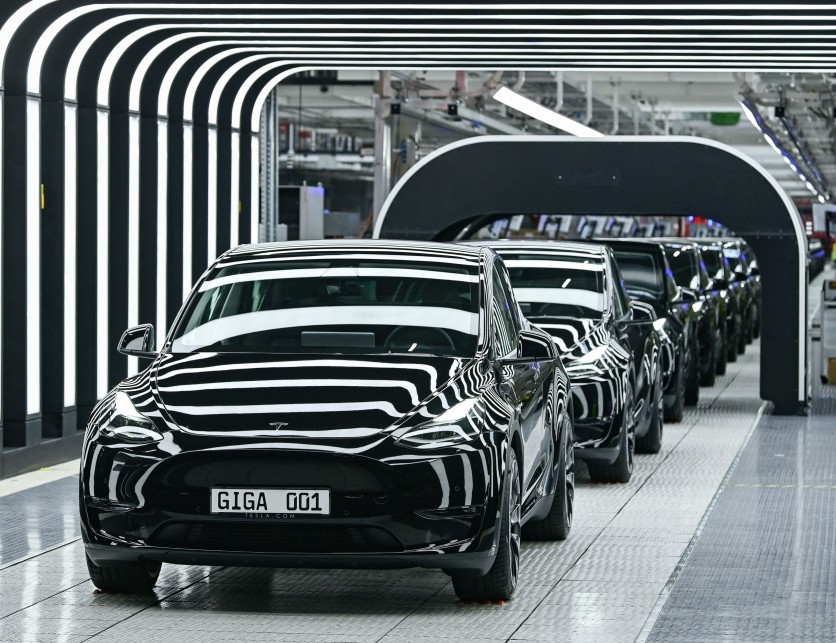
A line of electric vehicles of the model Y is pictured during the start of the production at Tesla's "Gigafactory" on March 22, 2022 in Gruenheide, southeast of Berlin. - US electric car pioneer Tesla received the go-ahead for its "gigafactory" in Germany on March 4, 2022, paving the way for production to begin shortly after an approval process dogged by delays and setbacks. Patrick Pleul/Getty Images
Tesla is attempting to win continent-wide approval for its Full Self-Driving system in Europe by submitting self-published safety statistics that ten of eleven independent traffic-safety researchers have characterized as misleading marketing. Two days ago, Sweden's national transport authority formally recommended that the European Union vote against bloc-wide FSD deployment — citing an engineered feature that allows Tesla's system to drive above posted speed limits. A decisive committee meeting is scheduled for June 30, and the outcome will determine whether Tesla's existing approvals in five countries survive or collapse.
The core of the dispute, documented in correspondence obtained by Reuters through public records requests, involves a statistical methodology that researchers say fundamentally misrepresents how safe FSD actually is on public roads.
Tesla's Disputed Safety Math: What the Statistics Actually Say
When Tesla lobbied regulators in the Netherlands and Sweden, it claimed that vehicles using FSD travel more than seven times farther between crashes than the average American driver, and that widespread FSD adoption could have prevented 32,000 deaths and 1.9 million injuries.
The seven-times figure rests on a comparison that researchers say is structurally invalid. Tesla counts only crashes in its fleet where airbags deployed — a threshold that captures only the most severe impacts. It then compares that narrow rate against the United States crash database, which includes every crash that results in a towed vehicle, a far lower severity bar. Marco Benedetti, an assistant research scientist at the University of Michigan Transportation Research Institute and a former National Highway Traffic Safety Administration statistician, corrected the comparison to airbag-deployment against airbag-deployment for both groups. His reanalysis collapsed Tesla's claimed safety advantage from roughly seven times to approximately 1.1 times — statistically indistinguishable from noise.
Phil Koopman, an engineering professor at Carnegie Mellon University who studies autonomous vehicle safety, identified a second distortion: Tesla's fleet averages 4.1 years in age, against the United States average vehicle age of 12.8 years. Older vehicles lack modern standard safety equipment — automatic emergency braking, electronic stability control — meaning Tesla compared its current-model fleet against a baseline that included millions of vehicles with no active safety systems at all.
The 32,000 lives-saved projection compounds the problem further. It assumes every vehicle in the United States — freight trucks, motorcycles, agricultural equipment — would be replaced by an FSD-equipped Tesla car that is already, per the inflated calculation, more than seven times safer. Researchers called the premise unrealistic on its face.
The Insurance Institute for Highway Safety has separately concluded that features like FSD are convenience features rather than safety features, and that Tesla's insurance loss rates are not distinctively better than the industry average.
Read more: Tesla Autopilot Claim in Fatal Katy Crash Hits 3.2 Million-Vehicle Recall Probe
What Tesla Told European Regulators
In a November 2024 letter to the Dutch road authority RDW, Tesla provided a link to its safety report and claimed that greater FSD use "leads to safer roads." After more than a year of testing and discussions, RDW approved FSD for supervised deployment on April 10, 2026 — the first European regulatory green light Tesla had received.
Shortly after that approval, Tesla policy manager Ivan Komusanac emailed Swedish regulators asking for similar recognition. His presentation included the seven-times safety claim and the 32,000 lives-saved projection — the same statistics researchers had called misleading marketing.
RDW told Reuters it "does not rely on marketing claims or external statistics" and verifies the system through its own road and test-track assessments. The agency did not say, however, whether it specifically evaluated the validity of Tesla's United States safety figures before approving the system — leaving open whether the disputed data influenced any early discussions.
The Architecture That Made the Cascade Possible
RDW's April 10 approval triggered something the EU's vehicle regulation framework was not designed to resist: a cascade of national recognitions with no mechanism to re-examine the statistical basis of the original decision.
EU Regulation 2018/858, Article 39, permits member states to recognize a provisional type approval granted by another national authority without conducting independent testing of their own. Lithuania did so within weeks of the Dutch decision, citing RDW's approval without running its own road assessments. Estonia, Denmark, and Belgium followed in rapid succession.
The architecture was designed for standardized, objectively verifiable physical safety requirements — brake performance, crash-test scores, headlight geometry. It was not designed to evaluate the statistical methodology a manufacturer chose when constructing its lobbying materials. A member state recognizing RDW's approval had no formal process for asking whether the data that informed the Dutch decision was built on valid comparisons.
The European Transport Safety Council, a road safety watchdog, formally wrote to EU Executive Vice-President Stéphane Séjourné urging the European Commission to ensure that any further policy decisions following the provisional approval go through a transparent, independently verified process. Spokesperson Dudley Curtis put it directly: if Tesla wants to make safety claims of this magnitude, the company should "give the data to a university, have it independently verified by a qualified researcher, and then let's talk."
How Different Countries Responded
The response from national regulators revealed a spectrum of skepticism — and at least one credulity.
Sweden's investigator Anders Eriksson told Reuters that officials "look beyond headline figures" and would not base a decision solely on aggregated safety claims. In a separate April email, Eriksson expressed surprise that Tesla's system was engineered to exceed posted speed limits, writing that he was "quite surprised" the company allowed FSD to speed. That concern — rooted in the Speed Offset feature that lets drivers set a margin above the legal limit — became the basis for Sweden's formal rejection recommendation to the EU on June 20.
Norway was the most direct. Stein-Helge Mundal of the Norwegian Public Roads Administration, responding to Tesla drivers who had written urging rapid FSD approval and citing Tesla's own safety report, wrote that Tesla's figures "are self-produced," making it "difficult to find correlation with the authorities' accident statistics."
Greece moved in the opposite direction. A Greek transport official told Reuters the country intended to approve FSD based on data "from the other side of the Atlantic" showing the system leads to a sharp drop in accidents. The ministry declined to confirm whether that data came from Tesla's own report.
The Speed Override That Could Decide Everything
The specific technical issue driving Sweden's formal opposition is FSD's Speed Offset feature — an engineered option that allows the system to drive above the posted legal speed limit by a driver-configurable margin. In the North American version of FSD, Tesla offers multiple speed profiles that allow significantly more aggressive speed behavior above limits.
The Swedish Transport Administration's letter to the EU Technical Committee on Motor Vehicles, dated April 30, stated that "allowing automated systems to systematically exceed legal speed limits" was incompatible with European road safety standards.
A qualified majority of EU member states — 15 of 27, representing at least 65 percent of the EU's population — must vote in favor of bloc-wide FSD approval for it to take effect continent-wide. If no majority is reached, existing provisional national approvals can lapse within six months. The June 30 committee meeting is the next formal venue for this determination.
Tesla could potentially resolve the Speed Offset objection by disabling the feature for European vehicles through an over-the-air software update. Whether that would satisfy Sweden's formal recommendation before June 30 is unknown.
Read more: Tesla Seeks 5,000 Las Vegas Robotaxi Slots With Camera Tech Under Federal Probe
Global Legal Pressure Converging on FSD
The European data controversy does not exist in isolation. The same week Reuters published its lobbying investigation, US Senators Edward Markey and Richard Blumenthal sent a letter to the National Highway Traffic Safety Administration demanding a full review of Tesla's FSD safety statistics by July 7, characterizing them as based on "misleading and incomplete data analysis."
NHTSA currently maintains three concurrent active investigations into FSD and Autopilot. The most serious, Engineering Analysis EA26002 opened March 18, 2026, covers approximately 3.2 million Tesla vehicles and focuses on whether FSD's camera-based system fails to detect degraded visibility conditions — sun glare, fog, and airborne dust — before crashes. Nine documented incidents sit in that docket, including one pedestrian fatality. Tesla's own internal analysis acknowledged that a 2024 software update it deployed would have addressed only three of the nine identified crashes.
In China, ten Tesla owners received their first court hearing in late May on a lawsuit alleging FSD was sold under false pretenses, with plaintiffs seeking roughly $583,000 in damages plus triple compensation under China's consumer fraud statutes. One week before that hearing, Tesla quietly renamed its system "Tesla Assisted Driving" in the Chinese market — a rebrand that plaintiffs' counsel said handed them their central argument. A Dutch collective action covering Hardware 3.0 owners across the EU has attracted more than 6,600 participants. Total global litigation exposure tied to Autopilot and FSD is estimated at $14.5 billion.
What the Safety Researchers Actually Found
When researchers adjusted Tesla's comparison to use consistent crash-severity thresholds — airbag deployments against airbag deployments, not airbag deployments against all tow-away crashes — the gap between FSD and the average human driver effectively disappeared. A third distortion remained even after those corrections: Tesla's figure implicitly assumed that its claimed safety advantage held across all road types, including conditions where the system has documented failure modes. NHTSA's ongoing probe focuses precisely on those conditions — degraded camera visibility — where Tesla's architecture, which relies on eight cameras and a neural network without radar or lidar backup, has been repeatedly found to lose track of vehicles ahead.
Waymo, which operates commercially deployed driverless vehicles and uses cameras combined with lidar and radar arrays, publishes its safety data using peer-reviewed methodology with controlled comparisons adjusted for road type and neighborhood density. John Scanlon, a Waymo safety researcher, has said that reporting safety outcomes requires "very specific research questions and very specific conclusions" — a methodological standard Tesla's lobbying materials did not meet.
What Happens After June 30
Tesla's push for European market share depends substantially on FSD. European sales declined sharply in 2025, a drop widely attributed to backlash over CEO Elon Musk's embrace of far-right European political movements, and BYD has outsold Tesla in Europe for multiple consecutive months.
If the June 30 committee meeting produces a positive direction for bloc-wide approval, Tesla could potentially achieve EU-wide FSD deployment before year-end. If the committee defers or Sweden's formal recommendation gains traction, a formal vote would shift to October or later, pushing any continent-wide rollout into 2027 at the earliest.
The more durable consequence of the dispute may be institutional. No mandatory independent audit requirement exists for safety statistics submitted in EU regulatory lobbying — a gap the European Transport Safety Council and others have now publicly identified. The affair establishes a precedent: the mutual recognition architecture, designed to lower friction for manufacturers with compliant physical products, can be reached by a company with proprietary operational data and no obligation to submit it for peer review before it influences a national approval that then cascades across the continent.
Frequently Asked Questions
Is Tesla Full Self-Driving safer than human drivers?
Based on Tesla's own self-published statistics, the company claims FSD-equipped vehicles travel more than seven times farther between crashes than the average American driver. Independent researchers dispute that figure. Marco Benedetti of the University of Michigan Transportation Research Institute found that correcting for Tesla's severity-threshold mismatch — counting only airbag-deployment crashes for both Tesla and the comparison group — reduced the claimed advantage to approximately 1.1 times, statistically indistinguishable from noise. A second distortion involves fleet age: Tesla's vehicles average 4.1 years old, while the United States fleet averages 12.8 years, meaning the comparison baseline included millions of vehicles without modern standard safety equipment.
Why did Sweden recommend the EU reject Tesla FSD approval?
Sweden's Transport Administration sent a formal letter to the EU's Technical Committee on Motor Vehicles recommending against bloc-wide FSD approval, citing the system's Speed Offset feature — an engineered function that allows the vehicle to drive above the posted speed limit by a configurable margin. Swedish authorities concluded that systematically allowing an automated driving system to exceed legal speed limits was incompatible with European road safety standards. If Sweden's position gains a qualified majority at the June 30 committee meeting, existing national approvals in the Netherlands, Lithuania, Estonia, Denmark, and Belgium could lapse within six months.
What is the EU's mutual recognition architecture, and why does it matter for FSD?
Under Article 39 of EU Regulation 2018/858, once one EU member state grants a provisional type approval for a vehicle system, other member states can recognize that approval without conducting their own independent testing. This architecture was designed for standardized, objectively measurable safety requirements — brake performance, crash-test scores — not for evaluating the statistical methodology behind a manufacturer's lobbying materials. In FSD's case, five countries recognized the Netherlands' April 10 approval without independently assessing whether the data that informed the Dutch decision was methodologically sound. The European Transport Safety Council has called for urgent reform of this process.
What autonomous driving investigations is Tesla currently facing?
As of June 22, 2026, the National Highway Traffic Safety Administration has three concurrent active investigations into Tesla's FSD and Autopilot systems. Engineering Analysis EA26002 covers approximately 3.2 million vehicles and focuses on whether FSD's camera-only system fails to detect degraded visibility conditions before crashes. A second probe covers approximately 2.88 million vehicles and involves more than 80 documented instances of FSD executing traffic violations — running red lights, crossing into opposing lanes. A third inquiry examines Tesla's crash reporting practices. Separately, US senators demanded by July 7 that NHTSA review Tesla's FSD safety statistics, which they characterized as "misleading and incomplete."

-
 C114 Communication Network
 -
 Communication Home
