
 Search

Nvidia.com
NVIDIA used its platform at ISC High Performance 2026 in Hamburg on June 22 to formally position the Vera Rubin system as a scientific computing platform — not just a cloud AI accelerator — and to disclose that 35 new AI supercomputers are currently under development across 23 European countries. The two announcements together mark the most concentrated single-day expansion of NVIDIA's scientific computing footprint since the company moved from selling discrete GPUs into selling full-stack HPC platforms.
The timing is deliberate. EuroHPC, the European Union's joint undertaking for sovereign supercomputing, has a founding mandate to ensure technological autonomy for European science. As of this week, NVIDIA says it powers more than 90 percent of Europe's AI factory buildout — a figure that raises a pointed question the continent's science ministers will need to answer: what does European sovereignty over scientific computing mean when the infrastructure is almost entirely built on one American vendor's proprietary hardware and interconnect stack?
Read more: ISC High Performance 2026 Opens: Post-Moore HPC Faces Open-Source Reckoning
What Vera Rubin Delivers for HPC — and What Changed from Blackwell
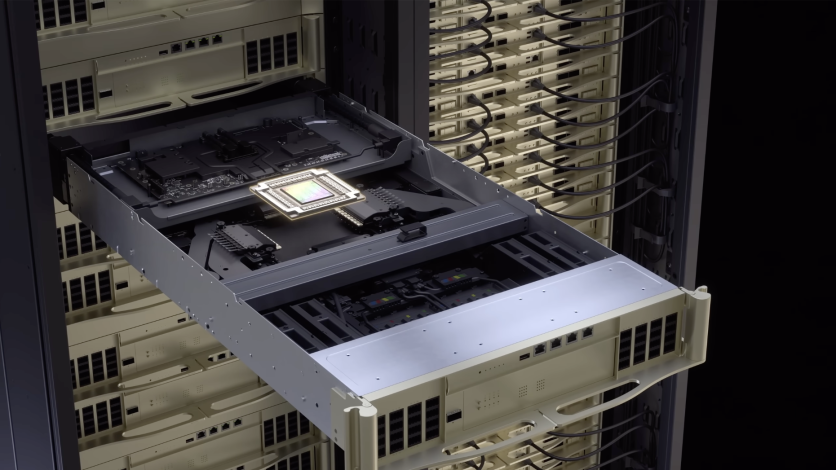
The Vera Rubin platform's scientific computing variant — marketed as Vera Rubin NVL4, configured for up to 144 GPUs per rack — is engineered to run two historically incompatible computing regimes on the same hardware without data-conversion overhead: traditional high-precision numerical simulation and AI inference. NVIDIA says a fully configured rack delivers more than 7 exaflops of AI performance for scientific workloads alongside 5 petaflops of native double-precision (FP64) computing, which would place a single cabinet on par with machines that currently rank on the TOP500 list of the world's most powerful supercomputers.
The "7 exaflops" and "5 petaflops" figures measure different things and should not be added together. The 7-exaflop figure uses NVFP4, a low-precision format optimized for AI inference. The 5-petaflop FP64 figure uses the same precision standard as the TOP500 rankings. The critical engineering advance is that Vera Rubin delivers both from the same silicon — a native FP64 capability that GPU practitioners have long demanded and that prior generations delivered inconsistently.
"Native FP64 precision remains absolutely vital for accurate fluid dynamics, climate modeling, and geoscience," said Dion Harris, NVIDIA's senior director of HPC and AI Factory Solutions, at a media briefing at ISC. "We are committed to maintaining that support moving forward."
Three architecture changes explain the performance gains over the Blackwell generation. First, the interconnect: NVLink 6 doubles GPU-to-GPU bandwidth from 1.8 terabytes per second (NVLink 5 on Blackwell) to 3.6 terabytes per second per GPU bidirectional, giving a 72-GPU NVL72 rack 260 terabytes per second of total all-to-all fabric bandwidth compared to 130 terabytes per second in the prior generation. Second, the memory: Vera Rubin moves from HBM3e to HBM4, which doubles the interface width from 1,024 bits to 2,048 bits and raises per-GPU bandwidth from 8 terabytes per second to 22 terabytes per second — a near-tripling of memory throughput per GPU. Third, the CPU-GPU integration: the 88-core Vera CPU connects to the Rubin GPU over an NVLink-C2C chip-to-chip link running at 1.8 terabytes per second, placing both under a single coherent fabric domain for the first time in a commercial rack-scale system. Data no longer crosses a PCIe boundary between preprocessing on the CPU and simulation on the GPU — a bottleneck that has constrained coupled workflows in prior generations.
For memory-bound workloads — computational fluid dynamics, lattice quantum chromodynamics, molecular dynamics simulations — NVIDIA projects up to four times the performance of prior-generation systems. The open-source HPC community at ISC is working through a practical consequence of the transition: the shift from NVLink 5 to NVLink 6, the new Vera CPU architecture, and the move to HBM4 all require updates across Spack, the Kokkos performance portability layer, and MPI and OpenMP runtime configurations before existing scientific applications can take full advantage.
System builders Bull, Dell Technologies, GIGABYTE, HPE, and Supermicro announced custom high-density Vera Rubin NVL4 configurations at ISC. OEM availability is targeted for Q4 2026.
Europe's 35-System Wave: What Is Actually Being Built
The 35 systems NVIDIA disclosed span national supercomputing centers, EuroHPC AI factories, universities, and industrial research institutions across 23 European countries. The majority of the current wave runs on NVIDIA's Blackwell and Hopper architectures, with Vera Rubin installations beginning to appear at the leading edge.
The headline deployment is Germany's Leibniz Supercomputing Centre, which will deploy Vera Rubin in Blue Lion, its upcoming exascale-class system built on HPE Cray hardware and scheduled to enter service in 2027. Blue Lion is expected to deliver approximately 30 times the computing power of LRZ's current system, supporting astrophysics, environmental science, and life sciences research.
Barcelona Supercomputing Center's upgrade to MareNostrum 5 — the first EuroHPC AI-factory-specific installation — will use NVIDIA GB300 NVL72 and GB200 NVL4 systems connected by Quantum-X800 InfiniBand, targeting approximately 20 exaflops of AI training and 33 exaflops of AI inference capacity. BavariaAI's Blue Swan project will bring 1,000 NVIDIA GB200 NVL4 GPUs to FAU Erlangen and LRZ, targeting 11 exaflops of AI training and 22 exaflops of inference. Sweden's Mimer AI Factory at Linköping University, owned by the EuroHPC Joint Undertaking, will deploy 400 GPUs from 100 GB200 NVL4 systems.
"BSC is committed to building AI infrastructure that advances science, industry and society," said Mateo Valero Cortés, director of the Barcelona Supercomputing Center. "With the upgrade to MareNostrum5 and NVIDIA accelerated computing, the consortium composed of Spain, Portugal and Türkiye will make available to European researchers the tools to tackle some of the world's most complex challenges, from climate modeling to biomedical discovery."
Across all 35 systems, NVIDIA says its infrastructure powers more than 800 AI exaflops deployed or announced in Europe since last year.
Read more: NVIDIA Vera Rubin NVL72 Cloud Rollout Expands to Europe as H2 Deployments Near
US National Labs Commit to Vera Rubin
NVIDIA also confirmed that three major US national laboratories have selected the platform, representing a parallel wave of federally funded scientific computing commitments.
The National Energy Research Scientific Computing Center at Lawrence Berkeley National Laboratory will deploy Vera Rubin in Doudna, its next flagship system, built by Dell Technologies to support large-scale HPC simulations, AI training, and data-intensive research connected directly to Department of Energy scientific instruments.
Los Alamos National Laboratory made the most architecturally significant commitment: three separate Vera Rubin systems — Mission, Vision, and Veritas — all to be built and delivered by HPE on its Cray architecture. Mission, configured with up to 2,160 Rubin GPUs and 1,080 Vera CPUs, will serve national security workloads. Vision, with 1,298 Rubin GPUs and 648 Vera CPUs, will support open scientific research including foundation models, agentic AI, and complex simulations in materials science, nuclear energy, fusion energy, and quantum computing. Veritas, announced at ISC and configured with 576 Rubin GPUs and 288 Vera CPUs, is specifically designed to enable agentic AI for scientific discovery — what NVIDIA is positioning as the first system built explicitly for AI-driven research autonomy at a national laboratory.
Agentic AI and the New Scientific Software Stack
NVIDIA used ISC to frame Vera Rubin not just as a faster supercomputer but as a platform for a new computing paradigm it calls agentic AI for science — systems that execute research tasks autonomously rather than waiting for human instruction.
"Agentic AI is already emerging as a powerful tool to do science at a scale that isn't possible when human scientists alone drive the process," Harris told The Register at ISC. "Agents don't need to sleep, or eat, or take breaks. They can consume thousands or millions of technical papers and remember the details."
Alongside the hardware, NVIDIA announced three new scientific software tools. ALCHEMI is a domain-specific toolkit for chemical and materials discovery that can simulate millions of molecular structures. DAQIRI connects next-generation scientific instruments directly to real-time AI inference pipelines; NVIDIA cited CERN's ATLAS experiment as an example, noting that fewer than 2 percent of collision data can currently be stored for analysis, and that a GPU-accelerated AI trigger pipeline would allow far more of it to be retained. cuPhoton targets photonics simulation workloads.
The quantum dimension of Europe's supercomputing buildout is also advancing through NVIDIA's CUDA-Q hybrid platform. CINECA, Fraunhofer, and the Jülich Supercomputing Centre are among institutions integrating quantum processors with classical supercomputers. Researchers at Jülich recently completed what NVIDIA described as a record simulation of a universal 50-qubit quantum computer, performed on the JUPITER system using NVIDIA GH200 Grace Hopper Superchips.
What the Architecture Means for Open-Source HPC
The HPC community's open-source software ecosystem faces a specific transition challenge from the Vera Rubin generation. The new NVLink 6 fabric and HBM4 memory architecture are not plug-and-play upgrades for existing scientific applications. Spack — the dominant HPC package manager used to build scientific software across heterogeneous hardware — requires updates to resolve the new chip topology. Kokkos, the C++ performance portability layer that lets code run across CPUs, GPUs, and other accelerators without full rewrites, needs profiling and tuning for the new bandwidth characteristics. MPI and OpenMP runtime configurations require adjustment for the coherent CPU-GPU fabric domain.
The High Performance Software Foundation, a Linux Foundation project that provides neutral governance for open-source HPC tools, is using ISC 2026 as the primary venue to address these engineering questions. Its membership spans Amazon Web Services, HPE, Lawrence Livermore National Laboratory, Sandia National Laboratories, AMD, Argonne, Intel, and NVIDIA itself — an indication that the transition challenge is recognized across the ecosystem, not just by research institutions.
The proprietary nature of NVLink — which is not an open standard and cannot be used by non-NVIDIA silicon — means the performance gains of the Vera Rubin architecture are accessible only through NVIDIA hardware. Institutions that build scientific workflows tightly coupled to NVLink's 260-terabyte-per-second fabric create a dependency that standard procurement diversification cannot easily offset.
Why Vendor Concentration Is a Policy Question, Not Just a Technology Question
Jensen Huang framed the European buildout in expansive terms at ISC. "AI is the new instrument of science, and Europe is building the infrastructure to put it in the hands of millions of researchers," he said. What the announcement also illustrates is that the infrastructure being built to deliver that ambition is, to an extraordinary degree, built on one company's hardware and software stack.
EuroHPC was founded to ensure that European research did not become dependent on infrastructure it did not control. The original mandate described a goal of developing a world-leading supercomputing ecosystem with a supply chain that would limit the risk of disruption. A continent that sources more than 90 percent of its AI factory compute from a single vendor with its own proprietary interconnect — and whose scientific software ecosystem now needs to be retooled whenever that vendor issues a new architecture — is running some version of the disruption risk the founding mandate was designed to avoid.
Whether that dependency is acceptable given the performance advantages Vera Rubin delivers, or whether it should accelerate investment in alternative architectures, is a question European research administrators and technology ministers will face as these 35 systems come online and the institutions that operate them build workflows increasingly optimized for NVIDIA's ecosystem.
Frequently Asked Questions
What is the NVIDIA Vera Rubin supercomputer and how does it differ from Blackwell?
Vera Rubin is NVIDIA's current-generation rack-scale computing platform, designed to run both high-precision scientific simulation and AI inference workloads on the same hardware. The platform succeeds the Blackwell generation and delivers two architectural improvements that matter specifically for scientific computing: it moves from HBM3e to HBM4 memory, doubling the per-GPU memory interface width from 1,024 bits to 2,048 bits and tripling memory bandwidth from 8 terabytes per second to 22 terabytes per second per GPU. It also advances from NVLink 5 to NVLink 6, doubling GPU-to-GPU interconnect bandwidth from 130 to 260 terabytes per second at the rack level. For HPC workloads that move large data sets between simulation stages — fluid dynamics, climate modeling, molecular dynamics — those bandwidth figures determine how fast science actually runs.
What are the 35 new AI supercomputers announced for Europe?
NVIDIA announced at ISC High Performance 2026 that 35 AI supercomputers are currently in development across 23 European countries — representing what the company describes as the largest single-year expansion of supercomputing capacity in the continent's history. The systems range from flagship national supercomputing centers such as Germany's LRZ Blue Lion and Barcelona Supercomputing Center's MareNostrum 5 upgrade, to smaller regional AI factory deployments at institutions including NAISS in Sweden. When complete, they are intended to serve more than 3 million researchers. The majority run on NVIDIA's Blackwell and Hopper architectures rather than the newer Vera Rubin platform, with Vera Rubin installations scheduled to come online as OEM systems become generally available in Q4 2026 and beyond.
How does NVLink 6 work and why does it matter for scientific computing?
NVLink 6 is NVIDIA's proprietary sixth-generation GPU-to-GPU interconnect, integrated into the Vera Rubin platform. It delivers 3.6 terabytes per second of bidirectional bandwidth per GPU — double the 1.8 terabytes per second of NVLink 5 in the Blackwell generation. A Vera Rubin NVL72 rack, connecting 72 GPUs through nine NVLink 6 switches, achieves 260 terabytes per second of total all-to-all fabric bandwidth. For scientific workloads that require frequent communication between GPU processes — such as large-scale parallel simulations where every compute node must exchange boundary data with its neighbors — that interconnect speed is frequently the system's actual performance ceiling. The improvement also enables the Vera Rubin platform to function as a single coherent accelerator at rack scale, rather than as a collection of loosely connected servers.
What does European investment in NVIDIA supercomputers mean for scientific sovereignty?
EuroHPC, the European public-private partnership that funds and coordinates European supercomputing, was established specifically to ensure technological autonomy for European science. NVIDIA's announcement that it powers more than 90 percent of Europe's AI factory buildout sits in tension with that founding mandate. The relevant risk is not geopolitical in the short term — NVIDIA is a US company, not a state adversary — but structural: scientific software workflows being built around NVLink's proprietary interconnect architecture are effectively locked to NVIDIA hardware generations. If NVIDIA changes its pricing, licensing, or architecture roadmap, the cost of migration for institutions that have built research workflows around the platform rises with each generation deployed. Europe's science administrators will need to determine whether the performance benefits of consolidating on NVIDIA's stack justify that long-term structural dependency, or whether parallel investment in open alternatives serves the original sovereignty mandate better.

-
 C114 Communication Network
 -
 Communication Home
