
 Search

chevrolet.com
Sunday's 104th running of the Broadmoor Pikes Peak International Hill Climb delivered its clearest verdict yet on the EV versus combustion debate: Romain Dumas drove Ford's all-electric Super Mustang Mach-E up Colorado's 14,115-foot mountain faster than every combustion and hybrid competitor on the course, while the Chevrolet Corvette ZR1X shattered the production car record by 23 seconds in the same race. For anyone tracking the performance trajectory of electric powertrains, Pikes Peak 2026 added a data point that is hard to argue away.
Why EVs Keep Winning at Altitude — and Why Combustion Can't Catch Up
The result is not a surprise to engineers, but it remains worth stating plainly. A naturally aspirated combustion engine loses roughly three percent of its rated power for every 1,000 feet of elevation gain, because the air thins and fewer oxygen molecules are available to burn fuel. At the summit of Pikes Peak — 14,115 feet above sea level — even a heavily turbocharged engine operates with a significant fraction of its sea-level output stripped away. Turbocharging mitigates the loss but cannot eliminate it, because the turbocharger itself relies on exhaust gas generated by the same combustion process that is starved of oxygen.
Electric motors have no combustion process. They convert stored electrochemical energy directly into torque, drawing from a battery pack that carries its own energy supply regardless of the oxygen content of the surrounding air. Electric motors deliver the same torque at the first corner as they do at the 14,000-foot summit — a structural advantage that no amount of ICE engineering can replicate at altitude. This is not a gap that will narrow as combustion technology improves. It is a ceiling imposed by physics, and it is permanent.
That ceiling is visible in the record books. The all-time Pikes Peak record — 7 minutes 57.148 seconds — was set in 2018 by the same driver, Romain Dumas, in the all-electric Volkswagen ID.R, the first run to break the eight-minute barrier in the event's 110-year history. His 2026 winning time of 8 minutes 18.202 seconds was the third-fastest run ever recorded on the mountain. Both records belong to electric vehicles.
Dumas Takes His Sixth King of the Mountain Title
Dumas crossed the summit in 8:18.202, more than 11 seconds ahead of Robin Shute, who finished second in the Sendycar V1 with a time of 8:29.497. The win delivered Ford Racing its second overall Pikes Peak victory and secured a sixth King of the Mountain crown for the French driver, who knows this mountain as well as anyone in the sport. The result carries additional symbolism: Ford entered the inaugural Pikes Peak Hill Climb in 1916, and the 2026 win arrived as the company marked 125 years of racing competition.
The Super Mustang Mach-E that Dumas piloted is a purpose-built demonstrator — not a production vehicle — built around a 50 kWh battery pack and a tri-motor electric powertrain rated at over 1,400 hp. The car generates up to 12,000 pounds of aerodynamic downforce, a figure Ford's program engineer confirmed after extensive testing in the company's new rolling road wind tunnel. Zach Burns, program engineer for Ford Racing Demonstrators, said the team used the tunnel to correlate aerodynamic measurements with computational fluid dynamics predictions before final track validation — work that also prepared the program for Ford Racing's upcoming Hypercar campaign.
Defending champion Simone Faggioli, who had taken pole position in qualifying, finished third at 8:32.997 after a technical issue affected his Nova Proto NP01 in the early stages of the course. Faggioli told reporters the machine was not working at all in the first two sections and only improved in the final stretch.
Corvette ZR1X Sets a New Production Car Benchmark — by 23 Seconds
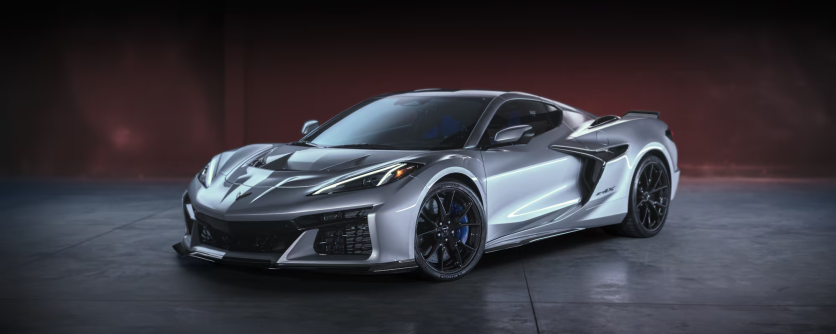
The production car story of the day belonged to the Chevrolet Corvette ZR1X. JR Hildebrand, an IndyCar and Pikes Peak veteran, drove the ZR1X up the full 12.42-mile course in 9:30.104, demolishing the previous PPIHC-certified production car record of 9:53.541 — a time set by David Donner in a 2022 Porsche 911 Turbo S. The ZR1X finished ninth overall in a field that included purpose-built unlimited-class prototype machinery.
The car Hildebrand drove was, to an unusual degree, essentially what a buyer walks out of a Chevrolet dealership with. It ran a stock exhaust system and Michelin Pilot Sport Cup 2R tires from the production performance package. The only modifications were safety equipment required by the event's regulations: a roll cage, fuel cell, seat belts, fire suppression system, and cutoff switches. No performance hardware was changed.
The ZR1X's 23-second record margin can be traced directly to two engineering decisions. The first is its hybrid powertrain architecture: a 5.5-liter twin-turbocharged V8 mounted behind the passenger cell, paired with a front-axle electric motor that adds torque to all four wheels independently of the combustion engine. The combined output is 1,250 hp, enabling a 0–60 mph sprint of 1.89 seconds when fitted with the ZTK Performance Package. The second decision is how those two powertrains interact during cornering. Because the front electric motor can deliver torque independently, it pulls the car out of corner exits before the V8 has time to wind up through the rev range. As Hildebrand put it, the front drive unit literally pulled the car out of the corners and right up into the RPM band of the combustion engine behind it — and the transition was seamless throughout.
That front-electric corner-exit advantage is particularly consequential on Pikes Peak, where the 156-turn course demands continuous acceleration out of tight hairpins. It is also why the ZR1X's hybrid record, while extraordinary, operates within a different physical ceiling than the all-electric cars above it in the overall standings. The combustion engine's output degrades as the car climbs; the electric front motor's does not.
Hartford Becomes the Fastest Woman in Pikes Peak History
The event produced a third record. Emelia Hartford, driving a 2026 Chevrolet Corvette ZR1, reached the summit in 10:11.018, setting a new women's record at the event and earning the title of Queen of the Mountain. Laura Hayes, who had held the previous women's record, competed in the same race in the GT4 Trophy by Yokohama class, finishing in 10:17.538. Hartford's margin was 6.52 seconds. The ZR1 Hartford drove was the base model, without the hybrid powertrain or all-wheel-drive system of the record-setting ZR1X — which makes the pace she posted in the Time Attack 1 class all the more notable.
What Pikes Peak 2026 Tells EV Buyers
Pikes Peak has served as a powertrain proving ground for over a century, from testing the durability of early automatic transmissions to settling the altitude-performance question for electrification. The 2026 results extend a trend that has been building since 2018, when Dumas first broke the eight-minute barrier in the VW ID.R. What changed in 2026 is the depth of the statement: the Super Mustang Mach-E did not beat a field of street cars. It beat purpose-built, no-limits racing prototypes designed from a blank sheet of paper for exactly this course, finishing more than 11 seconds ahead of the second-place machine.
For consumers choosing between combustion and electric powertrains, the altitude physics documented at Pikes Peak applies beyond motorsport. Colorado, Utah, Wyoming, Nevada, and much of the mountain west sit at elevations where combustion engines routinely operate below their rated output. Electric vehicles do not. The performance gap demonstrated at 14,115 feet is the same gap — expressed in smaller fractions — that exists at 6,000 feet, 8,000 feet, and 10,000 feet across the American west. Pikes Peak makes it visible at speed. The everyday altitude advantage is quieter but identical in mechanism, and no amount of turbocharger engineering will change the underlying physics.
Frequently Asked Questions
Why do electric cars have an advantage at Pikes Peak?
Electric motors convert stored battery energy directly into torque without requiring oxygen for combustion. Because the air at Pikes Peak's 14,115-foot summit contains roughly 40 percent less oxygen than at sea level, combustion engines — even turbocharged ones — lose a significant fraction of their rated power as they climb. Electric motors are unaffected by this change, delivering the same torque output at the summit as at the starting line nearly 5,000 feet below.
What record did the Corvette ZR1X set at Pikes Peak 2026?
JR Hildebrand drove the production-spec Corvette ZR1X to a time of 9:30.104, beating the previous PPIHC-certified production car record of 9:53.541 by more than 23 seconds. The previous record had been held since 2022 by David Donner in a Porsche 911 Turbo S. The ZR1X made only safety modifications required by the event's rules — all performance hardware remained stock.
Does the EV altitude advantage matter outside of motorsport?
Yes. The same physics that makes electric motors immune to altitude-related power loss at Pikes Peak applies at any elevation. At 6,000 feet — typical for much of Denver, Albuquerque, and Salt Lake City — a naturally aspirated combustion engine operates at roughly 82 percent of its sea-level power. An electric motor operates at 100 percent. The performance difference is smaller in everyday driving than in a timed race up a 14,000-foot mountain, but the mechanism is identical.
What is Romain Dumas' record at Pikes Peak?
Dumas now holds six overall King of the Mountain titles at Pikes Peak, more than any other current competitor. He also holds the all-time course record — 7 minutes 57.148 seconds — set in 2018 in the all-electric Volkswagen ID.R, the first run to break the eight-minute barrier in the event's history. His 2026 winning time of 8:18.202 in the Ford Super Mustang Mach-E is the third-fastest in the race's 110-year history.

-
 C114 Communication Network
 -
 Communication Home
