
 Search

Tamron-americas.com
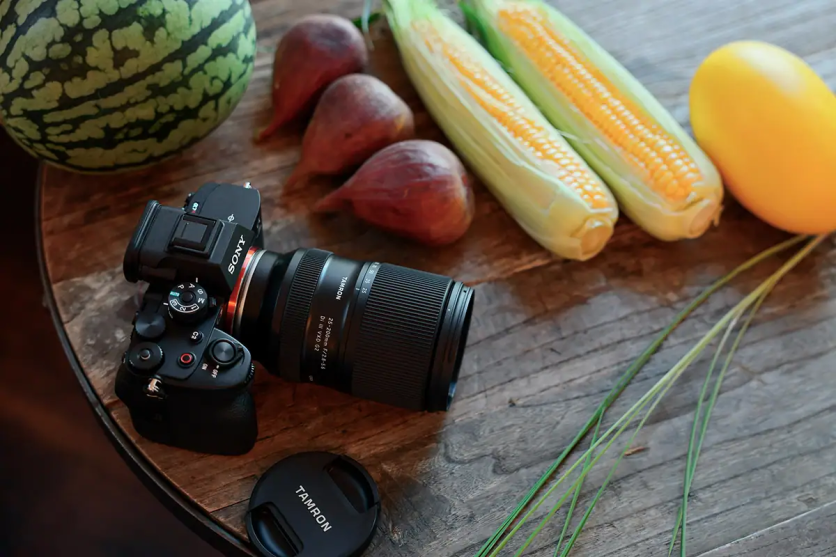
Sony E-mount owners who already carry the Tamron 25-200mm F/2.8-5.6 Di III VXD G2 (Model A075) now have a meaningfully more capable lens — at no additional cost. Tamron has released Firmware Version 3 for the A075, available today via the Tamron Lens Utility desktop application, delivering a dramatic improvement in close-focus performance: at the 35–50mm focal range, the lens now achieves a maximum magnification ratio of 1:1.7, up from 1:3.1 in the previous firmware version, per the official firmware announcement. That improvement — delivered entirely through a software push — puts a lens that previously offered modest close-up capability firmly into near-macro territory.
What the Update Actually Does to the Glass — and What It Cannot Do
Across the full 25–70mm focal range, Firmware Ver. 3 raises the A075's maximum magnification to 1:2 or better, according to Tamron's official release. The sweet spot sits between 35mm and 50mm, where the lens achieves that peak 1:1.7 figure. To understand what that number means concretely: at 1:1.7 magnification, a subject approximately 61mm (about 2.4 inches) wide will fill the full width of a 36mm full-frame sensor. That puts fine details of flowers, insects, food textures, jewelry, or small product components clearly within reach — no extension tubes, no dedicated macro prime, no new glass required.
The update does not make this a true macro lens. In strict optical terms, true macro requires a reproduction ratio of at least 1:1 — life size or larger. The A075 at 1:1.7 is technically "near-macro" or "extreme close-up," meaningfully surpassing the traditional half-macro threshold of 1:2, but stopping well short of the 1:1 benchmark that dedicated macro primes like the Sigma 105mm f/2.8 DG DN Macro Art (~$750) or the Sony FE 100mm F2.8 Macro GM OSS ($1,500 MSRP) achieve. For close-up photography that does not demand life-size reproduction, the gap between 1:1.7 and 1:1 is manageable. For scientific or technical macro where life-size reproduction is the point, it is not a substitute.
Read more: Ultra-Wide Zoom Gap Closes: Tamron A084 Brings 12mm f/2.8 to Sony and Nikon
Why Firmware Can Change Optics: VXD As Programmable Platform
The mechanism behind this update is what makes it genuinely significant beyond the specific magnification numbers. The A075 uses Tamron's VXD (Voice-coil eXtreme-torque Drive) linear motor autofocus system — a focusing mechanism that operates on electromagnetic principles rather than traditional gears. A copper-wire coil moves within a magnetic field, driving the focusing element group with precise, electronically commanded control. Unlike older gear-driven systems, the VXD motor's behavior is governed by software parameters embedded in the lens firmware. Those parameters define, among other things, the minimum focus distance the motor will travel to.
Firmware Ver. 3 changes those parameters to allow the VXD motor to push the focusing element group to a closer position than the previous firmware permitted. The physical glass and mechanical structure of the A075 were always capable of reaching this position — earlier firmware simply did not instruct the motor to go there, as Tamron's firmware release confirms. This is the same principle by which automotive manufacturers use electronic control unit updates to change a vehicle's performance profile without touching the engine: the firmware defines the operational envelope within the physical limits of the hardware.
That has a direct implication for how photographers should think about modern lens ownership. A VXD-equipped lens is not a fixed optical object — it is an electronically controlled platform whose characteristics can be revised post-purchase, within the physical limits of the glass and mechanics. Tamron has done this before with autofocus improvements and camera-body compatibility updates, but the A075's Ver. 3 is notably more consequential: improving optical magnification is not a refinement at the margin, it is a change in what the lens is capable of doing for photographers.
One constraint applies throughout: firmware cannot overcome physical limits. The A075's improvement is available at 25–70mm because the optical design has mechanical headroom at those focal lengths. At 200mm telephoto, element geometry and physical travel limits prevent similar gains. At 25mm, the lens was already specified at 1:1.9 from launch — 16mm minimum object distance (6.3 inches). The new firmware extends capability into the mid-range focal lengths where photographers often prefer working with close-up subjects, because longer focal lengths provide greater working distance between lens and subject.
Read more: Tamron 12-20mm f/2.8 Debuts at $1,699: First Constant-Aperture Ultra-Wide to Hit 12mm
The Lens This Update Transforms
The A075 launched in November 2025 as the successor to Tamron's popular 28-200mm F/2.8-5.6 Di III RXD (Model A071), priced at $899 USD. It offers an 8× zoom range from 25mm at F/2.8 to 200mm, in a package measuring 121.5mm (4.8 inches) long and weighing 575 grams (20.3 oz). The VXD linear motor provides fast, quiet autofocus throughout the range. Even at launch, the A075 distinguished itself from its predecessor with a 1:1.9 magnification ratio at the 25mm wide end — genuine half-macro performance from a travel zoom.
The Version 3 update extends that close-focus advantage across the mid-range focal lengths that are frequently more useful for close-up work than the extreme wide end. Shooting at 35–50mm for close-up subjects provides the photographer with more working distance and more flattering optical compression than shooting at 25mm, while the improved magnification means subjects of meaningful size can still fill the frame.
Is This a True Macro Rival?
That depends on the subject. Tamron markets the new capability as "half-macro or greater" across 25–70mm — accurate and appropriately conservative language, per Tamron's official announcement. At 1:1.7 in the 35–50mm sweet spot, the lens is a practical tool for photographing flowers, street food, architectural details, small objects, and textures that reward close-up treatment. For photographers who already carry the A075 as a travel or walk-around lens, that capability is now simply present — another tool in the bag without another lens.
It is not a replacement for a dedicated 90mm or 105mm macro prime for insect photography, forensic close-up work, or any situation requiring true life-size reproduction with the subject at a comfortable working distance. The best Sony E-mount macro options in those categories — the Tamron 90mm F2.8 Di III VXD Macro, the Sigma 105mm, and Sony's own FE 100mm GM — remain the appropriate choices for subjects demanding 1:1 or greater.
How to Get the Update
The firmware is available now and applies exclusively to the Sony E-mount version of the A075. Owners install it by connecting the lens directly to a Windows or macOS computer via USB-C cable and running the Tamron Lens Utility desktop application, which is available as a free download from Tamron's support portal. The process takes a few minutes. Tamron does not offer a mobile update path; firmware cannot be applied through the camera body. One standard caveat applies: once the lens is updated to Firmware Ver. 3, it is not possible to revert to an earlier version.
The update requires no subscription, no purchase, and no registration. It is available to every owner of the A075 Sony E-mount version from the moment this article publishes.
Frequently Asked Questions
Does the firmware update give the Tamron 25-200mm true 1:1 macro capability?
No. The update improves maximum magnification to 1:1.7 at the 35–50mm focal range, which is above the traditional half-macro threshold of 1:2 but still short of the 1:1 reproduction ratio that defines a true macro lens. For many practical close-up subjects — flowers, food, small objects, textures — the 1:1.7 performance is highly useful. For applications that require exact life-size reproduction, dedicated macro primes remain the appropriate choice.
Why can firmware change a lens's optical magnification — is this really just software?
Yes, in the sense that the Tamron A075's VXD (Voice-coil eXtreme-torque Drive) linear motor is electronically controlled. Firmware parameters define how closely the motor drives the focusing elements. The physical glass always had the capability to reach closer positions; previous firmware simply did not instruct the motor to go there. Firmware Ver. 3 changes those parameters, unlocking existing physical headroom. This is only possible with electronically controlled motors like VXD — traditional gear-driven lenses do not work this way.
Could other Tamron VXD lenses receive similar magnification improvements via firmware?
Potentially, yes — where the optical design and mechanical structure have physical headroom between the current minimum focus distance and the glass's actual limit. Tamron has a history of post-launch firmware improvements, and the A075's Ver. 3 demonstrates that the company is willing to use that headroom when it is available. Owners of other VXD-equipped Tamron lenses should monitor Tamron Lens Utility for updates, though Tamron has not announced similar magnification improvements for any other lens as of today's release.
What do I need to install the Firmware Ver. 3 update?
A Windows or macOS computer, a USB-C cable, and the Tamron Lens Utility desktop application (free download from Tamron's support site). Connect the A075 directly to the computer via USB-C — not through the camera body — and the Lens Utility will walk through the update process. The mobile version of Tamron Lens Utility does not support firmware updates; the PC/Mac desktop version is required. Note that once applied, the update cannot be reversed.

-
 C114 Communication Network
 -
 Communication Home
