
 Search

Samsung.com
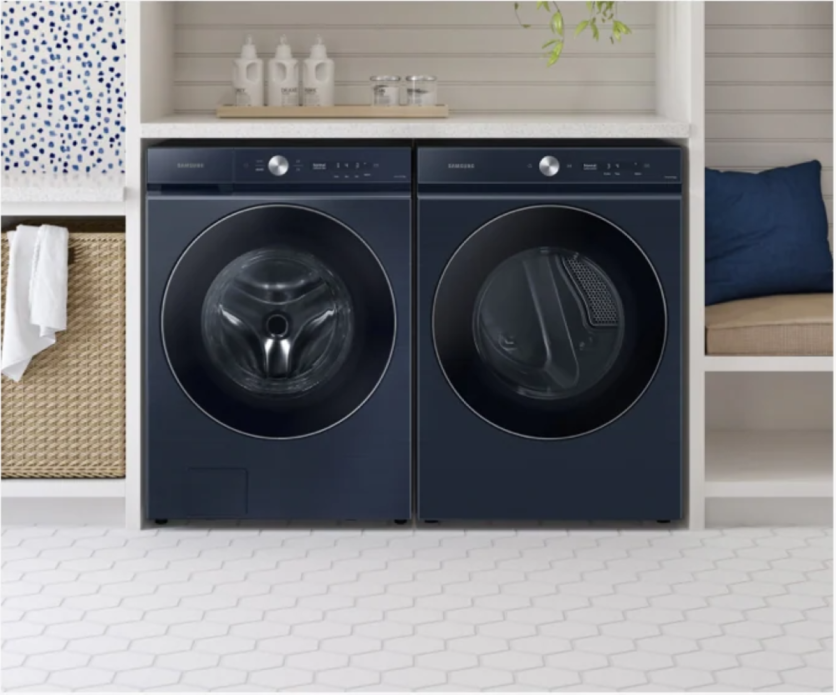
Samsung Electronics launched its new Bespoke AI Washer and Dryer lineup in July 2026, and the most technically significant feature is not the 7-inch touchscreen or the Bixby integration — it is how the washer figures out what is actually inside the drum. Before a single drop of water enters, the machine reads motor current signatures and vibration patterns to classify fabric type, then adjusts every downstream parameter accordingly. That sensing mechanism — and its hard engineering limit — tells you more about what this appliance can and cannot do than any feature list.
The feature Samsung calls AI Wash+ does not use a camera, RFID tags, or a spectroscope. It uses two existing hardware sensors — the three-axis accelerometer inside the drum and the motor's own current-draw telemetry — to infer what kind of fabric is loaded, as described in the Samsung Global Newsroom press release. The system runs three distinct sensing stages before the wash begins: a loosening phase, an unbalance-detection phase, and a weighing phase. During each stage, the AI model — trained on mechanical vibration signals and electromagnetic motor data — uses the physical behavior of the load inside the drum to infer its stiffness, weight distribution, and likely fiber composition.
Research published in Technologies (MDPI, March 2026) by a team including engineers from Xiaomi and Southeast University describes exactly this approach: a Physics-Aware Dual-Stream Multi-Scale Temporal Convolutional Network that processes accelerometer vibration at 100 Hz and motor electromagnetic signals at 5 Hz in parallel, achieving 94.05% average classification accuracy on a binary soft-vs.-hard fabric distinction across 168 independent wash cycles. Samsung's commercial implementation extends this to five named categories — Cotton, Delicates, Towels, Denim, and Outdoor — with Denim and Outdoor representing new additions to the system's prior coverage.
Read more: Xiaomi Launches Mijia Washing Machines in Germany With a Data Law Catch
AI Fabric Sensing Works via Dual-Stream Sensor Fusion, Not a Camera
The engineering constraint follows directly from the physics. At heavier loads, mass effects dominate the vibration and current signals, overwhelming the subtler texture differences between fabric types. That is why Samsung limits AI fabric detection to loads up to 2 kilograms (approximately 4.4 pounds) — not because of a software shortcoming, but because the underlying sensing mechanism cannot reliably extract fabric-type information when the drum contains more than that weight. A turbidity sensor continues to monitor soil levels for all load sizes, adjusting wash time and detergent dosage based on how dirty the water becomes during the cycle — so heavier loads still get adaptive treatment, just not fabric-type classification.
The practical meaning for buyers: the AI is most useful on exactly the loads that need it most — a small bundle of athletic wear, a few silk blouses, a pair of treated outdoor jackets. A full drum of cotton t-shirts will run on the turbidity sensor's soil-level readings rather than fabric classification. Mixed loads covering multiple fabric types may reduce detection precision even within the 2-kilogram window.
Ecobubble's Cold-Wash Energy Claim Comes With a Disclosure Worth Reading
Samsung's claim that AI Energy Mode reduces washer energy consumption by up to 70% is accurate — and requires one additional sentence of context. The 70% figure compares the Ecobubble cold-wash mode against the same machine's own default hot-water settings, tested on model WW11BB944AGB. It is not a comparison against a competitor's washer.
The underlying mechanism is well-established. A built-in Bubble Generator draws water into the detergent compartment, injects air through a pump, and creates a dense foam that is routed into the drum before the wash cycle begins. Cold water has higher surface tension than hot water, which normally slows detergent dissolution; the microbubbles overcome that surface tension by increasing the contact area between detergent molecules and fabric fibers, allowing the detergent to penetrate the weave without requiring heat to activate it. Samsung states that the Super Eco Wash program runs at 15°C (59°F) and delivers cleaning results comparable to a 40°C (104°F) cycle using 30% of the energy.
In practice, the 70% figure represents the maximum efficiency gain under ideal conditions with compatible cycles selected — not every wash will save 70%. The dryer's AI Energy Mode delivers a separately measured 20% reduction in energy use, based on internal testing on model DV90F09F4SU2 drying a 5-kilogram (approximately 11-pound) load: 0.952 kWh without AI Energy Mode versus 0.720 kWh with it.
Why Does a Dryer Need an Inverter Compressor?
The short answer: because this is a heat pump dryer, not a conventional vented or resistive-element dryer — though the press release does not use that term prominently.
The AI Dry+ system operates an Inverter Compressor and a Heat Exchanger. An inverter compressor, in a dryer context, is the variable-speed refrigerant pump at the heart of a heat pump architecture. Instead of converting electricity directly to heat via a resistive element — and venting that humid hot air outside — the system circulates a refrigerant that captures moisture from the drum air, releases it as condensed water, and returns the now-drier warm air back into the drum in a closed loop. Electric heat pump dryers use at least 28% less energy than conventional electric models at baseline; models with the AI Dry+ optimization layer achieve the additional 20% reduction on top of that baseline by modulating compressor speed and heat-exchange intensity based on real-time moisture and temperature readings.
The fabric-type detection on the dryer follows the same 2-kilogram limit as the washer — four categories (Normal, Denim, Towels, Delicates) rather than five — and influences how aggressively the compressor and heat exchanger work throughout the cycle.
SmartThings Is the Connective Layer — and It Is Much Larger Than You May Think
Samsung's SmartThings platform, which coordinates the Bespoke AI lineup's connected features, reached 430 million global users and 4,700 connected devices as of December 2025, according to an announcement at CES 2026. The platform recorded 2.5 billion device interactions in 2024, according to Samsung's own data.
For the Bespoke AI lineup, SmartThings serves several distinct functions: remote monitoring and cycle initiation via mobile app, energy-consumption reporting broken down daily and monthly with estimated electricity cost figures, AI Energy Mode activation, and cycle suggestions pushed from the appliance to the app based on learned usage patterns. Post-cycle laundry reports covering water and energy consumption are accessible through the app after each completed wash or dry cycle.
The competitive framing is worth understanding clearly. LG's ThinQ platform competes directly for this position — it connects LG appliances with Google Assistant and Amazon Alexa, and includes AI DD fabric detection and TurboWash cycle compression. A third-party repair and reliability analysis published in January 2026 found that LG's dual-inverter heat-pump dryer models cut energy use by 50% compared to standard electric models, outperform Samsung's energy baseline, and carry a 10-year direct-drive motor warranty. The same analysis noted that Samsung's heating element is its most commonly replaced part in high-use homes, typically failing at four to six years. Where SmartThings does have a measurable ecosystem advantage over ThinQ is breadth: 4,700 compatible devices across 390 partners versus ThinQ's more appliance-centric integration focus.
A 7-Inch Screen and Bixby as an Accessibility Layer
Both appliances ship with a 7-inch LCD touchscreen — Samsung calls it the Smart Screen — that learns usage patterns over time and proactively suggests appropriate wash or dry cycles. Samsung's upgraded Bixby voice assistant handles natural-language commands — starting a cycle, adding an extra rinse, requesting remaining time — without requiring any screen interaction. Bixby can also read out the information displayed on the screen, which Samsung frames as an accessibility feature for users who find small-screen appliance interfaces difficult to navigate.
The post-cycle laundry report, delivered through the SmartThings app, breaks down energy and water consumption per cycle — information that connects directly to the energy-management features and gives users a basis for comparing cycle choices over time.
Market Context: Where AI Washer-Dryers Land in the 2026 Appliance Landscape
The global smart home appliances market is projected to reach $192 billion in 2026, growing at roughly 10% annually through 2031, driven by falling connectivity hardware costs, IoT maturation, and utility incentives that make load-shifting appliances financially attractive in several North American and European markets. Samsung's Bespoke AI launch is a direct play into this momentum, positioning laundry appliances as data-generating nodes in a broader energy-management ecosystem rather than standalone machines.
Samsung has not announced final pricing for the Bespoke AI Washer and Dryer. The lineup is available in select markets beginning July 2026, with regional availability and capacity ranges varying by market. The Samsung Global Newsroom lists washer capacities from 10.5 kilograms (approximately 23 pounds) to 13 kilograms (approximately 28.7 pounds) and matching dryer capacities from 9 kilograms (approximately 19.8 pounds) to 13 kilograms (approximately 28.7 pounds), depending on market. Pricing absence is consistent with Samsung's Bespoke line, which typically targets premium buyers.
Frequently Asked Questions
How does Samsung's AI Wash+ actually detect what fabric is in the drum?
The system uses two sensors already present in the machine: a three-axis accelerometer that measures how the load moves inside the drum, and motor-current telemetry that tracks how hard the motor has to work at different rotation speeds. A pre-trained AI model processes both streams simultaneously during a pre-wash dry-sensing phase — before water enters — to infer the fabric type from the load's mechanical behavior. Independent academic research on the same sensing approach reports classification accuracy of around 94% in binary soft-vs.-hard tests; Samsung's commercial system extends this to five named categories. The hard limit at 2 kilograms (approximately 4.4 pounds) exists because at heavier loads, the total mass overwhelms the subtle texture signals the sensors need to distinguish fabric types.
Does the "up to 70% energy savings" claim mean compared to other washing machines?
No. Samsung's 70% figure compares the AI Ecobubble cold-wash mode against the same machine's own default hot-water cycle settings, based on internal testing. It measures how much energy is saved by washing at lower temperatures using the Ecobubble foam pre-treatment rather than relying on hot water to dissolve detergent. The comparison baseline is the default behavior of the same Samsung model — not a competitor's machine or an industry average. The 20% dryer energy reduction is a separate measurement, also from internal testing.
Is the Samsung Bespoke AI Dryer a heat pump dryer?
Yes. The Bespoke AI Dryer uses an Inverter Compressor and a Heat Exchanger — the components of a heat pump architecture — rather than a conventional resistive heating element. A heat pump dryer captures moisture from the drum's circulating air, releases it as condensed water, and returns warm dry air to the drum in a closed loop, recycling heat rather than venting it outside. This is structurally more efficient than a vented electric dryer. Samsung's US page notes that heat pump electric dryers use at least 28% less energy than conventional electric models before any AI optimization layer is applied. The AI Dry+ system adds a further 20% reduction by adjusting compressor speed and heat-exchange intensity in real time based on moisture content and detected fabric type.
How does Samsung's SmartThings compare to LG's ThinQ for laundry?
Both platforms offer remote monitoring, cycle control, and energy usage reporting via mobile app. The primary architectural difference is breadth versus depth: SmartThings integrates 4,700 devices across 390 partners, making it a wider cross-device home automation hub; ThinQ is more appliance-centric but supports Google Assistant and Alexa natively and includes SmartDiagnosis that can share error codes with LG service remotely, as documented in this 2026 comparison. On energy efficiency, a third-party repair analysis found LG's dual-inverter heat-pump dryer models cut energy use by 50%, ahead of Samsung's baseline for comparable models, and Samsung's heating element is its most commonly replaced component in heavy-use homes. The right platform choice depends primarily on whether a buyer already owns other Samsung or LG devices and which ecosystem they want to build toward.

-
 C114 Communication Network
 -
 Communication Home
