
 Search

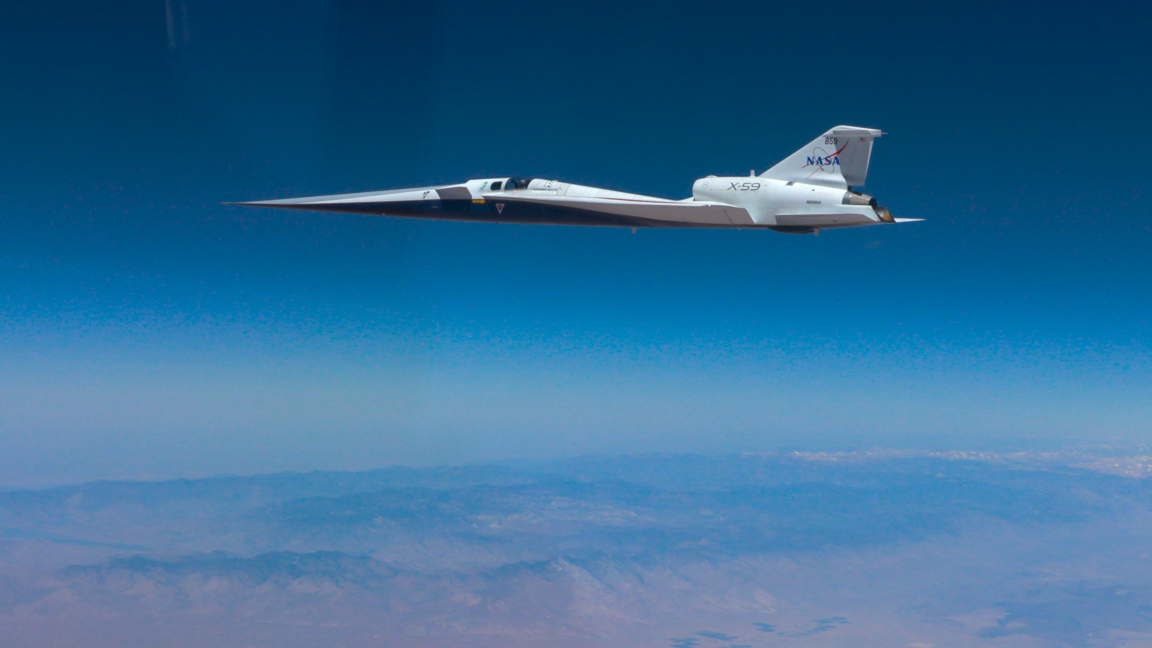
Credit: NASA | Lori Losey
More than two decades since the Concorde supersonic airliner last took to the skies, NASA has been flying an experimental aircraft designed to replace loud sonic booms with a quieter thump equivalent to a car door slamming shut 20 feet away. A successful NASA flight test program could influence the design of future supersonic airliners capable of flying overland routes without rattling buildings—and people’s nerves.
The Lockheed Martin X-59 Quesst—an acronym for Quiet SuperSonic Technology—first took flight late last year and recently began supersonic test flights. But unlike with many experimental “X-plane” aircraft that may never leave restricted airspace near Edwards Air Force Base in California, NASA plans to eventually take the X-59 on a tour around the United States so residents of various cities and towns can provide feedback on the quieter sonic “thumps” it produces.
“Usually an X plane is kind of bare-bones—‘cobble it together from a bunch of parts from other airplanes and just demonstrate one thing,’” said Jim “Clue” Less, a NASA test pilot and aerospace engineer, in an interview with Ars. “We need to demonstrate that one thing, but then we need a plane that’s robust enough that we can fly it all over the place and gather that data.”
The move comes at a time when the US Congress has been advancing legislation that could legalize overland supersonic travel. That would reverse a 1973 ban implemented by the US Federal Aviation Administration, which was informed by the public backlash and noise complaints following US military tests of supersonic flights over Oklahoma City, Chicago, and St. Louis in the 1960s.
But even if the X-59 program shows that quieter supersonic travel is possible, any potential revival of commercial supersonic flights would still have to prove financially viable despite challenges such as massive fuel consumption costs.
Less and Peter Coen, the mission integration manager for NASA’s Quesst mission and former manager of NASA’s Commercial Supersonic Technology project, spoke at length with Ars about the quirks of piloting a supersonic aircraft with no front window, the X-plane’s “frankenjet” design, a harrowing early flight test, and what people around the United States can expect once the X-59 starts doing its national tour.
NASA’s X-59 quiet supersonic jet flies over the Mojave Desert during its third flight on Thursday, March 26, 2026, from NASA’s Armstrong Flight Research Center in Edwards, California.
Credit: NASA | Carla Thomas
An airframe designed for sonic thumps
The X-59’s distinctive airframe, developed by Lockheed Martin Skunk Works in partnership with NASA, is most likely to stand out at first glance—especially the long, tapered nose that makes up almost a third of the aircraft’s nearly 100-feet length. The nose is designed to help break up the shockwaves that are typically created when an aircraft flies faster than the speed of sound.
“All the features of the X-59, from its long tapered nose to the engine mounted on top to the shape of the wing—each one of those features was done in one way or another to control the strength of a shockwave,” Coen told Ars.
A supersonic aircraft typically creates multiple shockwaves emanating outward from the nose, canopy, engine inlet, wings, and tail of the aircraft. Those individual shockwaves “start to pile up on each other” and eventually form two remaining shockwaves that travel down to the ground, Coen explained. People on the ground usually hear the double bang of the two shockwaves as a single sonic boom.
The “trick to solving the sonic boom problem” involved creating an airframe design that could make shockwaves of similar strength while spacing them out as equally as possible along the airplane, Coen said. That slows down the process of multiple shockwaves merging into larger ones and allows the atmosphere to weaken the smaller shockwaves to smear out the sharp pressure change into a more gradual increase.
The result is that human ears will hear a “thump or a whoosh” as opposed to a typical sonic boom, Coen said. Whereas the Concorde’s sonic boom noise was around 105 perceived level in decibels (PldB)—potentially enough to rattle window frames and household items if the supersonic airliner wasn’t banned from overland flights—NASA’s Quesst mission goal is to demonstrate a softer sonic thump closer to 75 PldB.
Not flying blind
One trade-off of the X-59’s long, tapered nose is that there is no forward window for the pilot. As a NASA presentation notes, the last notable crewed aircraft that flew in the United States without forward-facing windows was Charles Lindbergh’s Spirit of St. Louis monoplane that made the first nonstop transatlantic flight in 1927.
Instead, the X-59 pilot relies on an eXternal Vision System (XVS) developed by NASA Langley Research Center, which uses two high-resolution cameras on the top and bottom of the aircraft to display a forward view to the pilot through a 4K monitor. The same monitor provides additional flight data through augmented reality features to assist with takeoffs and landings.
The X-59 also has actual side windows that allow a pilot to check for runway edges when taxiing on the ground, taking off, and landing.
A close-up of the cockpit view of the eXternal Vision System before it was placed in the X-59. Instead of a front-facing window, the pilot uses monitors for forward-facing visibility.
Credit: Lockheed Martin | Garry Tice
Although some engineers and project managers were initially concerned about how well the pilots could adapt to the XVS system, Less and David Nils Larson, the lead X-59 test pilot, had prepared ahead of time by spending hundreds of hours training in an X-59 simulator, with Less having more than 300 hours and Larson spending more than 500 hours. They also practiced an estimated 1,000 simulator landings each.
“It’s not like hopping in an F-18 or an F-15, where you’ve got great visibility all around, but when we’re in the X-59, this is normal to us,” Less told Ars. “It’s gotten very routine.”
In 2021, NASA also evaluated the XVS technology’s ability to help the pilot easily spot nearby aircraft, performing live flight test scenarios with the hardware installed aboard a NASA Beechcraft King Air. A pilot using the XVS system was often able to spot nearby aircraft faster than a pilot sitting up front and looking out the window, possibly due to the technology’s image-processing capabilities.
“We’ve been able to show that it’s not only an equivalent level of safety to having a canopy, it’s actually better in some cases,” Less said. “I don’t know if this kind of system will find its way into future airliners—non-supersonic airplanes—just because it may allow you better visibility.”
Frankjet origins
Like many experimental aircraft, the X-59 is a “frankenjet” because it uses “off-the-shelf” components from many different aircraft, Less said. For example, the aircraft’s landing gear comes from an F-16 Fighting Falcon jet. The throttle that controls the aircraft’s engine power originated from an F-18 Super Hornet fighter jet that operates from aircraft carriers, whereas the stick comes from an F-117 Nighthawk stealth attack aircraft.
The aircraft’s fuel system and hydraulics also incorporate components from F-16 and F-18 fighter jets. The X-59’s F414-GE-100 engine—capable of providing 22,000 pounds of propulsive energy—is a customized variant of a turbofan engine used in F-18 Super Hornets.
The X-59 cockpit is based on the rear cockpit of a T-38 jet trainer, allowing Lockheed to reuse the T-38 canopy and ejection seat for the experimental aircraft. But the result is a relatively small cockpit space for the test pilots Less and Larson, who are both more than 6 feet tall.
“It does make for a pretty small, cramped cockpit—we’re always complaining about that,” Less told Ars. “Everything is right there at our fingertips, though, which is pretty nice.”
One of the most important components is the avionics system that allows the pilot to access the aircraft’s various navigation and communications systems. The X-59 incorporates a Rockwell Collins Pro Line Fusion avionics system commonly used in Beechcraft King Air turboprop aircraft. That will make it easier for the experimental supersonic jet to eventually operate safely alongside other aircraft at civilian airports and when flying in the US National Airspace System.
NASA test pilot Jim “Clue” Less is seen after completing his first flight of the X-59 and the aircraft’s second flight overall at Edwards Air Force Base in California on Thursday, March 26, 2026.
Credit: NASA | Ryan Kline
First flight tests
But before the X-59 can start a national tour, the test pilots must put the aircraft through its paces. The first phase of the X-59 program that began with the inaugural flight on October 28, 2025, involves testing the aircraft’s handling qualities and limits under various flight conditions while proving the aircraft’s safe operational limits. Between late 2025 and June 2026, Less piloted the X-59 during 10 flights while Larson took the controls for nine flights.
The X-59’s long nose and overall shape make the aircraft “a little bit sensitive in pitch” when the nose is moving up or down, Less said. That showed up as a potential issue early on during the simulator runs, so NASA and Lockheed Martin tried to ensure that the autopilot systems could provide backup in case the aircraft didn’t handle well in flight.
The initial test flights showed that the aircraft handled better than expected despite the pitch sensitivity. “If you start aggressively trying to control a very precise pitch attitude, you get into a little bit of an oscillation, but you can easily get out of that,” Less explained.
The most notable in-flight anomaly so far appeared during the X-59’s second flight on March 20, which happened to be the very first flight for Less. About four or five minutes after takeoff, a warning light appeared on the cockpit display that suggested the aircraft was experiencing an uncontrolled loss of air that might trigger a fire.
The aircraft’s pressurization system automatically shut down due to a potential bleed leak, which also cut off airflow inside the cockpit. Fortunately, Less had not flown very high yet and was able to quickly return to base for a safe landing. The post-flight investigation showed that the warning light had been a false alarm—the result of the indicator’s instrumentation being incorrectly installed.
“It may seem like we spent a lot of time and effort training, but it pays off when you get out there and something’s not going quite right and we know how to respond,” Less said. “We think we’re prepared for every contingency.”
Measuring the sonic thump
The X-59 has performed smoothly for the most part despite the few anomalies. On June 5, 2026, it went supersonic for the first time, with Less as the pilot. The 81-minute flight saw the aircraft reach a top speed of Mach 1.1—about 713 mph—at an altitude of 43,400 feet.
However, the experience of going supersonic as a pilot is significantly less exciting and more anticlimactic than what Hollywood films often show, Less said.
“What surprises most people is when you go supersonic, you really don’t know other than your gauges telling you that you’ve gone supersonic,” Less told Ars. “I was showing my wife and my daughter some video of the moment that we went supersonic, and I said, ‘I’m sorry, it’s kind of boring.’”
NASA followed up on that milestone with a second supersonic flight test on June 12 that achieved a top speed of Mach 1.4—approximately 924 miles per hour—and reached an altitude of 55,000 feet. Those represent the speed and operational altitude that the X-59 will aim for in future flight tests intended to evaluate the sonic thump.
X-59 supersonic flight test points.The early supersonic flight tests have included retired Air Force F-15 jets and F-18 jets being repurposed as NASA chase planes to follow the X-59 prototype and help monitor its operational performance. However, the sonic booms generated by the chase planes currently obscure any quieter sonic thump from the X-59.
The coming months of flight tests could pave the way for the start of the program’s second phase by the end of 2026, which would still take place in restricted airspace near Edwards Air Force Base. That next phase will focus on measuring the shockwaves generated by the X-59 in flight, along with evaluating the sonic thump impact on the ground.
“We’re going to fly the X-59 with a specially instrumented nose boom on the front of the airplane, which will be able to measure the flow field, the strength, and location of the shockwaves near the airplane,” Coen said.
NASA also plans to measure the shockwaves high up in the atmosphere by mounting a microphone system on a motor glider flying at an altitude of about 10,000 feet. An array of specialized and ruggedized acoustic recorders will also record the weakened shockwaves once they reach the ground.
Going on national tour
The ultimate test of the X-59 design’s success would come in the third phase of the program, when NASA plans to fly the aircraft above communities all across the United States. The agency wants to perform X-59 flight tests over communities that are broadly representative of the United States when factoring in demographics, building construction, climate, geography, and a host of other characteristics.
The ground microphone arrays will once again be deployed, but NASA also plans to recruit community members who can share their feedback on the sounds they hear each day during the flight tests. Each community may experience frequent flight tests for about a month, during which they may hear quieter and louder sonic thumps ranging from 70 PldB to 90 PldB, Coen said.
“Each day, we’ll fly over the community and [fly] the X-59 a little bit differently, so each flight will produce either a quiet sound or a louder sound,” Coen said. Many people may not even hear anything on the lower end, but the louder sonic thumps could approach “something that is quite annoying,” he said.
For the first community test, the X-59 will take off from NASA Armstrong Flight Research Center at Edwards Air Force Base in California’s Mojave Desert before conducting supersonic test runs over an unspecified neighboring community that does not typically hear sonic booms from other test aircraft.
But follow-on tests elsewhere in the United States will require an airfield capable of supporting the X-59’s runway requirement of 10,000 feet. Although NASA has not yet finalized its list of communities designated for the flight tests, dozens of major airports have the runway lengths capable of accommodating the X-59.
NASA’s X-59 quiet supersonic research aircraft approaches landing at Edwards Air Force Base in California on Thursday, March 26, 2026.
Credit: NASA | Carla Thomas
Community feedback and other data from the X-59 test flight program will eventually be shared with the US Federal Aviation Administration and the International Civil Aviation Organization, so regulators will have the evidence to create new standards for overland supersonic flights.
“The objective is to come up with a standard that enables innovation and allows us to have supersonic flight in the future but still protects the public on the ground,” Coen said. “Phase 3, where the public is allowed to weigh in on what they heard and how it affected them, is something that I’m personally really looking forward to.”

-
 C114 Communication Network
 -
 Communication Home
