
 Search

McMurty Automotive
McMurtry Automotive released a teaser video and preliminary specifications Thursday for the production-spec Spéirling PURE, its record-shattering electric fan car, confirming a full reveal will follow next week. The announcement lands as the British automaker transitions from a record-breaking prototype program to the harder problem it took years to solve: building 100 owner-ready versions of a machine that can drive upside down, generates more downforce than it weighs, and does all of it from a standing start.
The production car shares just five percent of its components with the prototype versions that have carved their names into track records from West Sussex to California. That figure — 95% new components — reflects not a crisis of confidence in the original engineering but the depth of work required to translate prototype performance into something a private buyer can take to a track day and drive home confident it will work next weekend, too.
Fan Car Downforce: How McMurtry's System Actually Works
The Spéirling PURE's defining technology is its Downforce-on-Demand system — a pair of electric fans spinning at up to 23,000 rpm beneath the car's sealed underbody. The fans evacuate air from a cavity formed by the car's floor and a set of rubber skirt seals running along the edges, creating a low-pressure zone that presses the car down against the surface with a force of up to 2,000 kg (4,400 lbs). The mechanism is an application of the Venturi effect: narrowing the underbody channel accelerates airflow, reducing pressure below ambient, generating a net downward force independent of the car's road speed.
That last point is the engineering differentiator. Conventional aerodynamic downforce is a function of airspeed — wings and diffusers require the car to be moving, and moving fast, before meaningful downforce builds. The Spéirling's fan system produces its full 2,000 kg from a standing start. This matters practically. Most of the highest-performance electric vehicles on sale today are now traction-limited: their motors can generate more torque than their tires can usefully transmit to the road. Ground-effect fan downforce sidesteps this constraint entirely by loading the tires with mechanical grip that does not depend on the car going anywhere first.
The system is managed by bespoke onboard software that simultaneously coordinates fan speed, dual-motor torque delivery, and aerodynamic load in real time. The motors themselves are Helix SPX242-94 units — each delivering 500Nm of torque in a 33kg package — mounted in a single rear e-axle. Combined output is 1,000 hp, routed exclusively to the rear wheels, producing a 0–60 mph time of 1.55 seconds and a top speed of 190 mph.
What McMurtry Redesigned for Production
McMurtry's prototype set records on a relatively narrow set of specialized components. Building an owner-ready car required solving a different set of engineering problems entirely — ones that become apparent only when a car needs to work reliably across climates, tracks, and driver skill levels.
The most visible change is a redesigned front cooling system that consolidates two separate radiators from earlier prototypes into a single, larger unit positioned at the front of the car. McMurtry says the revised package is 20% lighter than the combined weight of the two units it replaces. The tyre package has also been upgraded: the production car uses wider Michelin slick compounds, roughly 10% broader than those fitted to the prototype that set the Top Gear Test Track record in 2025. The additional contact patch pushes lateral cornering capability from 3G to 3.5G. Braking forces are rated at 4G — a figure usually found only in top-tier closed-wheel racing. The cockpit is wider, improving driver accommodation and opening the car to a broader range of owner body dimensions.
No road-legal version has been confirmed. McMurtry says it is working on a road car but has not given a timeline.
Track Record: What the Prototype Has Already Proven
The machines that logged those five percent of components came with a résumé that requires very little embellishment. The original Spéirling first appeared at the 2021 Goodwood Festival of Speed. Returning in 2022, it broke the outright Goodwood hillclimb record with a time of 39.08 seconds, eclipsing the unofficial benchmark set by Volkswagen's purpose-built ID.R electric racer and simultaneously surpassing the official 23-year-old shootout record, which had been held by Nick Heidfeld in a McLaren MP4/13 Formula 1 car since 1999.
In April 2025, the Spéirling PURE Validation Prototype 1 — the car that informed the production specification — set the outright record at the Top Gear Test Track with a time of 55.9 seconds, beating the 2004 V10-powered Renault R24 Formula 1 car's 21-year-old benchmark by 3.1 seconds. On the same day, McMurtry co-founder Thomas Yates drove the car upside down for five seconds on a rotating rig at the company's Gloucestershire headquarters, establishing — beyond any theoretical argument — that the fan system's 2,000 kg of suction exceeds the production car's mass.
Records have also been set at Laguna Seca, Hockenheimring, Castle Combe, and — most recently — two circuits in Denmark, where a non-professional customer driver set the outright lap record at Jyllandsringen, eclipsing the previous benchmark held by a professional in a Formula 4 car.
Why McMurtry Revived a Technology Banned From Racing
Fan-assisted ground-effect downforce is not a new idea. Jim Hall's Chaparral 2J, a Can-Am prototype from 1970, used fans powered by a separate two-stroke engine to stick the car to the circuit and was banned from the series after a single season. A more famous application followed in 1978, when Brabham designer Gordon Murray fitted a large fan to the rear of the BT46B Formula 1 car, powered through the gearbox. Niki Lauda drove it to a commanding win at the 1978 Swedish Grand Prix — the only race it entered — after which Brabham voluntarily withdrew it under pressure from rival constructors. The FIA subsequently outlawed fan cars from Formula 1 prospectively. The BT46B remains the only Formula 1 car in history with a 100% race win record.
McMurtry's revival of the concept for the electric era is architecturally different from both predecessors. Rather than drawing power from a combustion drivetrain, the Spéirling's fans are electrically driven, which means their output can be varied independently of road speed, engine RPM, or gearbox state. The software integration problem — coordinating fan demand against motor torque at 3.5G lateral acceleration — is what the company spent several years solving before committing to series production.
Production Details: 100 Units, £995,000 Each, Deliveries Before Year End
McMurtry will limit the Spéirling PURE to no more than 100 examples. The starting price is £995,000 — approximately $1.36 million USD — before taxes, shipping, and options. First customer deliveries are scheduled before the end of 2026. As of March 2026, the company had confirmed 24 orders and was producing approximately two cars per month at its new 29,000-square-foot factory in Wotton-under-Edge, in England's Cotswolds region.
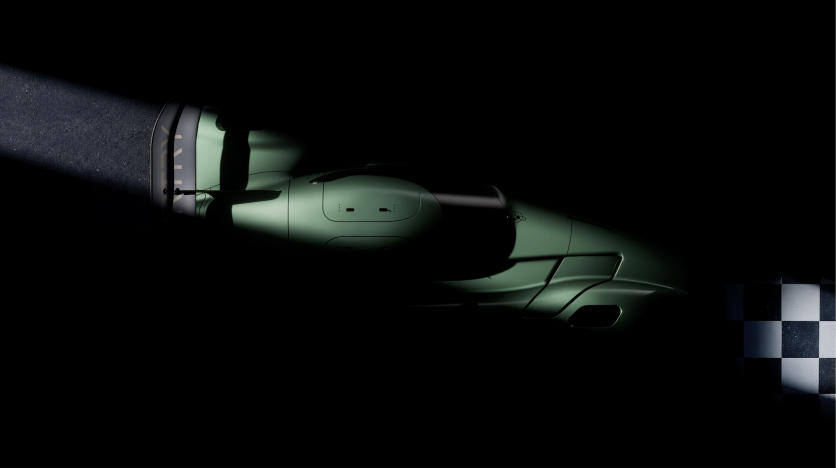
The teaser released Thursday shows the car in what appears to be a matte green finish — a departure from the silver and black prototype liveries familiar from its record runs. A full production reveal is expected next week. Prospective buyers can register interest directly at McMurtry's website; the company states that last available build slots are currently being assigned.
McMurtry founded the company in 2016. Its founding partner, Sir David McMurtry — inventor of the touch-trigger precision measurement probe, co-founder of Renishaw plc, and the engineer who first conceived the fan car project — passed away in December 2024. The company continues under co-founder and managing director Thomas Yates and technical director Kevin Ukoko-Rongione.
Beyond 100 Cars: McMurtry Technology's Licensing Push
McMurtry is not limiting the Spéirling PURE's engineering ambitions to 100 customers. Through a division called McMurtry Technology, the company is offering its three core patented systems — the Downforce-on-Demand fan package, its high-density battery solution using Molicel cells, and the Helix e-axle powertrain architecture — to external manufacturers.
The implication is significant: if the fan downforce system transfers to other vehicles, the Spéirling PURE becomes not just the most expensive track toy in the Cotswolds but the proof-of-concept for a different approach to electric performance — one that treats downforce as a software-controlled parameter rather than a fixed aerodynamic consequence of going fast.
Frequently Asked Questions
How does McMurtry's fan downforce system work differently from conventional aerodynamics?
Conventional aerodynamic downforce is generated by shaping wings and underbody surfaces so that airflow at speed creates a pressure difference between the top and bottom of the car. This requires the car to be moving — faster speeds produce more downforce. The McMurtry Spéirling's Downforce-on-Demand system uses electrically powered fans to actively evacuate air from a sealed underbody cavity, applying the Venturi effect regardless of vehicle speed. The result is 2,000 kg of downforce available from a standstill — including while the car is stationary, inverted, or traveling slowly through a corner.
Why was the fan car banned from motorsport, and why can McMurtry use it?
Racing series banned fan-assisted downforce because it was deemed a movable aerodynamic device — the same regulatory category that prohibits adjustable wings. The Brabham BT46B in 1978 and the Chaparral 2J in 1970 both ran briefly before being withdrawn or banned under this framework. McMurtry operates outside racing regulations: the Spéirling PURE is a non-competition track day car and is therefore not subject to FIA rules prohibiting movable aerodynamic devices. It is eligible for the GT1 Sports Club track program but not for sanctioned circuit racing.
What changed between the record-breaking prototype and the production Spéirling PURE?
Ninety-five percent of the components are new. The most significant production engineering changes include a single front-mounted radiator replacing two rear-mounted units (saving 20% in system weight), wider Michelin slick tyres that increased cornering capability from 3G to 3.5G, a redesigned wider cockpit, and a 100kWh battery pack using Molicel P50B 21700 cells rated for approximately 25 minutes of track driving. The production car weighs approximately 1,300 kg, compared to under 1,000 kg for earlier prototypes, reflecting the additions required to meet ownership standards.
Is McMurtry building a road-legal version of the Spéirling PURE?
McMurtry has confirmed it is working on a road car but has not announced a price, specification, or delivery timeline. The Spéirling PURE being revealed next week is a track-only car and is not road-legal in its current form.

-
 C114 Communication Network
 -
 Communication Home
