
 Search

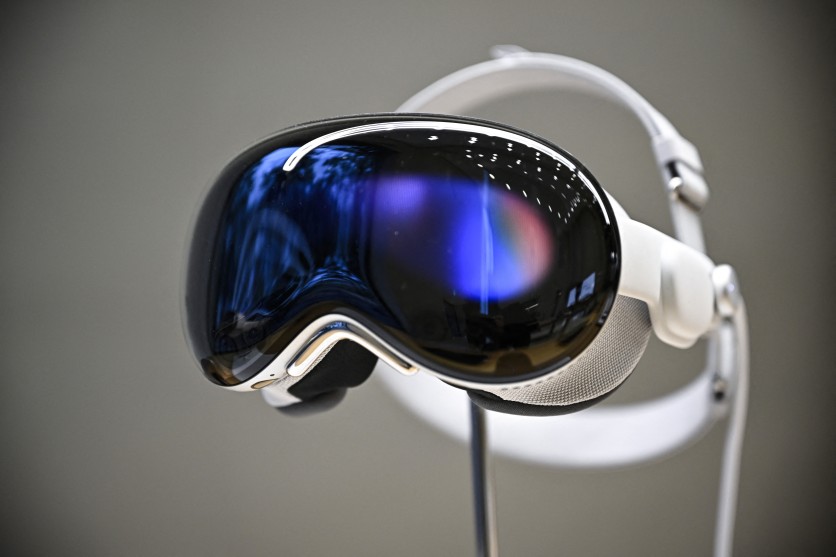
This photograph shows the Apple Vision Pro mixed reality glasses device by US company Apple Inc. during the launch at the Apple store on Champs Elysees avenue in Paris on July 12, 2024. JULIEN DE ROSA/Getty images
Apple is losing the engineer who spent seven years building the Vision Pro's hardware and was leading the company's push into AI smart glasses — with a late 2027 launch target bearing down. Paul Meade, vice president of hardware engineering in Apple's Vision Products Group, will leave Apple by next week to join OpenAI's hardware division, according to Bloomberg — citing people familiar with the matter who asked not to be named on unannounced personnel moves. Apple and OpenAI both declined to comment.
The departure is the most consequential hardware engineering exit from Apple yet in a string of VP-level defections that has accelerated over the past eight months. Meade does not just take deep institutional knowledge with him — he takes the specific expertise in wearable systems architecture that Apple needs most right now, as it races to ship display-free smart glasses expected to reach the market in late 2027.
AR smart glasses represent a categorically harder engineering problem than the Vision Pro that Meade spent the previous seven years building. Where the Vision Pro's design allowed for a large battery pack, active cooling, and a display system built around high-power micro-OLED panels, smart glasses must accomplish comparable AI processing tasks within a total system power envelope of roughly 3 to 8 watts — roughly the draw of a single LED bulb — packed into a frame light enough for all-day wear. The waveguide optics that project digital overlays through thin glass elements remain commercially unproven in full-color form at consumer scale. Apple knew, when it assigned Meade to lead the smart glasses effort, that it was assigning its hardest hardware problem to its most seasoned hardware engineer.
Apple's Spatial Computing Brain Trust Is Now at OpenAI
At OpenAI, Meade will join Jony Ive, Tang Tan, and Evans Hankey — the former heads of Apple design, hardware product design, and industrial design, respectively. The three co-founded an AI hardware startup that OpenAI acquired in May 2025 for $6.5 billion — its largest deal to date — bringing roughly 55 engineers and designers under OpenAI's roof. Meade's addition gives OpenAI a hardware engineering architect who has shipped some of the most technically demanding consumer electronics ever made — credentials it needs as it prepares to reveal its first AI-native consumer device in the coming months.
Fletcher Rothkopf, Meade's longtime deputy and head of product design for both the Vision Pro and smart glasses programs, will assume Meade's responsibilities within the Vision Products Group.
Read more: Apple Offers Massive Bonuses to iPhone Design Team to Stop Talent Poaching by OpenAI, Rivals
Why AR Glasses Are Harder to Build Than the Vision Pro
The Vision Pro is, at its core, a high-power device that happens to rest on your face. It draws enough power to run active cooling, drives two 4K micro-OLED displays, and relies on a dedicated R1 chip for sensor fusion alongside the M-series processor — all within a device that weighs around 600 grams and is acceptable for sessions of an hour or two.
Smart glasses invert almost every one of those design constraints. The target weight for all-day-wear AR glasses is under 100 grams — comparable to a standard eyeglass frame. That weight budget means the battery is measured in milliamp-hours rather than watt-hours. The system-on-chip must handle always-on sensor processing, camera inference, SLAM (the technique that continuously maps the glasses' position in three-dimensional space), and AI model queries, all while generating so little heat that it does not become uncomfortable resting on a person's face.
Current AR display glasses achieve between 50 and 70 degrees of field of view — enough for notifications and navigation overlays but far short of the Vision Pro's immersive field. Waveguide optics are the enabling technology: thin glass elements with diffraction gratings etched in that bend projected light toward the eye. Both the leading approaches — diffractive waveguides for thinner lenses and geometric reflective waveguides for better energy efficiency — remain difficult to manufacture at consumer scale with full-color fidelity. Meta's Orion AR prototype, the most advanced full-AR glasses publicly demonstrated, still required external hardware for its compute and battery systems. This is the engineering challenge Meade was tasked with solving at Apple — and that he will now help OpenAI navigate.
Eight Months of Executive Departures
Meade's exit is the latest in a pattern of VP-level attrition at Apple that began in October 2025, when Ke Yang — who led Apple Intelligence's Answers, Knowledge, and Information team — left for Meta. Two months later, Alan Dye, Apple's vice president of Human Interface Design, followed him to the same company.
The reorganization that preceded many of these exits began in April 2026, when Apple announced that John Ternus — Apple's longtime head of hardware engineering and Meade's former boss — would succeed Tim Cook as CEO on September 1, 2026. Johny Srouji, Apple's chip chief, took over as chief hardware officer and launched a restructuring that merged the hardware engineering and hardware technologies organizations. Under the new structure, Meade and other hardware vice presidents no longer reported directly to Srouji — they reported instead to Tom Marieb, the new vice president of hardware engineering, who in turn reports to Srouji. The added reporting layer effectively demoted several executives without formally changing their titles, and it appears to have been a precipitating factor in Meade's decision to leave.
Meade's predecessor atop the Vision Products Group, Mike Rockwell, had already stepped back from the headset role earlier this year, moving to lead the revamped Siri AI effort and splitting the Vision Products Group into separate hardware and software organizations.
Vision Pro's Commercial Failure Set the Stage
Meade's departure cannot be separated from the Vision Pro's commercial performance. After selling roughly 390,000 units during its 2024 launch year, Apple's manufacturing partner Luxshare halted production in early 2025. By the fourth quarter of 2025, IDC estimated only around 45,000 units shipped — a collapse steep enough that Apple slashed its digital advertising for the product by more than 95 percent in key markets. The company has since gone back to the drawing board on its next enclosed headset, with no new device expected before late 2028 or 2029.
The failure did not kill Apple's spatial computing ambitions. It redirected them — away from enclosed headsets and toward the lightweight smart glasses market where Meta's Ray-Ban frames have established a commanding early lead, with the XR smart glasses category shipping roughly 7.25 million units in 2025. Smart glasses, unlike the Vision Pro, are products people can wear all day in public without social friction. They are also dramatically harder to build at a level that delivers meaningful AI capabilities without either an external compute pack or a prohibitively short battery life. Apple's pivot is strategically sound. Executing it is a different matter — and losing its lead hardware engineer while the deadline approaches makes execution harder.
What OpenAI Is Building
OpenAI has stated publicly that it expects to reveal its first AI-native consumer device before the end of 2026, with commercial availability potentially sliding into 2027. The device is reported to be screenless and audio-first — a wearable or pocketable companion focused on voice interaction rather than a display, with manufacturing expected to be handled by Foxconn.
Whether that product eventually extends into a glasses form factor is not publicly confirmed. What is clear is that OpenAI is assembling the team that could credibly build whatever comes next in AI wearables. With Meade, it now has the hardware architect who built the most technically complex consumer wearable Apple has ever made, joining the designer who created the iPod, iPhone, and iPad, alongside two senior Apple hardware executives — all under one roof, all working toward devices that do not yet have names or release dates.
For Apple, the question is whether the remaining engineering leadership can sustain a smart glasses development timeline that was already slipping before its lead engineer decided to leave.
Frequently Asked Questions
Why did Paul Meade leave Apple for OpenAI?
Meade's departure follows a reorganization at Apple's hardware engineering division led by new chief hardware officer Johny Srouji. Under the restructuring, Meade and several other vice presidents were placed under a new reporting layer — reporting to Tom Marieb rather than directly to Srouji — effectively reducing their organizational standing. That change, combined with a perceived de-prioritization of the Vision Products Group following the Vision Pro's commercial struggles, appears to have factored into Meade's decision. Neither Apple nor OpenAI has publicly confirmed the reasons.
What will happen to Apple's smart glasses development without Paul Meade?
Fletcher Rothkopf, Meade's longtime deputy, will assume the hardware engineering responsibilities for both the Vision Pro program and the smart glasses effort. Apple's smart glasses — expected to launch in late 2027 — remain in active development, but the loss of the executive who led the hardware engineering program since 2017 raises real questions about execution continuity at a late stage of development.
How many Apple hardware engineers has OpenAI hired?
Beyond the named executives — Jony Ive, Tang Tan, Evans Hankey, and now Paul Meade — OpenAI hired more than 40 additional Apple hardware engineers in just one month before November 2025, according to published reports. The recruiting campaign has been focused specifically on engineers with experience on flagship Apple products including the iPhone, Apple Watch, and Vision Pro.
Why are AR smart glasses harder to engineer than the Vision Pro?
The Vision Pro is a high-power device that can run active cooling and large displays because it does not need to be light. Smart glasses must deliver AI computing within a total system power budget of roughly 3 to 8 watts, in a frame weighing under 100 grams — roughly the constraints of a conventional pair of eyeglasses. The waveguide optics needed to project digital images through the lenses remain difficult to manufacture at consumer scale in full color, and running AI inference continuously without draining the battery in under two hours is an unsolved engineering challenge for the entire industry.

-
 C114 Communication Network
 -
 Communication Home
