
 Search

kia.com
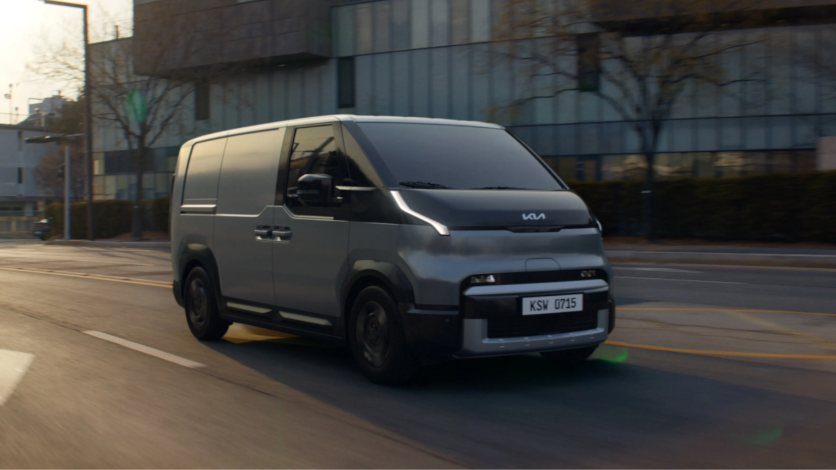
Kia today used the opening press day of the 2026 Busan International Mobility Show to world-premiere three new PV5 electric van variants and reveal six industry-specific collaboration vehicles — including an AI patrol car capable of deploying a drone from its roof — capping six months of European sales that have already surpassed 10,000 units for the van that won the 2026 International Van of the Year in November. The Busan reveals push the number of possible PV5 configurations to 16, making it the most configurationally diverse electric light commercial vehicle on the market.
The show, running June 26 through July 5 at BEXCO in Busan, South Korea, marks the first time all 16 body configurations have been presented together publicly. What fleet operators, municipal procurement officers, and commercial vehicle buyers now understand for the first time is that the PV5 is not merely an electric van — it is a mobile-platform ecosystem, one whose engineering architecture was specifically designed to make body variants cheaper and faster to develop than any rival built on an adapted internal-combustion-engine frame.
Three New Variants for Families, Ride-Hail, and Heavy Deliveries
The three world premieres — the PV5 Passenger 7-Seater, the PV5 Passenger Prime, and the PV5 Cargo High Roof — each target a distinct commercial segment.
The PV5 Passenger 7-Seater introduces a 2-2-3 seating configuration in which the second row is offset to one side to improve third-row access. Kia says the layout targets families, rental fleets, and shuttle services. The cabin includes a rear air conditioning system, heated rear seats, and USB Type-C charging ports.
The PV5 Passenger Prime targets premium ride-hailing and corporate travel. Built on the existing Passenger platform, it offers independent rear seats, seat rails, and ventilated seating. The 7-seater had already launched in the UK earlier this month, giving it a domestic market head start; this Busan appearance marks its first global platform reveal.
Rounding out the trio is the Cargo High Roof, adding critical headroom for last-mile delivery and trade applications. The variant was shown at the Commercial Vehicle Show in Birmingham for the UK market in April; its Busan appearance represents the global lineup integration of the body type.
How E-GMP.S Makes 16 Variants Possible Without 16 Powertrains
The engineering reason Kia can field 16 distinct body configurations — and add new ones without rebuilding the drivetrain — is the E-GMP.S platform's Integrated Modular Architecture.
The E-GMP.S (Electric-Global Modular Platform for Service) is a purpose-built derivative of Hyundai Motor Group's E-GMP platform, the same 800-volt architecture that underpins the Ioniq 5, EV6, and EV9 passenger vehicles. For commercial PBV use, Hyundai Motor Group engineered a critical divergence: the E-GMP.S runs on a 400-volt architecture rather than 800 volts. That choice is a deliberate engineering tradeoff. Commercial fleets charge at depots and public charging points where 400-volt infrastructure is far more widely deployed than high-power 800-volt installations; choosing 400 volts keeps charging compatibility broad, reduces system complexity, and lowers per-unit cost — making the platform viable at the fleet procurement price points where the PV5 competes with the Volkswagen ID. Buzz and Mercedes-Benz eSprinter.
The IMA works on a building-block principle. The front cabin and first-row seating are structurally fixed and identical across all PV5 variants. Only the rear section — the module that includes rear bodywork, quarter glass, and roof height — is swappable. Upper body modules attach to the lower platform via a combination of mechanical brackets and electromagnetic coupling. The result is that Kia's engineers can develop a new body variant by designing a new upper-rear module, without touching the battery pack, motor, inverter, or suspension that live in the fixed lower skateboard.
The powertrain in that fixed lower section delivers a 120 kW motor producing 250 Nm of torque. Three battery options cover different operator needs: a 43.3 kWh lithium iron phosphate pack available on European Cargo models, a 51.5 kWh NCM pack, and a 71.2 kWh NCM pack for maximum range. DC fast charging brings any pack from 10 to 80 percent in approximately 30 minutes. The Cargo Long holds a Guinness World Record for the greatest distance traveled by a light commercial electric van with maximum payload: 693.38 km on a single charge.
This architecture distinguishes the PV5 from every rival electric van it competes against. The Volkswagen ID. Buzz and the Mercedes-Benz eSprinter were both developed by adapting existing passenger-car or ICE-van architectures to accommodate electric powertrains. They are not purpose-built modular platforms. Developing a new body variant on either requires significantly more structural engineering work because the upper and lower sections are not designed to separate cleanly. The PV5's IMA is the reason Kia can credibly promise dozens of body variants across the PBV family while the Buzz remains in a small number of configurations.
AI Patrol Car: Drone Station and 4K Cameras in a Production-Ready Van
Of the six collaboration vehicles Kia revealed at Busan, the AI Patrol Car represents the clearest demonstration of where the PV5 platform's commercial ambitions are heading.
Developed with the Korean National Police Agency and based on the standard PV5 Passenger 5-Seater, the patrol car integrates three 4K AI cameras — mounted to detect hazards and track subjects in real time — plus a roof-mounted drone station that allows coordinated ground-and-air patrol operations from a single vehicle. Interior monitors display live camera feeds; rear-facing external screens give pedestrians and other drivers real-time information. The drone docking station effectively turns each PV5 patrol unit into a mobile aerial launch platform, eliminating the need for a separate drone support vehicle.
The collaboration vehicles deployed with other partners round out the platform's commercial reach. A Mobile Pet Pop-up Store, developed with pet platform Fitpet using the PV5 Cargo, features an open-sided configuration for on-site retail. A Children's School Vehicle, developed with shuttle specialist Ibus, is tailored to the ergonomic and safety needs of young passengers. An Ice Cream Truck, built on a Chassis Cab variant with partner Primo, is configured for mobile sales and promotional activations. Two further variants — a Mobile Bank and a Bike Transport Vehicle — complete the set.
Kia says all six collaboration models are scheduled to launch under each partner's brand in the second half of 2026.
Read more: Uber Chooses Kia PV5 Modular EVs to Drive 2040 Climate Pledge
What Comes After the PV5: PV7, PV9, and a Taxi-Specific 5-Seater
Kia has also outlined the next expansion of the PV5's own lineup beyond the three Busan premieres. A 5-Seater Passenger in a 1-2-2 layout — designed specifically for taxi and on-demand mobility services — is in development, alongside a box truck for small business owners and outdoor and leisure-focused variants.
The broader PBV roadmap extends the family to larger vehicles: the PV7 is planned for 2027 and the PV9 for 2029. Speaking at the press day, Kia President Song Ho-sung framed the Busan reveals inside the company's larger technology ambition. He said Kia is proactively responding to changes in the future mobility industry being reshaped around autonomous driving, software-defined vehicles, and robotics, and that the company aims to become an EV Tier 1 brand that transforms the mobility paradigm.
Is the Kia PV5 Coming to the United States?
A US launch remains unconfirmed. PV5 prototypes have been spotted testing in the US and the concept debuted at CES in Las Vegas — but Kia has not disclosed a US release timeline. The primary barrier is a 15% import tariff applied to South Korean-built vehicles under current US trade policy; until Kia builds PBV production capacity outside South Korea, the PV5 faces the same pricing headwind that postponed the EV6 GT's US launch indefinitely. For American fleet operators, the Busan reveals nonetheless signal what a potential US lineup could include — assuming the tariff picture changes or domestic production begins.
Frequently Asked Questions
How does the E-GMP.S platform allow so many Kia PV5 variants?
The E-GMP.S uses an Integrated Modular Architecture that physically separates the vehicle into two sections: a fixed lower platform carrying the battery, motor, and underbody structures, and a swappable upper body module covering the rear section, roof height, and quarter glass. New body configurations require engineering only the upper module — not the powertrain. Mechanical and electromagnetic coupling connects the two sections. That is why Kia can field 16 PV5 configurations while rival vans built on adapted platforms cannot match that number without far more intensive engineering work.
What is the AI Patrol Car's technical setup?
The AI Patrol Car is based on the PV5 Passenger 5-Seater and integrates three 4K AI cameras for real-time hazard detection and subject tracking, a roof-mounted drone docking station for coordinated aerial patrol, interior command monitors, and rear-facing external displays. It was developed in collaboration with the Korean National Police Agency and is scheduled to deploy under the agency's brand in the second half of 2026.
How does the Kia PV5's battery and charging compare to rivals?
The PV5 offers three battery sizes: 43.3 kWh (lithium iron phosphate), 51.5 kWh, and 71.2 kWh (both NCM). All charge from 10 to 80 percent in approximately 30 minutes via DC fast charging. The Cargo Long variant set a Guinness World Record by traveling 693.38 km on a single charge with maximum payload. The Volkswagen ID. Buzz uses a larger 86 kWh battery and runs on an 800-volt architecture; the PV5's 400-volt system trades peak charging speed for broader fleet infrastructure compatibility and lower per-unit cost.
What awards has the Kia PV5 won?
The PV5 was unanimously named the 2026 International Van of the Year by 26 commercial vehicle journalists worldwide — the first Korean vehicle and first Asian electric van to win the award in its 34-year history. The recognition was presented at SOLUTRANS 2025 in Lyon, France in November 2025. The Cargo Long also holds a Guinness World Record for the greatest distance traveled by a light commercial electric van with maximum payload on a single charge.

-
 C114 Communication Network
 -
 Communication Home
