
 Search


cncf.io
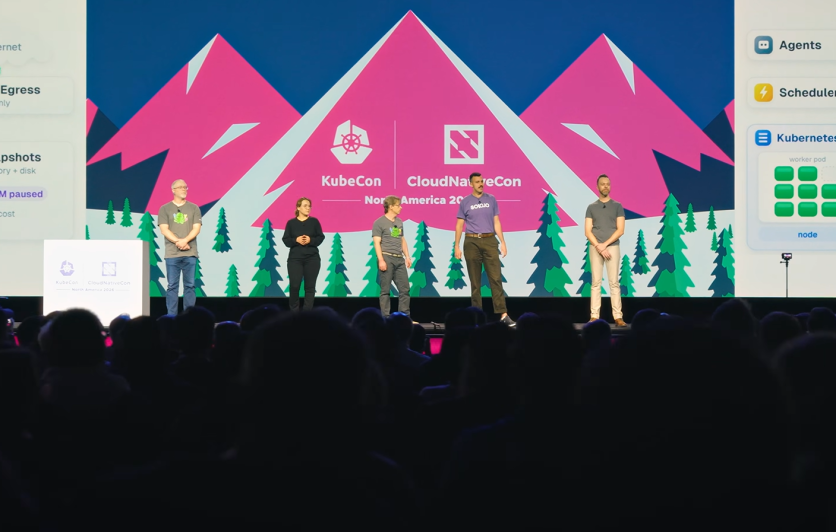
For the first time in its history, KubeCon + CloudNativeCon North America carved out an entire programming track for AI inference and autonomous agents — and the four days that concluded Thursday at the Salt Palace Convention Center in Salt Lake City delivered a verdict that the cloud-native community has been building toward for years: Kubernetes is no longer simply a container orchestration layer. It has become, by every practical measure, the operating system underneath the AI era.
From Feasibility to Execution: The Question That Defined the Week
KubeCon NA 2026 marked a decisive reframe in how the cloud-native industry talks about artificial intelligence. The conversation has moved well past whether Kubernetes can support AI workloads. The question now is how organizations run those workloads reliably, securely, and at a cost that holds up under production pressure. That shift in framing — from feasibility to execution — set the tone for every keynote, breakout session, and vendor-floor exchange throughout the week.
Jonathan Bryce, Executive Director of Cloud & Infrastructure at the Linux Foundation and head of the Cloud Native Computing Foundation, framed the moment in terms of scale: "AI is quickly becoming one of the largest compute workloads the industry has ever seen." He noted that the transition from training models to running them in production is where the real engineering challenge now lives, and that the Kubernetes community has spent years hardening the platform for exactly this kind of distributed, always-on demand.
The data backs that sense of urgency. According to the 2026 CNCF Annual Cloud Native Survey, among organizations actively hosting generative AI models, 66% now rely on Kubernetes to manage some or all of those inference workloads — a figure that made the new AI Inference + Agentic track less of an experiment and more of a direct response to what platform teams are navigating every day.
A New Track Built for Production Reality
The AI Inference + Agentic track covered GPU scheduling, model serving, agentic system design built on protocols including MCP, Agent Skills, and A2A, AI gateways, and energy-efficient inference optimization — the unglamorous plumbing that separates a successful demo from a system that runs at three in the morning without human intervention.
Sessions put tools like vLLM and KServe under the microscope for model serving, alongside dynamic routing approaches and observability architecture across inference pipelines. The track was added precisely because inference has become the AI workload Kubernetes operators are most regularly asked to run — and the platform's native scheduling, autoscaling, and routing primitives were built for a pre-AI-inference era.
Co-Located Events Set the AI Agenda Before the Main Doors Opened
Monday's full-day co-located programming signaled how much of the week's agenda the agentic theme would claim before the main conference even started. Agentics Day: MCP + Agents and Cloud Native AI + Inference Day were among 11 CNCF-hosted co-located events requiring an All-Access Pass — a clear signal that the community had stopped debating whether AI belongs on Kubernetes and moved on to building the production stack for it.
Three Product Launches That Fill Real Gaps
Three announcements from the week's news wire stood out, each targeting a distinct gap in the cloud-native AI stack.
Cloudsmith: Governance Where It Has Been Missing
Cloudsmith moved directly into agent supply chain security with the launch of its AI Agent Skills registry. The registry allows platform teams to host, version, and govern the skill bundles that AI coding agents use to perform specialized tasks — storing them in the same multi-format repository alongside other artifacts. Alison Sickelka, VP of Product at Cloudsmith, identified the gap the product fills: "Community skill registries were built for sharing, not for control." With Cloudsmith, she explained, platform teams decide which skills and versions are approved, and block everything else. The registry is available immediately to existing customers and ties into Cloudsmith's existing observability tooling.
groundcover: Connecting Requests to Queries Without SDK Changes
groundcover shipped what the company called the most direct expression yet of its instrumentation-free approach. The expanded eBPF sensor now ties application-layer request spans directly to the underlying SQL queries those requests trigger — without requiring any SDK modifications from engineering teams. A new Crossplane provider completes the picture by letting platform engineers manage groundcover configuration as Kubernetes custom resources inside standard GitOps workflows, closing the loop between observability configuration and the platform tooling their organizations already run.
DataAgent: A Local Lab That Earns Trust Before Production
DataAgent, which emerged from stealth in September 2026, used the conference to release its open-source lab under the Apache 2.0 license. DataAgent Lab gives DevOps, SRE, and platform teams a local environment to deploy an autonomous agent, simulate infrastructure failures, and evaluate detection and remediation workflows — without granting any external system administrative access to production. The lab is built on CNCF project K8sGPT and underpins the company's commercial platform, which routes automated fixes through GitOps pull requests and mandatory human review before any change reaches a live environment.
Platform Engineering and Security Held Their Ground
The conference's AI pivot did not come at the expense of its established pillars. Dedicated tracks on Platform Engineering and Security returned with full programs covering internal developer platforms, GitOps adoption, software supply chain security, eBPF, and runtime protection. With 154 speakers and 335 sponsors represented across the four days, the breadth of the program reflected just how thoroughly cloud-native infrastructure has become the shared substrate beneath every significant workload in enterprise computing.
Thursday's closing day opened with morning keynotes before transitioning to breakout sessions, Maintainer Tracks, and ContribFests — the hands-on community programming that distinguishes KubeCon from a conventional vendor expo and keeps open-source contributors at the center of an event that has grown well beyond any single company's influence.
What Comes Next: Barcelona 2027
The cloud-native community's next gathering is KubeCon + CloudNativeCon Europe 2027, set for March 15–18 in Barcelona, Spain, at the CCIB International Barcelona Convention Center. If Salt Lake City established that Kubernetes is the production platform for AI inference, Barcelona will be where the community takes stock of how far that production story has actually come.

-
 C114 Communication Network
-
 Communication Home
