
 Search


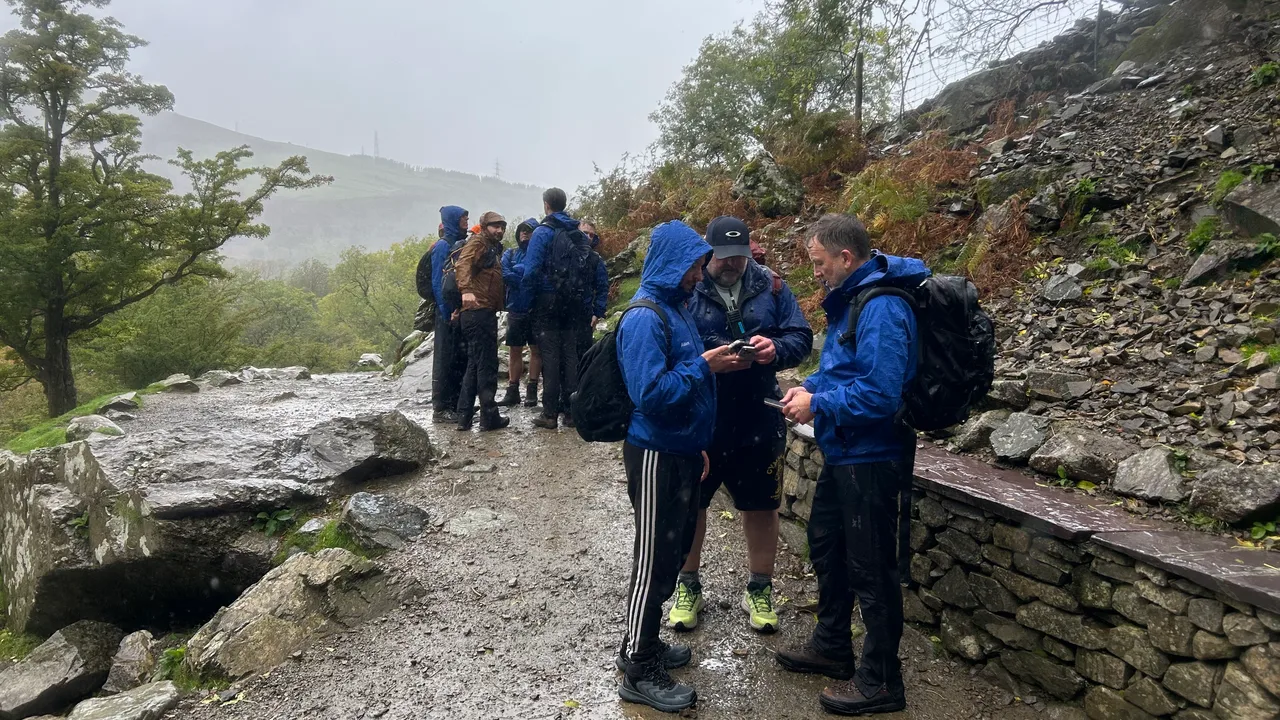
Virgin Media O2's Rob Joyce (right) tests satellite technology and talks mobile network plans in northern Wales.(Source: Iain Morris/Light Reading)
Rob Joyce knows the Virgin Media O2 (VMO2) mobile network includes precisely 18,552 macro cell sites and more than 2,500 small cells. As the director of mobile access engineering for the UK operator, Joyce is tasked with making sure its network is at least a technological match for the other two in the country and capable of satisfying all customer demands. He is conscious of lagging VodafoneThree by several thousand sites. That makes VMO2 look no different from BT-owned EE. Whether it puts them at a service disadvantage is the concern.
When regulators approved the merger between Vodafone and Three that created VodafoneThree last year, they did so in the belief it would force rivals to respond. The combination of the two networks produced an operator with a rich assortment of spectrum and a grand total of about 37,000 sites, according to VodafoneThree's recent investor update. After some decommissioning of sites deemed superfluous, VodafoneThree will end up with a footprint of about 26,000. Faced with such a powerful adversary, EE and VMO2 would have to invest more – and possibly even build new sites of their own.
But will they? At VMO2, Joyce and his team are currently weighing the need for such "densification," as the industry describes it, under an internal plan called "Grid 2040." Adding sites would obviously entail additional expense in a mobile market that has struggled to grow sales. "The trick is to build as few towers as possible but deliver the service that people need or want," Joyce told a roomful of reporters and analysts gathered in Caernarfon, Wales, for a subsequent demonstration of VMO2's Starlink-provided satellite service.
"There are already plans to densify the macro grid, and we're talking to VodafoneThree about the towers they've got that we're not on, and likewise BT, MBNL," he explained. "There is a bit of flux in the tower market, and we'll look to use that to our advantage."
Dividing the kingdom
For years, VMO2 has shared towers as well as basestation gear with Vodafone via a network-sharing arrangement known as Cornerstone. It bisects the UK into eastern and western halves, with VMO2 responsible for everything that happens east of the dividing line and Vodafone managing the west. Joyce evidently feels there is scope for a potential expansion into areas where VMO2 does not currently have equipment on Vodafone towers.
Separately, BT and Three have shared thousands of towers, although not 4G and 5G basestations, through the MBNL venture that Joyce named. Decommissioning by VodafoneThree is expected to leave BT as the sole operator of equipment at some of those MBNL sites and desirous of a new partner to bolster the economic case. "They're now in a share that's unwinding, so they're going to have towers that they used to share but don't anymore," said Joyce.
It is early days for Grid 2040, and nothing has been finalized. Today, Joyce would clearly disagree with anyone saying VMO2 is at some kind of service disadvantage. "We're currently running at 88% population coverage on 5G plus, so we still think we're the biggest," he said. What VMO2 calls 5G plus is the Standalone variant of the technology that introduces a new core, the software brain of the system. VodafoneThree had reached only 60% last month, according to its own update. "We think we can do a lot more on the towers that we've got, and if we can do that, we can reduce the need to densify," said Joyce.
Forthcoming 6G technology, due to launch in 2030, might also influence VMO2's thinking about densification. UK telcos, like those in other countries, are expected to deploy 6G in currently licensed spectrum bands, today used for both 4G and 5G technology. But they also covet the untapped upper 6GHz band. "It really is just 5G shifted to 6GHz with a few more bells and whistles," said Joyce in assessing a standard increasingly described as an "evolution" of its predecessor rather than a revolutionary breakthrough.
Such relatively high spectrum bands are good for supporting bandwidth-thirsty services like video. Their drawback is coverage: Signals do not travel as far or bypass obstacles as effectively as they do in sub-GHz spectrum. Ericsson and Nokia, VMO2's 5G vendors, are trying to compensate for that by designing even more advanced massive MIMO radios, which cram units with antenna elements. 5G came with configurations of up to 64 transmitters and receivers per unit. 6G could increase that to more than 128. With beamforming, a related technology, signals can supposedly be steered to user gadgets like heat-seeking missiles.
Yet numerous telco executives sound dubious that a 6GHz-based massive MIMO network would economically map to a 4G and 5G site grid that uses lower spectrum bands. 6GHz will most likely be used in densely populated urban hotspots and not to provide wide-area coverage.
Giga buildout
Long before then, Joyce expects to have rolled out an even bigger number of VMO2 "giga sites," featuring today's dual-band massive MIMO technology. The operator is due to deploy its thousandth giga site before the end of the year and will build more of them in 2027, said Joyce. The rollout forms part of the £700 million (US$932 million) investment in mobile network upgrades announced at the start of the year, after VMO2 had spent the same amount in 2025.
Massive MIMO equipment is not shared with VodafoneThree at giga sites, unlike many of the lower-band radios that might neighbor it. At a giga site in Middlesbrough, VMO2 has been using a massive MIMO antenna that combines spectrum in the 2.6GHz and 3.7GHz bands while simultaneously relying on a radio shared with VodafoneThree for all other bands. It is, Joyce thinks, "probably the most complex shared tower in the world" and carries about 75% of all mobile traffic in that part of Middlesbrough.
Helpfully, the retirement of old mobile technologies is starting to free up spectrum that could prove much more valuable than 6GHz for wide-area rollout. 3G spectrum is being refarmed now that VMO2 has switched off the technology, a move it completed in January. In the summer of 2029, it plans to start taking the even older 2G network out of service.
O2 Satellite, courtesy of an agreement with Elon Musk's Starlink business, beams more limited signals to customers outside VMO2's current terrestrial footprint. Light Reading and other traveling publications were given a taste of the experience during a trek in Snowdonia. But Joyce dismisses talk of satellite as a mainstream threat to cellular. Like the 13th-century castle that looms over Caernarfon, built by Edward I to subjugate the Welsh, his real challengers remain firmly rooted to the ground.

-
 C114 Communication Network
-
 Communication Home
