
 Search


Background image: 123rf
European fiber networks pass millions of apartment buildings, but subscriber take-up remains stubbornly low in several major markets. Maravedis examines why building density alone fails to drive adoption, and where operators can unlock growth.
Europe has built the fiber. The apartment block is where it stalls.
How many households live in apartment buildings tells you surprisingly little about how many of them use fiber. Across our ten focus markets, the share of households living in multi-dwelling buildings and the FTTH/B take-up rate barely move together (correlation of about 0.17). Spain and France convert more than 89% of homes passed into subscribers. Germany and Austria, where more than half of households live in MDUs, convert fewer than one in four.
That gap is the story of European MDU connectivity in 2026. According to IDATE’s FTTH/B Market Panorama for the FTTH Council Europe, fiber now passes 191 million homes across the EU27 and the UK, or 76.8% of households. Only 105 million subscribe, a take-up rate of 54.9%. IDATE’s own conclusion is that the priority has shifted from building networks to monetizing them.
For anyone who owns, wires, manages or equips a multi-dwelling unit (MDU), that shift matters. The next wave of fiber adoption will not be won in the street cabinet. It will be won in the riser, the basement and the resident’s living room. That is exactly the ground we will cover at RISER Summit, the European Summit for Residential MDU Connectivity and Proptech, in Amsterdam from April 6 to 8, 2027.
Ten markets side by side
Spain is both the most vertical market and the fiber adoption leader, but it is the exception, not the rule. The table sets the share of households living in multi-dwelling buildings against IDATE’s September 2025 fiber metrics, sorted by MDU share.
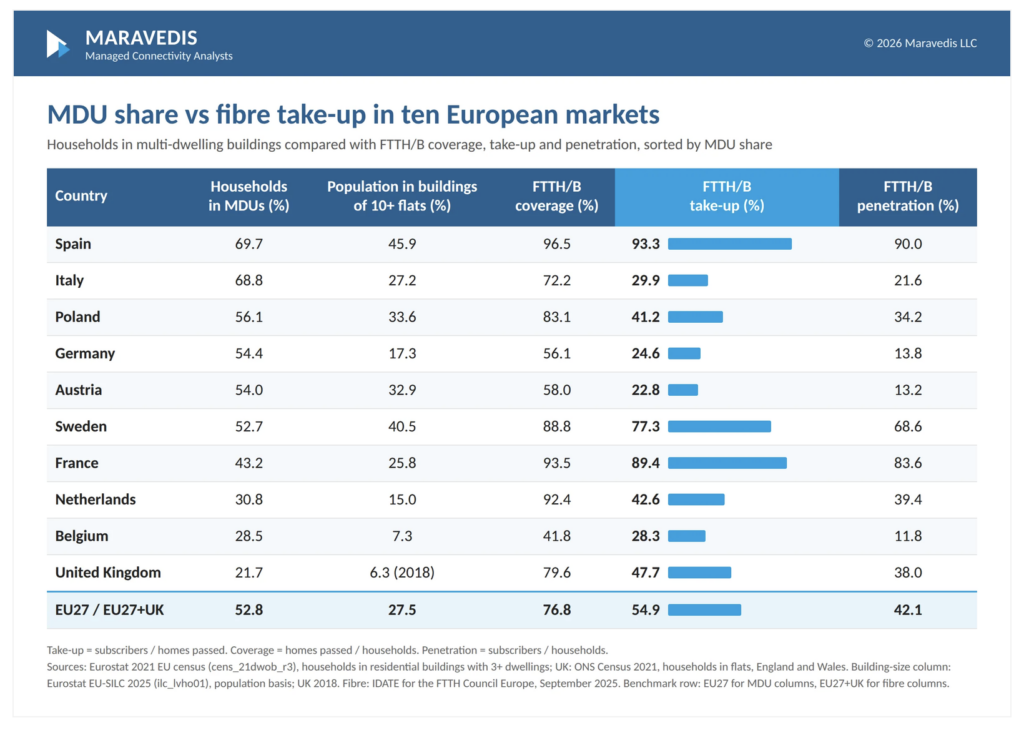
How to read it: coverage is homes passed divided by households; take-up is subscribers divided by homes passed; penetration is subscribers divided by all households. Take-up is the conversion metric, so we compare it with MDU share. Like the MDU share, all three are measured in households.
Households in MDUs is the share of occupied dwellings located in residential buildings with three or more dwellings, from the 2021 EU census (Eurostat). For the UK it is the ONS Census 2021 share of households in England and Wales living in a flat, maisonette or apartment, a close but not identical definition. The 10+ flats column is the only source for building size and is a population share from EU-SILC 2025 (2018 for the UK), so read it as an indicator of large-building living rather than a household count. fiber figures are IDATE for the FTTH Council Europe, as of September 2025. The EU27 benchmark applies to the MDU columns; EU27+UK applies to the fiber columns.
Four clusters, one lesson
The measure that tracks fiber take-up is not how many households live in MDUs, but how many people live in large apartment buildings. The share of the population in buildings of ten or more flats correlates with take-up at about 0.52, about three times the 0.17 of the overall MDU household share. Large, professionally managed buildings are easier to wire once and sell many times. The ten markets fall into four groups.
1. Vertical and converted: Spain and Sweden
Spain (93.3% take-up) and Sweden (77.3%) both house more than 40% of their people in buildings of ten or more flats, and both turned that density into subscribers. Spain’s common telecom infrastructure rules have required shared in-building wiring for years, so most blocks were fiber-ready before operators arrived. Sweden got there through municipal open networks and housing companies that wire buildings and contract connectivity on behalf of residents. In both cases the building, not the individual flat, is the unit of sale.
2. The policy-made converter: France
France (89.4% take-up) has a below-average MDU share, with 43.2% of households in multi-dwelling buildings against 52.8% for the EU, yet it is Europe’s largest fiber market with 26.3 million subscribers. Its success is regulatory rather than demographic: fiber-ready rules for new buildings and symmetric regulation of the in-building segment meant one operator wires each building and every retailer can sell over it. 6 France shows that the right in-building framework can outrun housing stock.
3. Vertical but stalled: Germany, Italy, Austria, Poland
This is the largest untapped pool of MDU fiber in Europe. Between 54% and 69% of households in these four countries live in MDUs, yet take-up runs from 22.8% in Austria to 41.2% in Poland.
– Germany (24.6%): the in-building segment (NE4, from basement to flat) is the bottleneck. Cable TV was long bundled into rent through the operating-cost privilege, which ended in July 2024, and many buildings still stop fiber in the basement.
– Italy (29.9%): a large FTTC copper base still delivers “good enough” speeds, and the wholesale map is split between Open Fiber and FiberCop, which slows migration.
– Austria (22.8%): coverage is only 58%, and generous mobile broadband is a strong substitute for fixed lines in apartments.
– Poland (41.2%): coverage is high at 83.1% and one in three people lives in a large block, but a crowded market of cable operators and local ISPs keeps many households on legacy services.
4. Low-rise and cable-heavy: the Netherlands, Belgium, UK
Fewer than a third of households in these markets live in MDUs, and all three have strong cable incumbents. The Netherlands has 92.4% coverage but only 42.6% take-up, because nationwide cable competes at gigabit speeds. Belgium has the lowest coverage (41.8%) and penetration (11.8%) of the ten. The UK is the one to watch: take-up jumped from 37.1% to 47.7% in a year, on the back of 3.6 million net additions, the most of any European country, as altnets and Openreach push migration.
Density alone does not deliver adoption
An apartment building concentrates demand, but it also concentrates friction. Five factors decide whether a vertical market converts.
1. In-building wiring. fiber that stops in the basement is counted as passed, not used. The European Commission’s impact assessment for the Broadband Cost Reduction Directive estimated about EUR 11.5 billion of capex just to fiber buildings lacking suitable internal infrastructure. It noted that buildings in Spain, Portugal and France are largely fiber-ready thanks to standards in place for over a decade, while elsewhere such rules are recent and apply only to new builds and renovations.
2. Who decides for the building. Where a landlord, housing company or co-op can contract once for all units, as in Sweden, conversion is fast. Where every tenant must be won one by one, and landlords see little upside, it is slow.
3. Cable and “good enough” copper. DOCSIS 3.1 cable in the Netherlands, Belgium and Poland, and VDSL in Germany and Italy, deliver speeds most households accept. Migration waits for a push, usually copper switch-off.
4. Landlord billing rules. Germany’s end of the cable operating-cost privilege in July 2024 broke a decades-old bulk model. Tenant free-choice rules across the EU make classic US-style bulk internet hard, so the model shifts to open-access building networks paired with managed services.
5. Mobile substitution. In Austria in particular, unlimited mobile and 5G fixed wireless access keep many apartment households off fixed lines altogether.
The policy tide is now turning in favor of the building. The Gigabit Infrastructure Act requires new and majorly renovated buildings to be fiber-ready from February 2026, and national reforms such as Germany’s pending telecoms law amendment aim to give operators a right to wire whole buildings. The question is no longer whether European MDUs get fiber, but who captures the value once they do.
What it means for operators, owners, vendors
Europe’s MDU opportunity is shifting from building fiber to converting and monetizing it inside the building. Each stakeholder has a different job to do.
– Fiber operators and altnets in the stalled cluster (Germany, Italy, Austria, Poland) should target large blocks and institutional portfolios first. That is where one agreement moves dozens or hundreds of units, and where the correlation data says conversion follows.
– Property owners and housing companies hold the key to the riser. fiber-ready, open-access buildings are becoming a compliance requirement for new builds and a value driver for existing stock, and owners who move early can negotiate better terms.
– Managed service providers and integrators have their opening where fiber ends and experience begins. A building on fiber still needs reliable in-flat Wi-Fi, onboarding, support and proptech integration. Managed Wi-Fi turns a passive fiber line into a service residents notice and landlords can market.
– Equipment and platform vendors should read the clusters as a go-to-market map. Spain, Sweden and France are replacement and upsell markets for in-home Wi-Fi. Germany, Italy, Austria and Poland are greenfield conversion markets where the in-building design is still being decided.
Two principles hold in every market: follow the large buildings, and win the in-building layer. That is where Europe’s remaining 45% of unconverted homes passed will be decided.
RISER Summit: Amsterdam, April 2027
The gap between fiber passed and fiber used is Europe’s defining MDU challenge, and RISER Summit is built around it. Co-produced by Maravedis and Hansecom, RISER is the European Summit for Residential MDU Connectivity and Proptech. It brings together operators, property owners, investors, proptech innovators and vendors for a workshop day and two days of main conference.
The agenda maps directly onto the questions this analysis raises:
– State of MDU Connectivity in Europe, a data-driven opening keynote on where the gaps remain across markets.
– Fiber to the Unit: Business Models That Work, on commercial structures making in-building fiber viable at scale.
– Regulatory Landscape, on how EU and national rules on access, wiring and pricing are changing.
– Investment and Infrastructure, on the capital behind the build-out.
– Proptech Meets Connectivity and Tenant Experience: Connectivity as a Service, on turning a fiber line into a resident service.
If you are working to convert Europe’s apartment buildings, register your interest and join us in Amsterdam.

-
 C114 Communication Network
 -
 Communication Home
