
 Search

Background image: 123rf
Wi-Fi 8 could give ISPs a new line of defense against AI-driven cyberattacks, embedding inference hardware in residential gateways. Airties CEO Metin Taskin argues operators must pair next-generation chipsets with software to detect threats.
Much of the industry discussion around Wi-Fi 8 has focused on the standard’s wireless advances: improved reliability, lower latency, multi-AP coordination, and more consistent performance across a wider range of devices. While all meaningful, perhaps the development of most importance for ISPs is the AI-enabled silicon that chipset vendors are now embedding into Wi-Fi 8 hardware.
Leading chipset vendors are now putting AI processors into their next-gen Wi-Fi 8 hardware, effectively bringing an always-running AI machine into the router. With the right software, these processors can function like a constantly active IT manager and cyber-guardian inside the home: monitoring performance, identifying faults, optimizing connectivity, and securing access to both the home network and the ISP’s own infrastructure in real time.
The security dimension is where ISPs must focus as they consider their next-gen CPE upgrades to customers. We now live in an era in which we should expect AI-driven attacks on broadband infrastructure to grow in sophistication and scale, and in which the residential gateway will be both the primary target and, if operators invest wisely, a critical line of defense.
A threat operators know well

Taskin – not a theoretical concern
The vulnerability of the residential gateway is not a theoretical concern. All the way back in 2016, a Mirai botnet variant targeted routers in Germany by abusing exposed remote-management mechanisms, disrupting internet, telephony, and television services for roughly 900,000 customers.
Germany’s Federal Office for Information Security, the BSI, has since continued to treat IoT botnets as a serious threat category, reflecting the persistent risk created by inexpensive consumer devices, short support cycles, and unpatched vulnerabilities.
That threat has grown considerably over the last decade. In late 2023, the Chalubo remote access trojan was used to render more than 600,000 routers at a U.S.-based ISP permanently inoperable, leaving subscribers without connectivity and requiring large-scale hardware replacement.
In 2025, the Aisuru botnet, built from compromised devices such as home routers, cameras, DVRs, and other IoT equipment, grew into one of the largest known DDoS botnets, with Cloudflare estimating 1 million to 4 million infected hosts globally and linking it to record-scale attacks against telecommunications providers, hosting providers, and other major internet-facing sectors.
In 2026, U.S., Canadian, and German authorities disrupted infrastructure used by Aisuru and related IoT botnets that had collectively infected millions of devices worldwide. Without question, AI now raises the risk that future security attack campaigns could be faster, more adaptive, and harder to contain. Notably, earlier this year in the U.S., the FCC added foreign-produced consumer-grade routers to its “Covered List”, blocking authorization of new models after U.S. national security agencies determined that such routers posed unacceptable cybersecurity and national-security risks.
These incidents all underscore how difficult it is currently to defend residential gateways at scale.
AI is changing the threat landscape
Today’s hackers are using AI, and if ISPs are not using AI in response, they will lose this fight. Accessible AI tools are fundamentally changing what adversaries can do against residential broadband infrastructure, potentially enabling them to scan millions of gateways simultaneously for exploitable vulnerabilities, adapt attack strategies in real time, and deploy persistent agents inside subscriber homes that activate on command. In short, an ISP’s entire network can be attacked from their own customers’ homes.
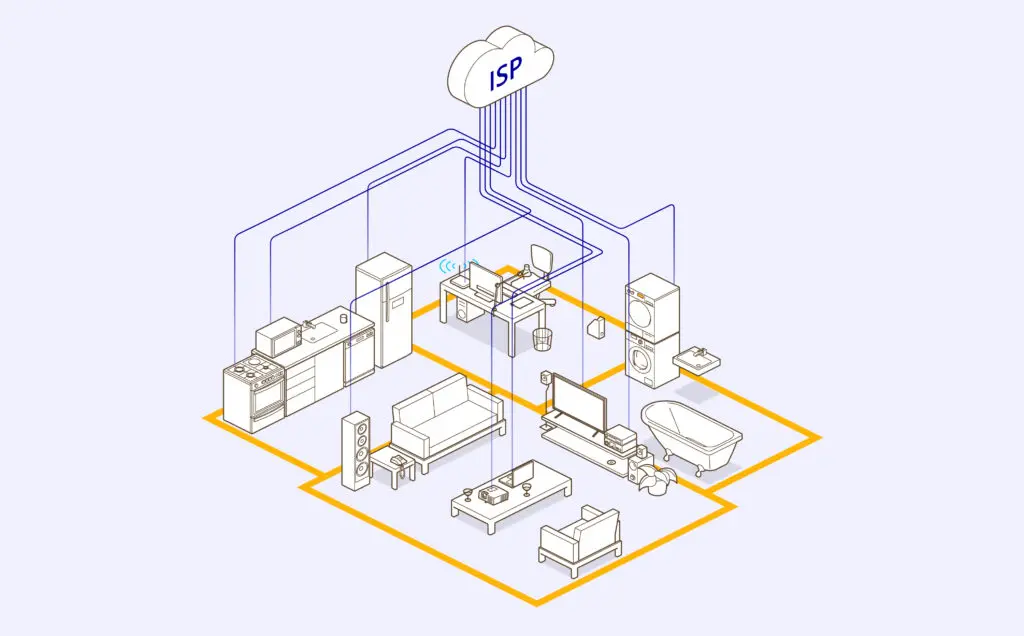
Or as the line goes in that old horror-thriller When a Stranger Calls, “the call is coming from inside the house”.
Traditional home security approaches, which focus on blocking inbound traffic, are not designed for this kind of new AI-driven threat model. Once a compromised device inside the home begins communicating outward, enrolling in a botnet or probing the ISP’s network, conventional perimeter defenses offer little protection.
Infected smart cameras or IoT devices can quietly become botnet nodes, generating outbound attack traffic that can affect ISP network operations and other internet-facing services, and AI could allow attackers to customize these campaigns for individual households at scale. Broadband providers will need to invest heavily in AI-based protection across both home and core networks as connected devices
continue to multiply.
Wi-Fi 8 chipset changes the equation
Earlier this year, Broadcom unveiled the BCM4918, the accelerated processing unit at the center of its Wi-Fi 8 platform. Alongside the radio and networking components, the BCM4918 integrates a dedicated Broadcom Neural Engine, an on-device AI and machine learning inference accelerator built into the residential gateway SoC. Qualcomm’s Dragonwing Wi-Fi 8 platform, presented at MWC 2026, follows the same approach. MediaTek’s Filogic 8000 series is designed around the same principle.
For the first time, dedicated AI inference hardware is being built into the silicon that ISPs can deploy at scale in subscriber homes.
A gateway equipped with a neural processing engine can analyze network traffic behaviorally and in real time, without a round-trip to a cloud platform. With the right software, a gateway equipped with a neural processing engine could analyze local traffic patterns and help identify devices exhibiting botnet-like behavior before that traffic reaches deeper ISP infrastructure. Detection can run on the edge silicon, continuously, inside every deployed gateway.
The software layer delivers the value
The chip creates the capability, but it does not by itself constitute a security strategy or solution. Realizing the value of edge AI also requires a software orchestration platform that deploys and updates behavioral models across a heterogeneous gateway footprint, aggregates anonymized signals across the subscriber base to improve detection accuracy, and integrates threat response into existing network operations workflows. ISPs that approach Wi-Fi 8 as a hardware refresh alone will see the wireless improvements but miss the more significant security upgrade opportunity.
Of course, one practical consideration for deployment planning is a global shortage of memory chips, driven by surging demand from AI that is creating supply pressure that could persist for several years. ISPs should factor potential hardware delays into their Wi-Fi 8 rollout timelines and use the intervening period to evaluate the technology partners that can help them maximize the value of next-generation hardware when it arrives.
The tools available to attackers in the years ahead will become even more capable, and residential gateways will remain one of the most accessible entry points into ISP networks for as long as they go undefended.
ISPs that view Wi-Fi 8 as a security platform, pairing AI-hardware with a software platform able to detect and respond to threats at the edge, can build a defense infrastructure suited to the impending threat environment. These AI attacks are not a distant scenario. They are already underway, and the residential gateway is where much of the battle will be won or lost.
Metin Taskin is CEO and co-founder of Airties. Airties provides software that enables ISPs to provide optimized and secure Wi-Fi connectivity. Airties customers include leading service providers such as AT&T, Cox, Deutsche Telekom, Telia, Telstra, T-Mobile US, Vodafone, and others across the world.

-
 C114 Communication Network
 -
 Communication Home
